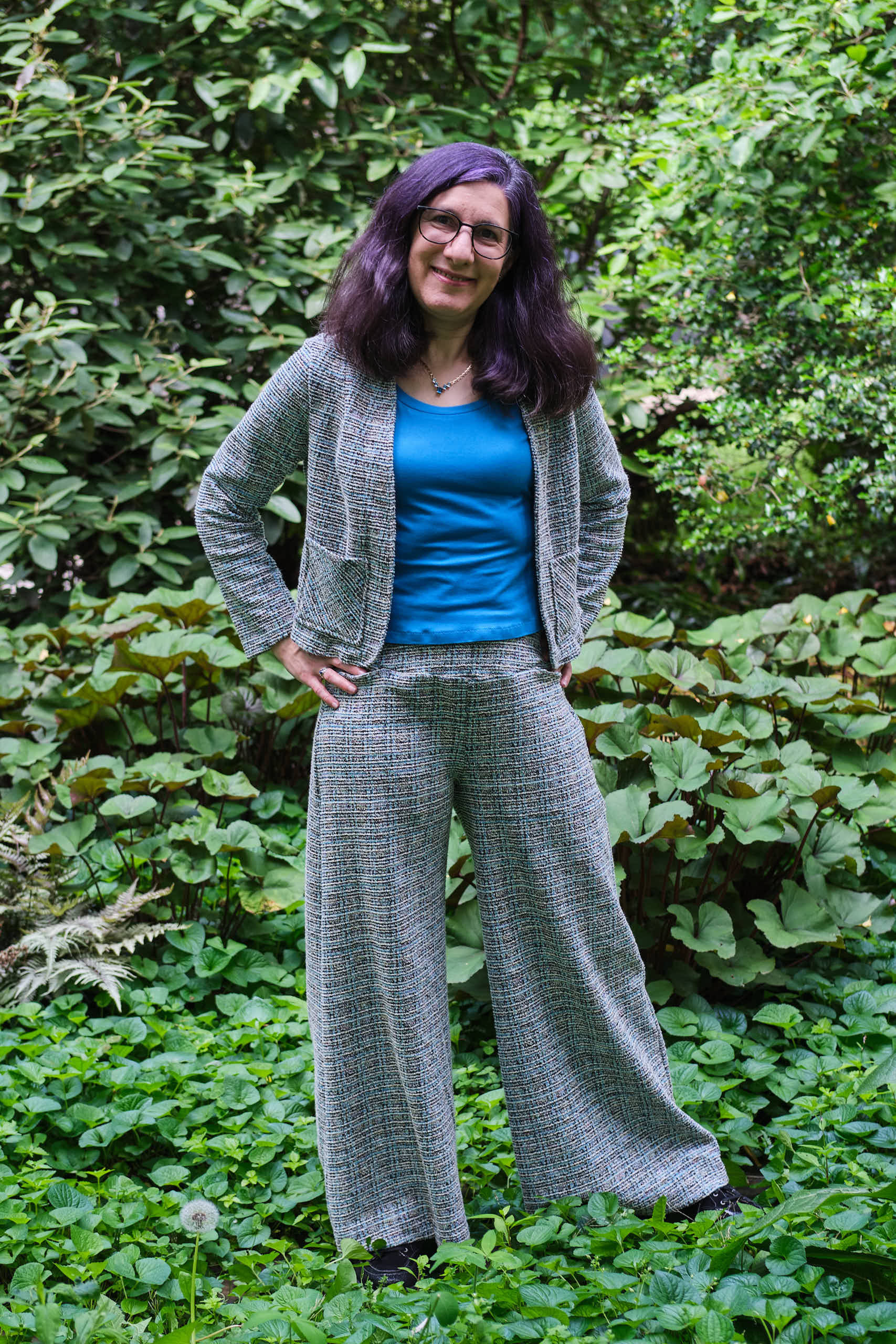
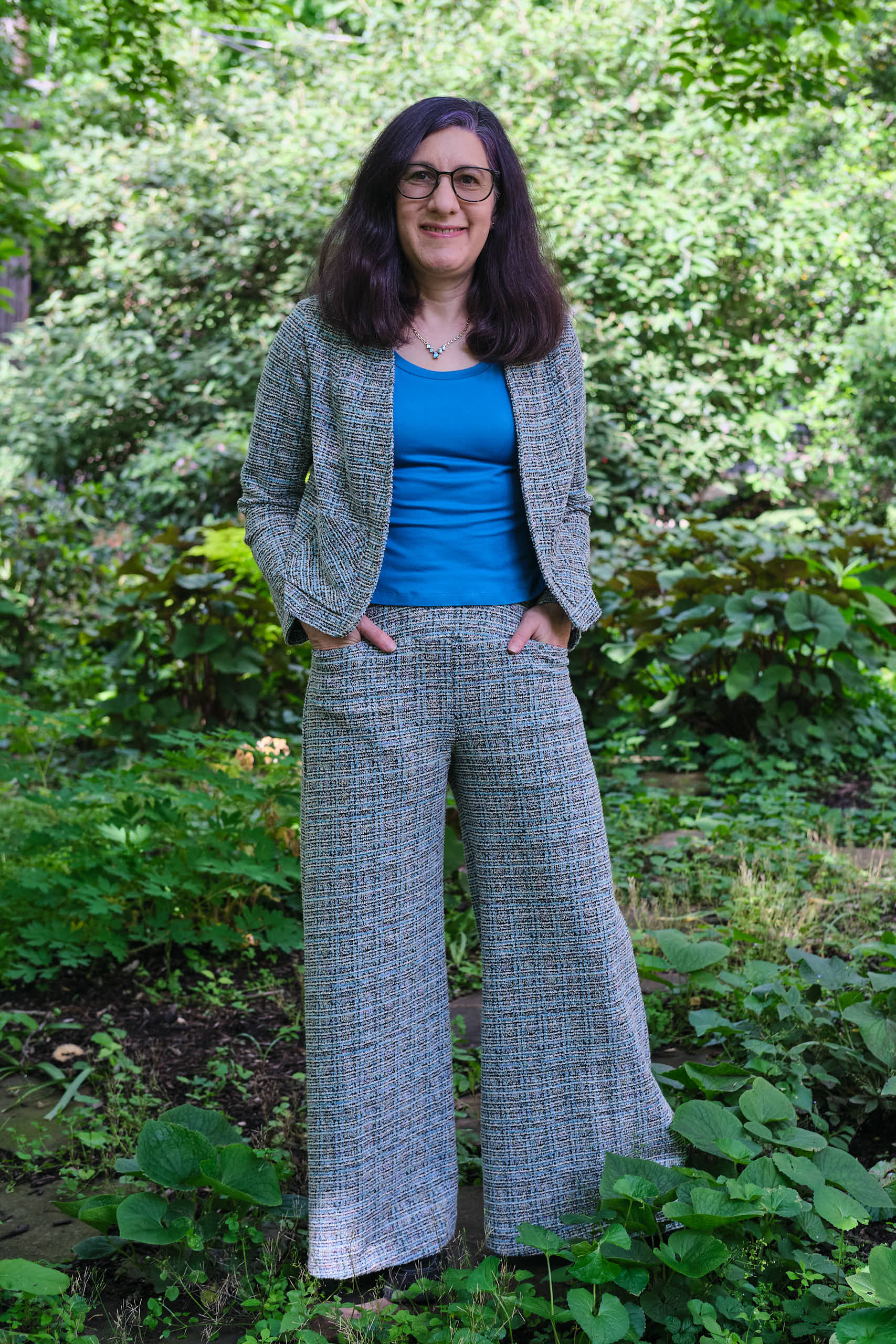
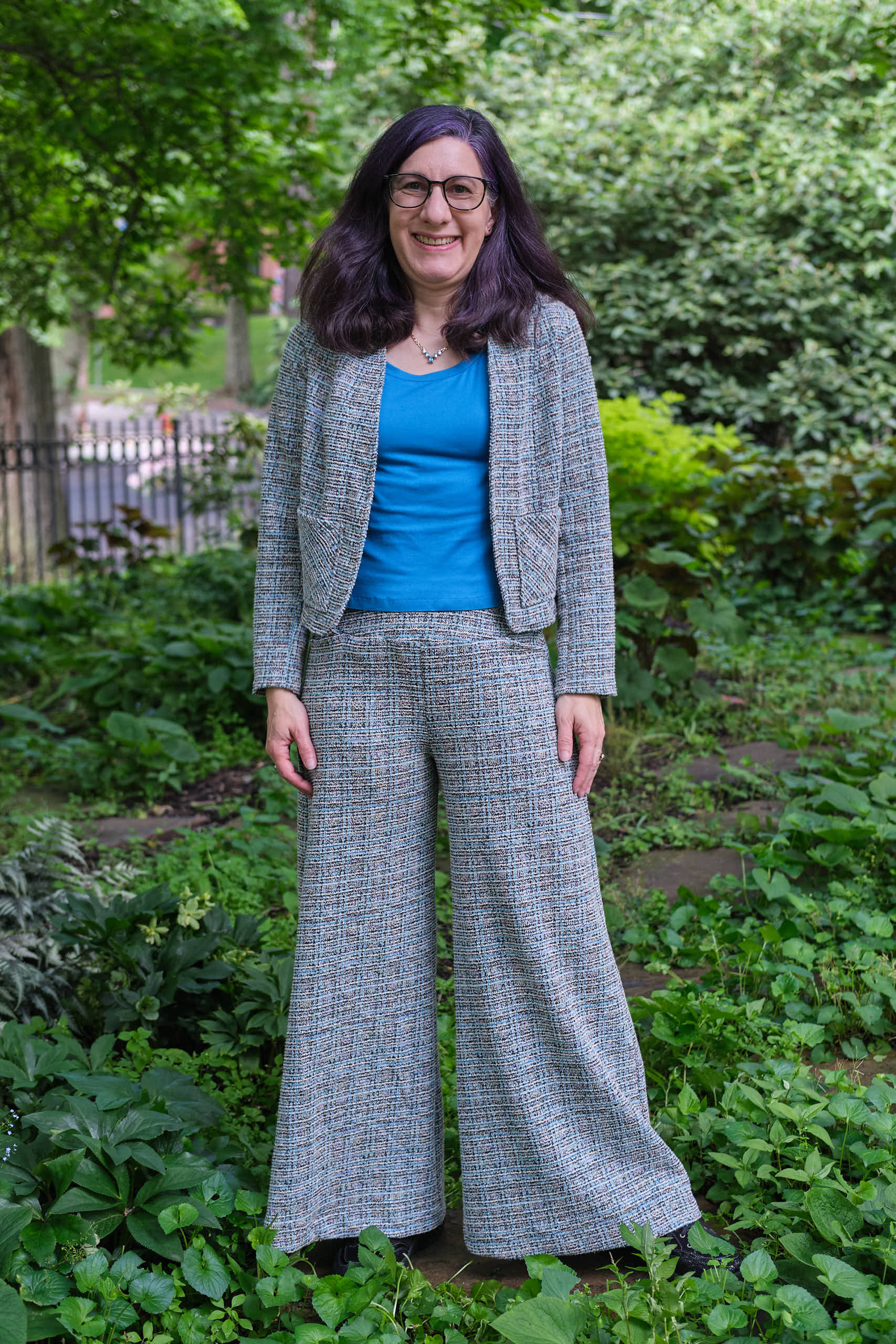
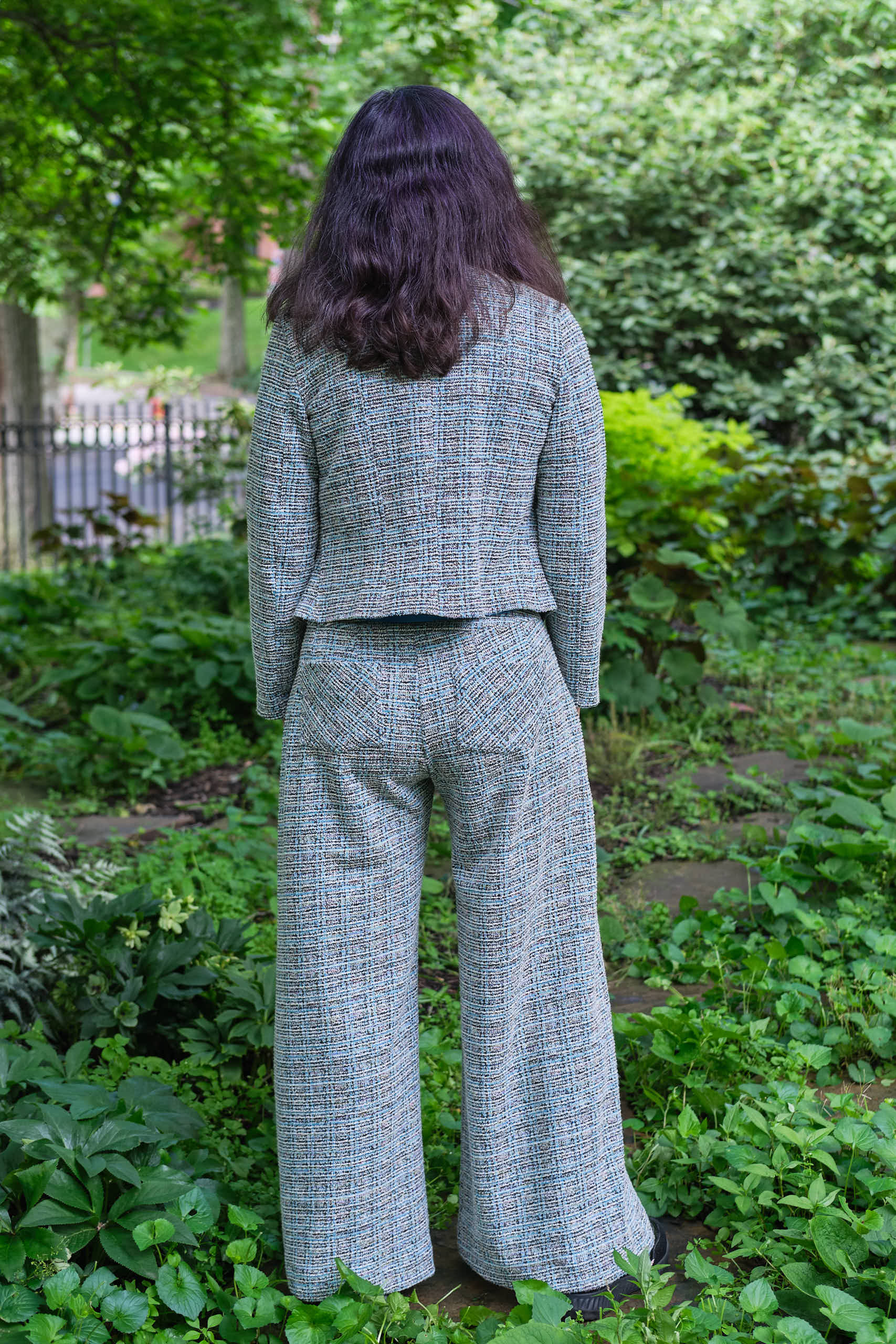
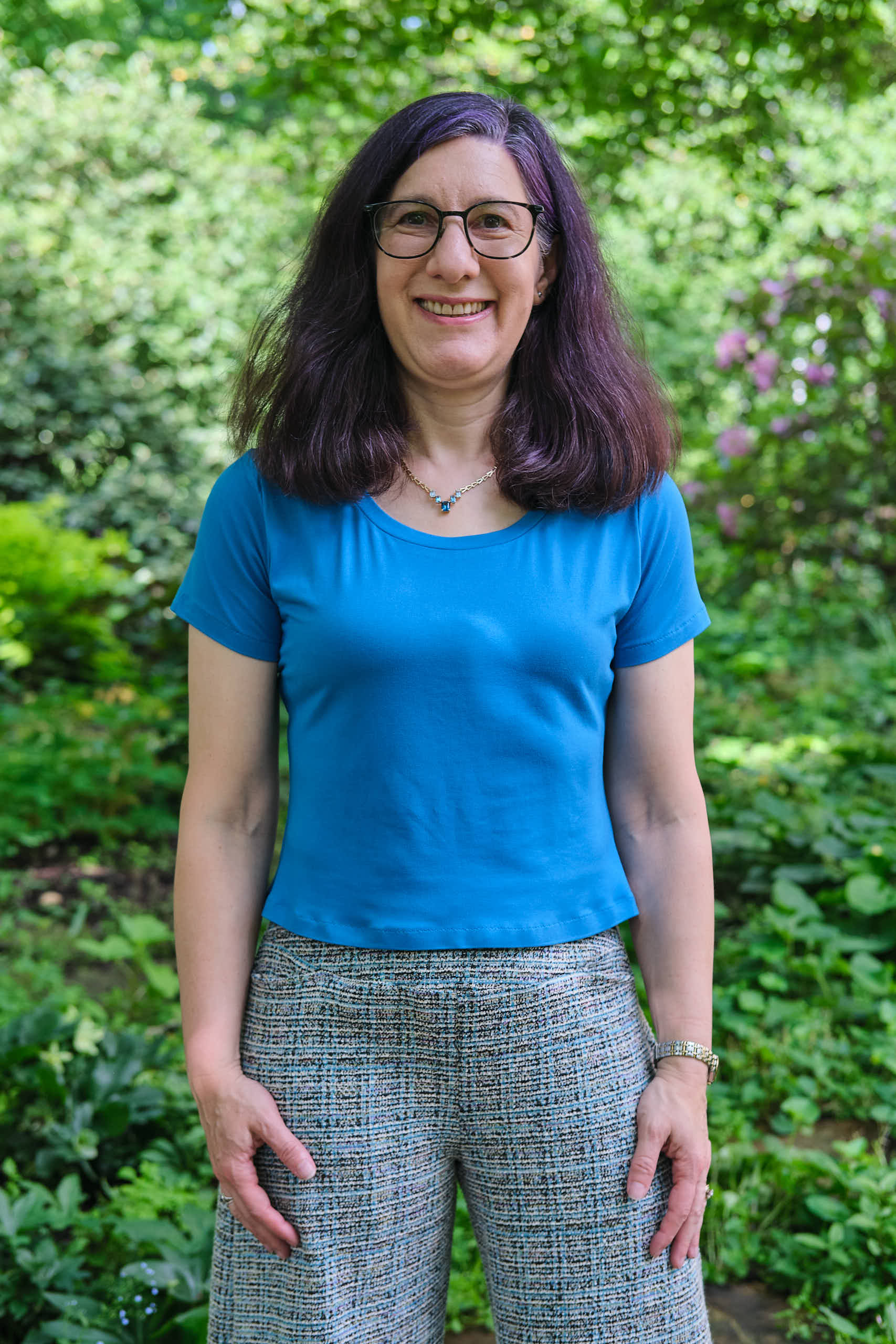
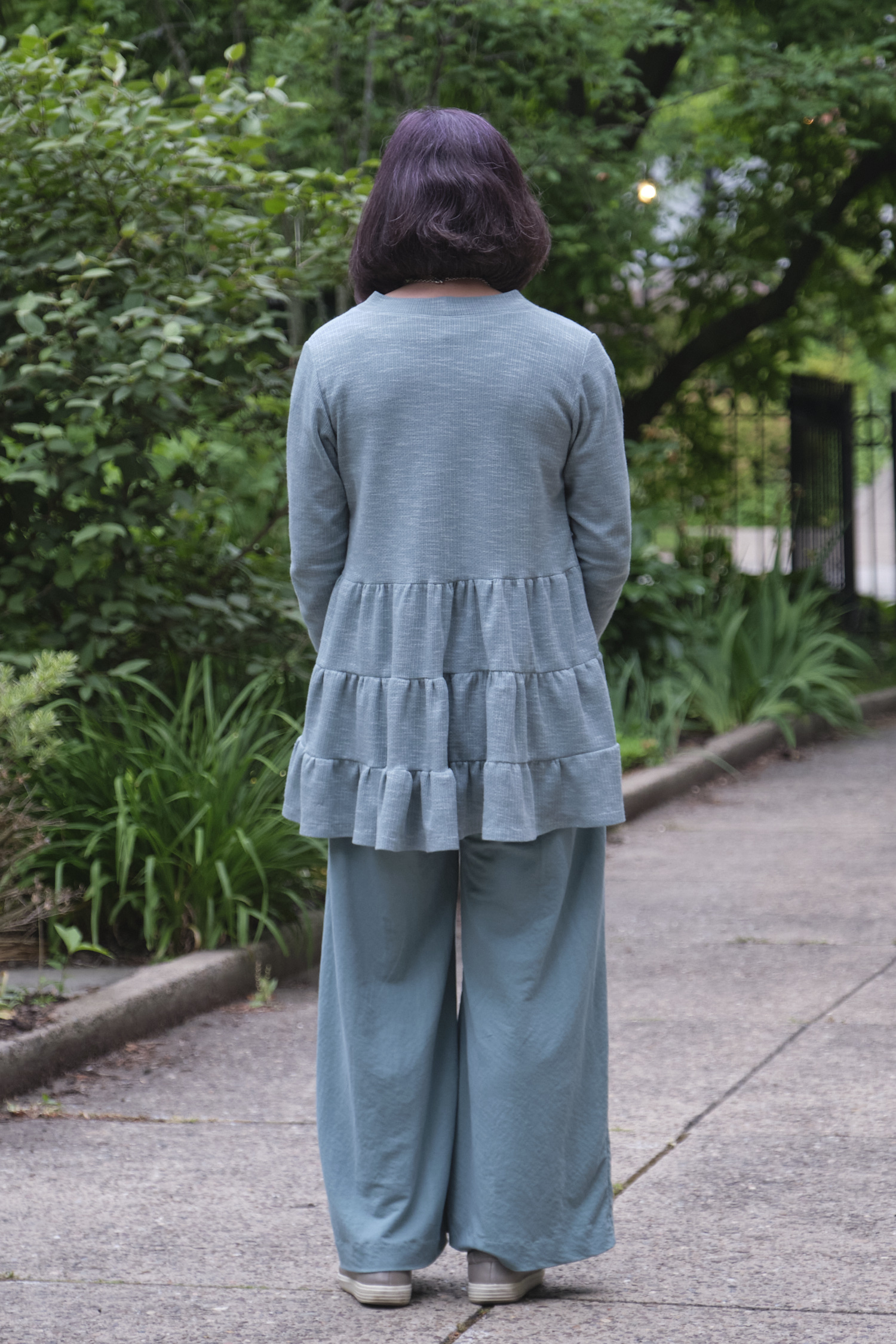
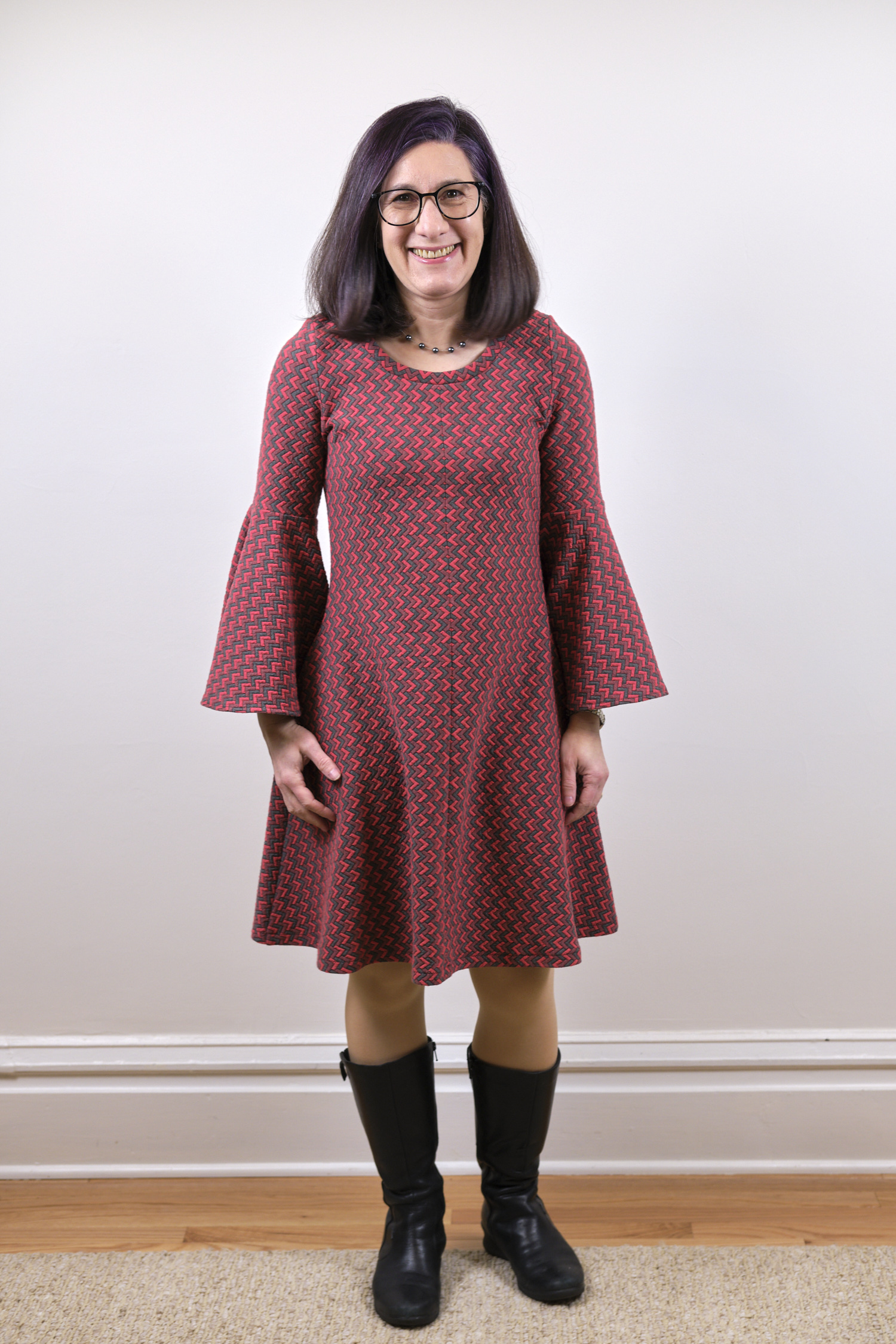
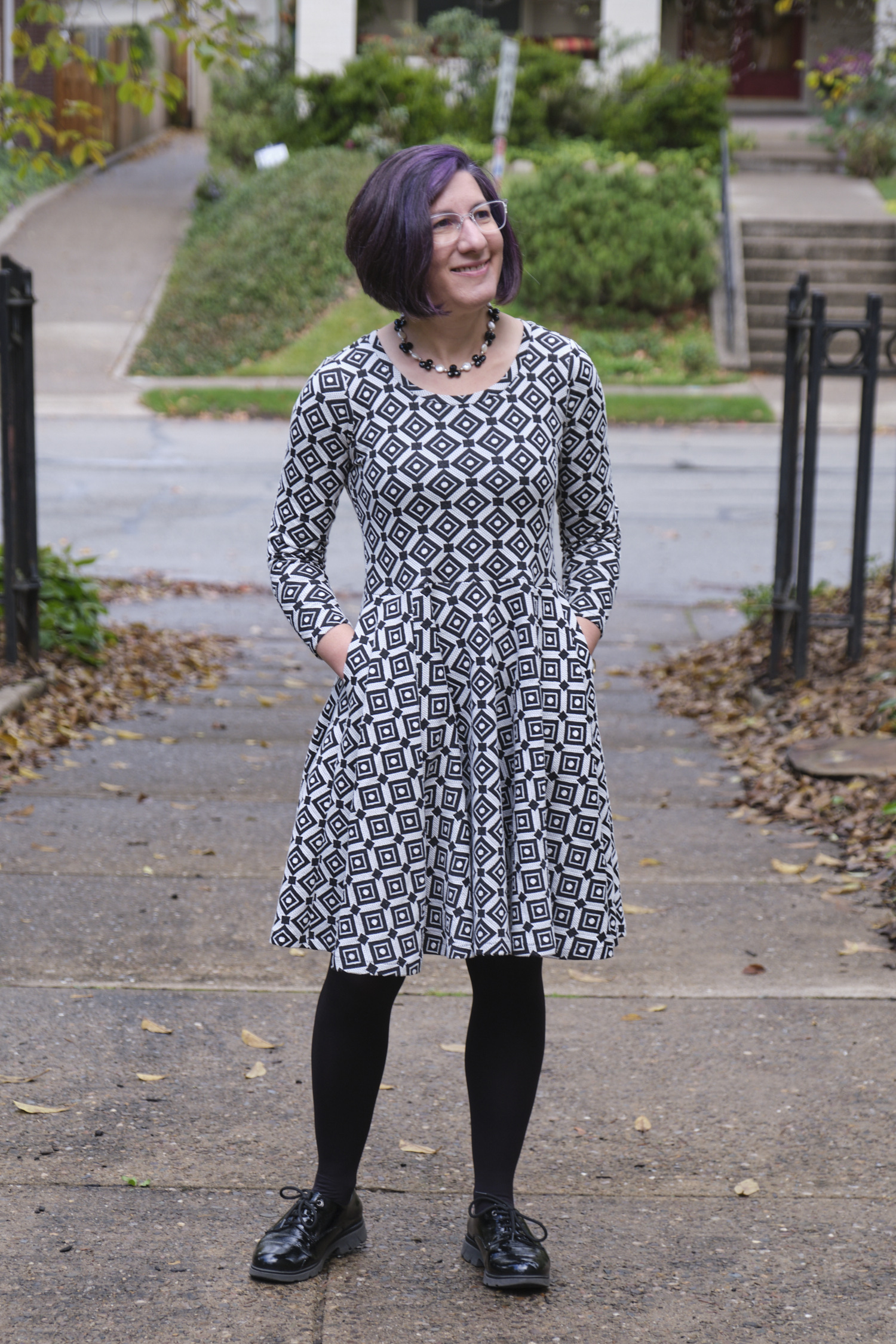
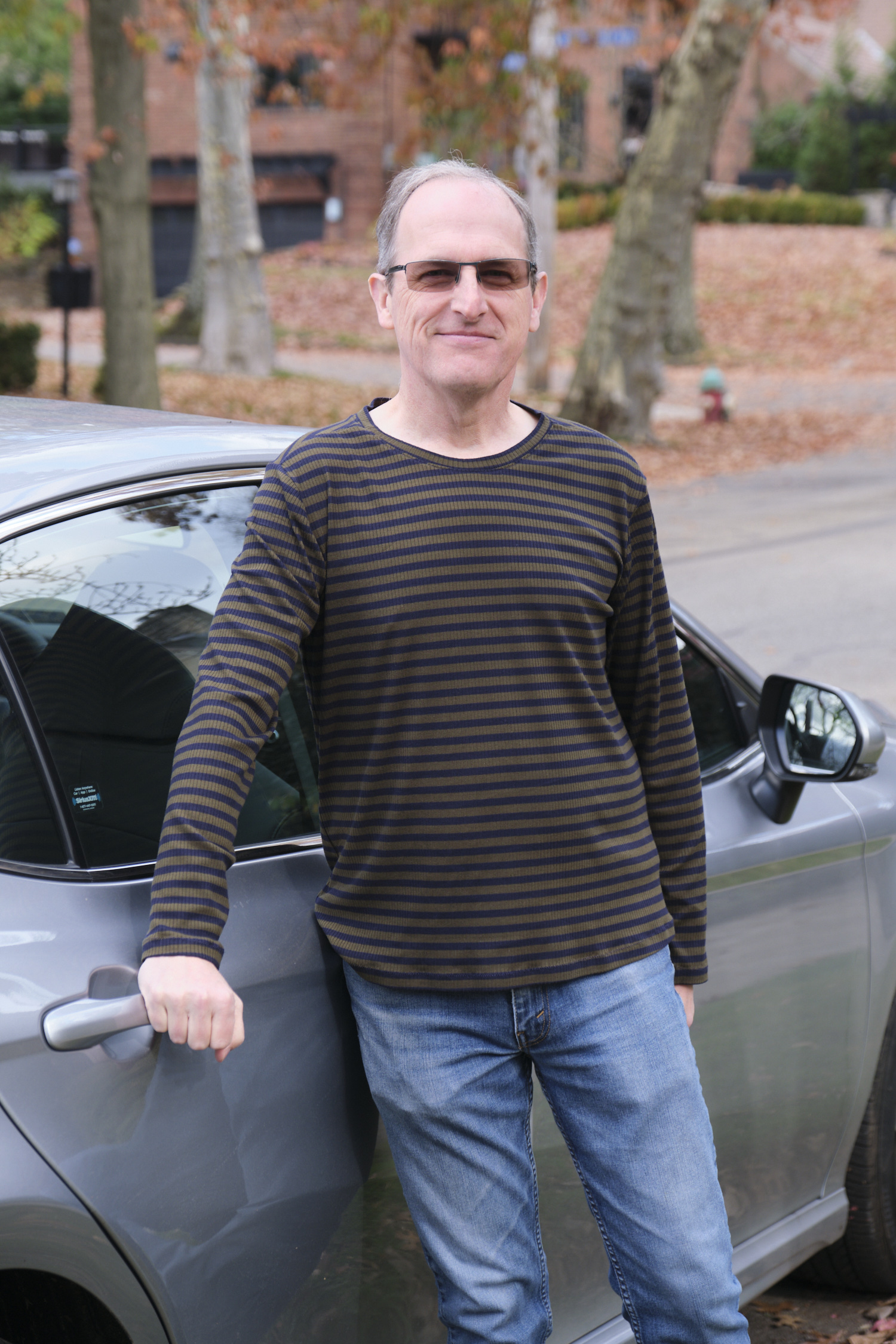
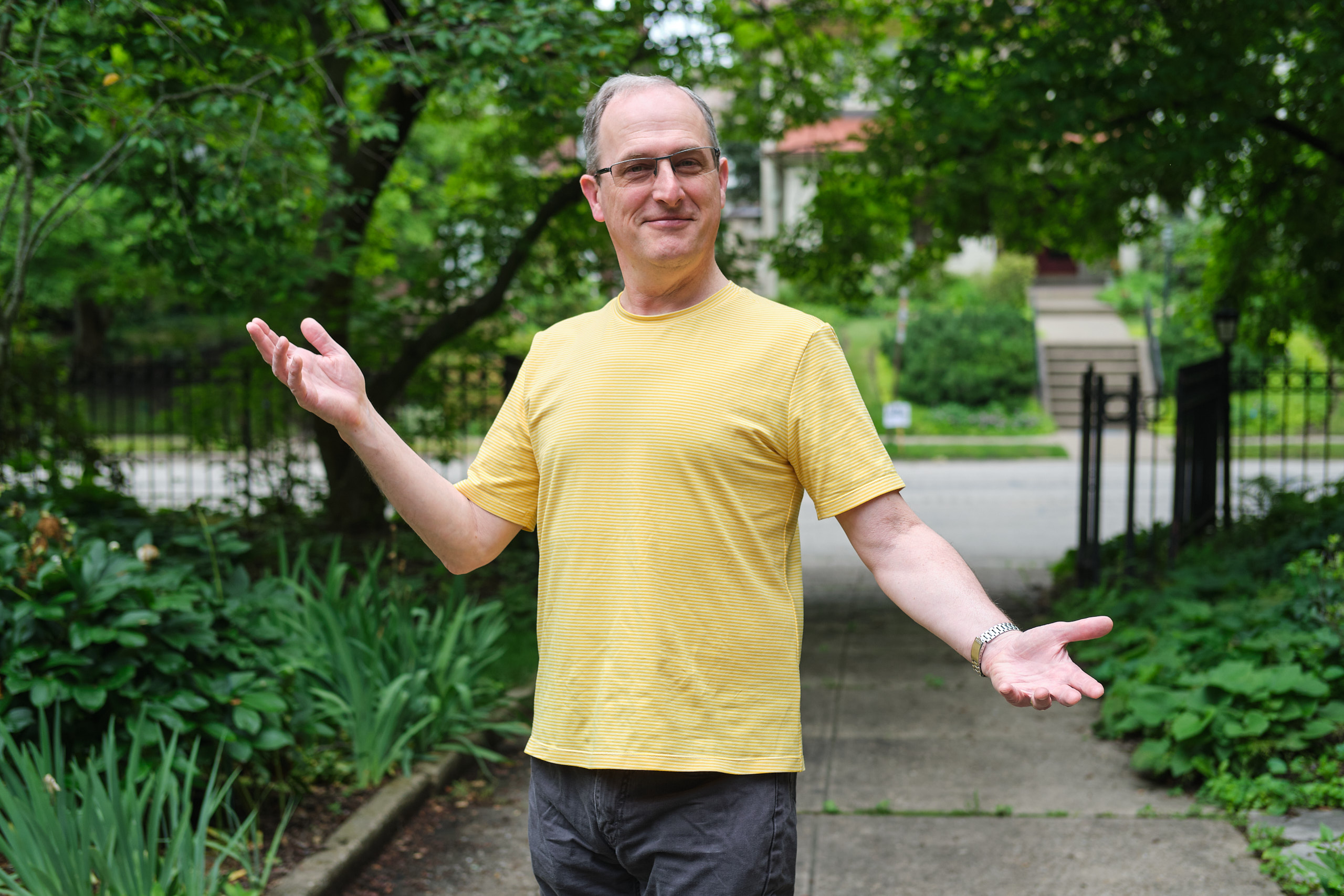
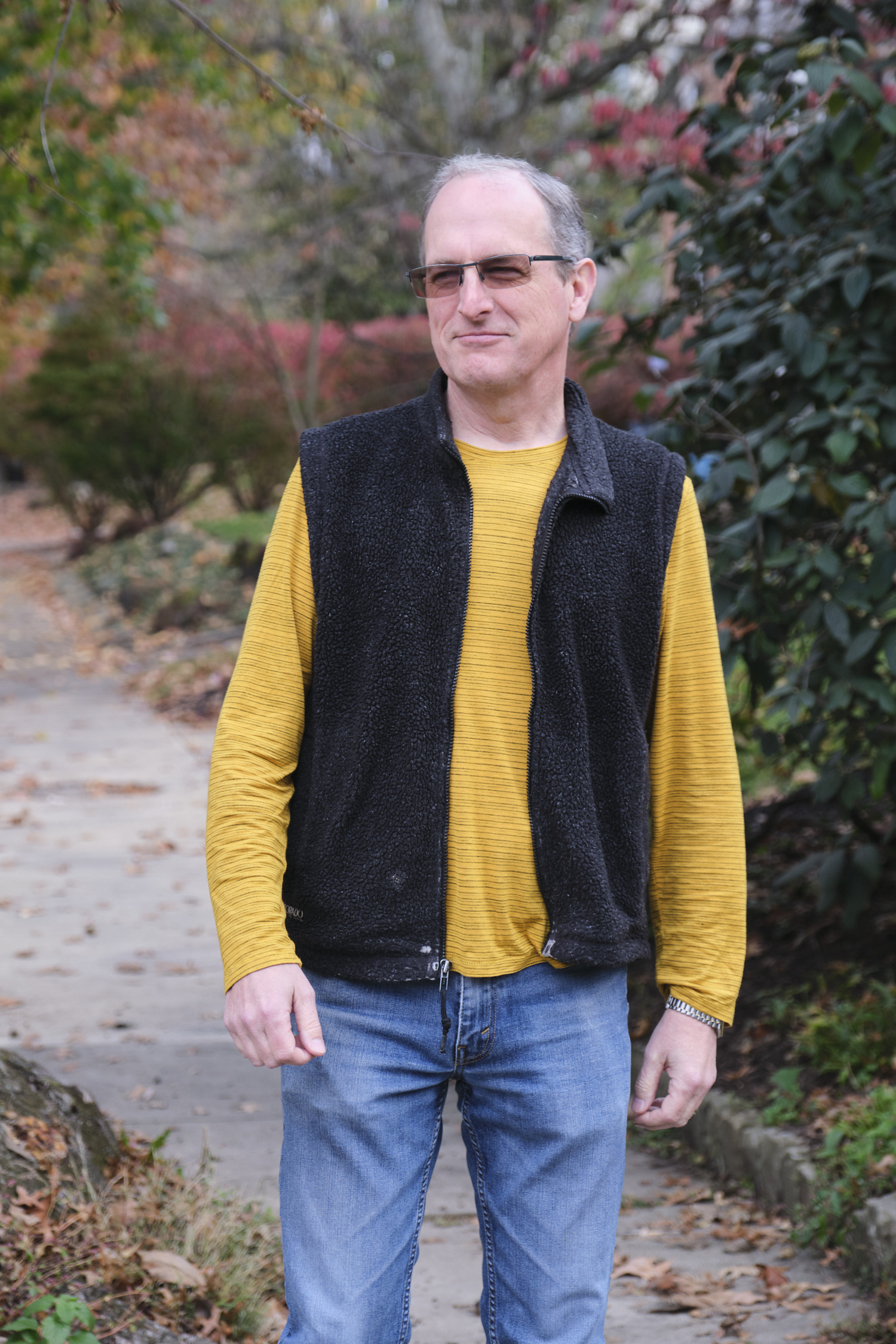
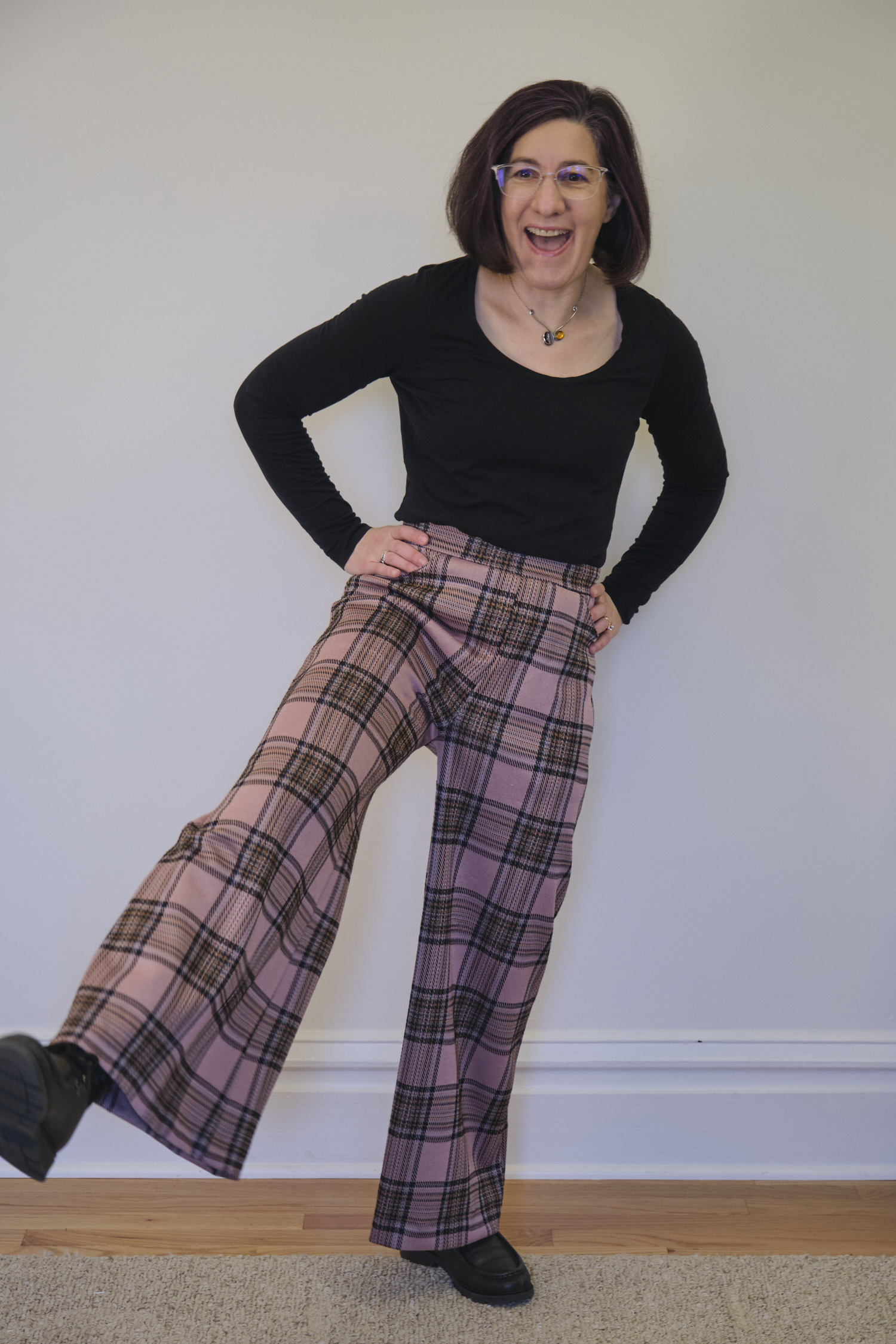
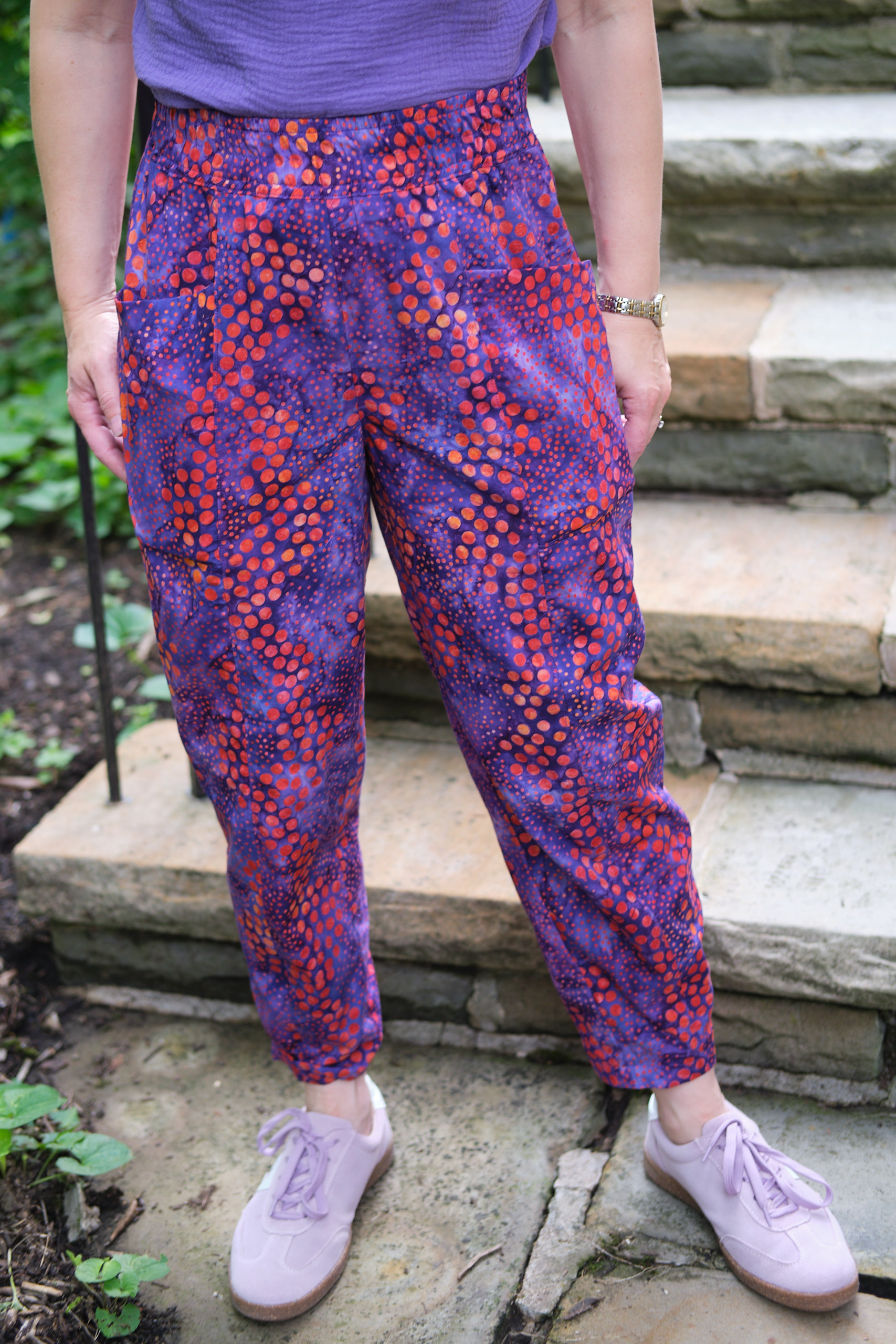
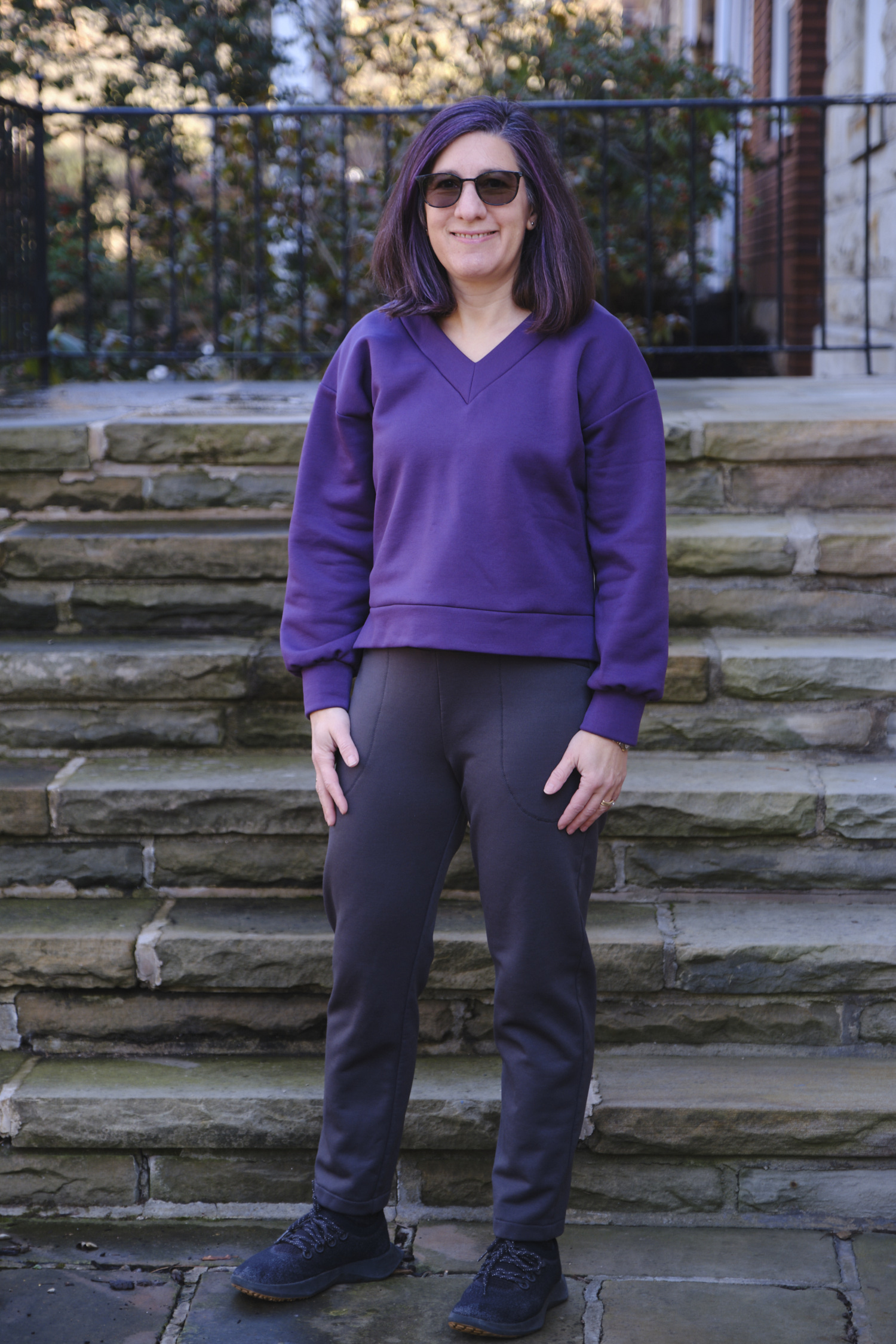
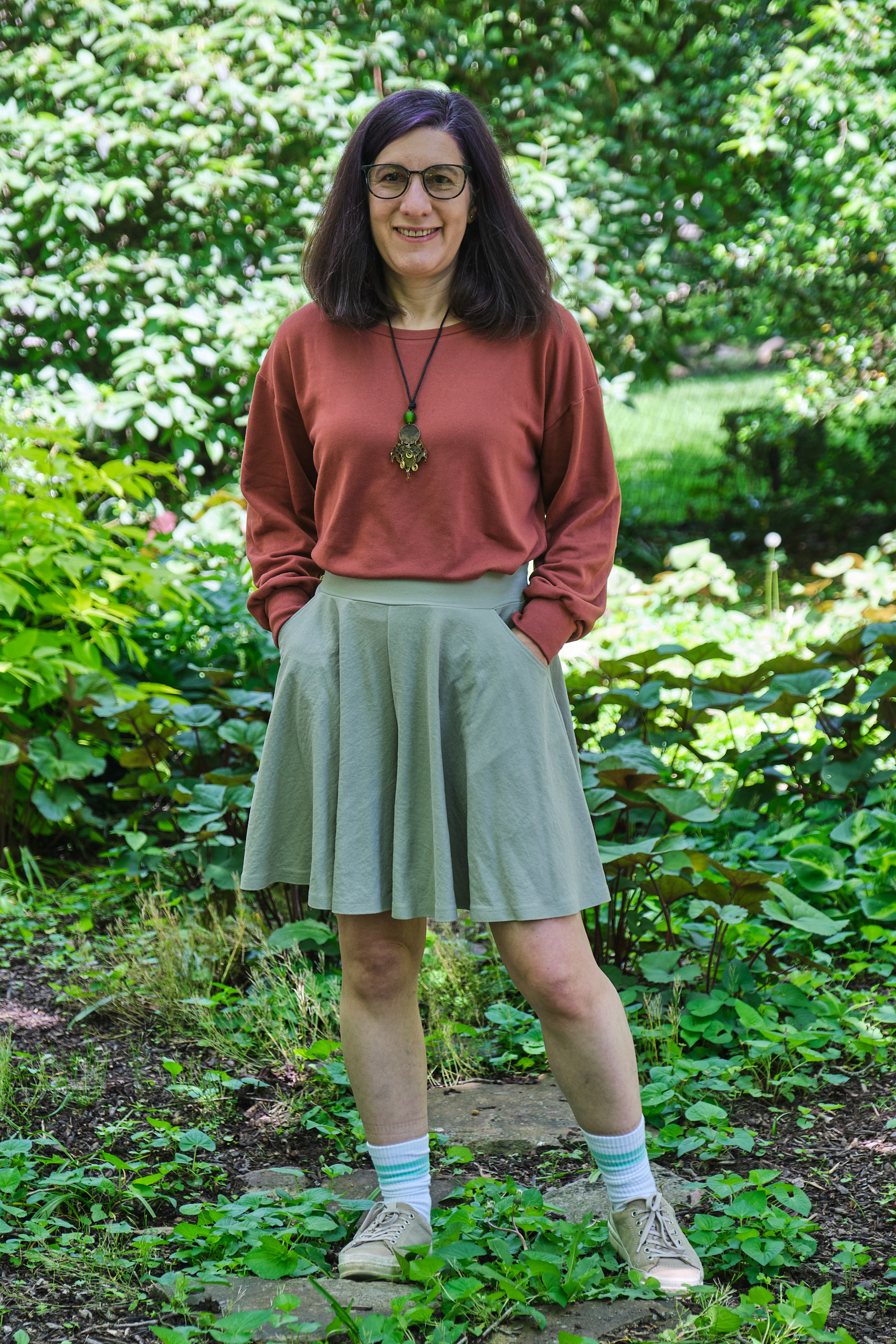
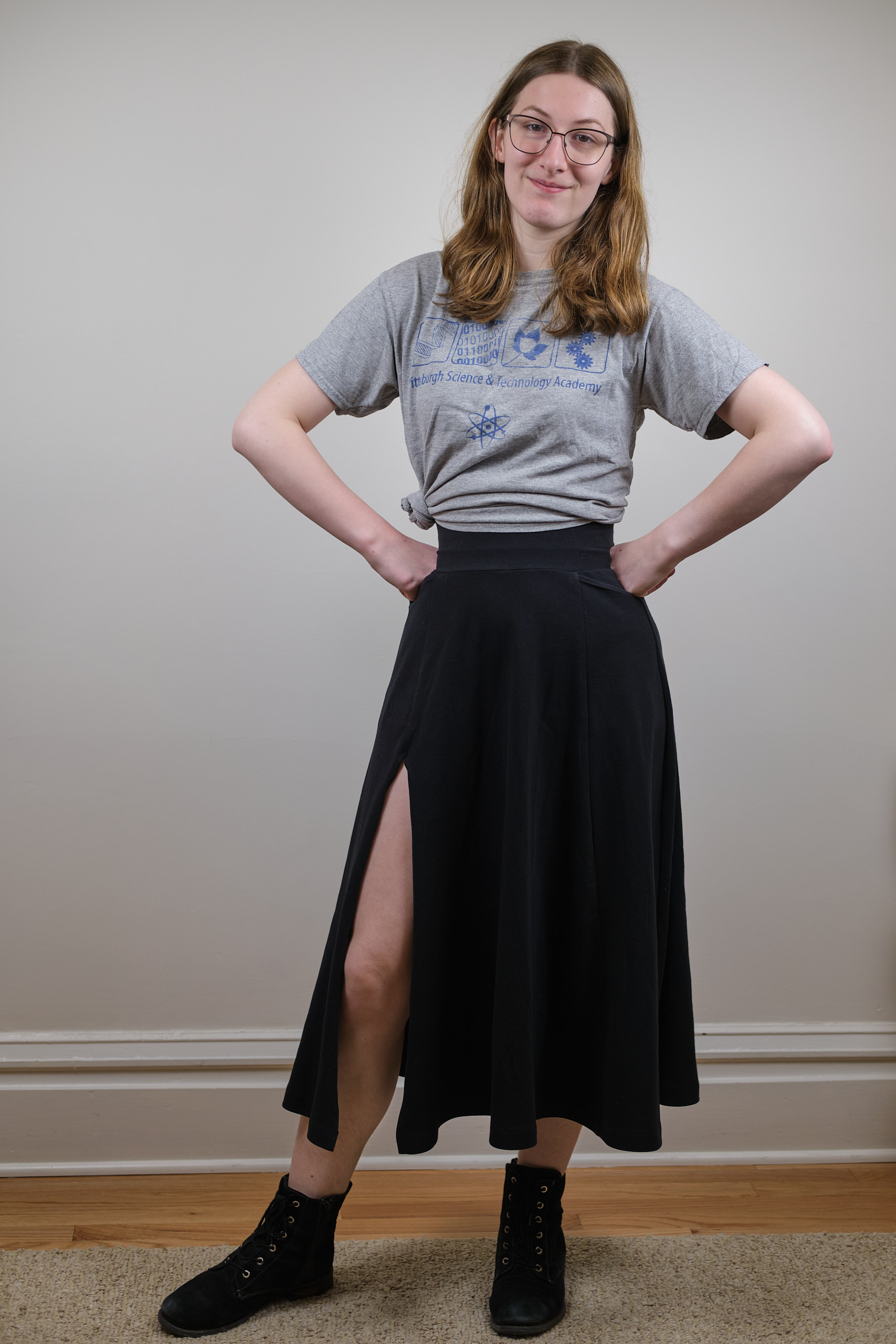
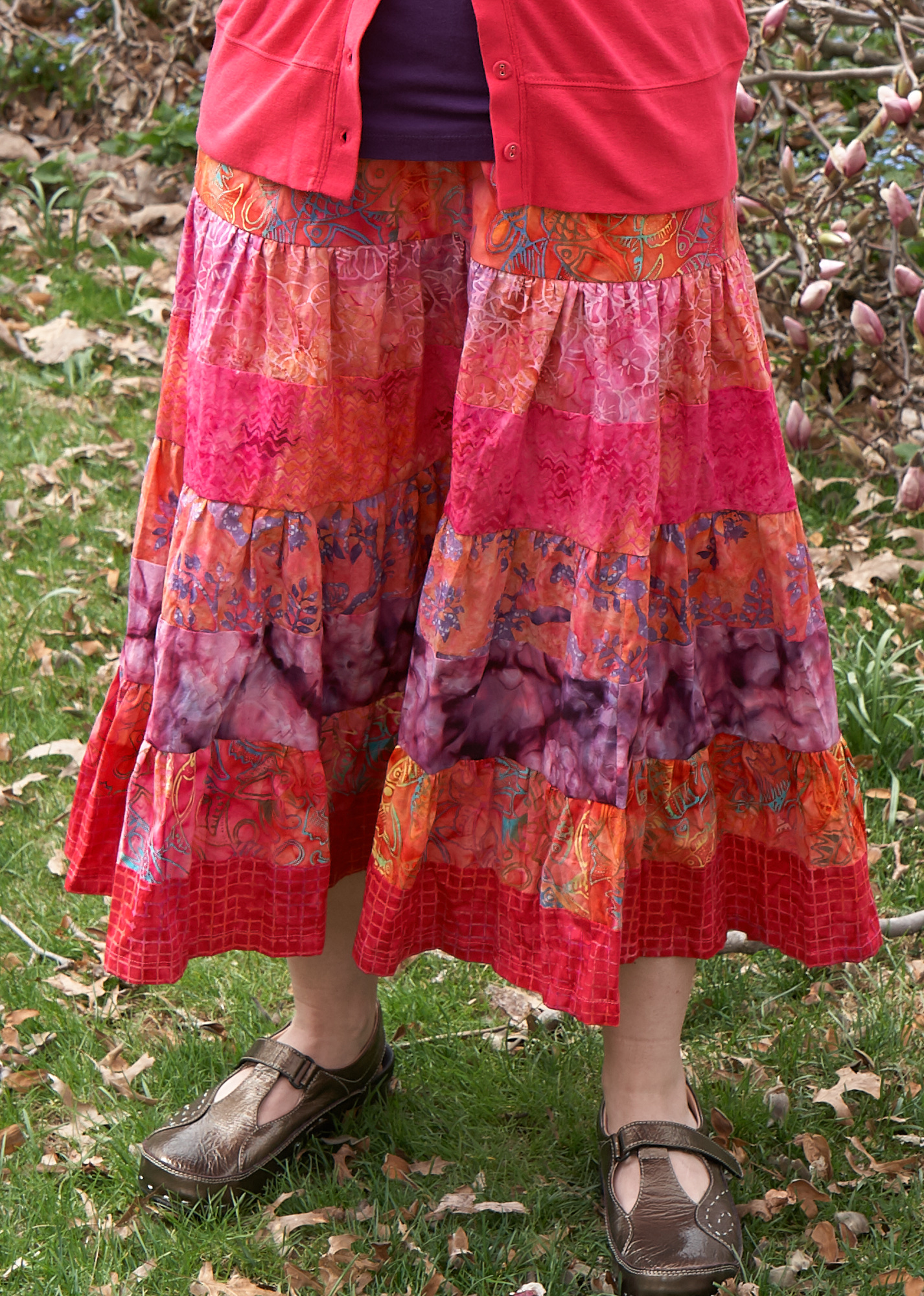
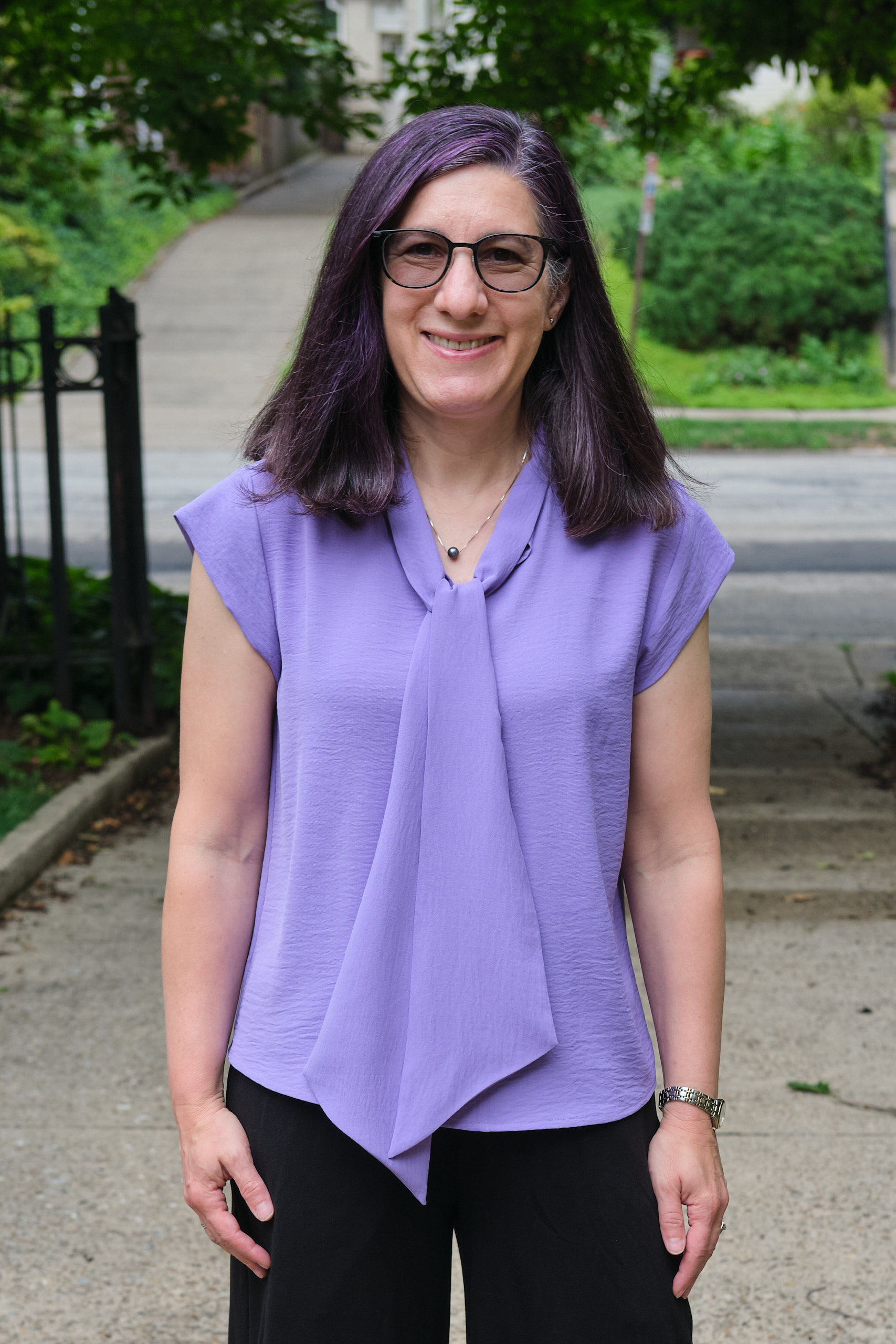
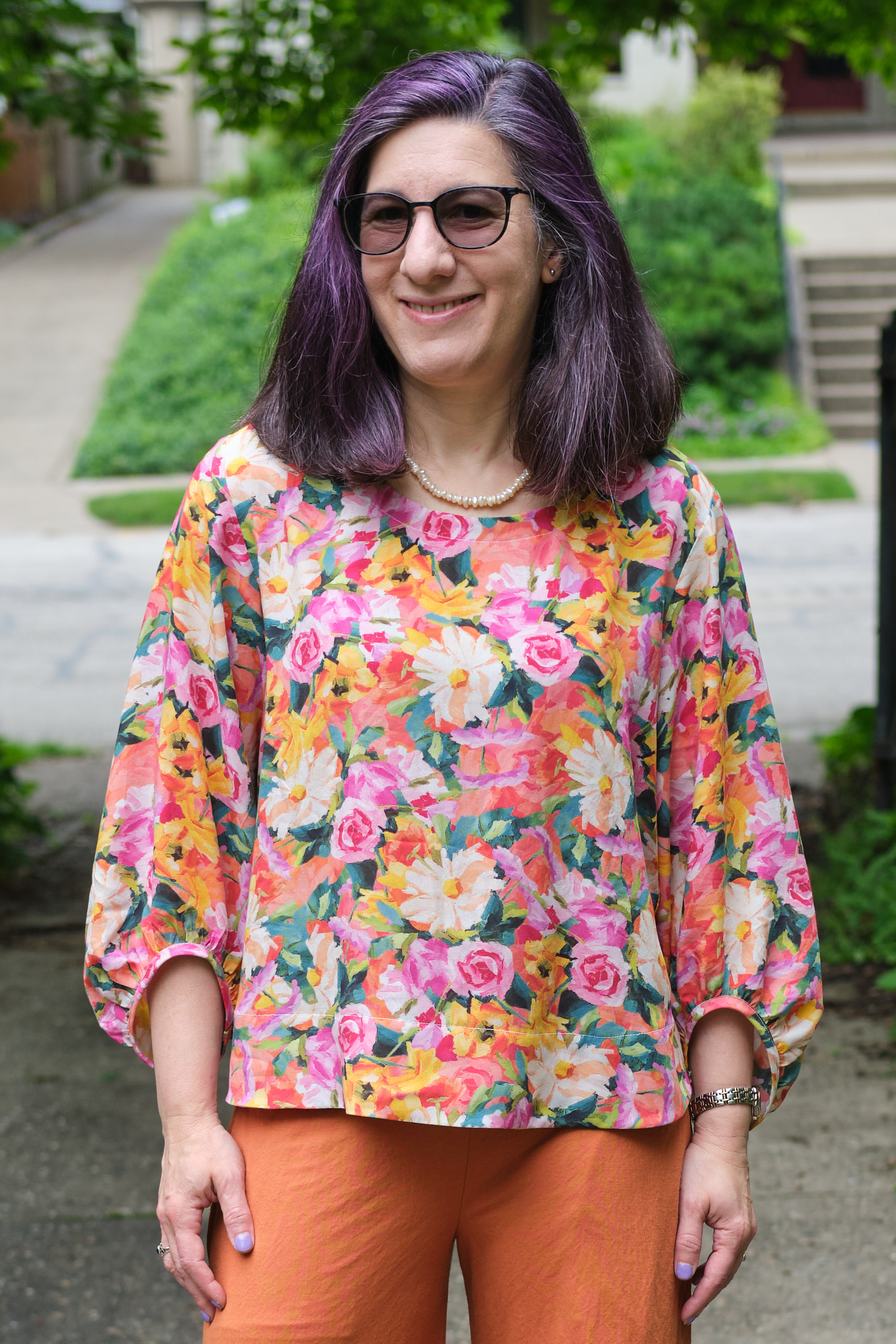
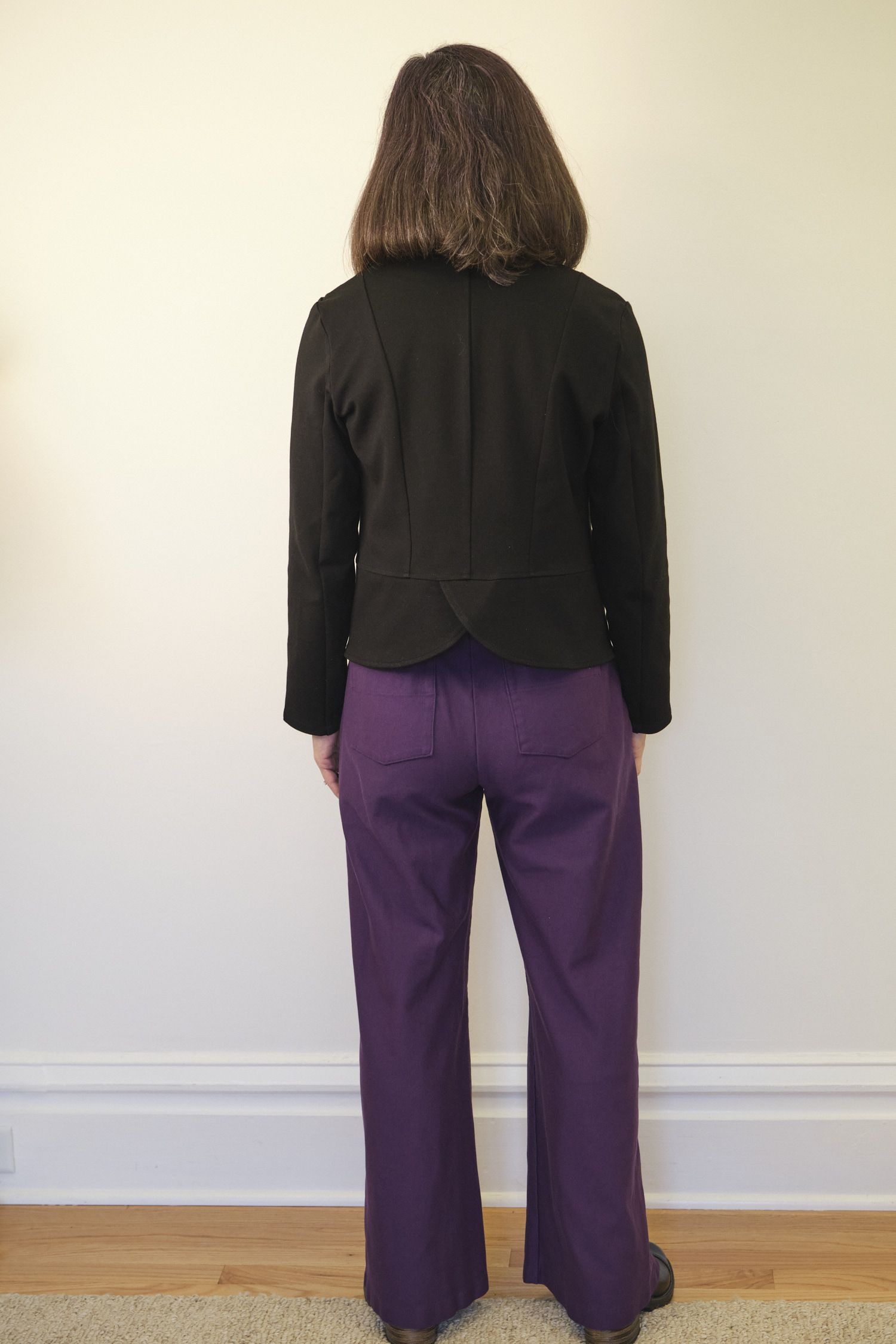
Pattern Emporium Walk Boldly Pants with modified yoga waistband from Pattern Emporium Urban Pants, size 10 AU short length with adjustments at waist and crotch, modified jeans pockets and back patch pockets. From ~1.5 yard blue/black tweed bouclé knit, waistband lined with athletic knit.
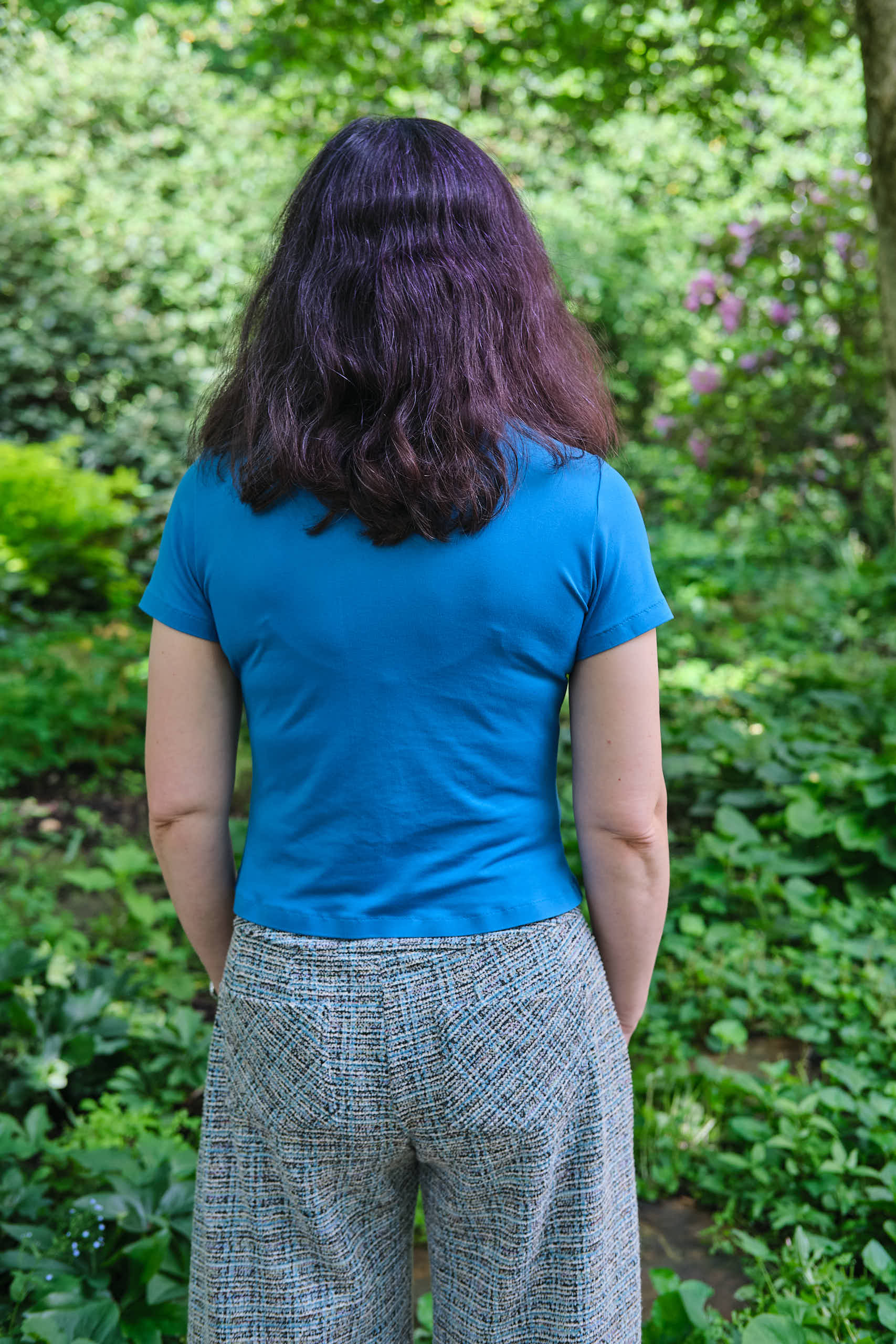
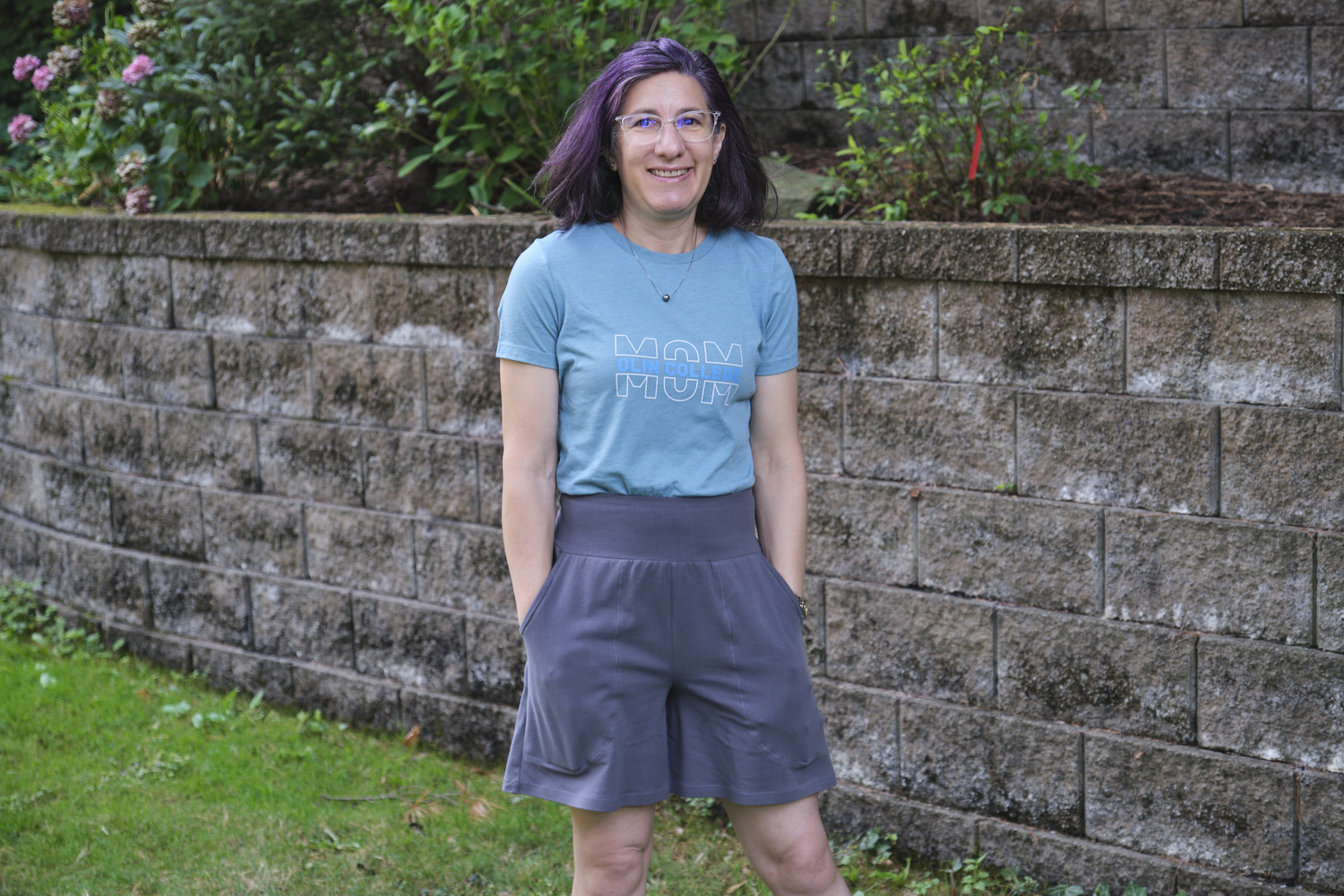
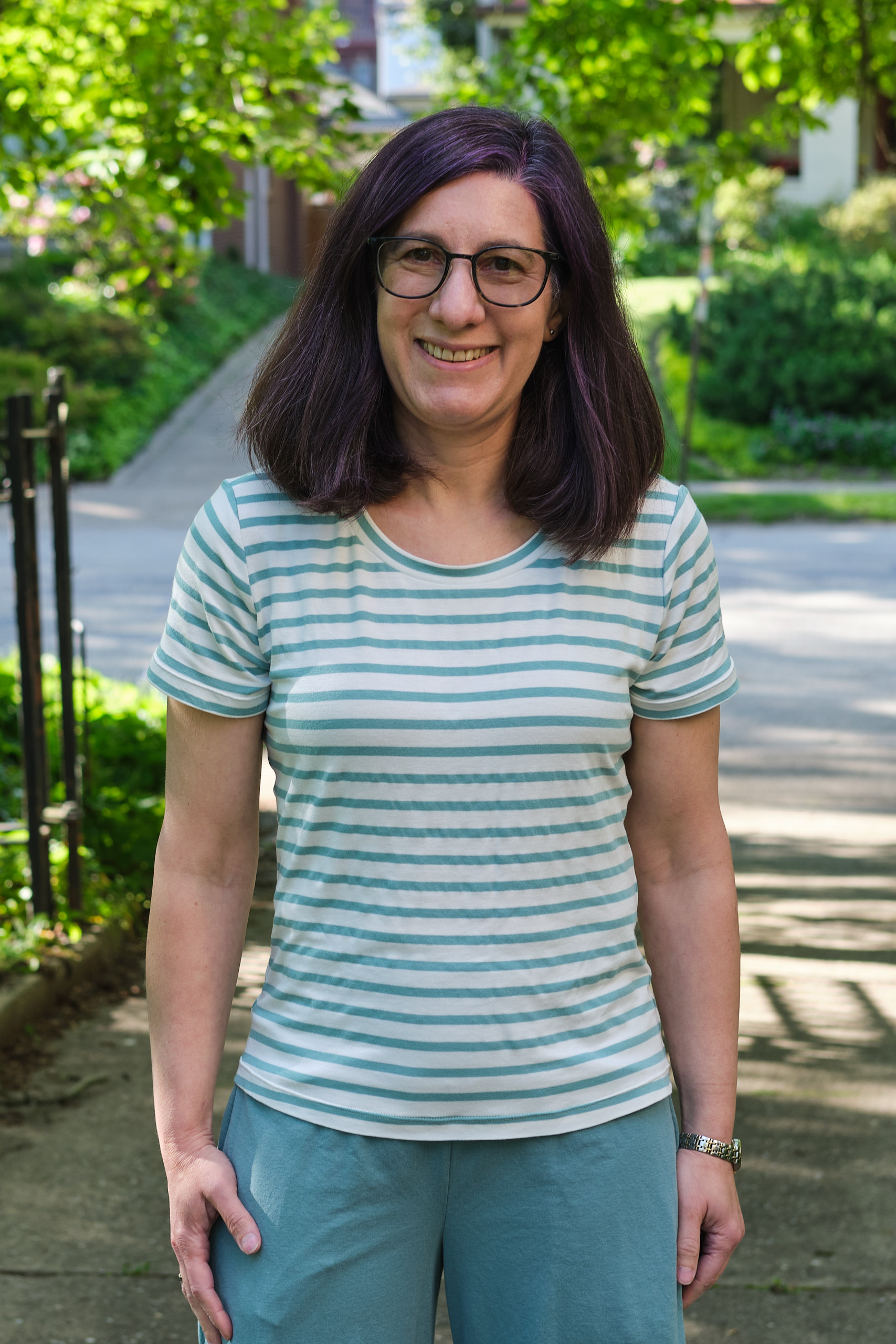
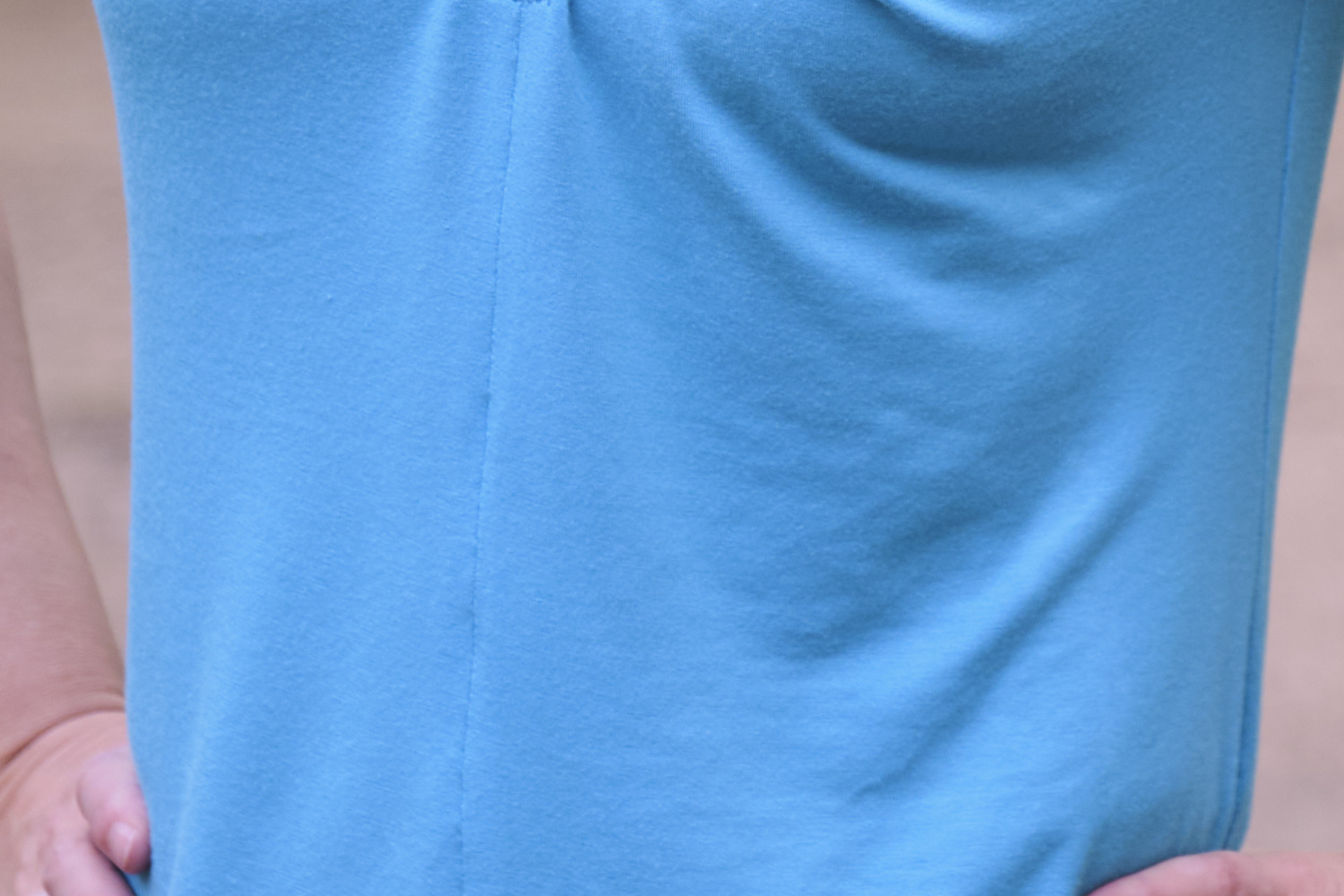
Sinclair Bondi classic fitted t-shirt, size 4p with broad and sloped shoulder adjustments, cropped length, low screwp neck, in <1 yard of turquoise double-brushed poly.
I’m enjoying wearing my tweed bouclé knit jacket and dress, and since I still had more of the fabulous blue/black tweed bouclé knit, I decided to make a pair of wide-leg pants to go with the jacket. I used the Pattern Emporium Walk Boldly Pants pattern with a modified yoga waistband from Pattern Emporium Urban Pants. The Walk Boldly pattern really shines with more structured knit fabric that shows off the wide legs, and the Urban pants yoga waistband is a great substitute for the Walk Boldly elastic waist. I made these pants in my usual size AU 10 with my usual modifications. I used the lower waist, tapered the waist in a bit, lengthened the front crotch, contoured the yoga waistband and split it into separate inner and outer pieces, made the inner piece from a heavy athletic knit, and sewed half-inch elastic into the top of the waistband seam between the layers. I used the jeans pockets but sewed the pocket openings on a straight diagonal. And I added back patch pockets to play up the Channel vibe of the outfit.
Cutting the tweed was a bit of a challenge. I knew I wanted the vertical lines in the fabric to align vertically with the grain. I also attempted some plaid matching horizontally, but eventually gave up as the knit fabric was too fiddly for that. Fortunately, the plaid pattern is fairly subtle and so the lack of plaid matching is not obvious.
Now I have a dress, jacket, and pants in the tweed bouclé knit, and I still have a little bit more than a yard left. Perhaps I need a skirt? A sleeveless top? Or maybe I’ll use it to make something for someone else?
After I finished the pants, I decided I needed a turquoise blue scoop-neck top to go with the pants. I had just barely enough turquoise double-brushed poly left over from another project in my stash. I tetrised my adjusted size 4p Sinclair Bondi classic fitted t-shirt pattern to fit the little fabric I had with short sleeves and a cropped length — it was as long as fit the piece of fabric I had, but coincidentally, at 3-inches above hip length, also the perfect length to wear under the jacket untucked. It is a great length on me with high-waisted pants, but may show a smidge of midriff when worn with lower-riding pants. I made my usual broad and sloped shoulder adjustments and tried a new, slightly lower version of my screwp neck, this one made from the size 00 wide scoop. The DBP fabric is soft and stretchy, but also a little bit clingy to my rib cage, making me consider sizing up next time I sew a top with DBP.
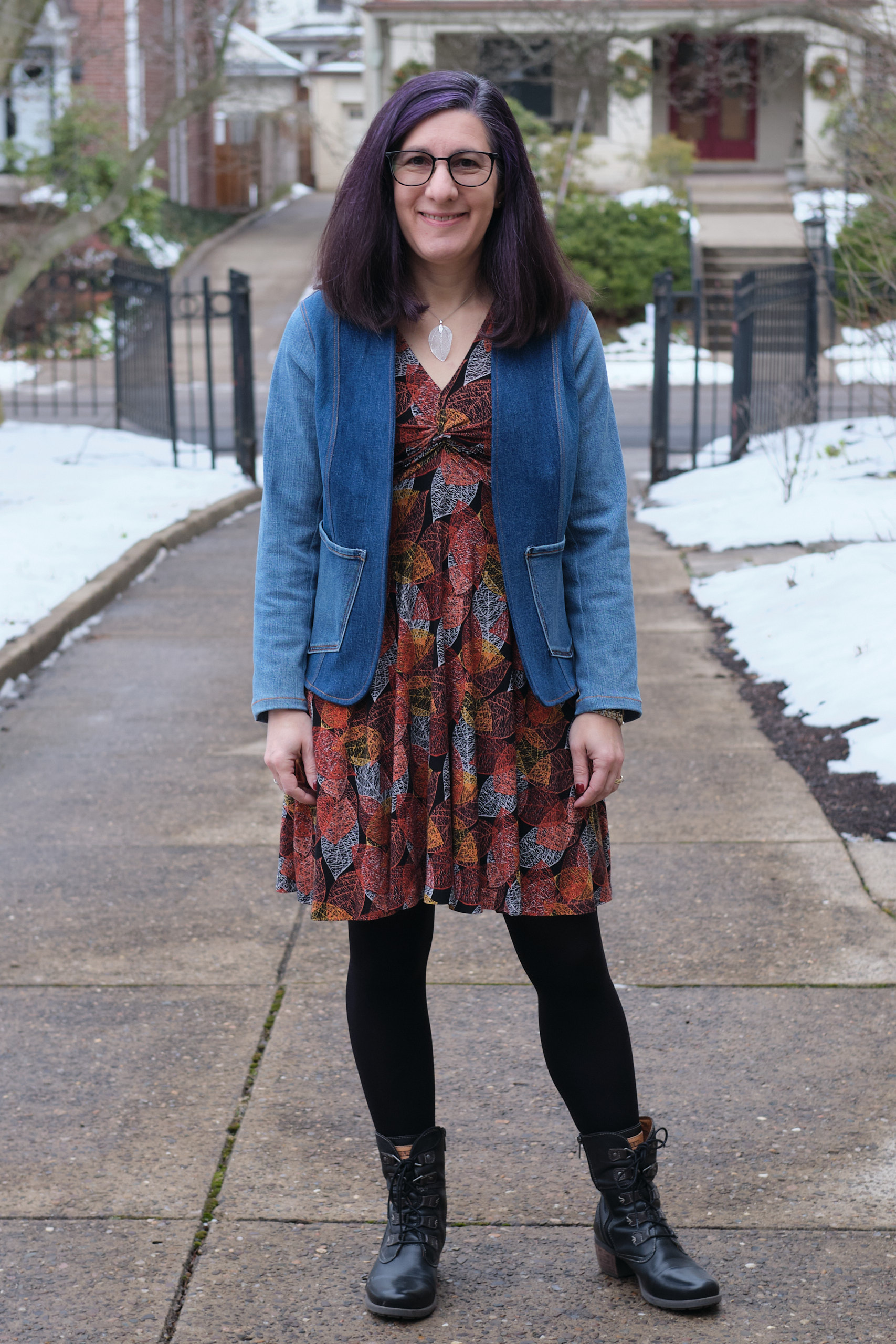
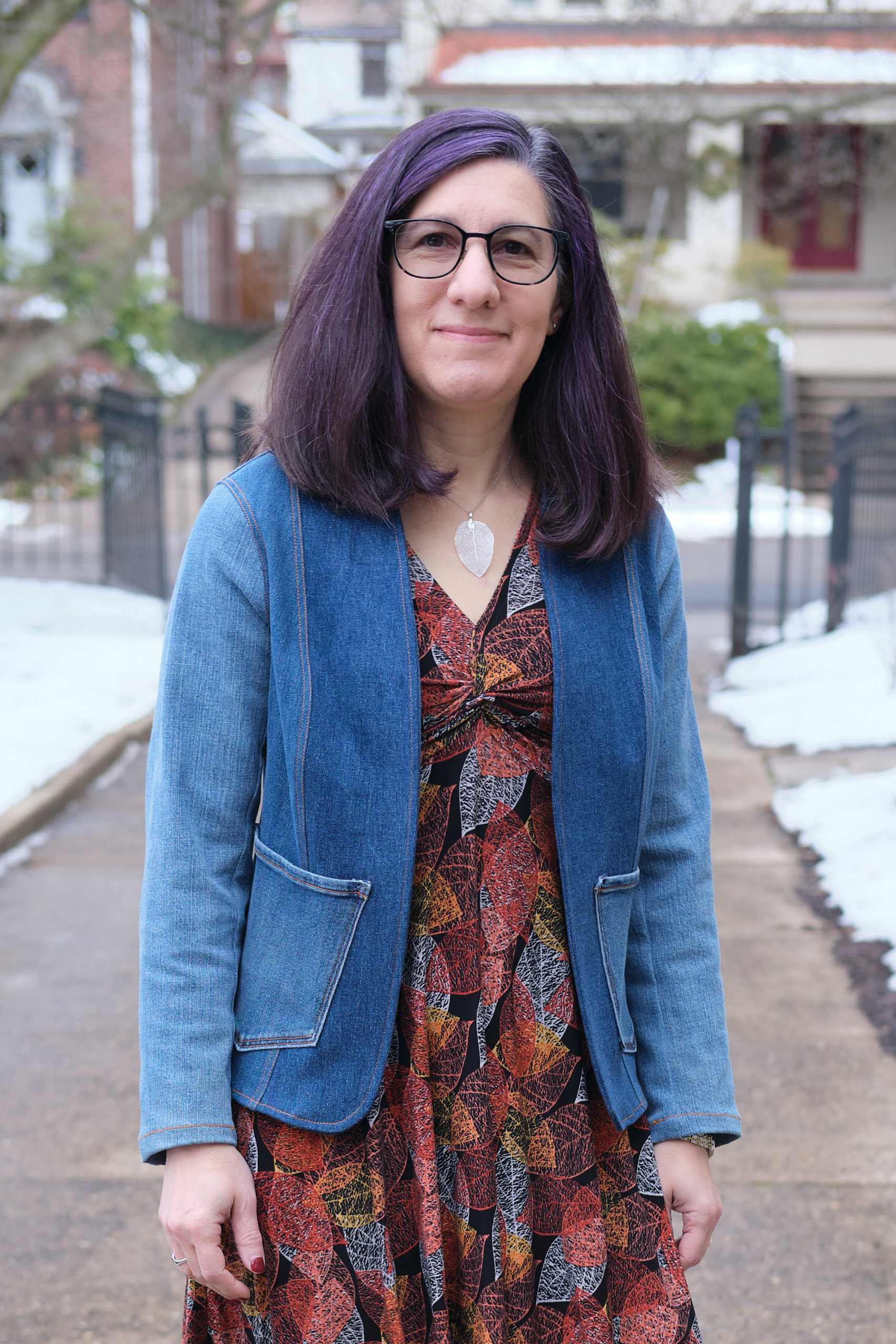
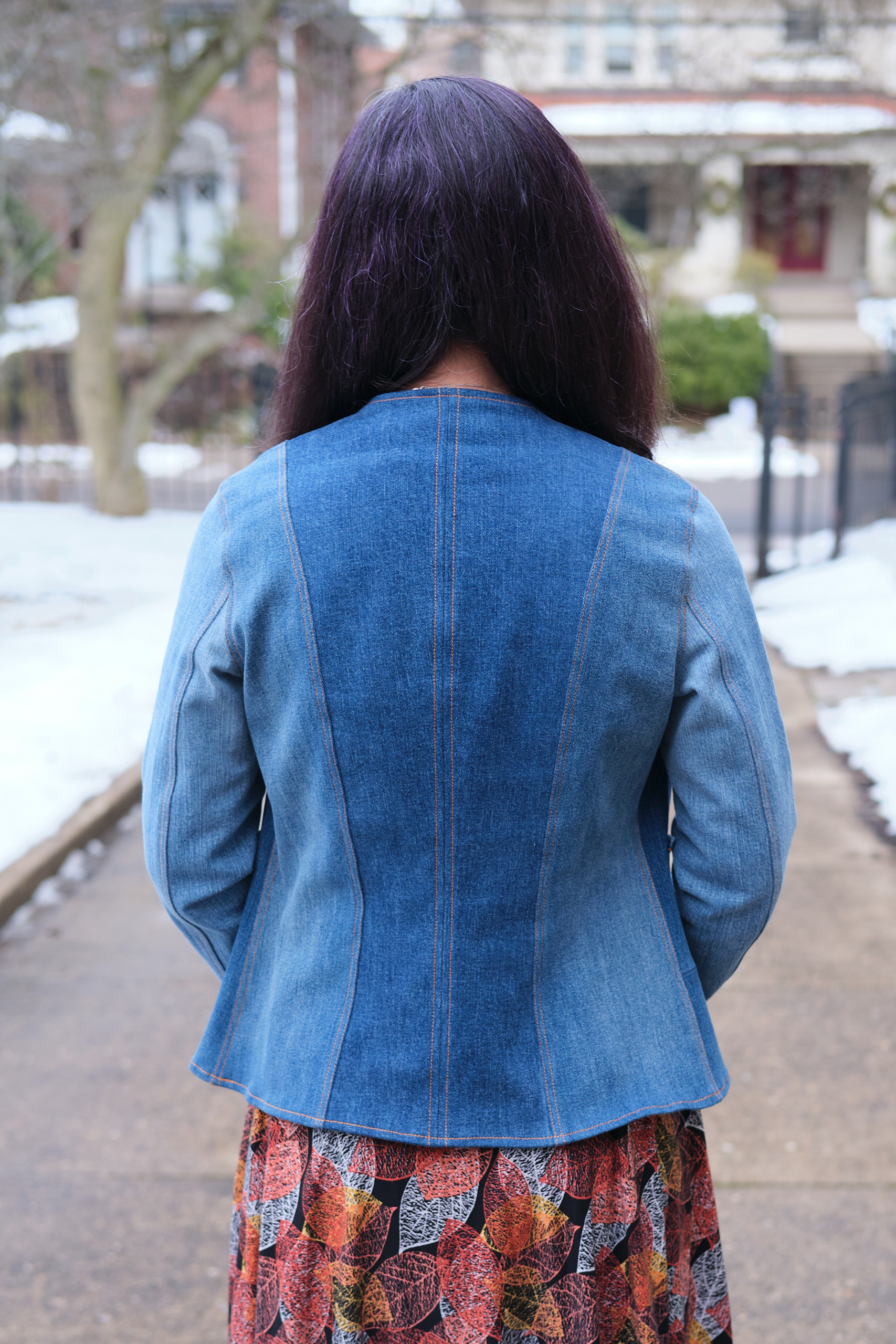
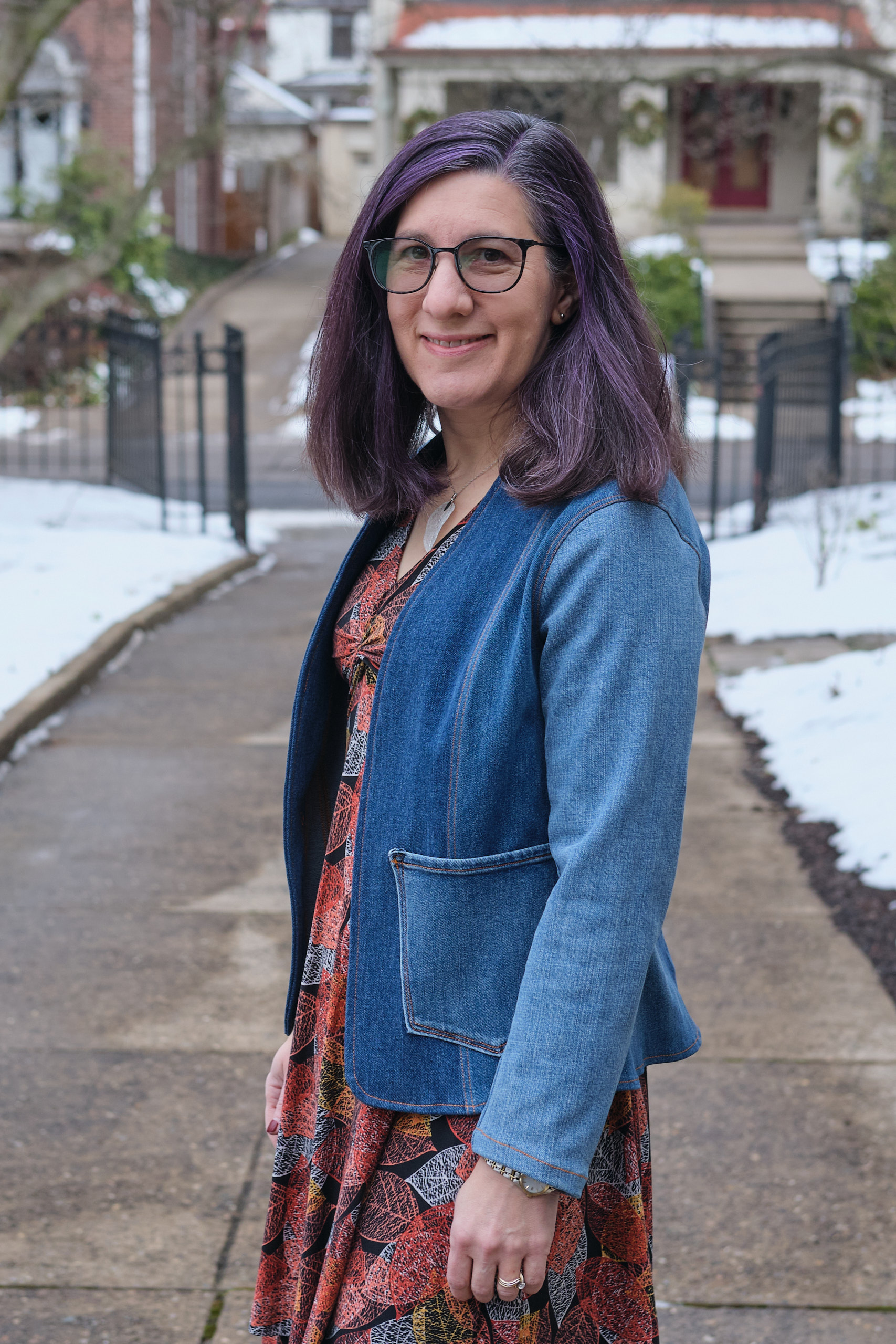
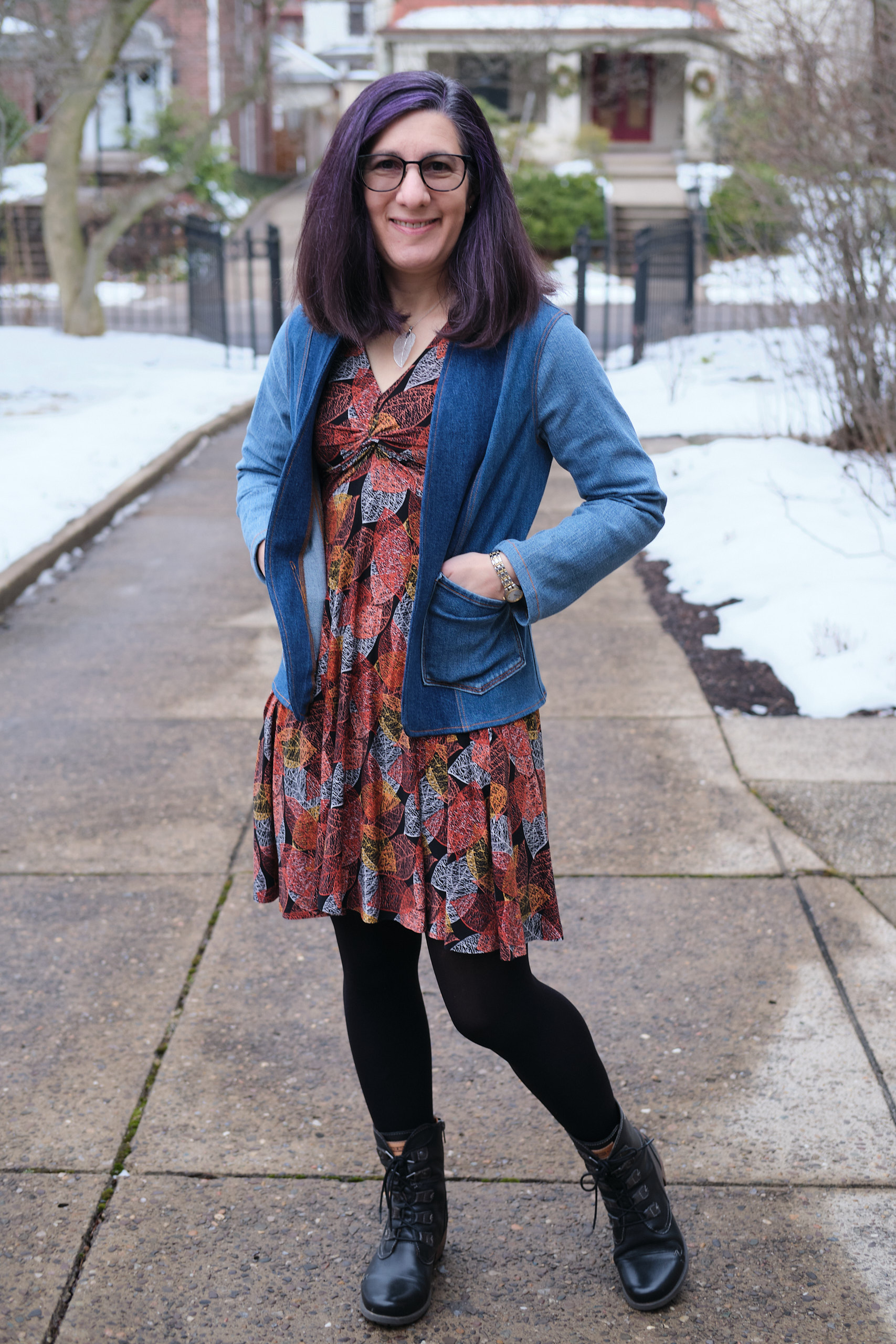
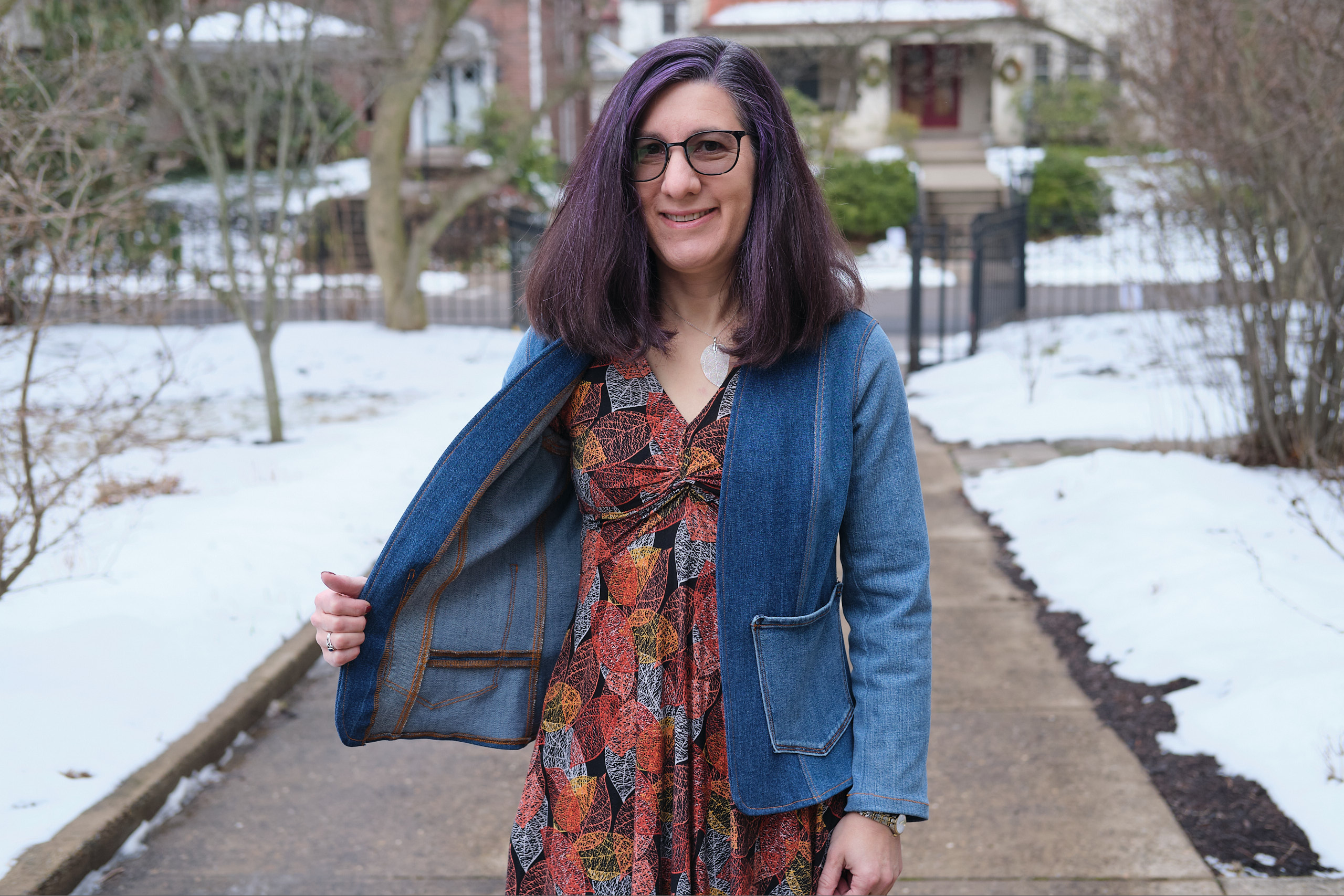
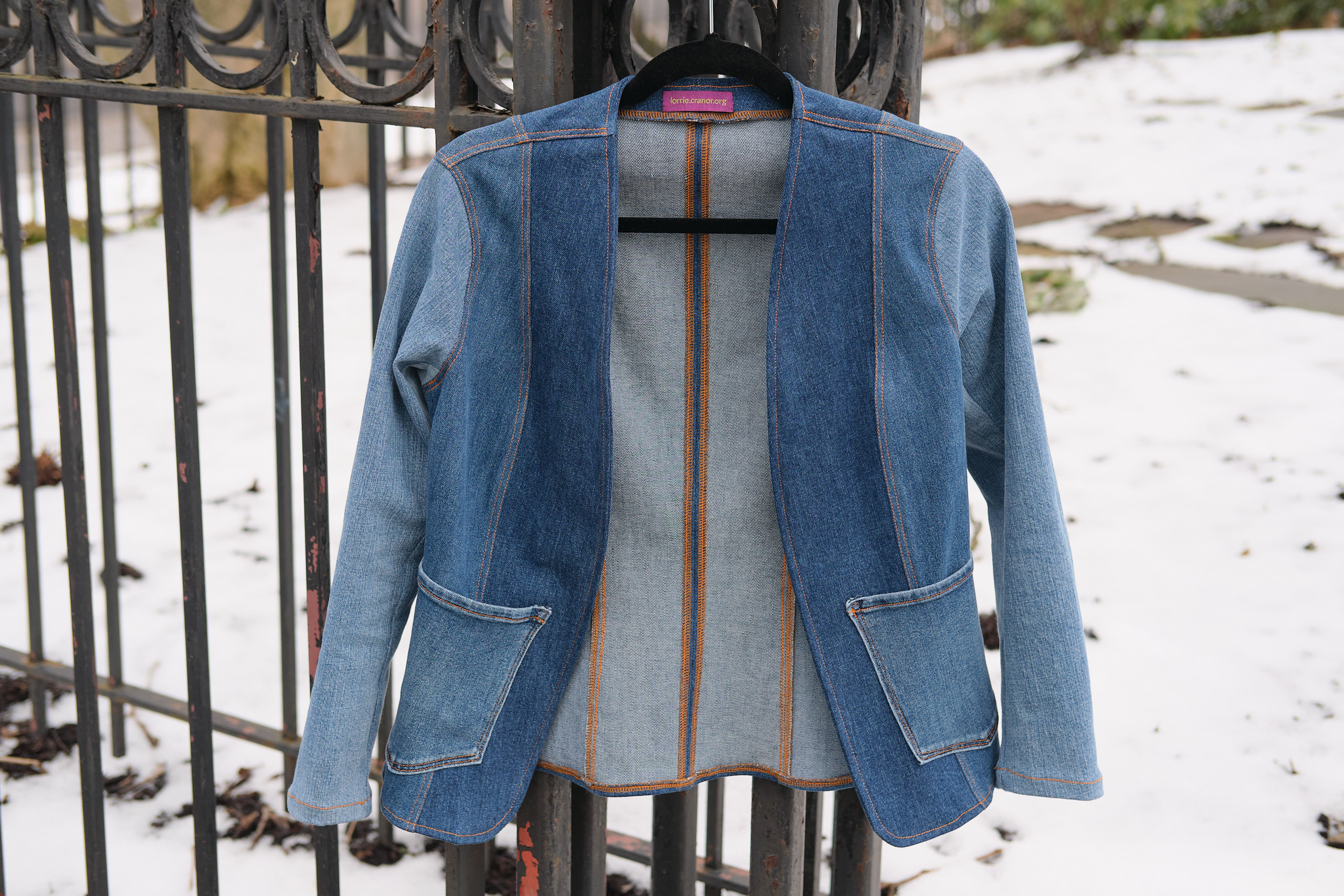
Boo & Lu Onyxblazer, size 4 with small bust adjustment, shortened waist and sleeves, lower back neck facing, repurposed jeans pockets. Made from three pairs of thrifted jeans.
I used to love wearing denim jackets, which seem to go with just about everything, but I’ve found their collars increasingly uncomfortable. So the thought of a collarless denim jacket in a bit dressier blazer style was appealing. Unfortunately, I seem to have already given away most of the discarded jeans in my household and those that I could find were either full of holes and paint spots or ridiculously skinny and thus had very little fabric to work with.
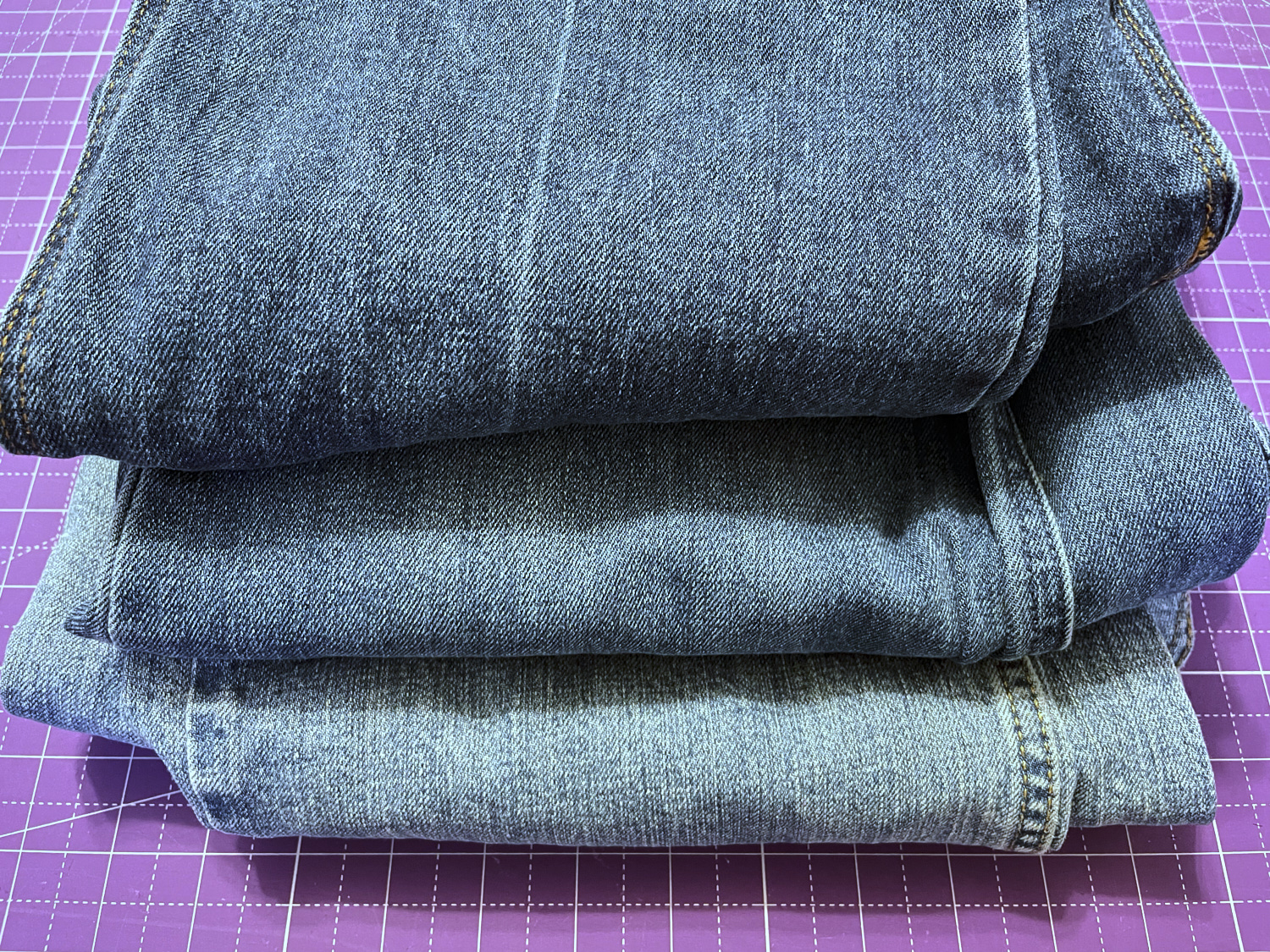
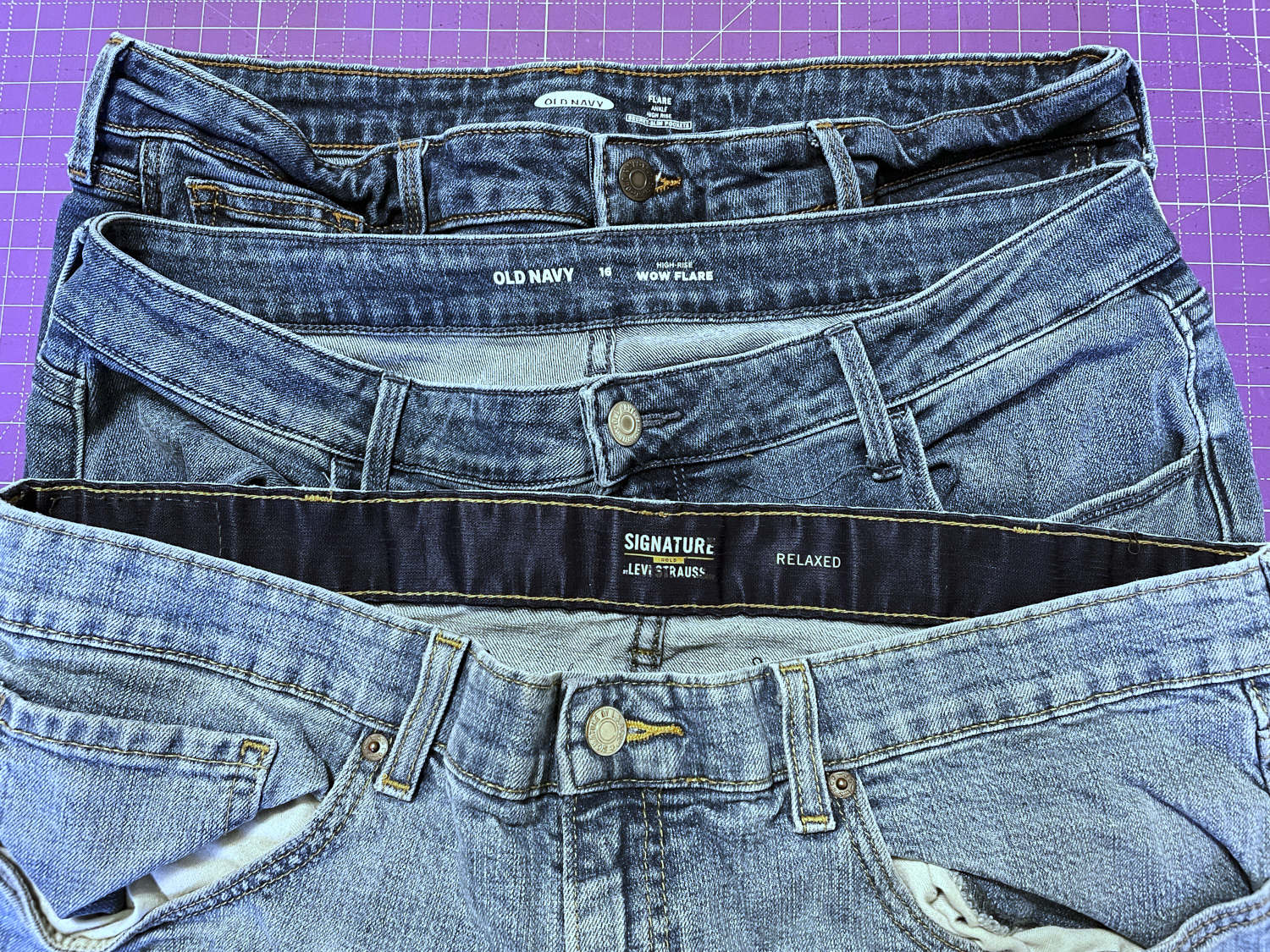
Last fall, when I was visiting my daughters in Boston, we went to a thrift shop and I asked them to help me find three pairs of inexpensive jeans I could cut up. I looked for jeans that were less than $10 a pair, medium-weight, slightly stretchy denim, in large sizes. I collected a pile of jeans that met these criteria and sorted them from lightest to darkest. Then I selected three pairs with distinctly different shades of blue that went well together. They were $6 each and with the $6 coupon I picked up on my way into the store, I paid a total of $12 for all three pairs.
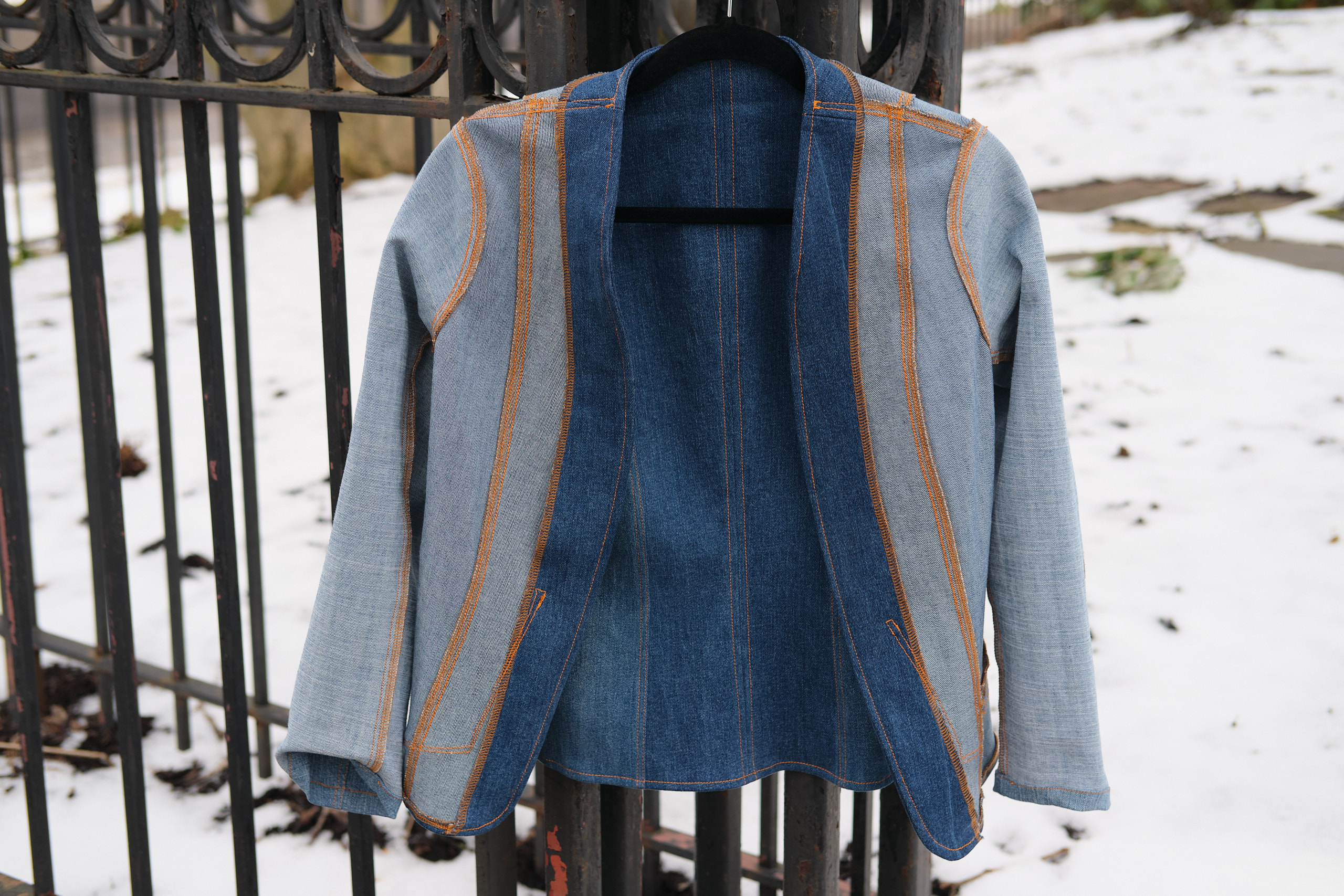
I didn’t get around to working on the jacket project until New Year’s Day. First, I spent a lot of time debating the color placement and where to place each pattern piece. I decided to go with a symmetrical color arrangement and place the pieces from the darkest in the center to the lightest on the sleeves.
I previously spent a lot of time working out adjustments to the size 4 hip length version of the jacket pattern to fit me better. These worked great on my grey and magenta ponte jackets so I used the same pattern file I had already prepared with all of these adjustments: small-bust adjustment (performed by redrawing the inner curve on the side-front pieces to have less of a contour and then shortening the center front pieces to match the length of the new curve), sloped-shoulder adjustment (3/4 inch), round-back adjustments (two 5/8-inch adjustments near top and bottom of arscye), back neckline lowered by about 3/4 inch, bottom hem and sleeves shortened by 2 inches. The only thing I did differently was using the jeans pockets rather than the pattern pocket pieces and using the normal pattern facings rather than the wider facings I used previously. There’s always a risk that a pattern fitted with one type of fabric won’t fit right when cut from a very different type of fabric. Thankfully, my denim version seems to fit pretty much the same way as the ponte.
I carefully cut out all the pieces, making sure to pair pieces from the left and right legs of each pair, cut at approximately the same height on the leg. I accidentally cut one of the front side pieces too short and wasn’t going to be able to cut a piece of a similar color at the full size so I just cut the missing part and spliced them together. I knew most of this seam would be under a pocket and hardly noticeable.
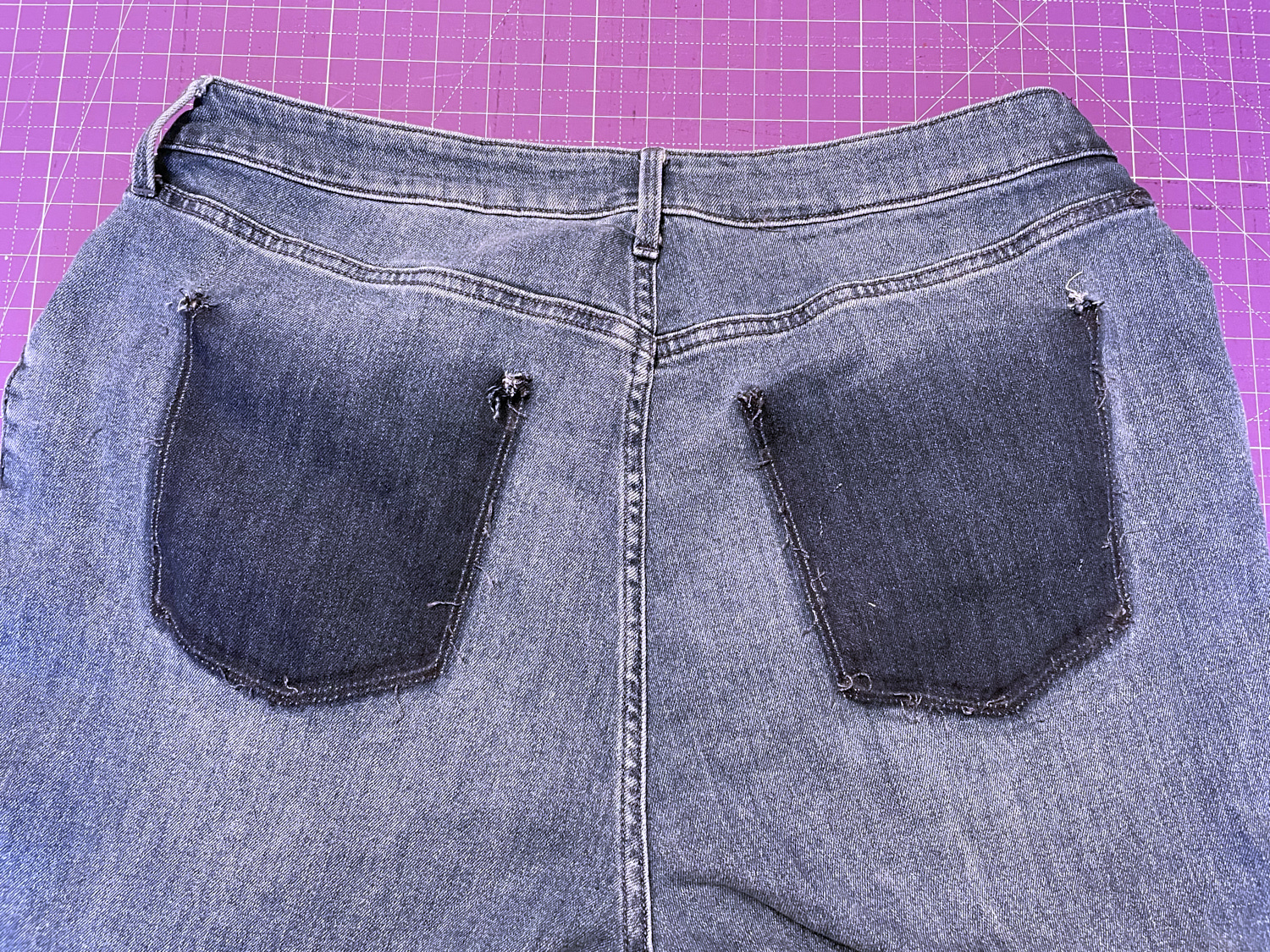
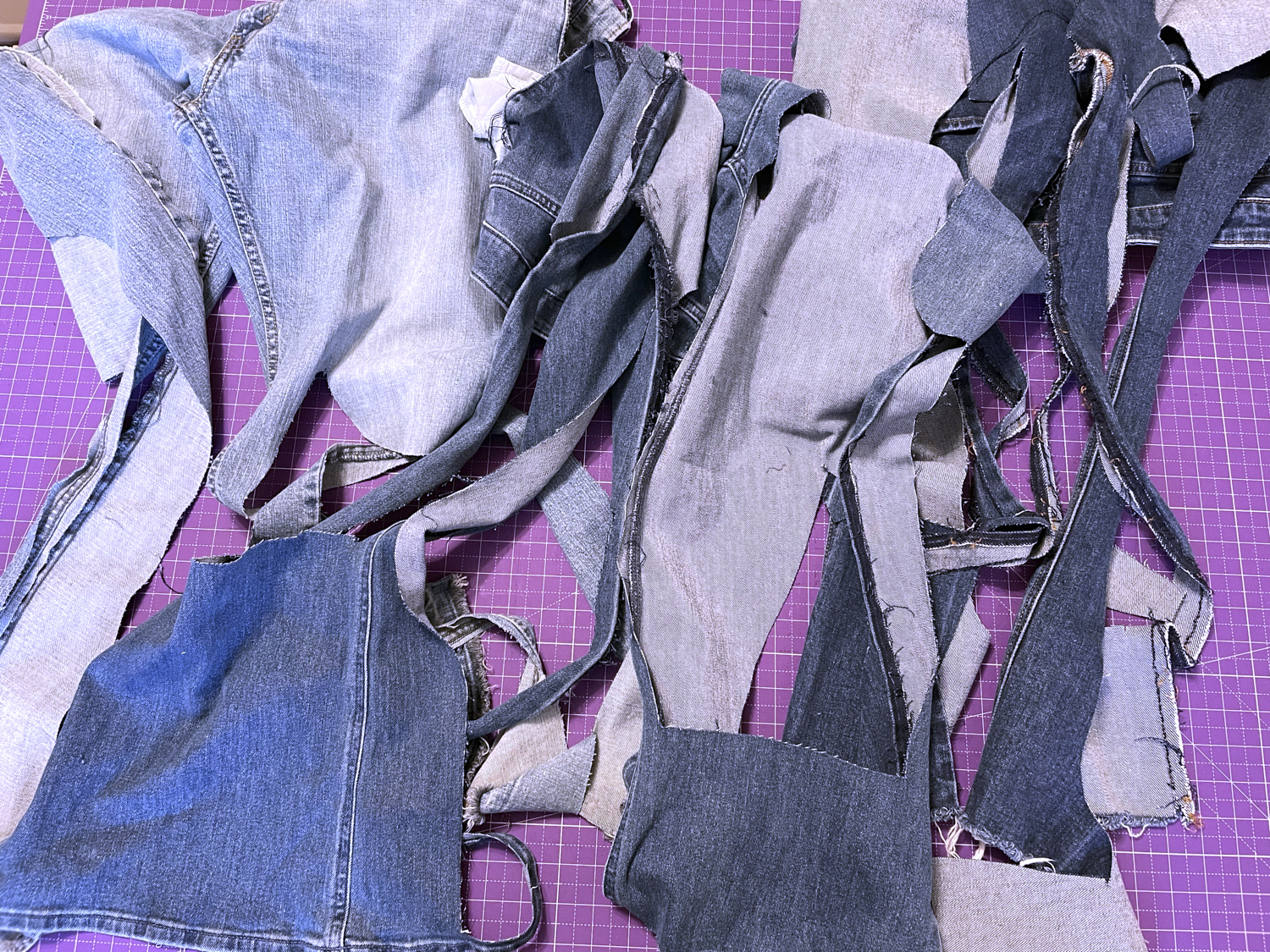
Rather than using the pocket design included in the pattern, I decided to use the rear pockets from one pair of jeans. I carefully unpicked them and removed all the top stitching. Unpicking pockets from jeans is mostly easy as they are attached with a chain stitch that easily unravels – except for the corners, which are thoroughly attached with a bartack and require some effort and a bit of elbow grease to remove. I ended up using most of the legs of all three pairs of jeans. There is still a little bit of leg fabric and seat fabric that might be used for other projects that can use smaller pieces.
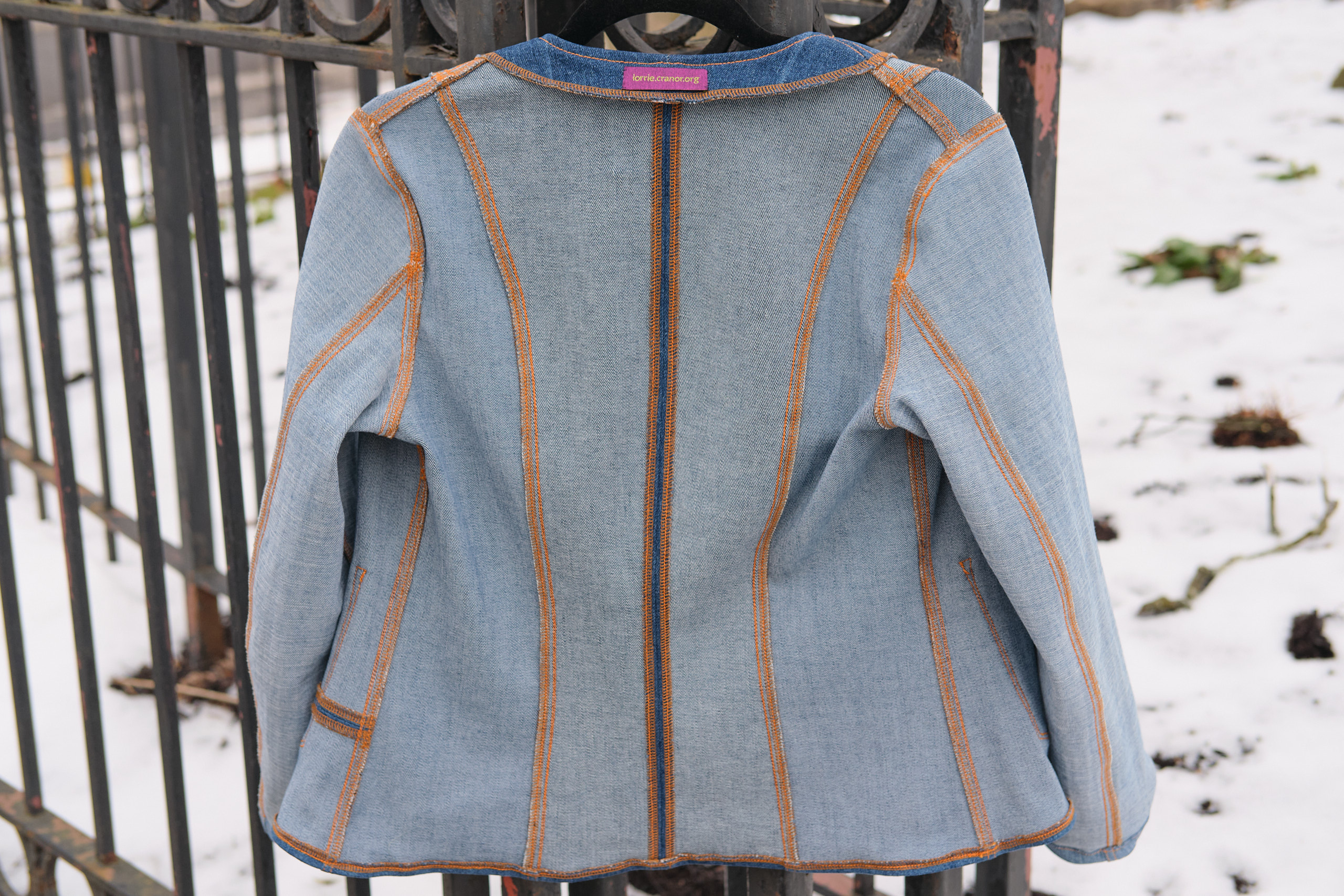
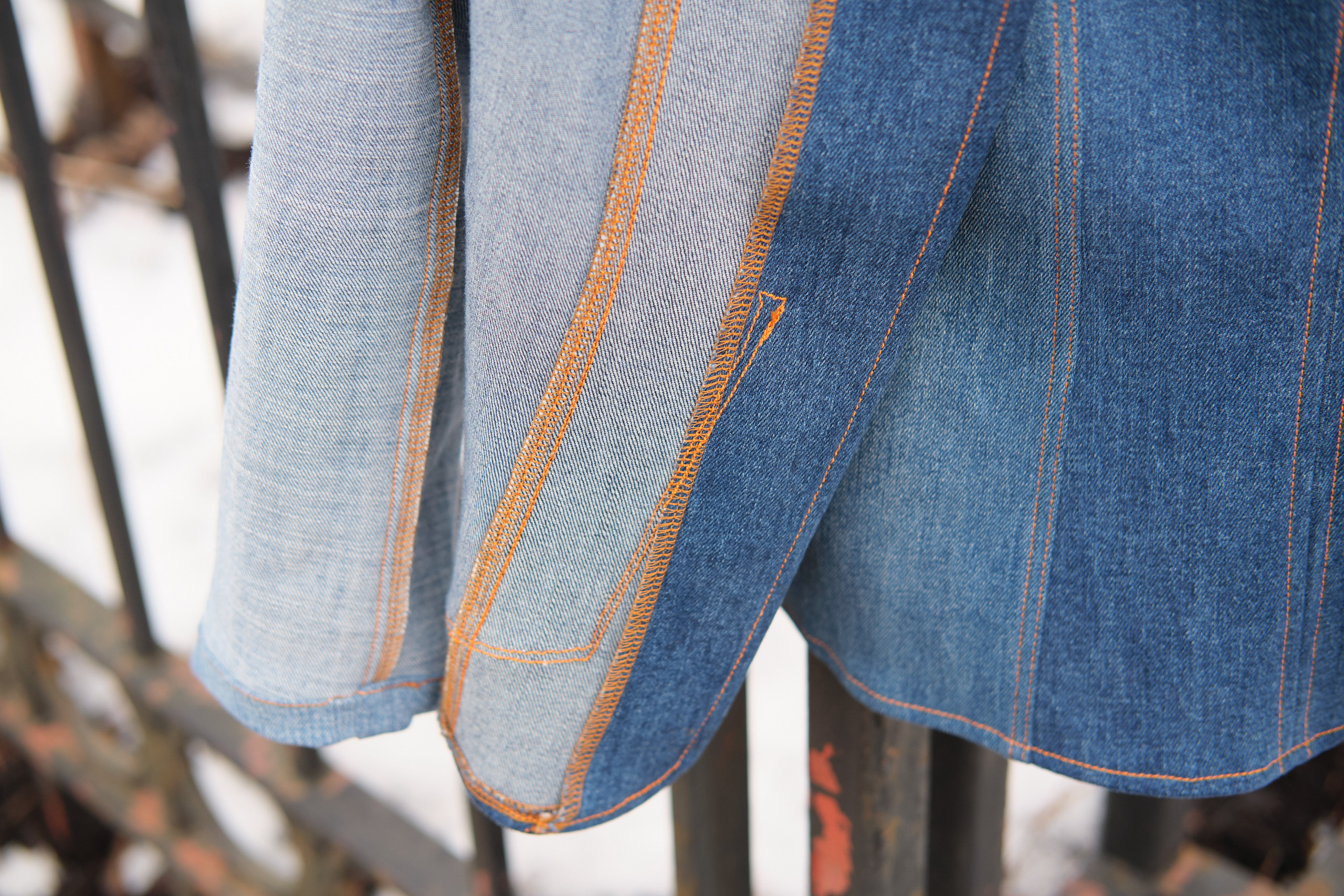
I also spent some time studying the stitching on different brands of jeans and denim jackets to see what color top stitching thread is used and where the top stitching is placed. I also read some blog posts on jeans anatomy. Some jeans match the top stitching to the denim color, others use a light yellow gold, and still others a more orangy gold. I’m sure there are other variations too. I observed that most jeans top stitching is done in two parallel lines, and generally as a chain stitch. Of course, it can’t be done everywhere because once you close both sides of a pant leg or sleeve, it is no longer possible to topstitch. Thus, one side is topstitched while the leg or sleeve is still open and the other side doesn’t get topstitched. I noticed that jackets don’t usually have topstitching on the side seams, but there is no practical reason not to do it so I decided to do it anyway.
I threaded my sewing machine with 30 weight polyester topstitching thread in a golden orange color that I thought would nicely “pop” against the blue denim. After some tests on denim scraps, I decided I would use the topstitching thread for piecing as well so as to avoid lots of thread changes. I set a slightly longer-than-normal stitch length of 3. I did not opt for chain stitching as that would have required lots of resets on my serger. I found I could achieve the parallel topstitching lines by stitching very close to the seam with my edge foot with the needle shifted 3 clicks, and then a quarter inch over using my quarter-inch quilting guide foot. I threaded the serger with four spools of regular polyester overlocking thread in a similar color as the topstitching thread.
The pieces of the jacket were easy to sew together and the topstitching looked awesome. It took a while as I stitched most seams four times: first I joined the fabric with a 3/8-inch seam allowance on my sewing machine, then I cleaned up and overlocked the edges (without trimming fabric, just stray threads) on my serger, then pressed the seam with steam, then I sewed the two parallel lines of topstitching. It was a lot of work, but also somewhat meditative to sew.
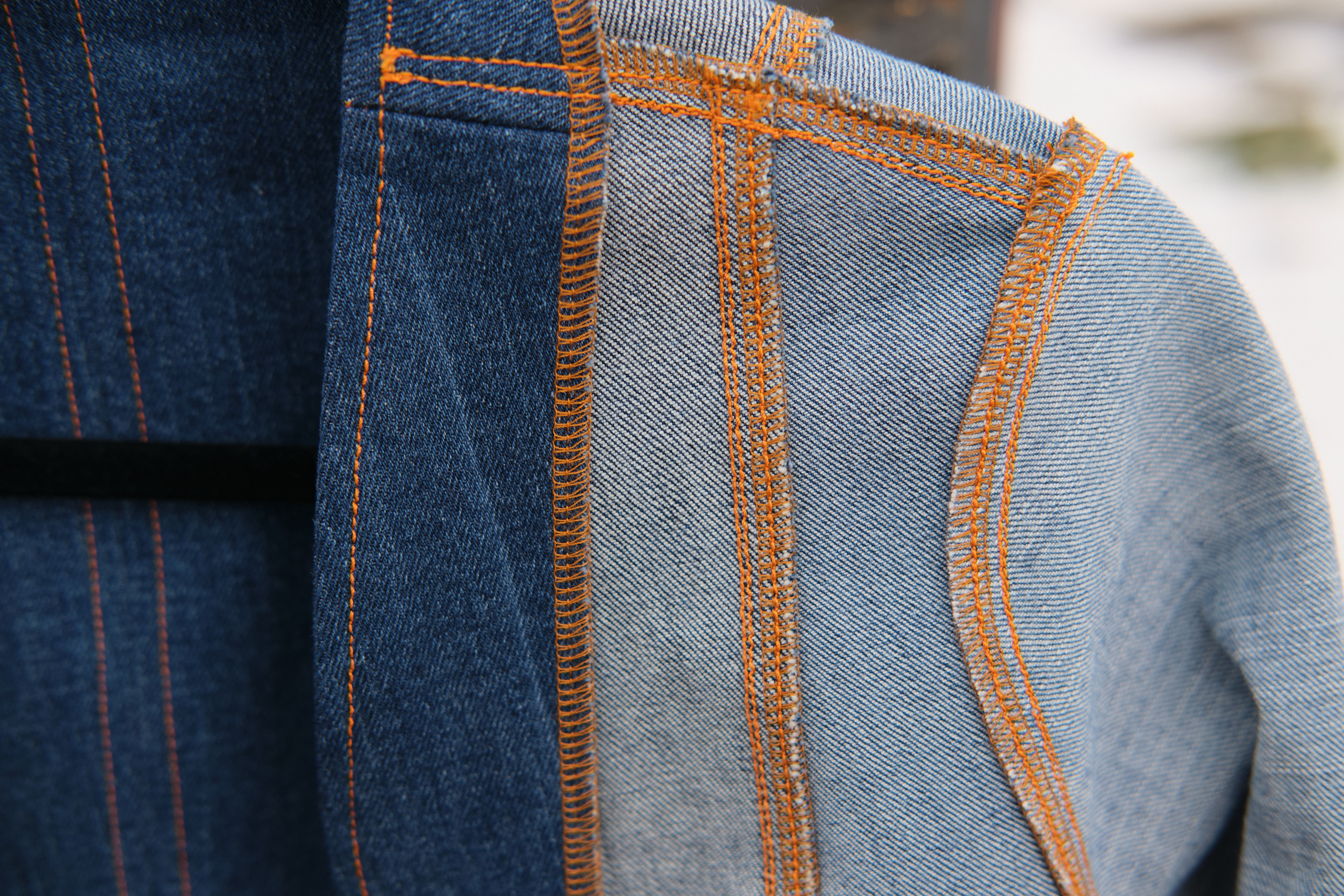
The facing pieces were more problematic. I debated whether the fusible interfacing was needed and also whether I should make the facing out of denim or a lighter fabric. I eventually opted for denim with the fusible interfacing, as recommended in the pattern instructions. I cut the facings as the pattern specified and did not make them wider as I had with the last two jackets. I had previously had trouble using non-stretch interfacing with stretchy ponte knit fabric. This time I didn’t think that would be a problem since I was using woven fabric. However, the denim I used has a bit of stretch. I don’t fully understand how it happened, but after fusing the interfacing onto the facings and sewing the three facing pieces together, the facings ended up slightly longer than the jacket front pieces they were supposed to attach to. I decided to sew them on anyway and figured I could trim the bottoms. But I noticed as I was sewing with the interfacing side on the bottom, the jacket was stretching to match the size of the facings. But I could see if I was not careful it would stretch too much. With some careful flipping and a bit of unpicking I was eventually able to get the jack front and facings to match each other. This was a complete trial and error approach and not the ideal way to do it. There are some very thick layers where the interfaced pieces join. I’m still not sure what approach would have been better, but probably not what I did. Nonetheless, it all came together, I was able to iron it all flat, and it looks fine. I top stitched across the shoulder seam, which helped hold the facing in place. The pockets also ended up holding the facing down and so far I haven’t had the problem I had with the ponte jackets where the facing doesn’t lie flat and requires gluing.
I followed the pattern steps a bit out of order and sewed the whole jacket together before I started working on the sleeves. The order really doesn’t matter and I just wanted to be able to try it on without the sleeves and see how it was coming together. The sleeves went together easily. I topstitched the outer sleeve edge. I was also able to easily set the sleeve heads into the armscye without any need for ease stitches. I sewed a 3/8-inch seam on my sewing machine and then overlocked the edges of the armscye. I then topstitched all the way around the armscye. I hemmed the sleeves by folding under 1/4 inch and then again at 3/4 inch and top stitched.
The final step was adding the pockets. First I topstitched the top edge of the pocket where they had been previously topstitched (but I had removed all the thread). I tried on the jacket and pinned the pockets where I wanted them. Then I took off the jacket and measured carefully and repositioned slightly so they would be symmetrical. I followed the dark line from where the previous top stitching had been and top stitched a pair of parallel lines around the pocket edges. Then I pressed everything again and I was done!
The topstitching thread is heavy, and a bobbin doesn’t hold a lot of it. I had to reload my bobbin twice. I also used a lot of steam when pressing my seams. I lost track of how many times I had to refill my iron. I managed to get through the whole project without breaking a needle, which was good because I was using my last topstitching needle.
I’m really happy with how this came out and I know I will wear this jacket a lot! I’m modeling it here with my Boo & Lu Blizzard dress, but it also looks great with pants, and even jeans.
Wow, I’ve sewn a lot of clothes! To make it easier to find my makes, I’ve put together this index page. You can look for garments by type, or by pattern maker. You can also use the search box in the upper right corner of this page to find more specific items.
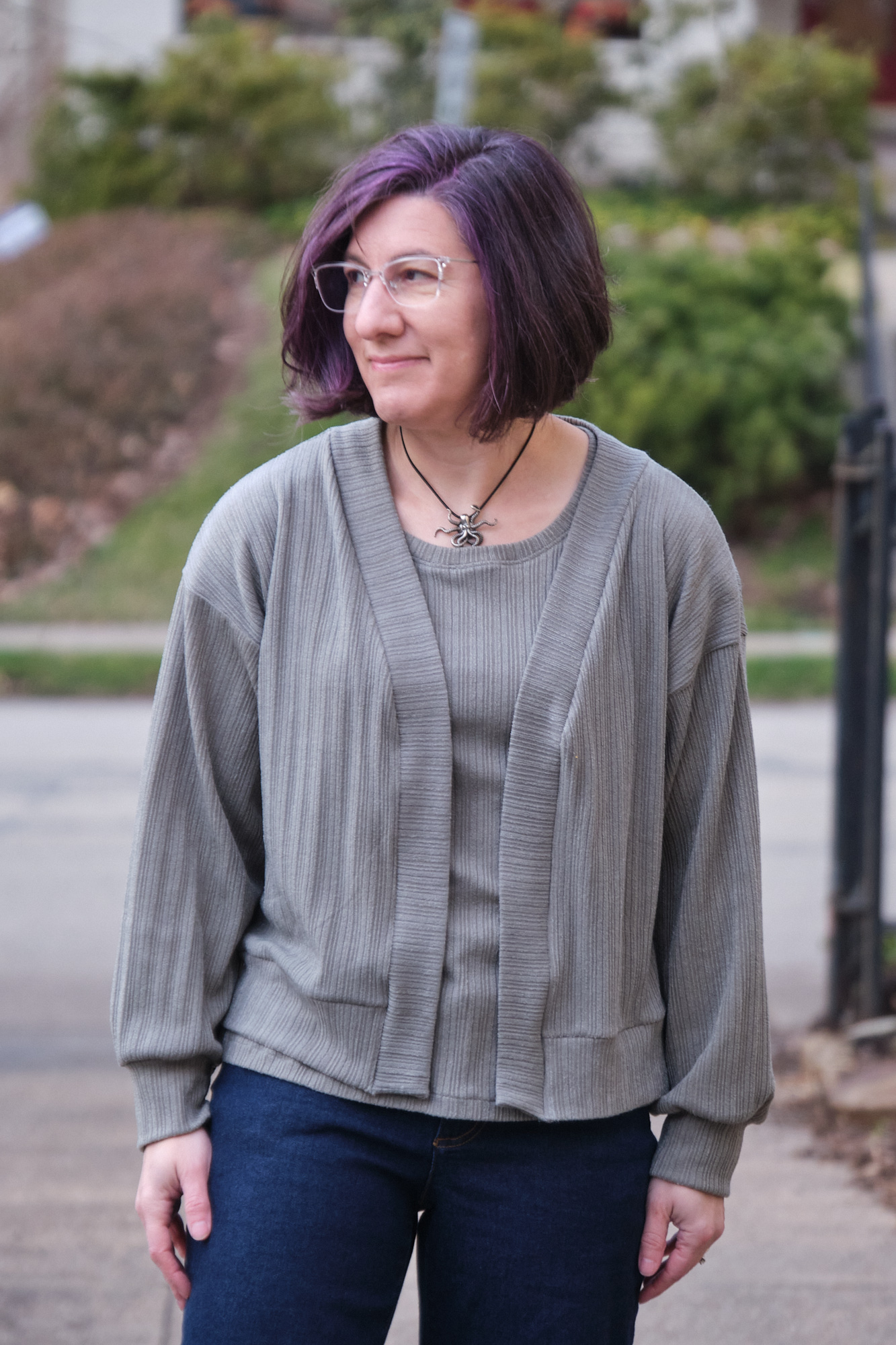
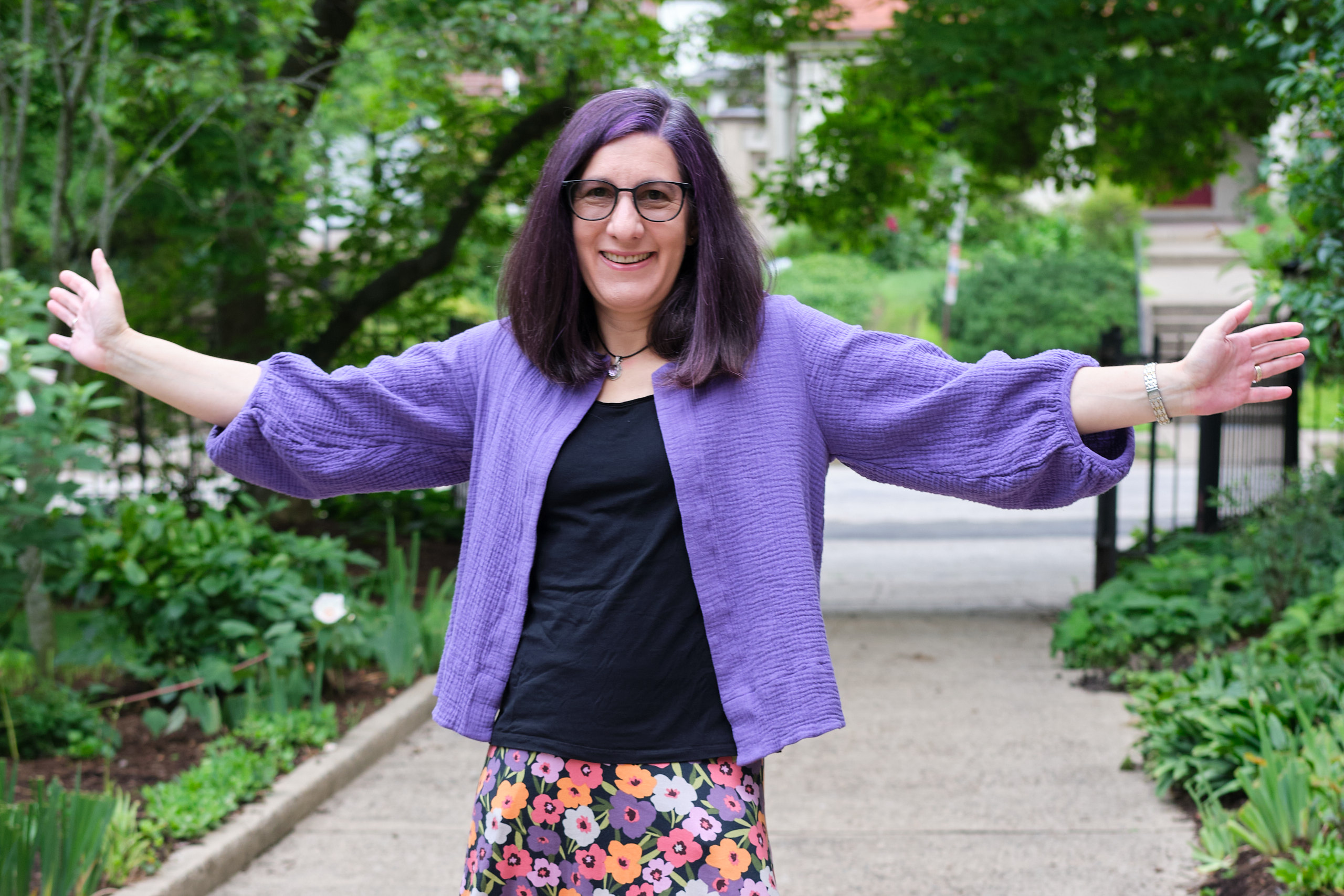
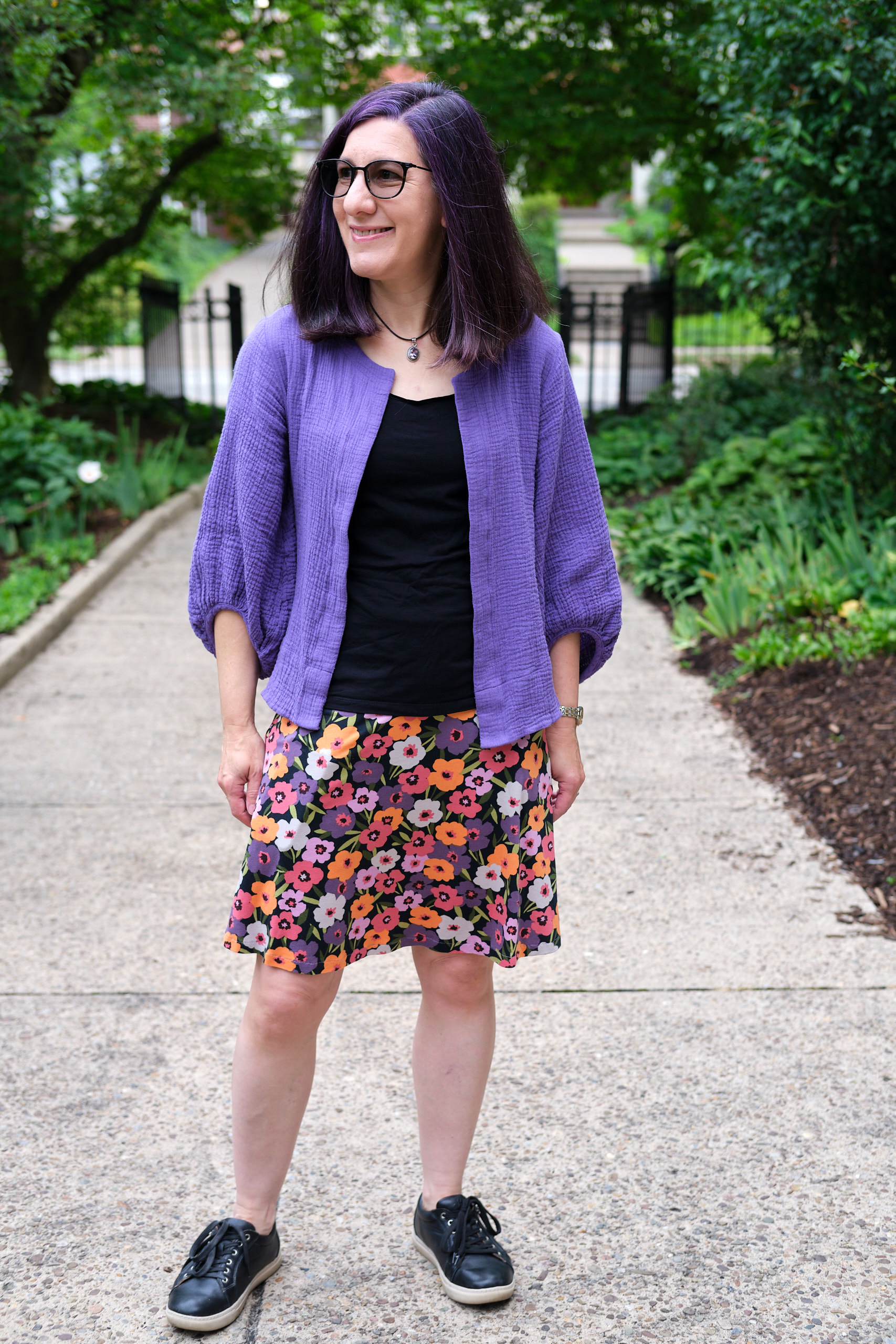
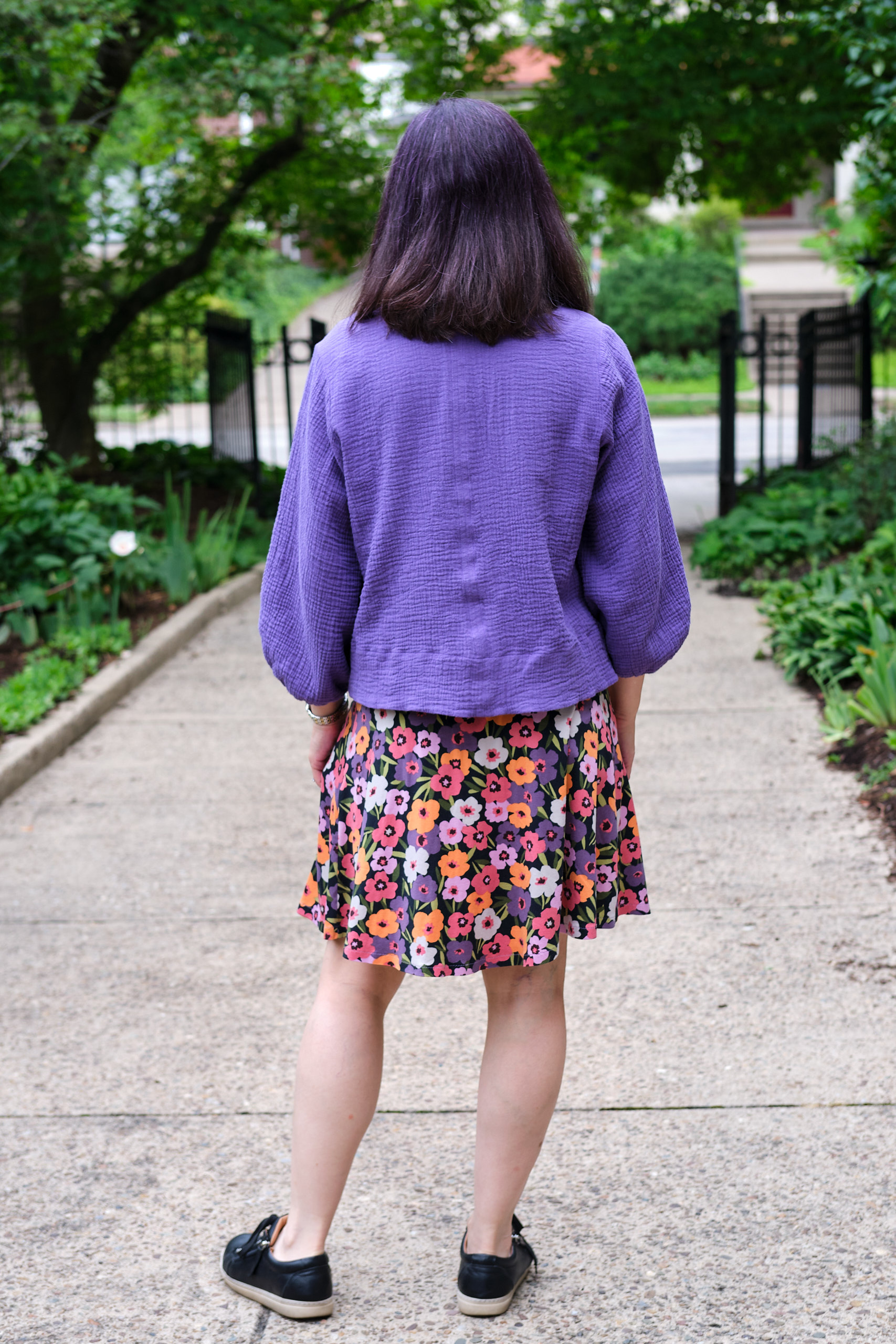
Pattern Emporium Be Mine Balloon Sleeve top with jacket hack, size AU8, 1.5 yards cotton double gauze, high neck, regular length, wide facing, no button loop, sloped-shoulder adjustment
I love the Pattern Emporium Be Mine Balloon Sleeve top pattern but find it difficult to wear under a sweater, and even if it fits, a sweater would hide the beautiful sleeves. So when I saw that sewist Livia Jonker-Yamada had hacked Be Mine into a jacket, I was excited to give it a try myself so that I could wear it over a shirt. I waited for Liv’s promised blog post with instructions, but it never came so I figured it out myself.
I started with the size AU8 pattern, which is one size smaller than the size chart recommends but this is an oversized pattern and sizing down worked well for me on my first Be Mine top. I could probably go down one more size for a more fitted top. I used the high neck option so that the neck opening would hit above a scoop-neck t-shirt. I added a half-inch sloped shoulder adjustment as I did on my first Be Mine. I decided to make this jacket from purple cotton double gauze since I still have a lot left even after making PE Vacation Vibes pants and a Sinclair Alva top and I thought it would coordinate with a lot of things in my wardrobe. The double gauze is a good weight for a light summer jacket, it has enough body to help the sleeves balloon, and once you’re done sewing it doesn’t need to be ironed. Having previously experimented with both ironing and not ironing gauze before cutting and sewing, I am firmly on team wash and iron now, despite the fact that ironing the wrinkles out of a couple of yards of double gauze is fairly tedious.
Most of the hack is pretty obvious: you follow the instructions for eliminating the back button, sew the back pieces together, and then you don’t sew together the two front pieces. The tricky part is what to do to have a nice clean finish on the jacket front openings. It looked to me like Liv split the neck facing and added vertical strips to it to face the jacket opening edges. I couldn’t work out exactly what she did where the front edges met the wide hem facing so I improvised a bit.
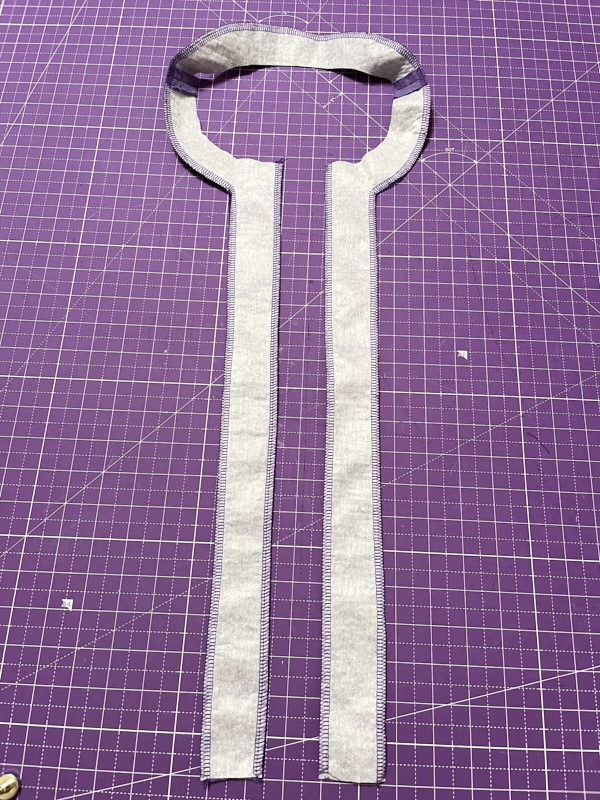
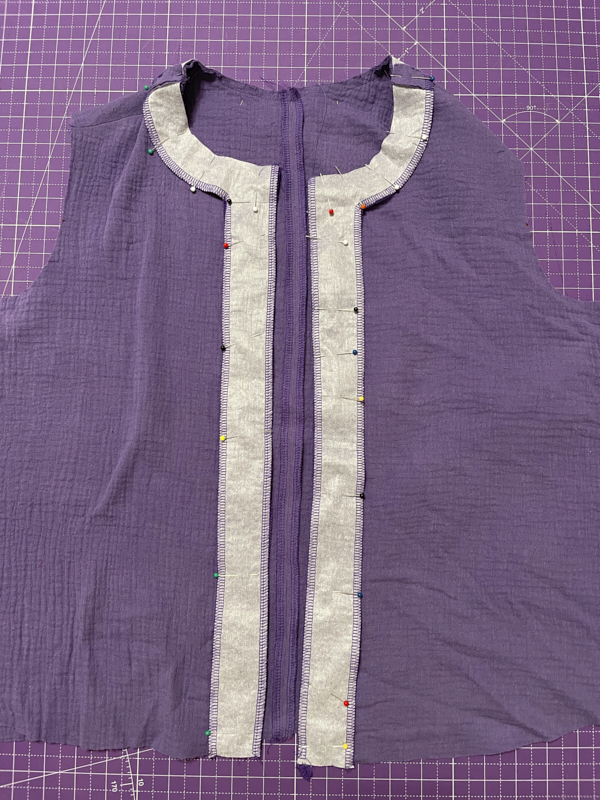
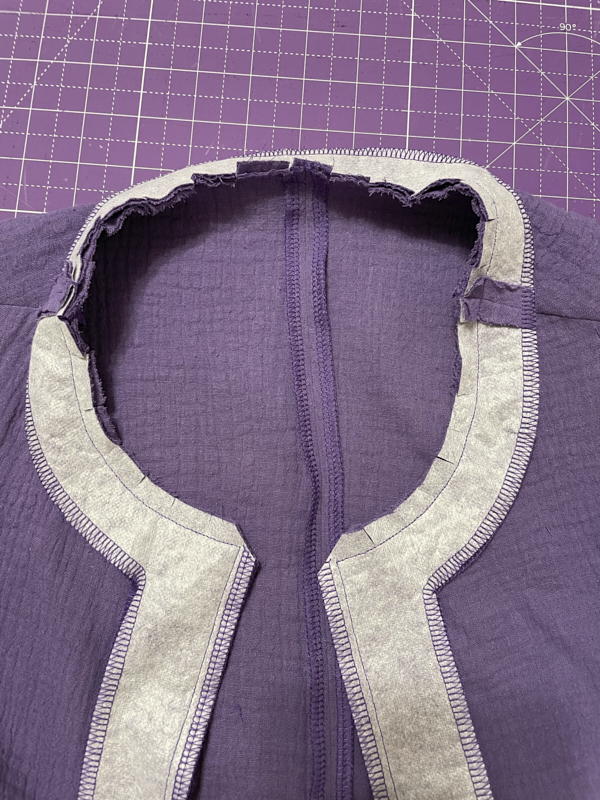
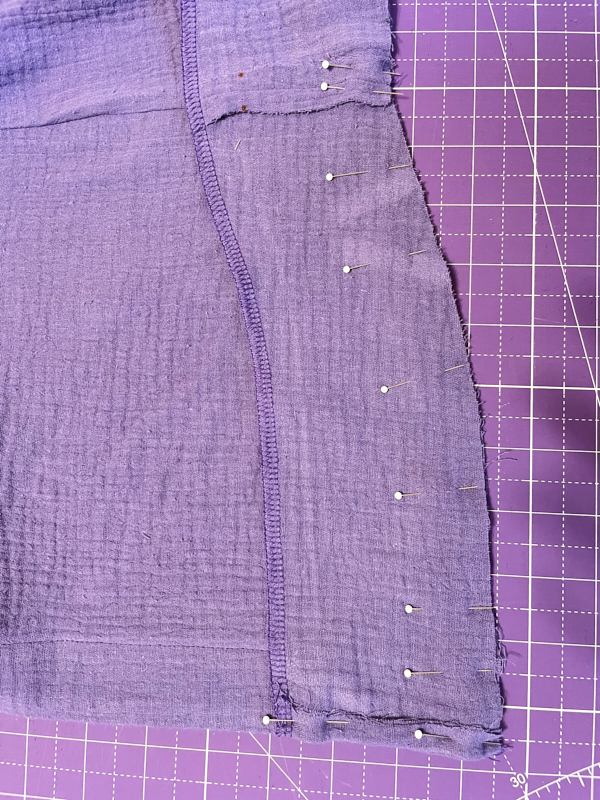
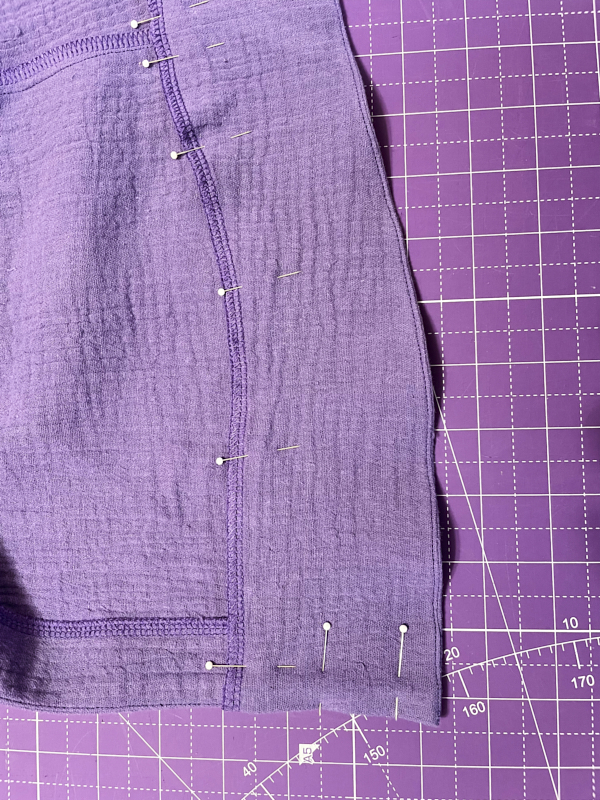
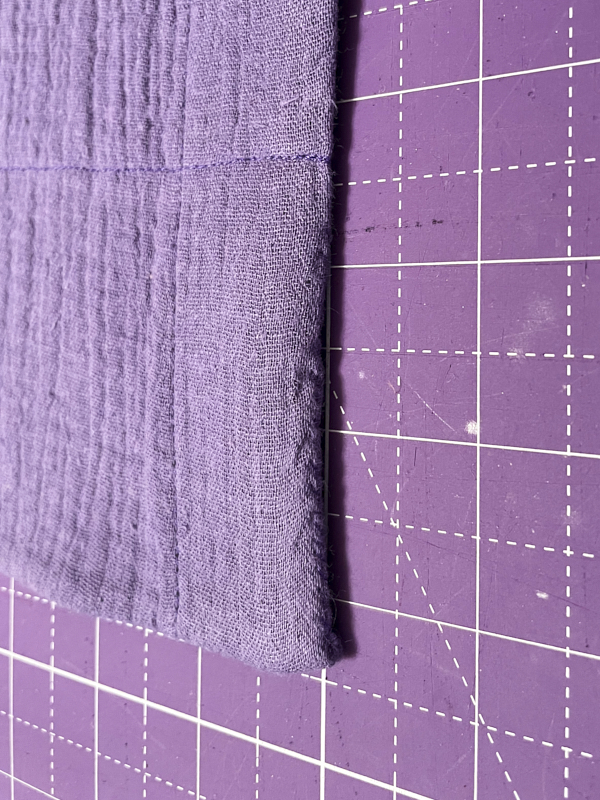
In the photos below you can see the split neck facing sewed to the merged back facing on its owned and pinned to the bodice. When I split the front facing, I made sure to add my 3/8-inch seam allowance to the split on both sides. The vertical facing is 1 3/4 inches wide and runs the length of the top. I decided to cut neck and vertical facing as a single piece to avoid the need for a joining seam. I used Heat n Bond Ultra Lightweight Fusible Interfacing and fused it to a piece of gauze before cutting out the facings. After I sewed the front and back facings together, I serged around the outer edges and also along the inner edge of the vertical pieces. That last bit of inner edge surging probably wasn’t necessary.
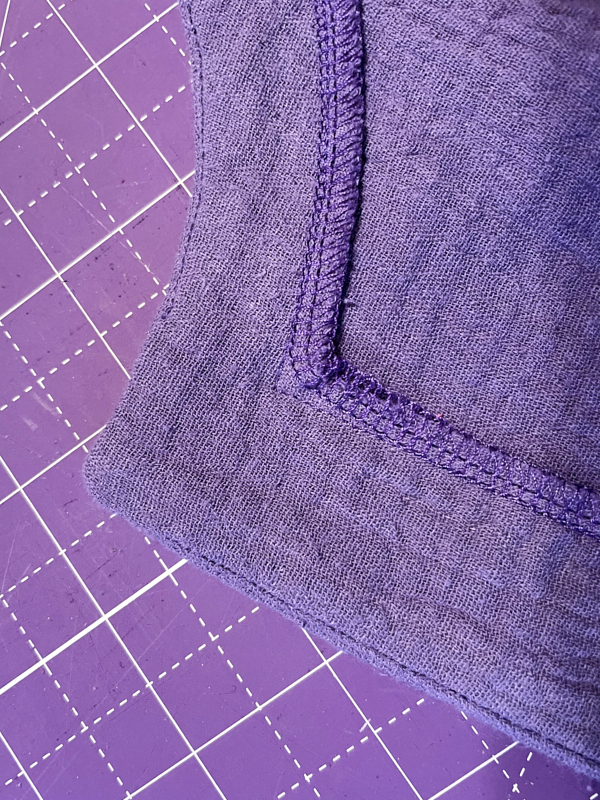
After I finished sewing on the neck and vertical facings I clipped the seam allowance around the neck as per pattern instructions and trimmed the corners to make it easier to turn them under. Then I understitched and top stitched according to the pattern instructions. It was impossible to understitch all the way into the corners, as you can see in this photo, but that didn’t seem to be a problem. I did the topstitching all in one go, from the bottom, up one side of the front, around the neck, and back down the other side of the front, pivoting at the corners. I used an edge foot for all the top stitching and under stitching.
Then I added the sleeves (hand basting the sleeve bindings so the gauze would behave), closed up the sides, and turned to adding the wide bottom hem facing. I split the front hem facing piece in half, adding 3/8 inch seam allowances to the inside edge of each piece. Then I sewed the front hem facing pieces to the back hem facing pieces and serged the top edge. I pinned the facing to the bodice, folding in the seam allowance. I sewed everything together and understitched following pattern instructions. Then I top-stitched just below the serged edge at the top of the hem facing. Finally, I was left with the unsolved problem of what to do with the unstitched 3-inch edges where the hem facing meets the bodice on the jacket opening edges. I decided to whip stitch that closed by hand, which seemed to have worked well.
I decided not to add buttons as I rarely button jackets (and I’m still a bit afraid of button holes). I’ve recently read that tie-front tops are quite fashionable right now, so I thought about adding ties, but decided I was unlikely to actually tie them (or wear them fashionably without a shirt underneath), so I left the jacket with no closures. As a result, it was a little tricky getting the neck openings aligned for the photographs, but they mostly stay in place.
The jacket looked neat and crisp, but since I will never iron it again I threw it in the wash to see how it would look crinkled up. When I took it out it looked great except for the center back seam, which didn’t lie flat because I forgot to top-stitch the seam allowances in place. After a quick trip back to my sewing machine to topstitch, the jacket was complete. That was yesterday, and today I wore my new jacket to work with the PE Heartlight skirt that I sewed last summer. When the outdoor temperature cools down a little I expect I will wear it a lot with wide-leg pants.
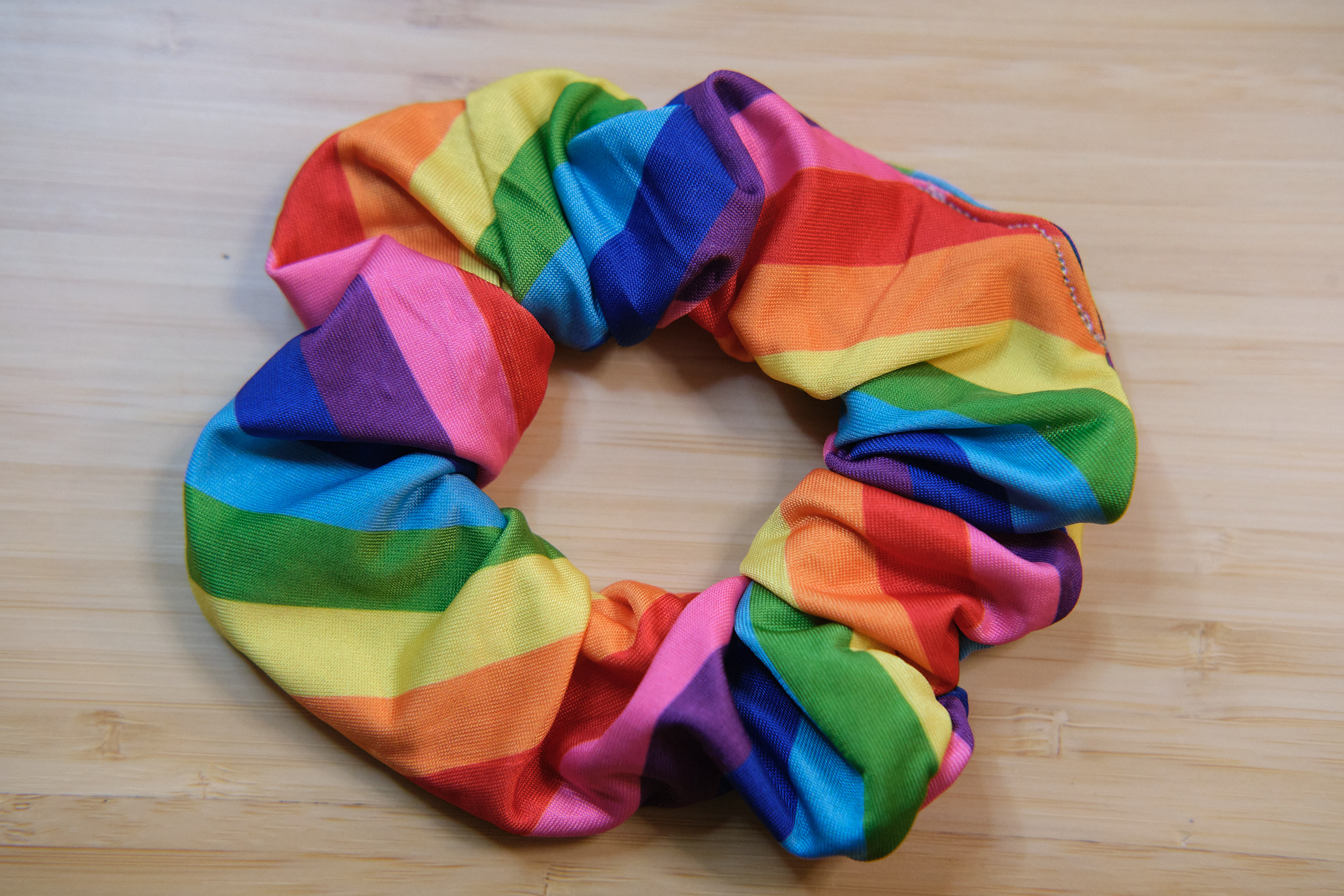
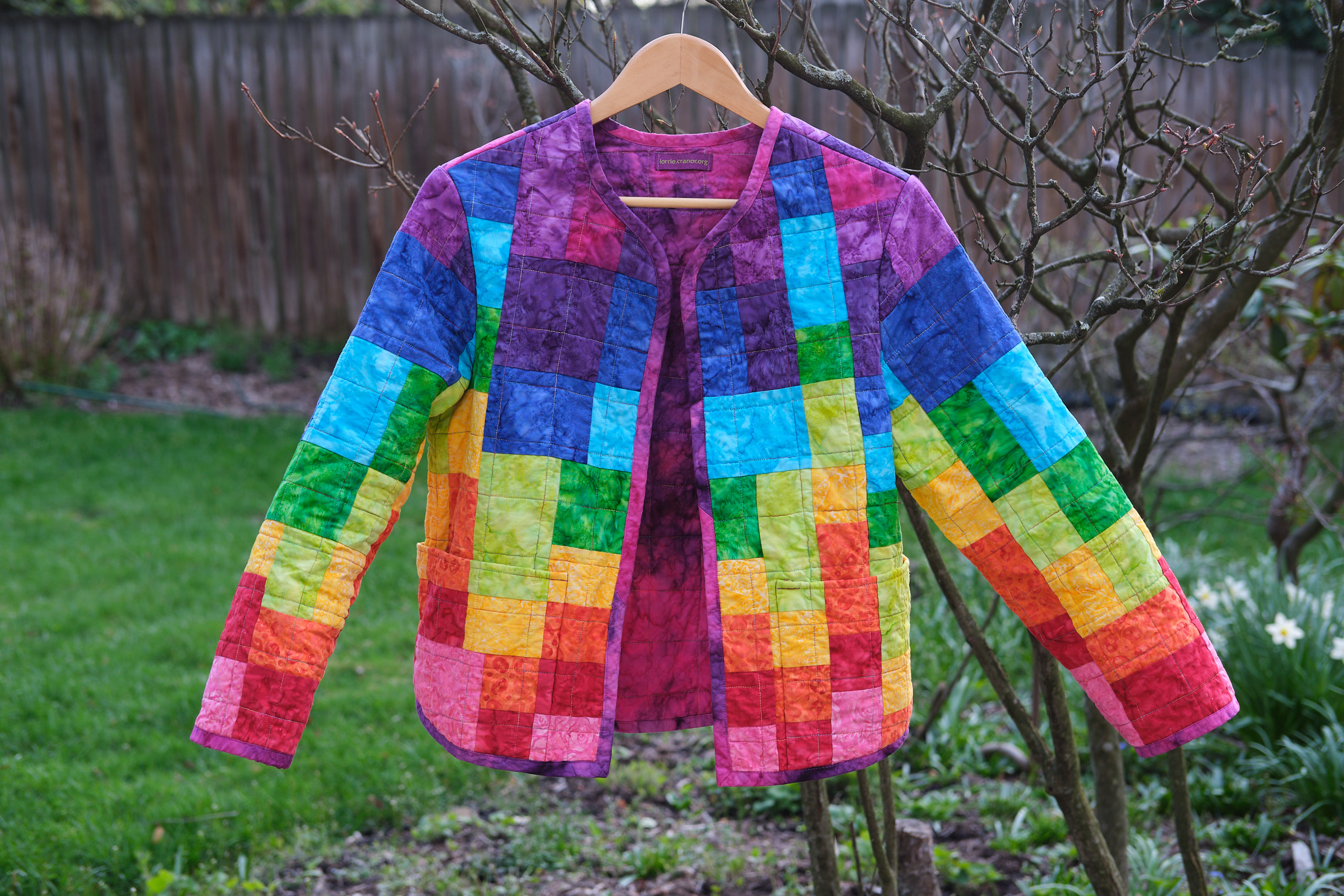
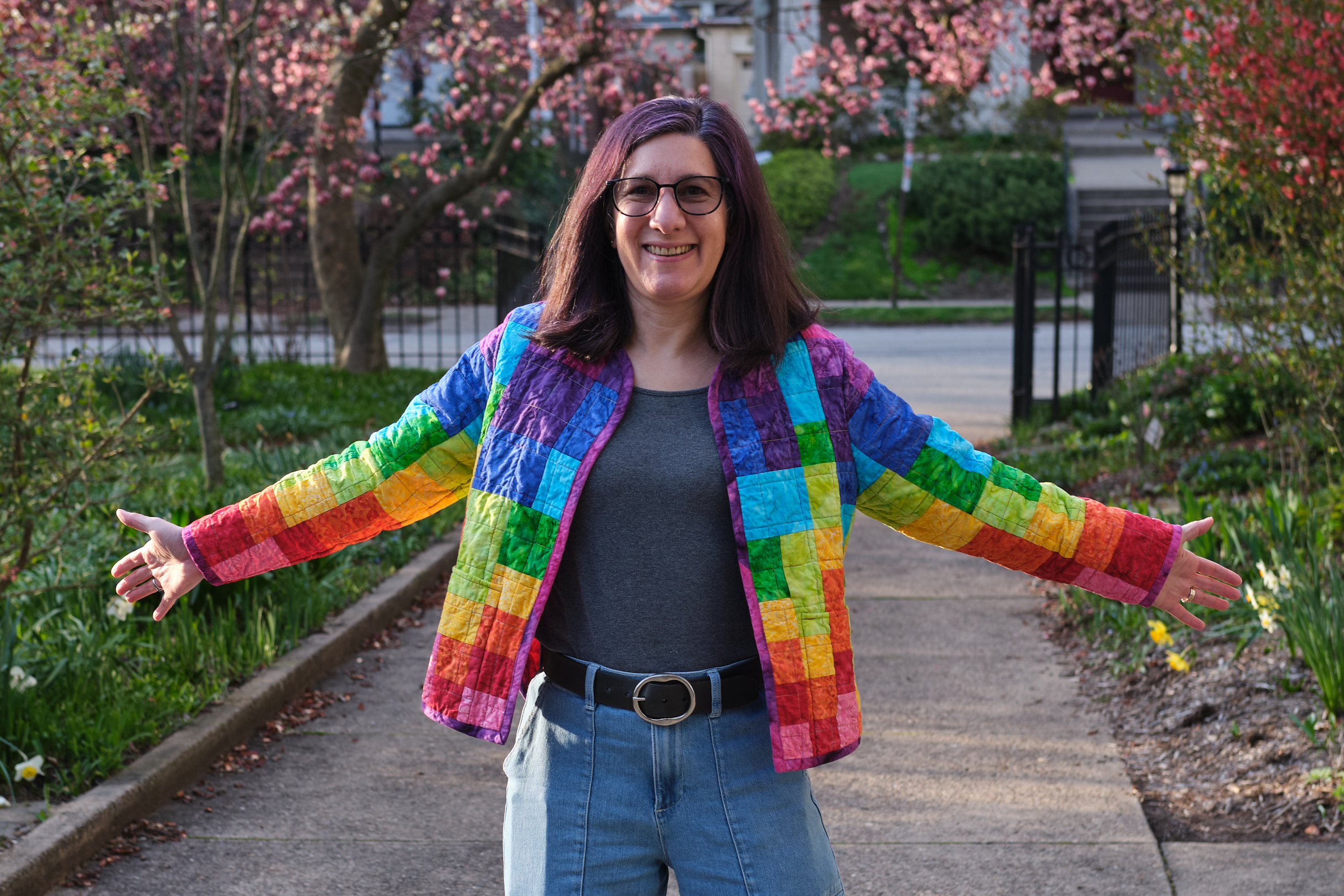
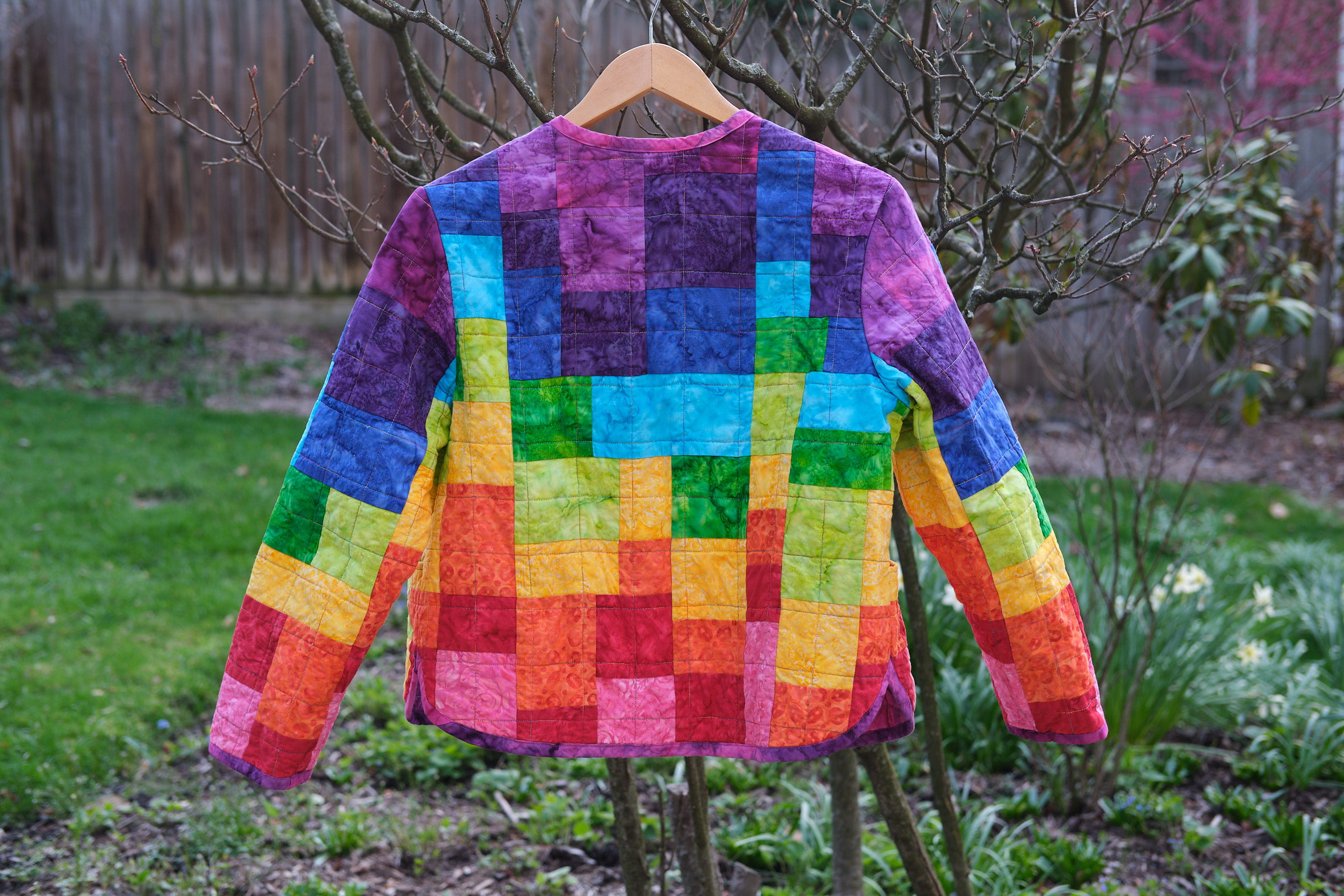
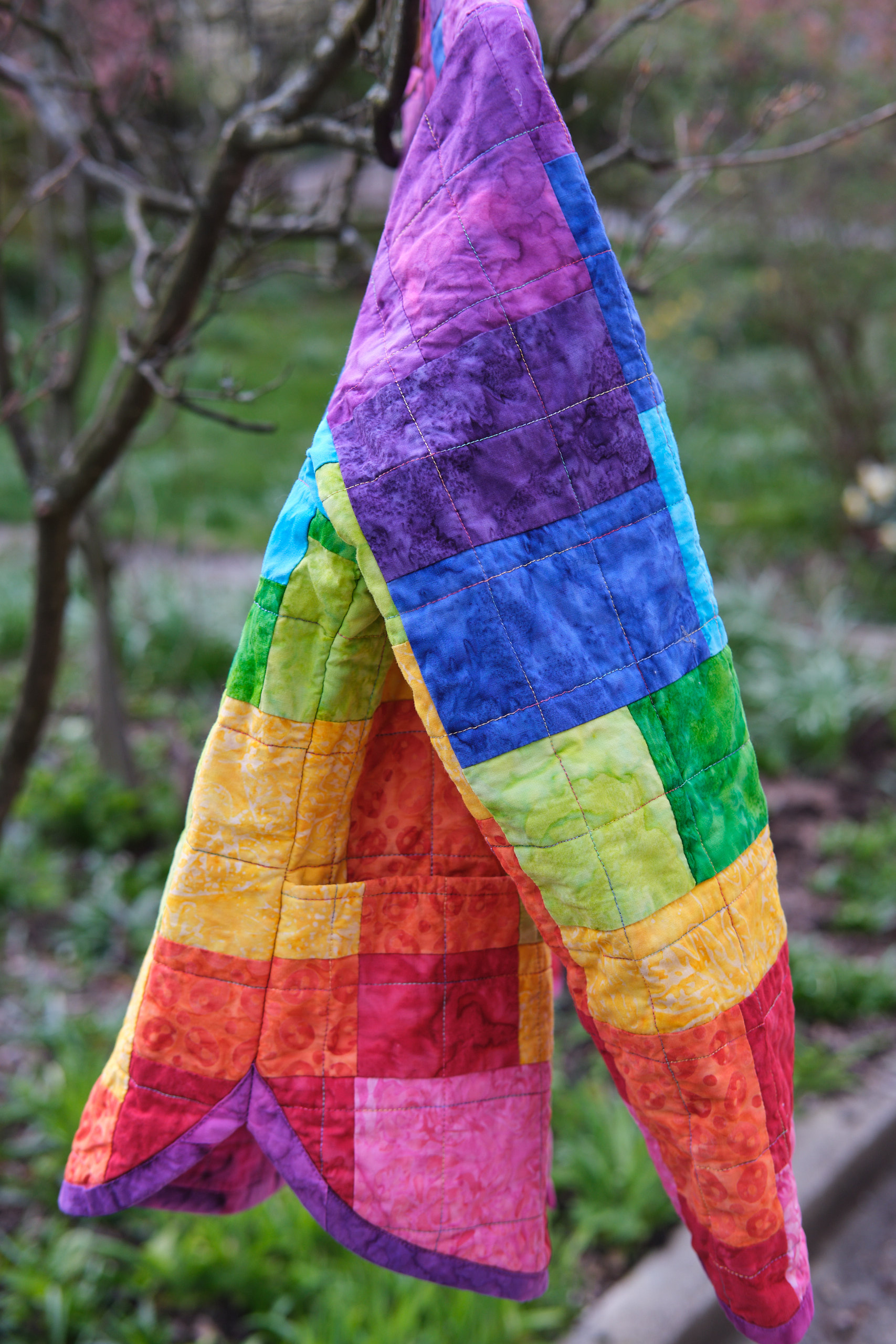
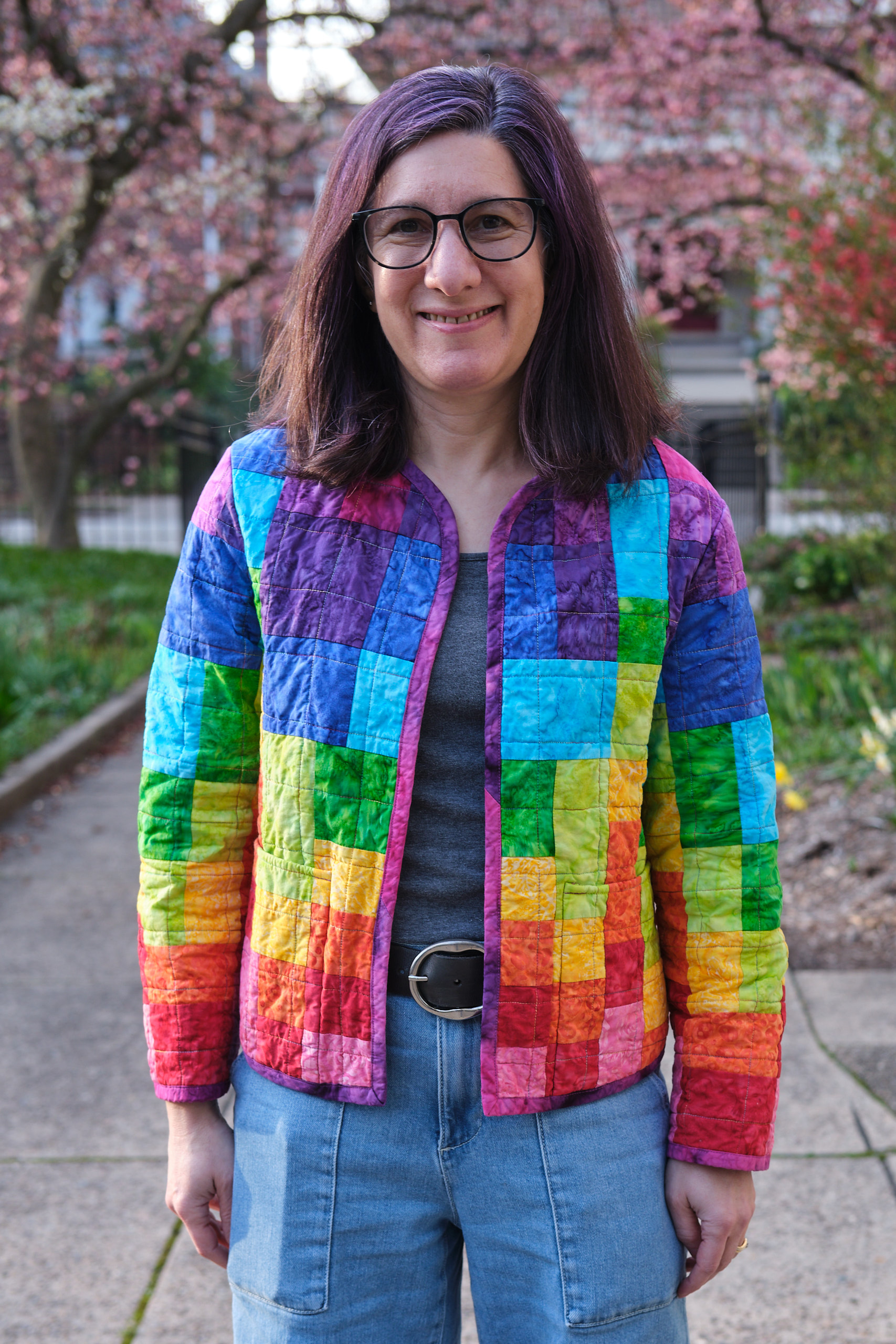
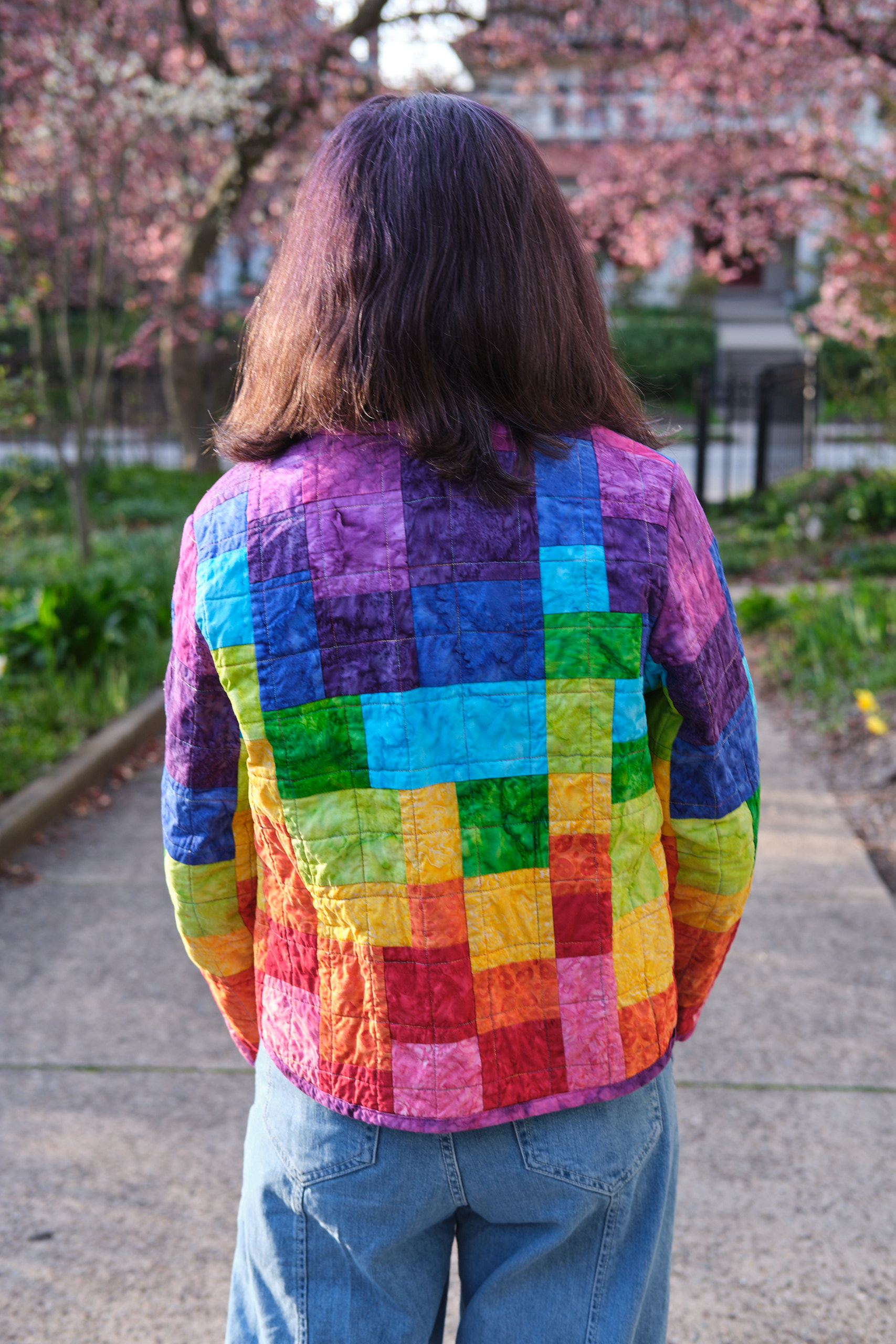
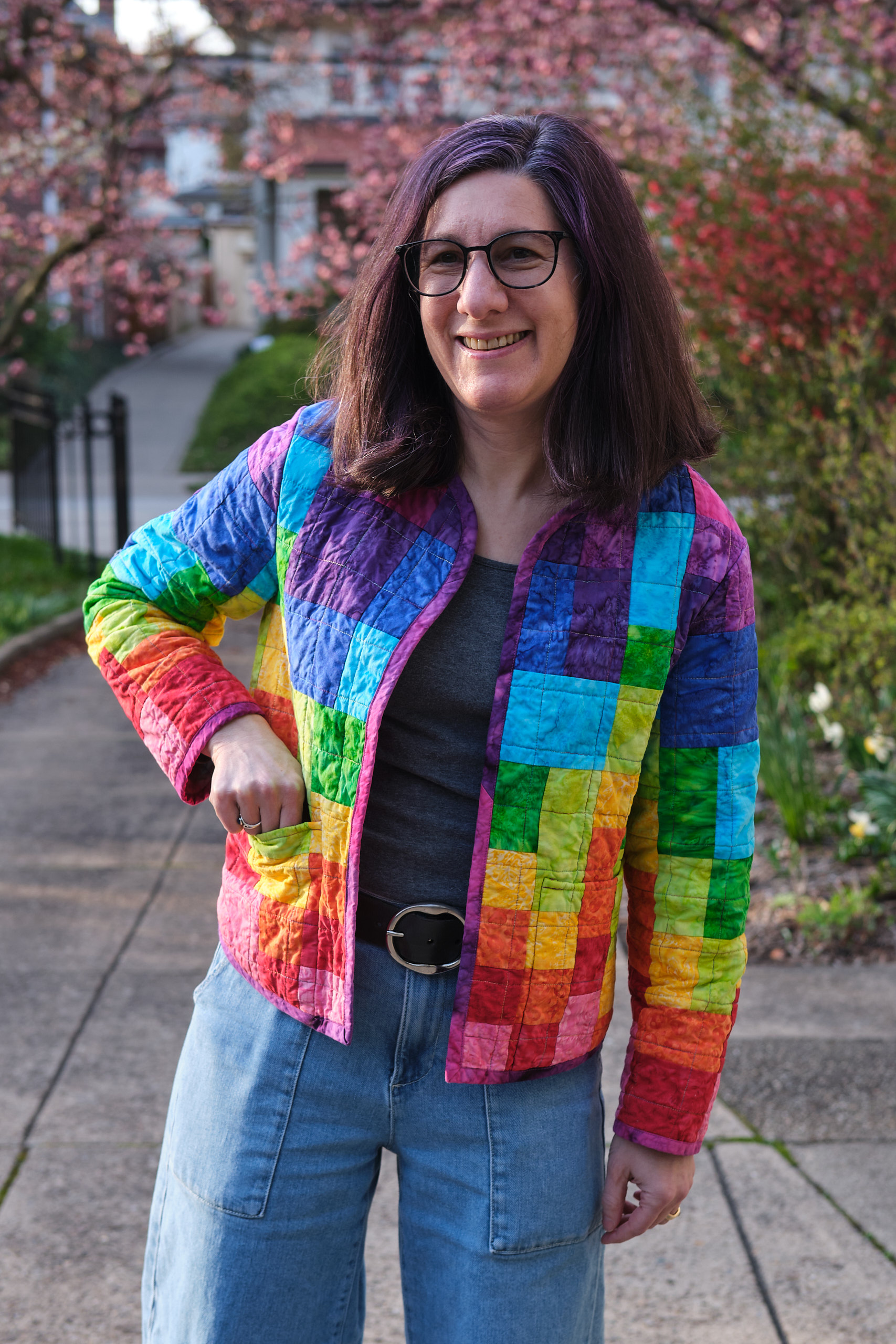
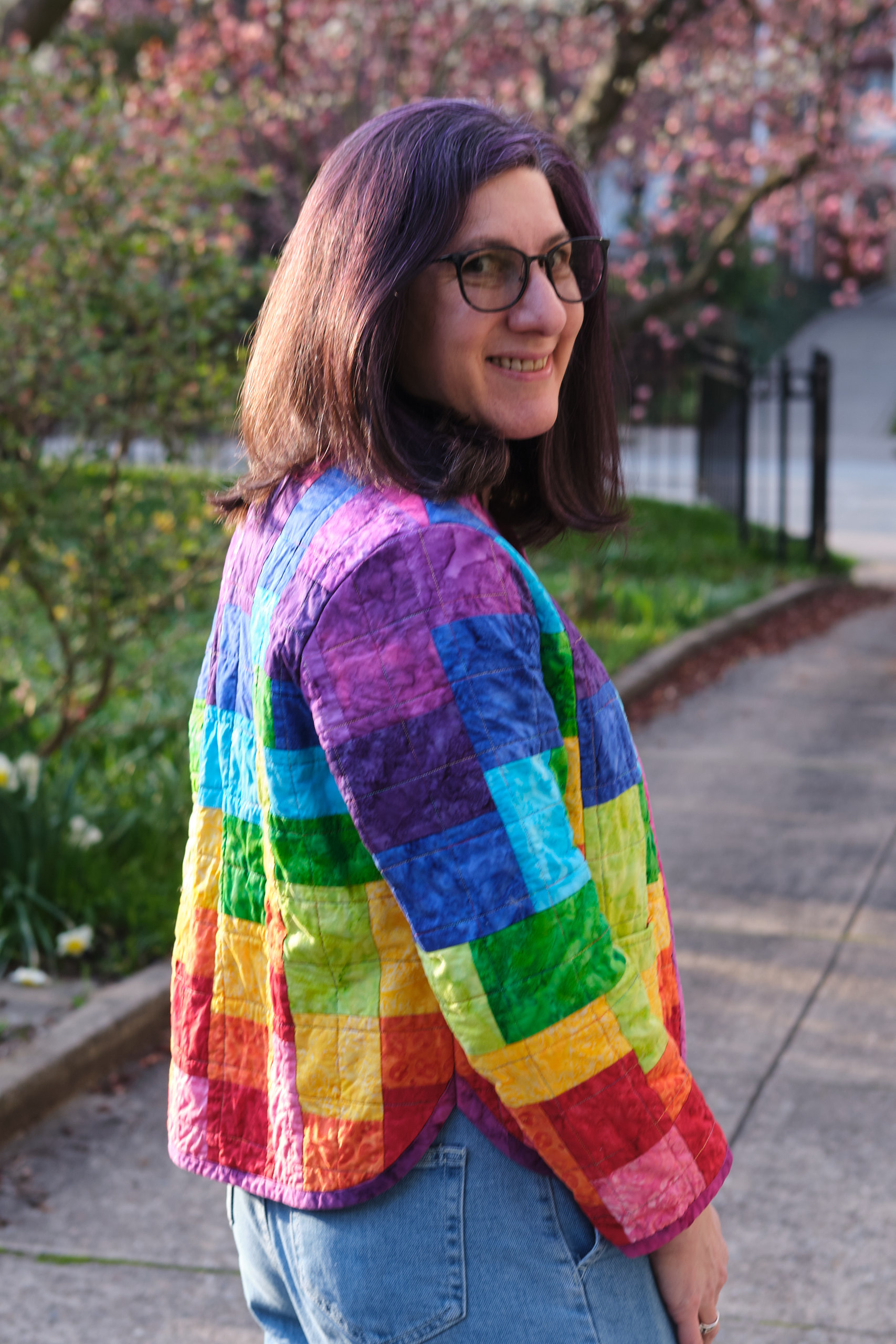
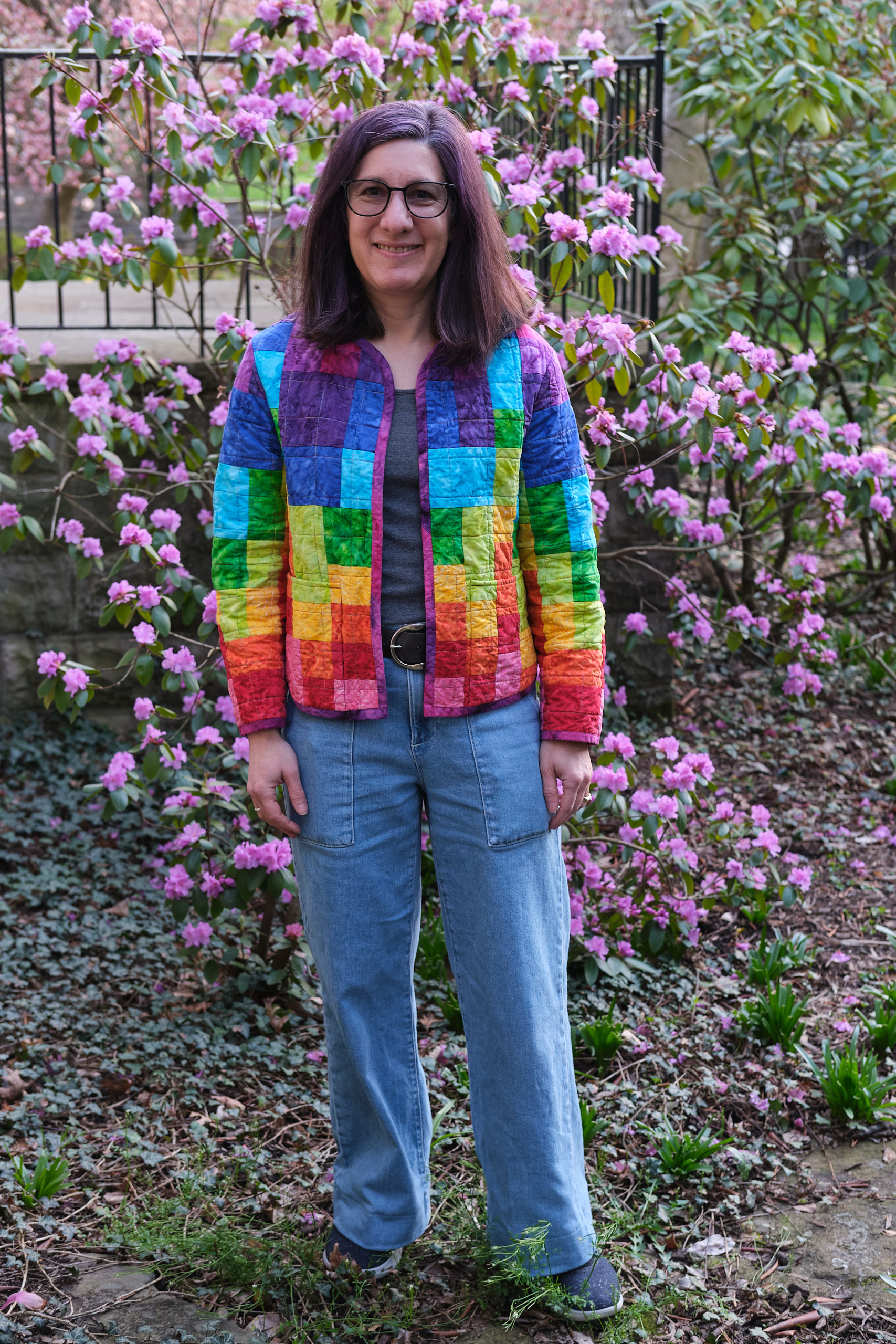
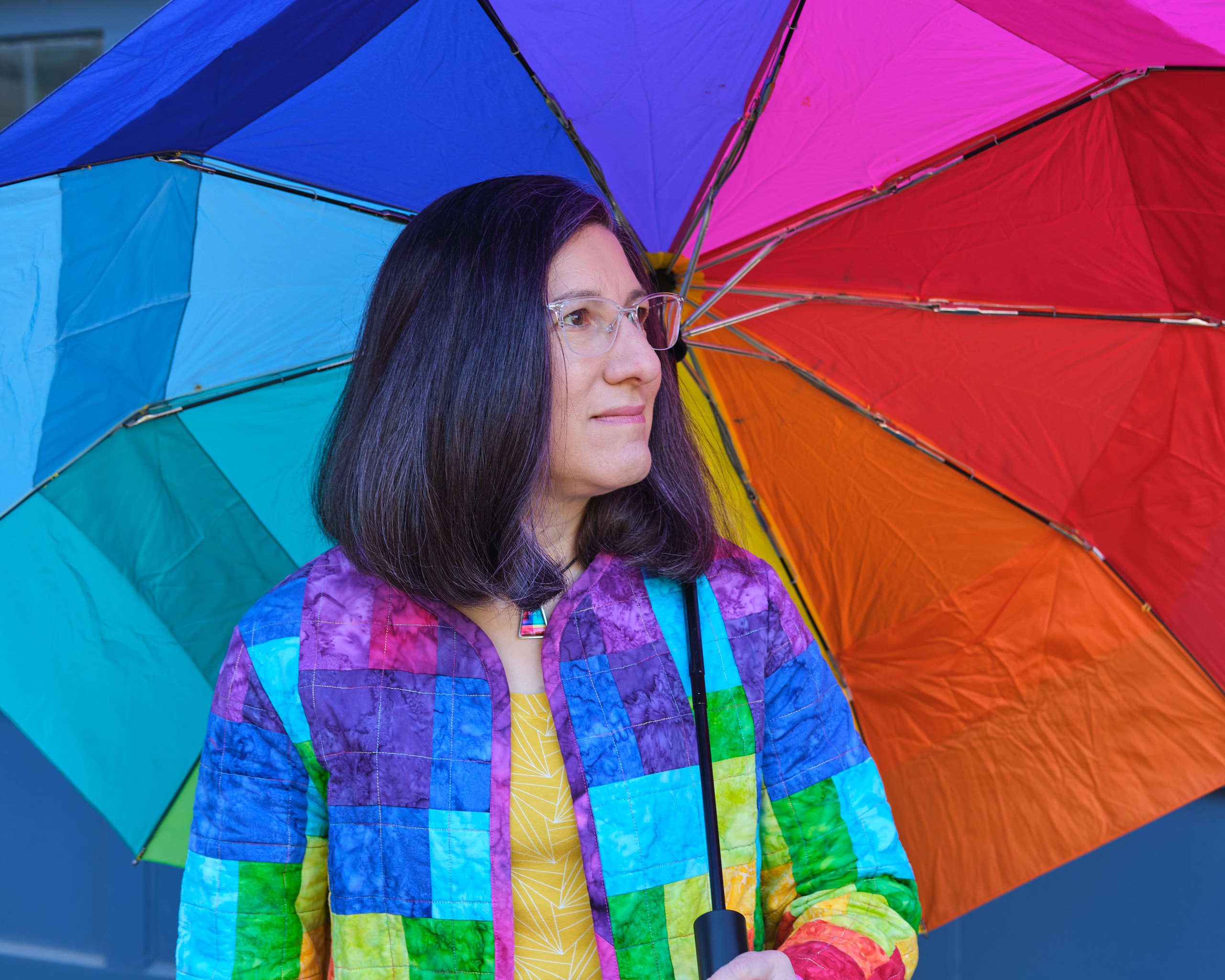
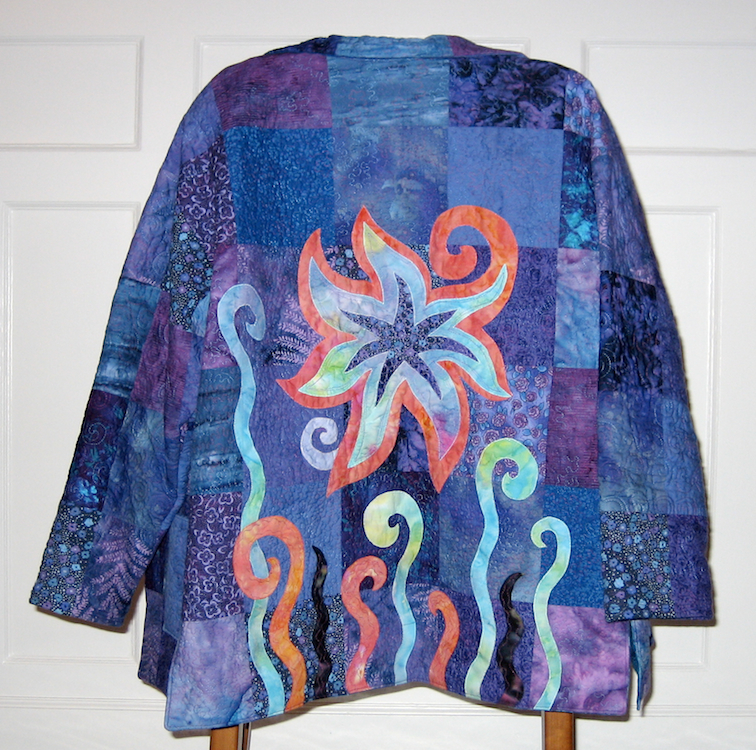
It’s been over 20 years since I last sewed a quilted jacket (see my first quilted jacket, made in 1999 and my second, made in 2003). Quilted jackets seem to be somewhat fashionable this year, and when I saw the Love Notions Coda Quilted Coat pattern I had to give it a try. I saw lots of people using pre-quilted fabric or turning thrifted quilts into Coda coats (some nice examples and tips here), but since I am a quilter, I decided to piece and quilt my own Coda (some nice examples and tips here). I spent hours asking the Internet to show me quilted coats, and finally settled on using a rainbow of bright batik fabric from my stash in a random-looking pattern of squares and rectangles that I designed. I was inspired by several of the quilted coats I saw, including Thread + Sprout‘s rainbow scrappy patchy jacket. Here’s my finished coat – yes it is very colorful and bright, but sometimes I need that! Now let me tell you all about how I made it.
I started with the size small Coda pattern and projected and cut out lining pieces from batik fabric in my stash. I then basted them together to check the fit of the coat. I decided to make a sloped shoulder adjustment, scoop out the back of the neck a bit, and shorten the sleeves by 2.5 inches. I considered shortening the whole coat since I am 5’2″ and it is drafted for someone 5’5″, but I decided I preferred it to be a little longer (and saw that many other sewists were lengthening their Codas). I could have left the sleeves as-is and cuffed them, but figured the quilt would be bulky so decided to shorten so I would not have to cuff.
Next I needed to decide what type of batting to use. I usually use cotton or fusible polyester cotton batting, but was hoping to make a lighter-weight jacket so looked to see what batting people recommended. I noticed that people who wanted a lighter batting often chose silk or bamboo. I ordered both from Battingsupersale.com (first time ordering from them and was quite pleased) and chose their Simply Bamboo batting because it seemed softer and drapier than the silk.
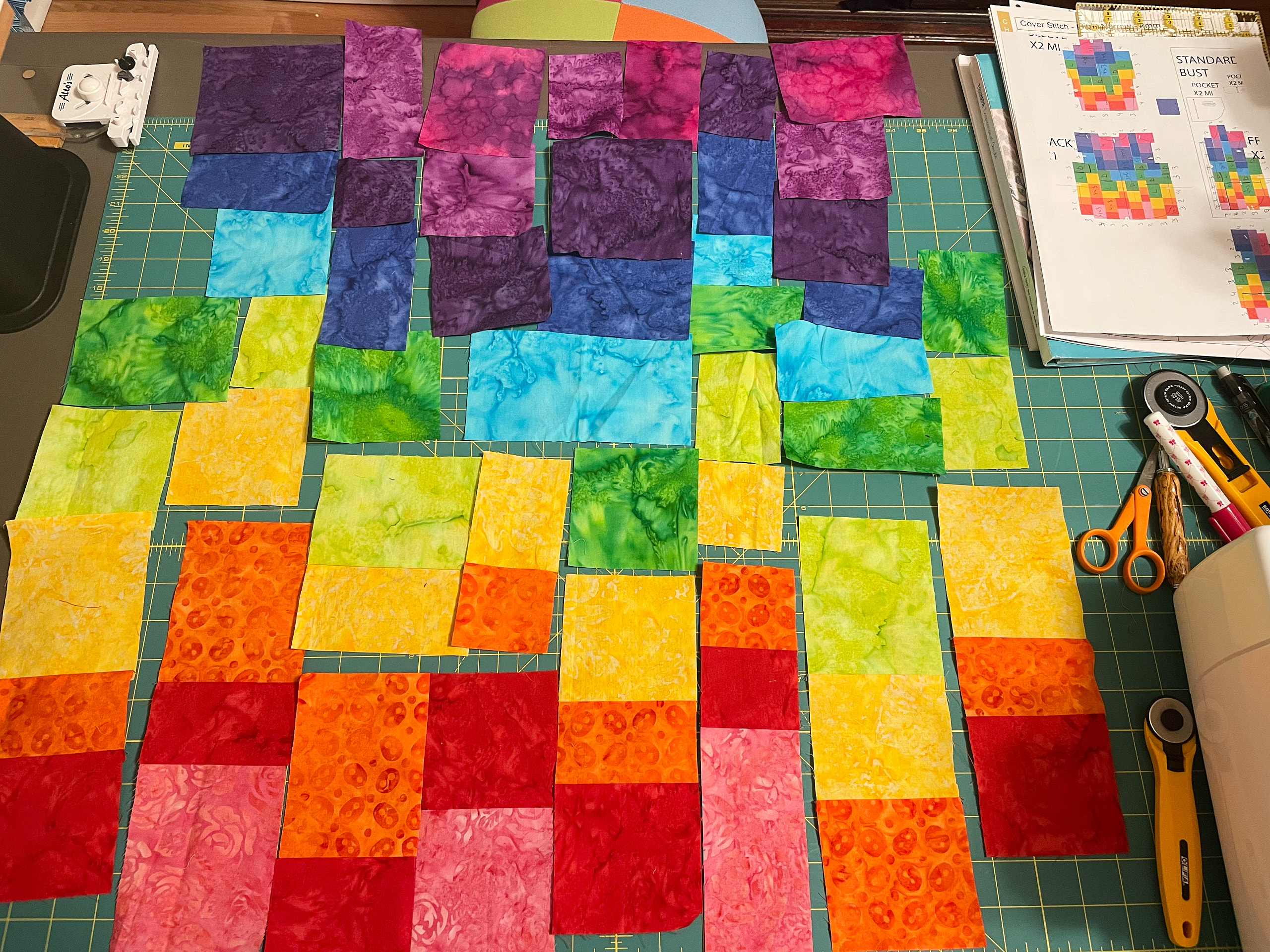
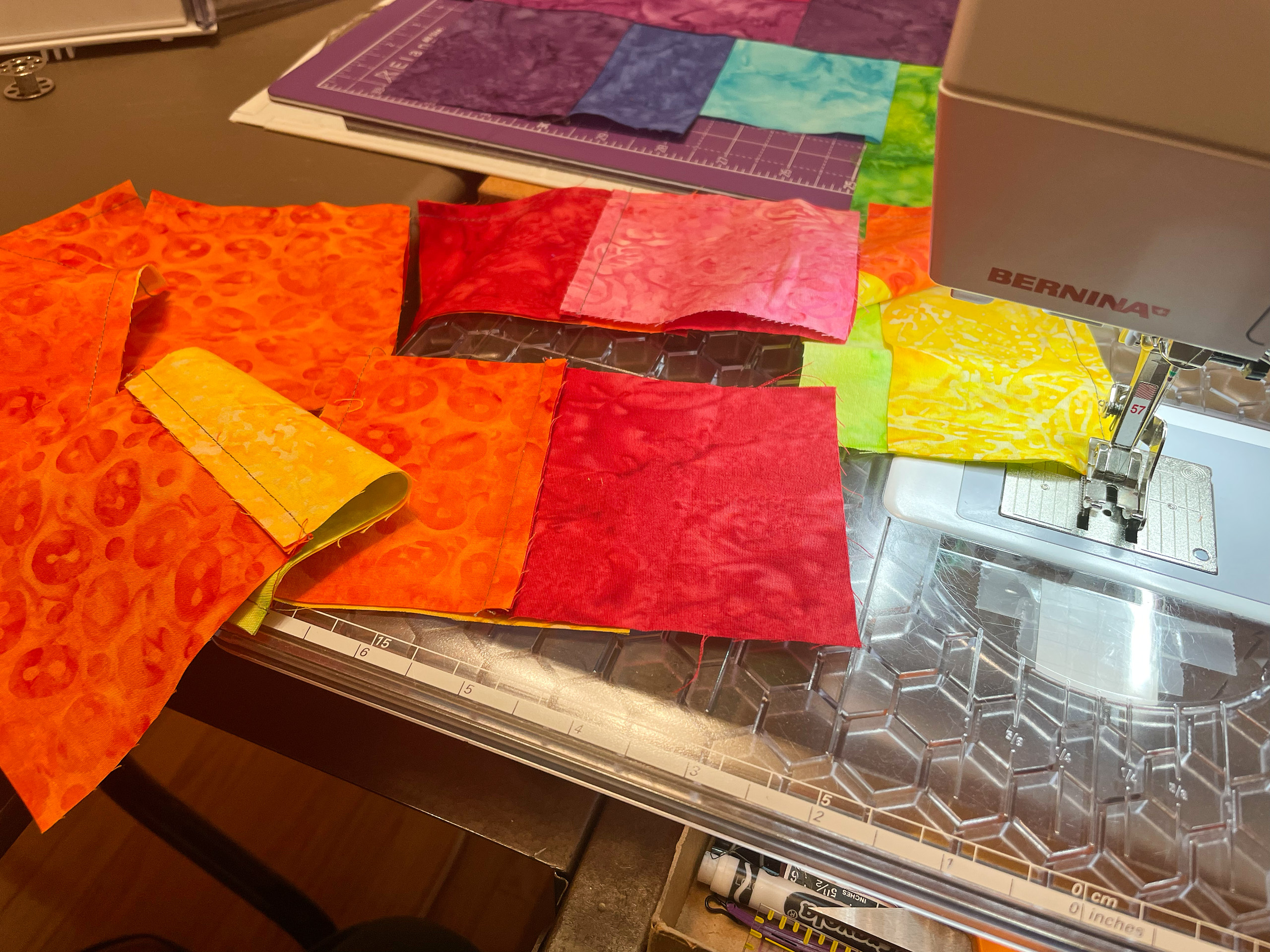
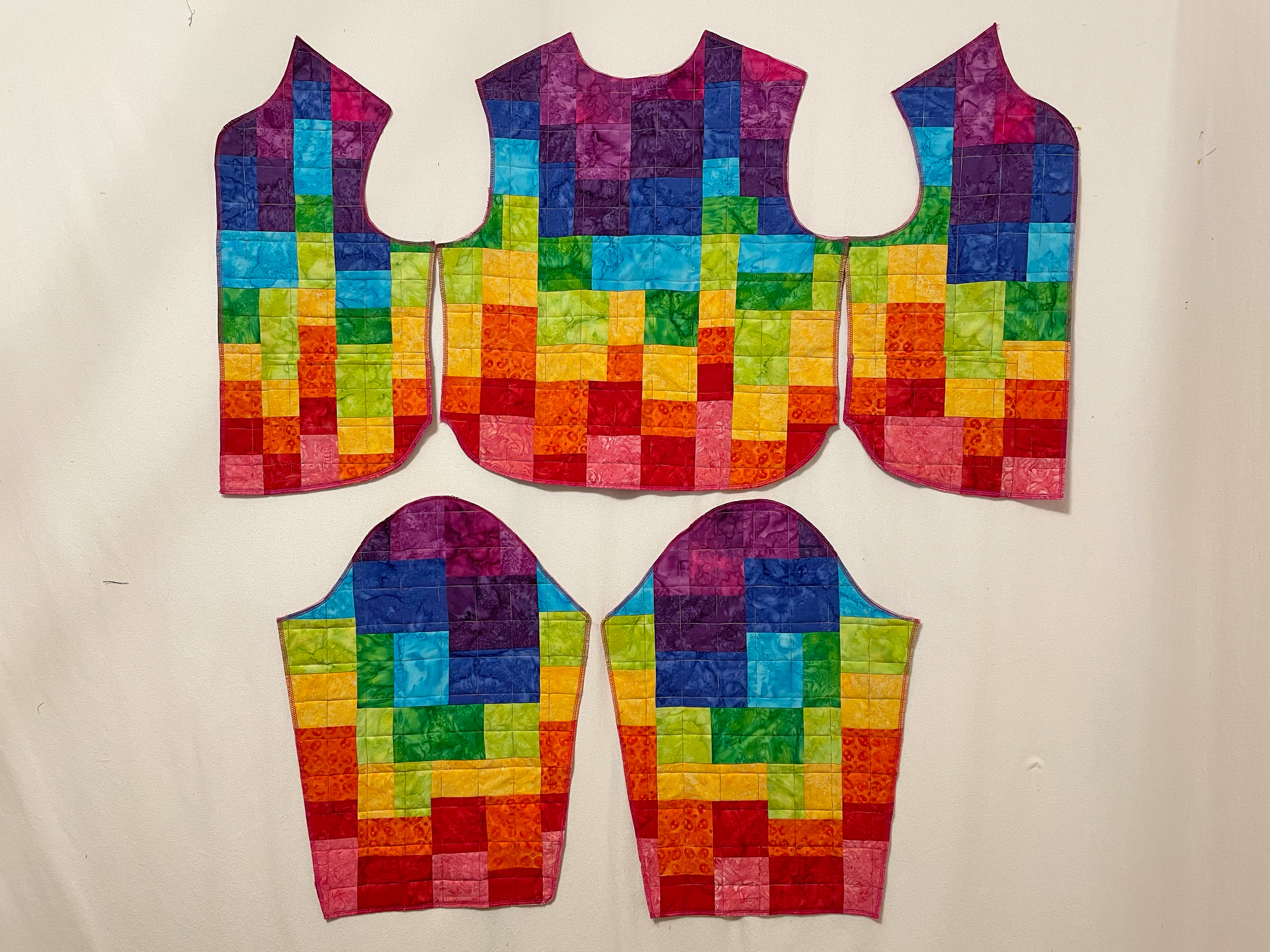
Next I designed my quilt. I drew out my pattern in Affinity Designer and overlayed it on the Coda pattern pieces. Then I started cutting up my fabric and made a stack of the squares and rectangles needed for each section of the jacket. One piece at a time I laid out each section (guided by a print-out of the design), and pieced it with my quarter-inch guide foot. I pressed the seam allowances in opposite directions so they would butt up to each other nicely, and occasionally applied a dab from my fabric glue pen to achieve perfect alignment.
Once I pieced all the sections, it was time to make the quilt sandwiches. I spread out my bamboo batting on the floor and attached the lining pieces with basting spray, which is basically a light-weight repositionable glue (like on a post-it note). This is the first time I used basting spray, and it was a lot easier than I anticipated. It mostly stayed where I sprayed it and did not have a lot of lingering fumes. I then used the lining pieces as templates to cut out the batting. Then I layered the batting/lining pieces on top of my pieced sections, carefully aligned them, and cut them out. I had designed the pattern so that the front and back pieces all aligned so it was important to get everything lined up properly. I did not use spray baste here because I discovered that the bamboo batting was very clingy and stayed in place just fine on its own without any pins or glue.
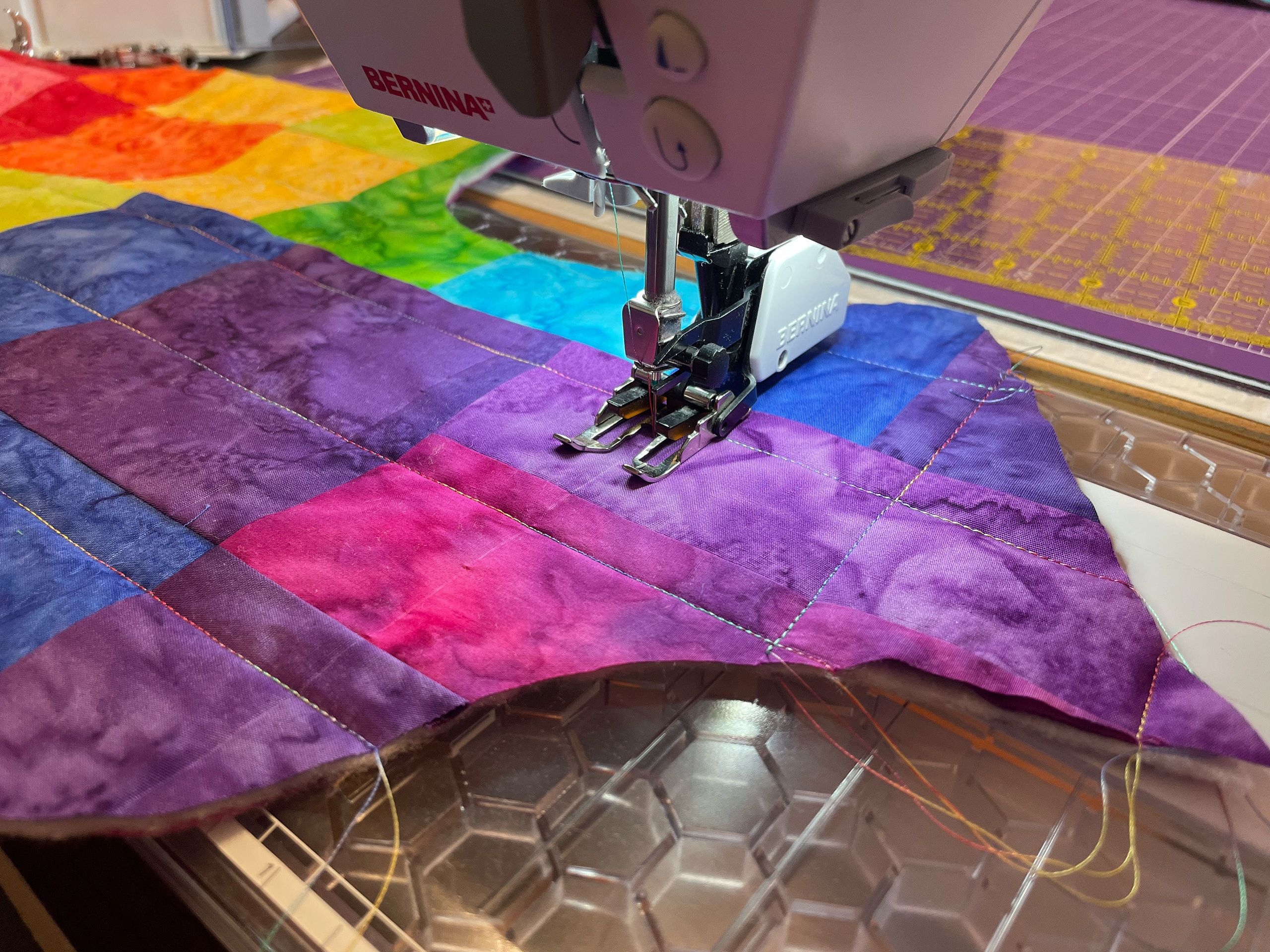
Now it was time to quilt. After weighing many quilting options, I decided to go for a simple two-inch grid, quilted with a variegated rainbow polyester thread (with the same thread in the bobbin). I used a hera marker and a ruler to mark the quilt lines, and I quilted it using my walking foot. It mostly went well, but I’ve been having some issues with the bobbin tension on my sewing machine and the stitches are not as even as I would have liked.
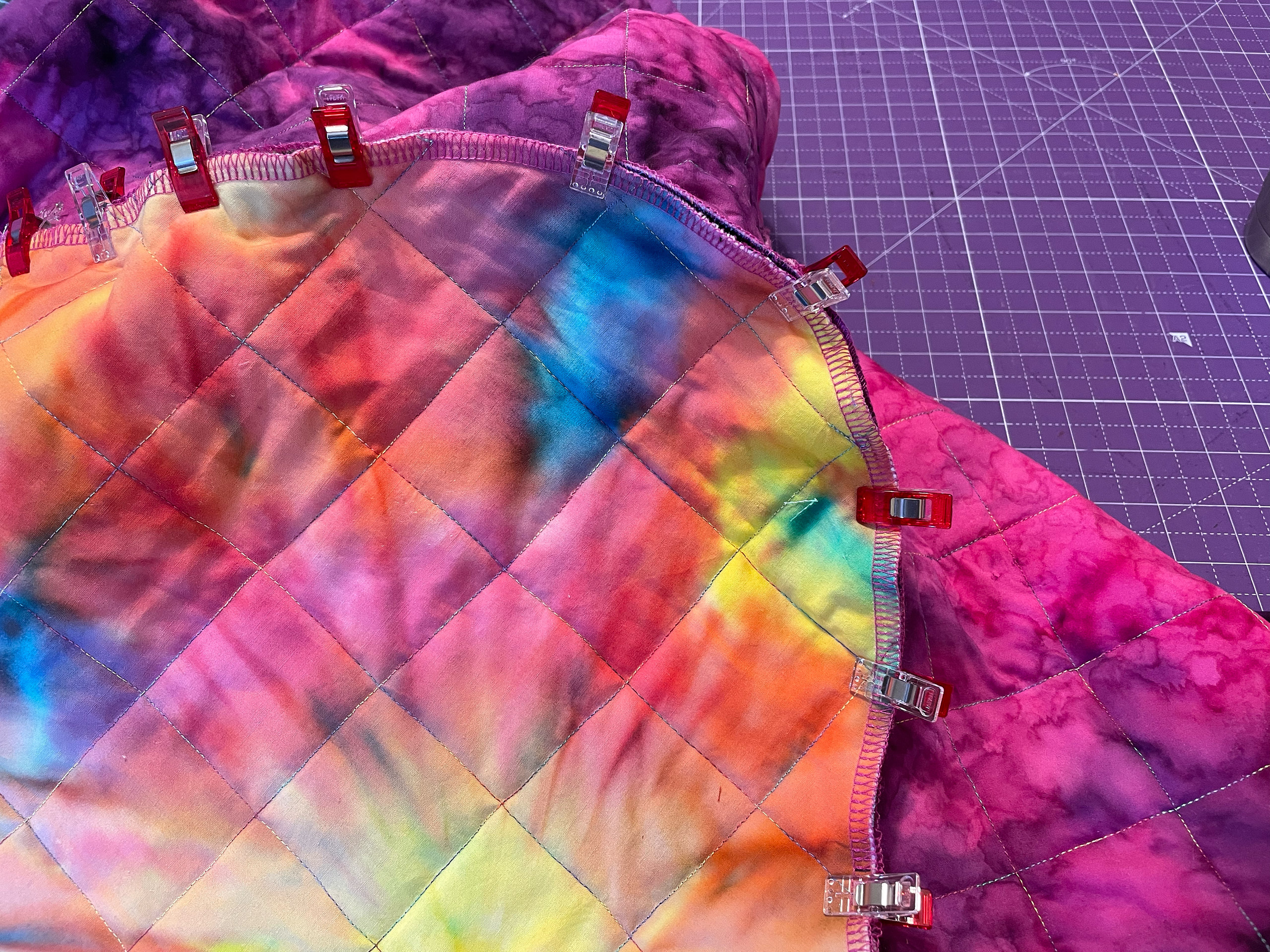
After all the pieces were quilted I lined up and carefully attached the pockets. I decided not to bind the tops of the pockets and just folded them under and topstitched. Without binding, they are almost invisible since I matched the pattern and the quilting pretty well. Then I surged around all the edges with pink thread that sort of matched most of the lining.
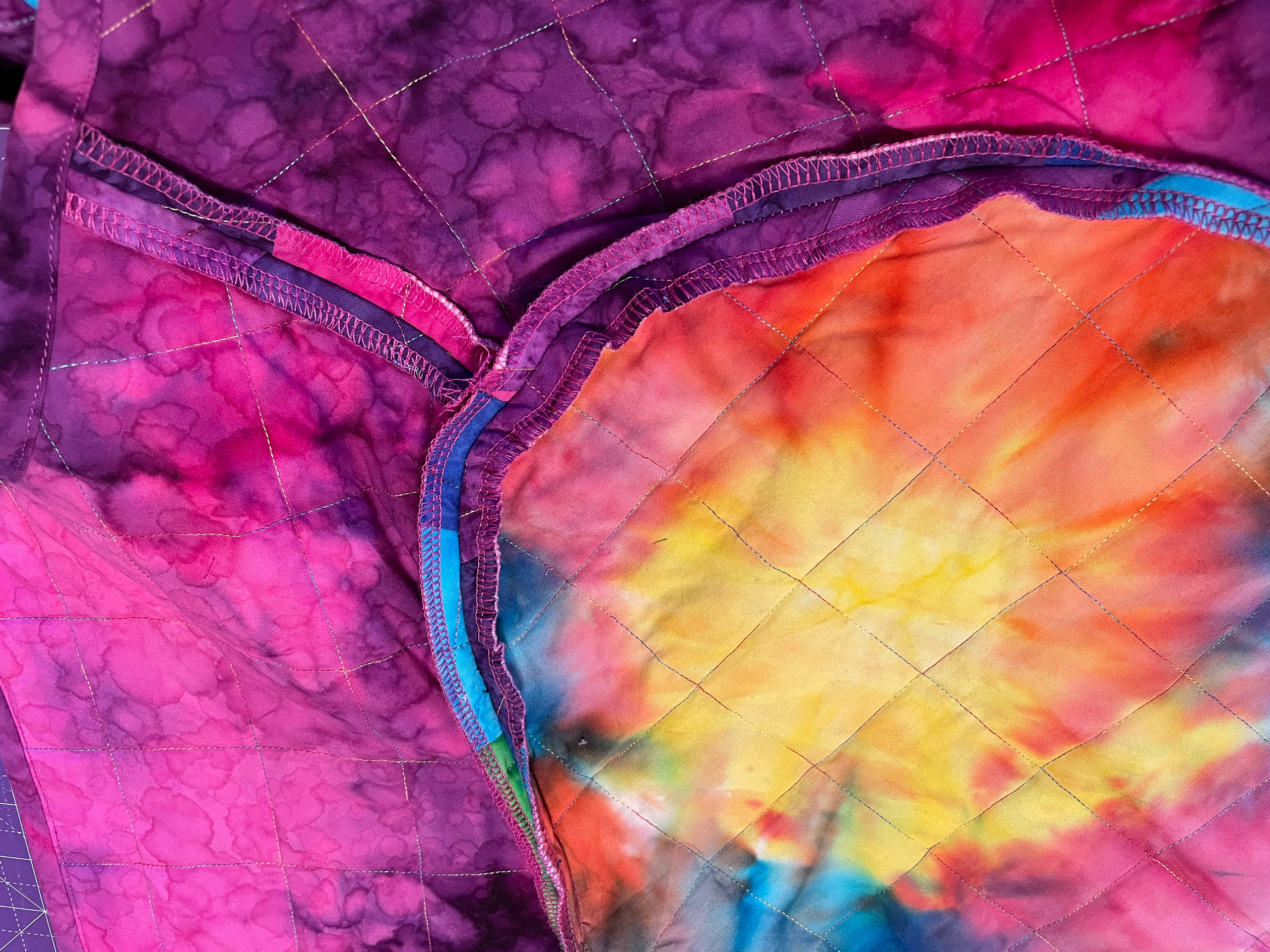
I had previously considered my construction options. Should I quilt the lining with the top and batting or use a separate lining piece? I decided to quilt the lining because I thought it would further minimize bulk. I think its fine, but you do end up with interior seams that you have to treat. I decided to serge the edges, sew with a half-inch seam allowance, and press open. A nicer option would be to bind them, but I didn’t want to bother. Next time (yes there will be more quilted coats) I may just add a separate lining and keep all those pesky seams hidden from view, as some sewists suggest (this tutorial has lots of great tips).
I ended up sewing the shoulder seams and attaching the sleeves, but leaving the side seams unsewn until after I attached the binding so as to avoid having to bind the sharp corner where the front and the back meet.
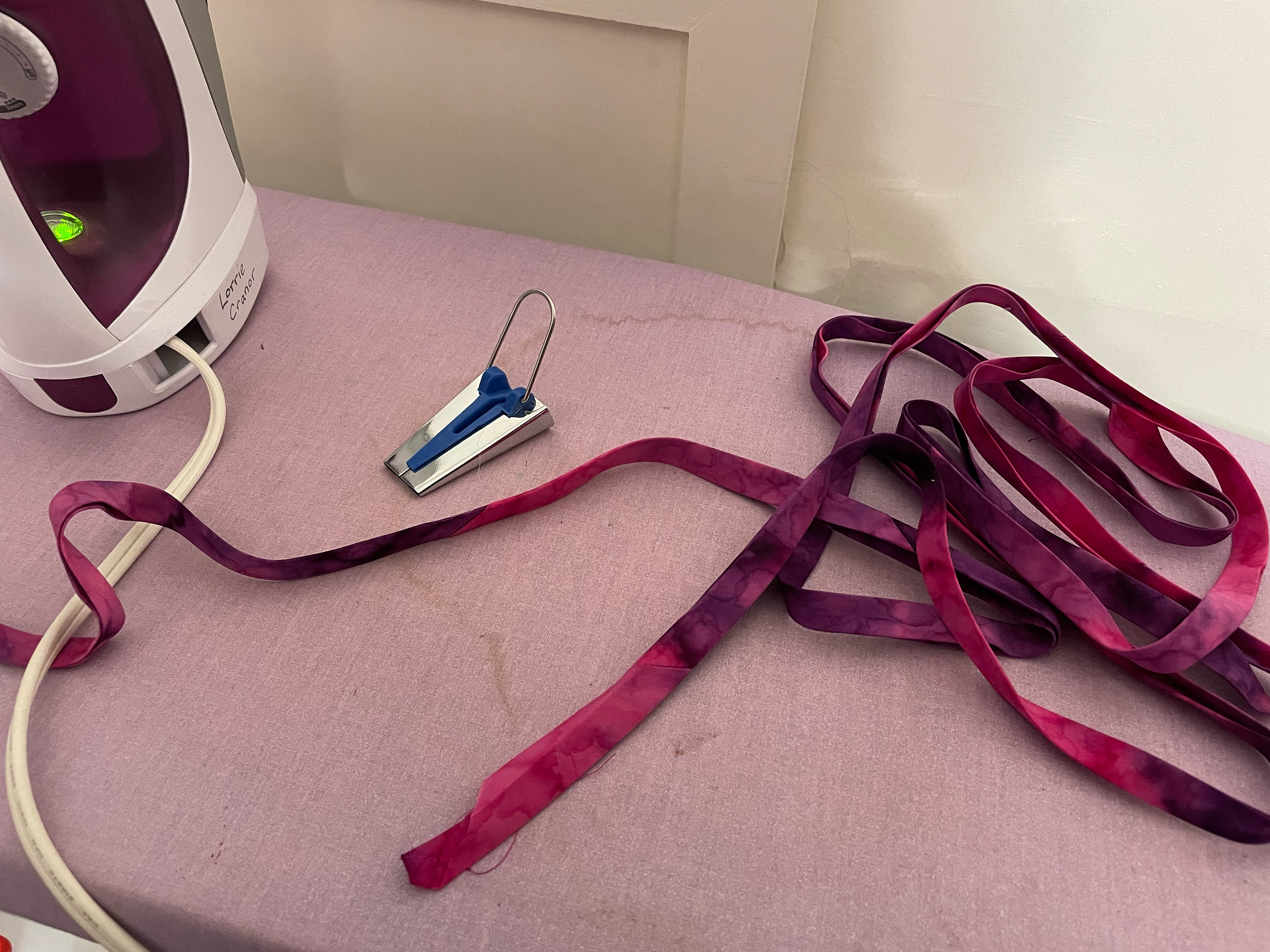
The pattern suggests making your own double-fold bias binding tape, something I had never done (I usually bind with French-fold binding, as is common for quilts). But I read that making double-fold bias binding tape was pretty easy to do, especially with the help of a cheap bias tape tool. Some sewists even find making binding tape quite enjoyable. Having now tried it, they are not wrong. I used this nifty technique where you start with a large square, cut it into two triangles, mark them lines parallel to the hypotenuse, and sew them together in a staggered way so that you can use your scissors to cut one long continuous bias trip. Then you run it through your bias tape tool and iron and you have binding. I followed this process with 2-inch strips to make half-inch bias binding. It worked great except that I miscalculated and started with a 15-inch square, and ended up with slightly less binding than I actually needed, so I had to stop attaching the binding and go make some more. Next time I’ll probably go with an 18-inch or 20-inch square to make sure I have more than enough.
Once I made the binding, I followed the pattern instructions to attach it to the jacket by first unfolding it and sewing it to the inside, then wrapping it around to the front and sewing it in place. Instead of pinning it to the front I held it in place with a thin bead of Elmer’s washable school glue, and then set it with my iron (you can still easily peel it off, even after ironing). Yes, I have really embraced the use of adhesives in sewing – for this project I used basting spray, fabric glue pen, and Elmer’s glue. Once the binding was in place, I stitched it near the edge, sewed up the side seams, added a label, and I was done.
I tried it on and was fairly pleased with the results, but despite my use of bamboo batting, it was still pretty stiff. I decided it needed to go through a round of washing and drying to loosen it up a bit, shrink it slightly, and turn it into its natural puckered shape. If you never wash a quilt you can keep it nice and crisp, but I plan to wear this one enough that it will need to be washed, so I figured I might as well get that over with now and soften it up in the process. I always have a little bit of fear about washing a quilt though. I tossed it in my washer on delicate cycle with Woolite, and then after a quick spin in the dryer it was ready to wear (and much more comfortable now).
This project took a bit longer than most of the clothes I make because first I had to make a quilt and then turn it into a jacket. It would be much faster with pre-quilted fabric or cutting up an old quilt. But I really enjoyed both the process and the very colorful results!
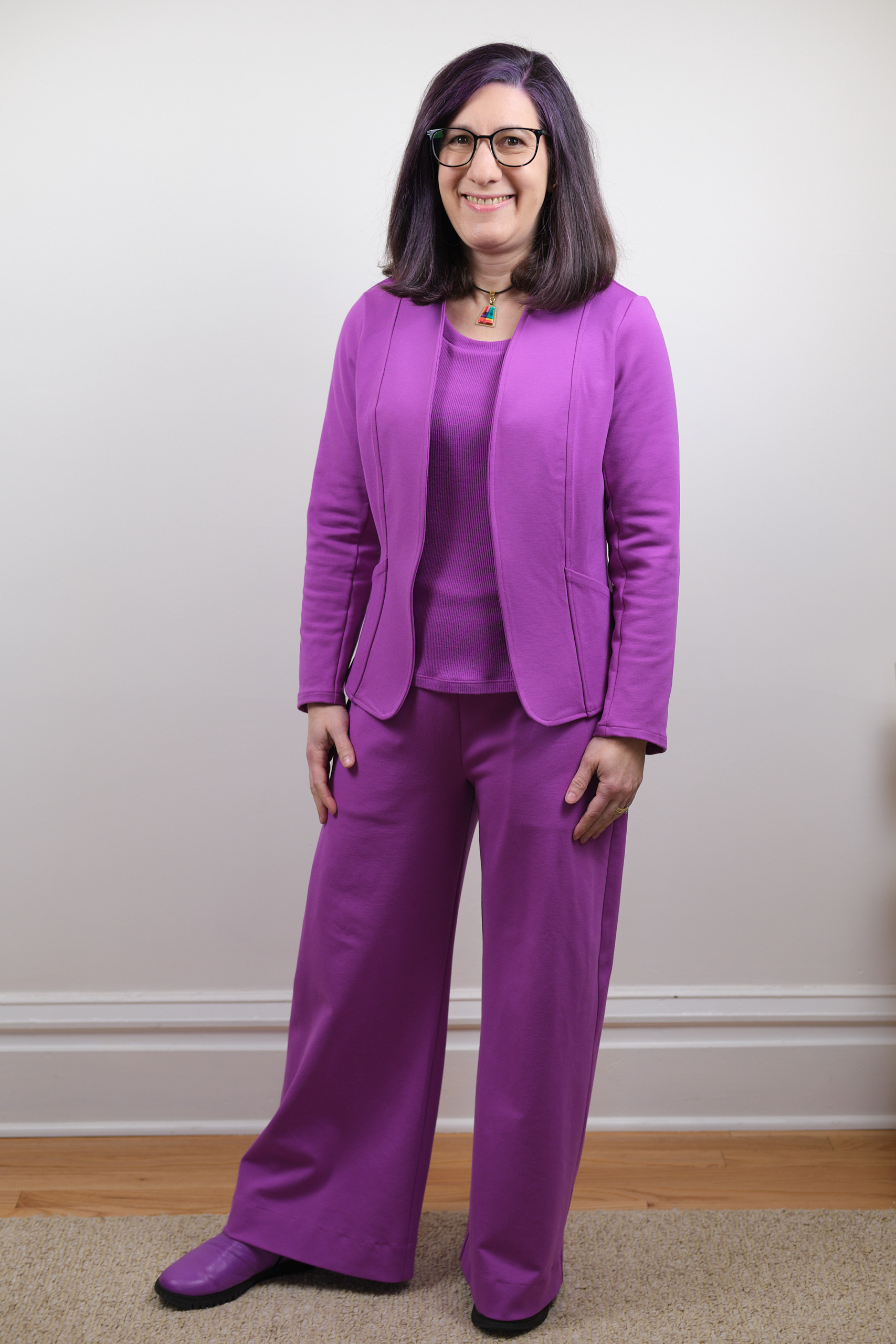
I bought three yards of a beautiful magenta ponte fabric from Mily Mae last year because I love the color (it matches the highlights in my hair) and I love working with this kind of ponte (67% Rayon/28% Nylon/5% Spandex). I thought about making a dress out of it, but eventually decided on a magenta suit. I already have a (store-bought, me altered) purple suit, but I don’t have a pink suit. Magenta is on the more purply side of pink, which means it can be interpreted either as pink or purple.
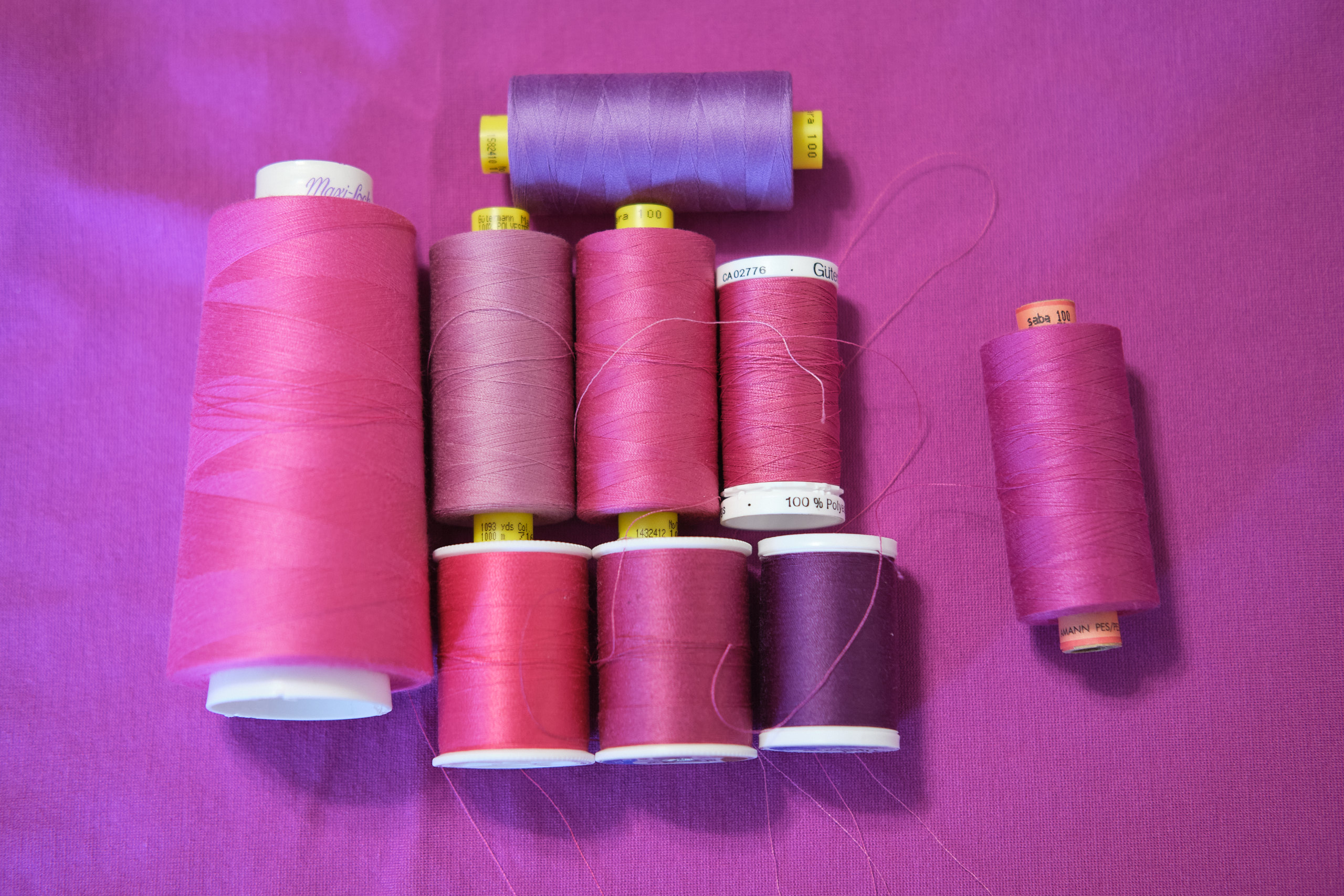
Unfortunately, magenta doesn’t seem to quite match either pink or purple threads, so I had to order several threads online until I found a close match that I could use for top stitching that would blend into the fabric. None of the Gutermann or Coats & Clark threads I ordered were quite right, but Amann Saba all purpose poly wrapped poly core thread tex 30 color 1059 did the trick.
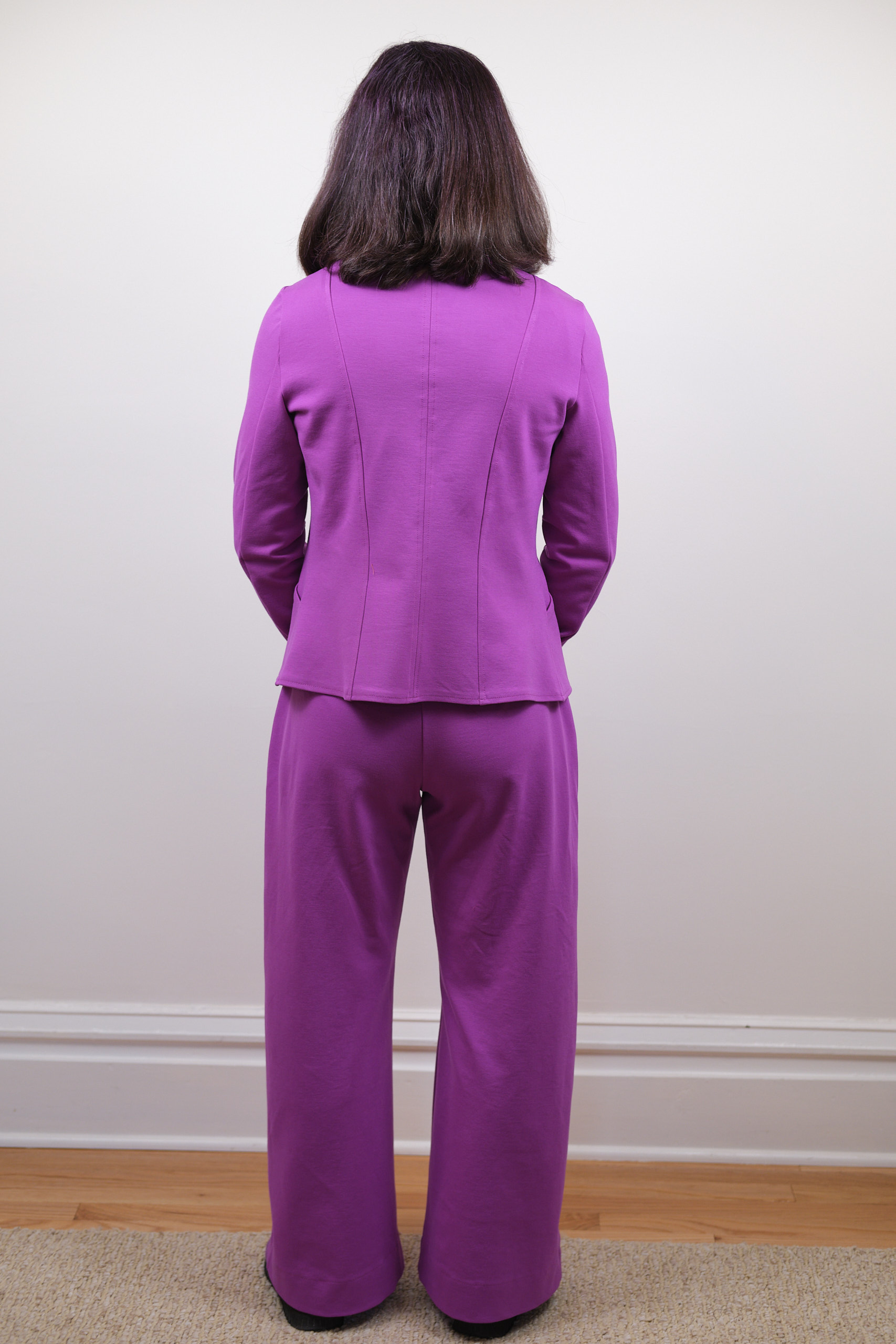
I used the Boo & Lu Onyx blazer pattern for my magenta suit jacket, with the same modifications I used for my hip length grey ponte version with pockets. I had hoped to get the facings interfaced and catching in the top stitching properly this time, but still ran into problems that required extra gluing and fusing to resolve. I still feel there must be a better way to make the facings, and if I make another Onyx maybe I will figure out what it is.
I used the Pattern Emporium Urban Wide Leg pants pattern to make magenta pants to go with the jacket. I haver previously made three tapered and three wide-leg pants with this pattern (plus a few mashups with this pattern and the PE Walk Boldly pants). I made these size AU10 low-rise (which ends up being high-rise on me), with the waist graded in and the waistband modified to be a contour waistband lined in athletic knit and with elastic added. I added front jeans pockets with straight pocket openings.
Last winter I also bought some super soft purple 86% Poly/12% Rayon/2% Spandex Monaco Rib fabric from Mily Mae, and it turns out to be almost the exact same color as the magenta ponte. Why they don’t call them both by the same name is a mystery to me, but regardless, I clearly needed to make a rib-knit sweater to go with my suit. I used my favorite Sinclair Bondi classic fitted t-shirt patten in size 4p hip length with a screwp neck, adjusted slightly for a broad and sloped shoulder. I cover stitched the hems, using the magenta thread spool and a bobbin wound with the same thread for the needle threads.
The whole outfit looks great together, and I will wear it as a suit with my matching magenta booties! I expect I will also wear the pieces as separates. Although this is a color I wear year round (I also have a cashmere sweater and a winter parka in this color), to me it is really a spring color.
April update: I couldn’t resist some magenta jacket photos with the magnificent magnolia trees in front of my house!
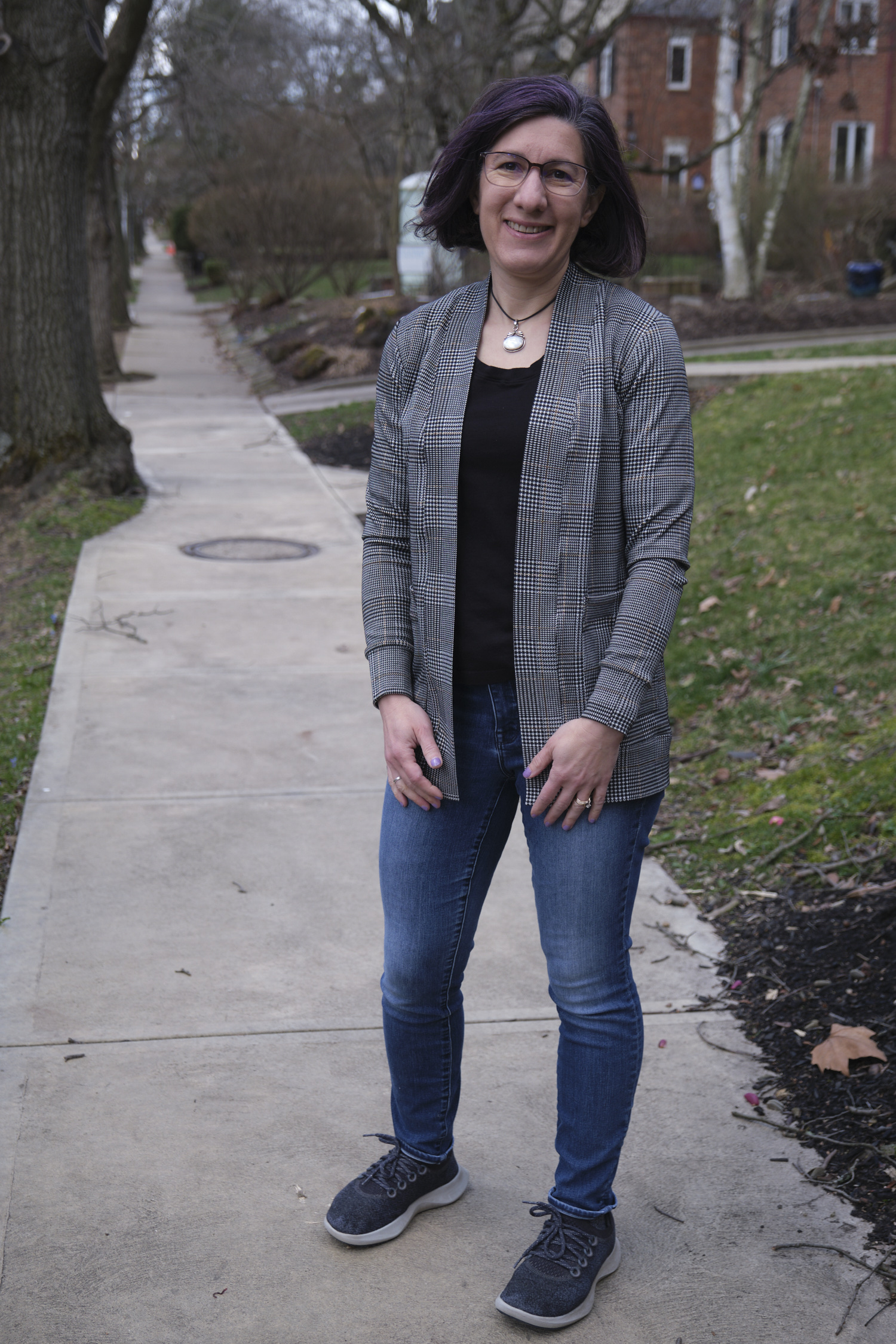
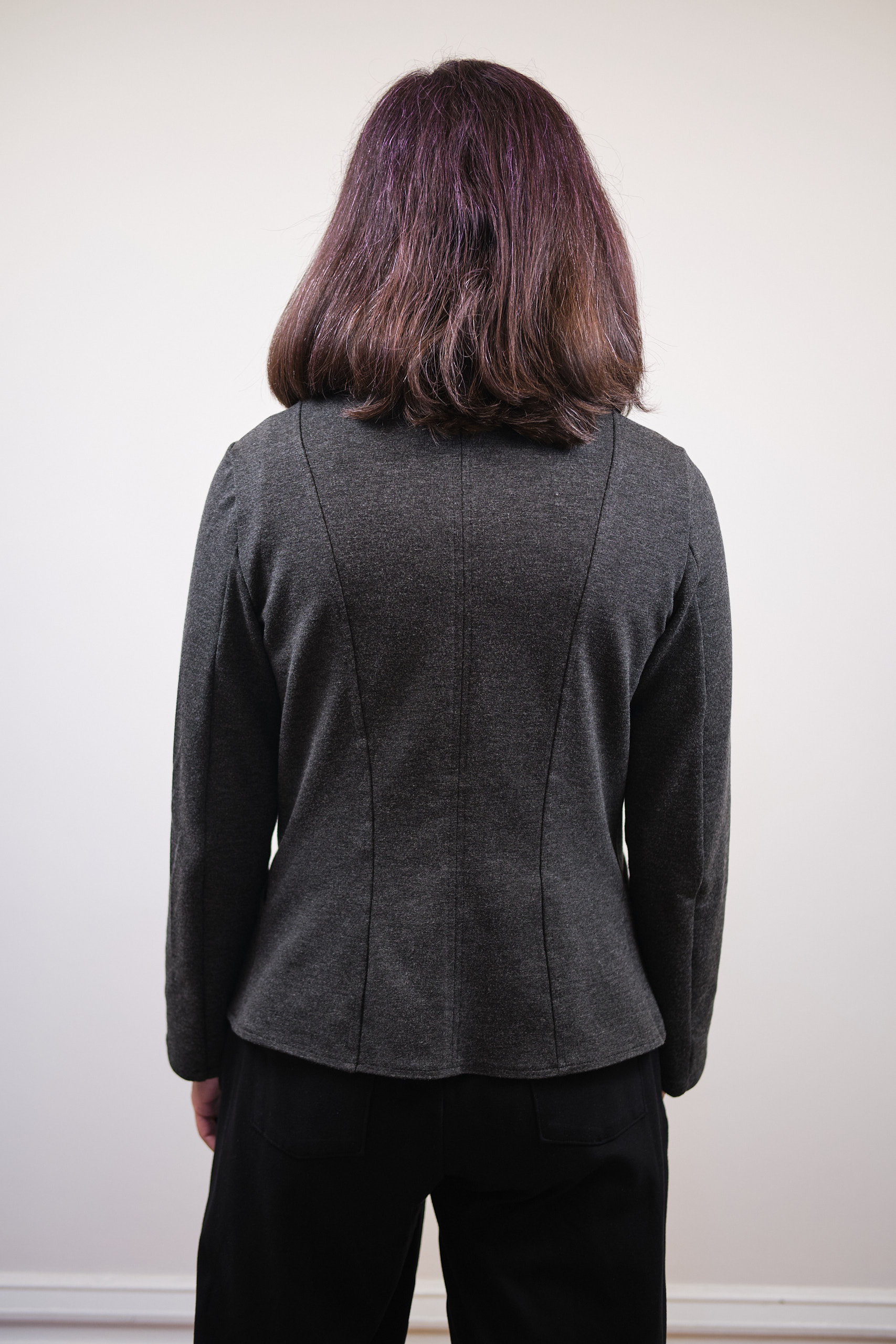
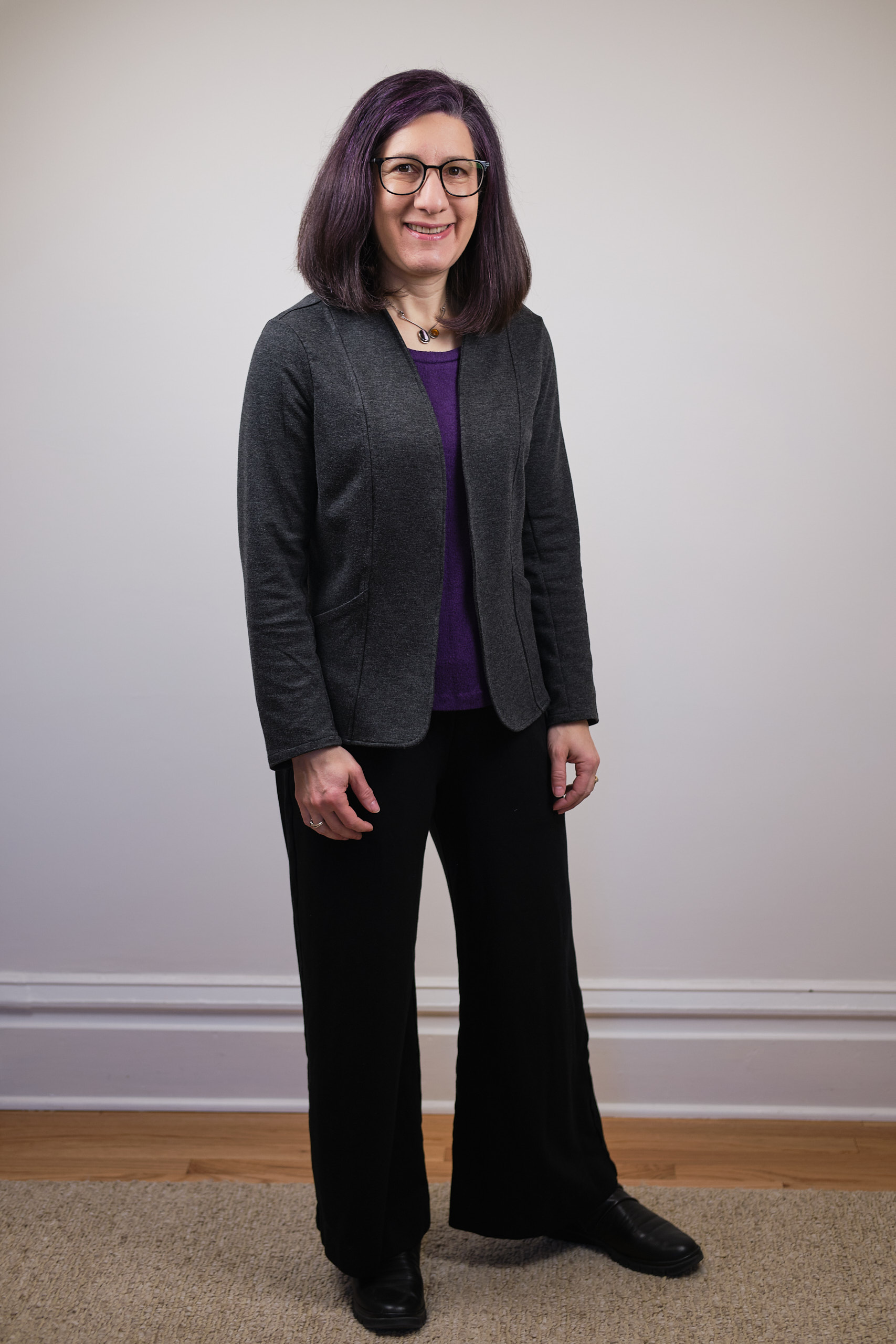
I made another Onyx blazer, this one hip length in charcoal grey ponte (charming heather legacy ponte from Zelouf) with pockets. I tweaked the pattern some more before I cut it out, this time to add a simple sloped shoulder adjustment (in addition to the round-back adjustment and small-bust adjustment I made on my purple cropped Onyx). I noticed that when I raised my shoulders (as in a shrug) the drag lines I saw on the back of my purple Onyx mostly disappeared. So I lowered the outside point of the shoulder by .75 inch and adjusted the shoulder line on the center and side front and back pieces accordingly. Then, I lowered the armscyes to meet the lowered shoulder point, ensuring that the size of the arm openings did not change. This reduced the excess fabric from the shoulder area that had been pooling around the armscye and helped reduce drag lines on the back. The fit of the back is now about as good as I’m going to get so I will stop tweaking and use this going forward. I made a size 4 hip length, shortened by two inches. I reduced the height of the pockets by only about .5 inches and made them a tad narrower to fit the shortened side-front pieces.
For the purple Onyx, I cut the facing pieces using the front-center pattern piece so that I could sew them down when I top stitched the front seams. I used a lightweight fusible interfacing with no stretch. I noticed that the interfaced facing shrunk a little bit, making it more difficult to attach smoothly, but I made it work. However, on the grey ponte, the lightweight interfacing was a complete disaster. When I clipped the facing to the front center pieces, I found the facing was about an inch shorter. I tried to make it work but it was clearly not happening. Then I remembered that I had tricot interfacing (Superpunch Fusi-Knit White HTC1300), which has some stretch to it. So I cut new facing pieces and fused the tricot interfacing on, with the stretch running vertically. This time the facing did not shrink and everything went together the way it was supposed to! This was a great lesson in selecting the right interfacing for the job.
I did most of the sewing on my serger but I used my sewing machine with my quarter-inch edge foot to do the stay stitching, basting, and top stitch the front and back seams. I used my regular edge foot to top-stitch the tops of the pockets. I sewed the arms to the bodice with my sewing machine before serging, and I made sure to start and stop the serged seam in the armpit. As with the purple Onyx, I sewed the center back seam with my sewing machine, pressed it open, and then topstitched a quarter inch on either side of the back seam. This makes for a nice flat seam that looks very nice.
I used fusible hem tape on the bottom hem and sleeve hems before sewing. I also used it to hold the facing edge in place before top-stitching. I used a glue stick in a few places to keep pieces aligned before sewing.
Ponte is a comfortable fabric to wear, washes well, and resists wrinkles, snags, and pills. The charcoal grey should go well with a lot of things and I expect I will wear this one a lot. The pockets are a nice convenience too, although I probably won’t routinely put my phone or anything heavy in them as it will stretch the ponte. The hip length is just long enough to cover an untucked shirt, which makes it a pretty versatile length to wear with a lot of things. Here I am modeling it with black ponte PE Urban Wide leg pants and a Sinclair Bondi top in plum brushed sweater knit. The jacket also looks great with the PE Urban Wide leg pants I made previously in the same charming heather ponte fabric.
Summary of modifications to size 4 hip-length pattern with pockets:
Small-bust adjustment (performed by redrawing the inner curve on the side-front pieces to have less of a contour and then shortening the center front pieces to match the length of the new curve)
Sloped-shoulder adjustment (3/4 inch)
Round-back adjustments (2 5/8-inch adjustments near top and bottom of arscye)
Deepen back neckline by about 3/4 inch and adjust back facing
Shorten bottom hem by 2 inches
Shorten sleeves by 2 inches
Shorten pockets by 1/2 inch and adjust width to match width at hem line
Cut facing and interfacing from front-center pieces instead of facing pieces
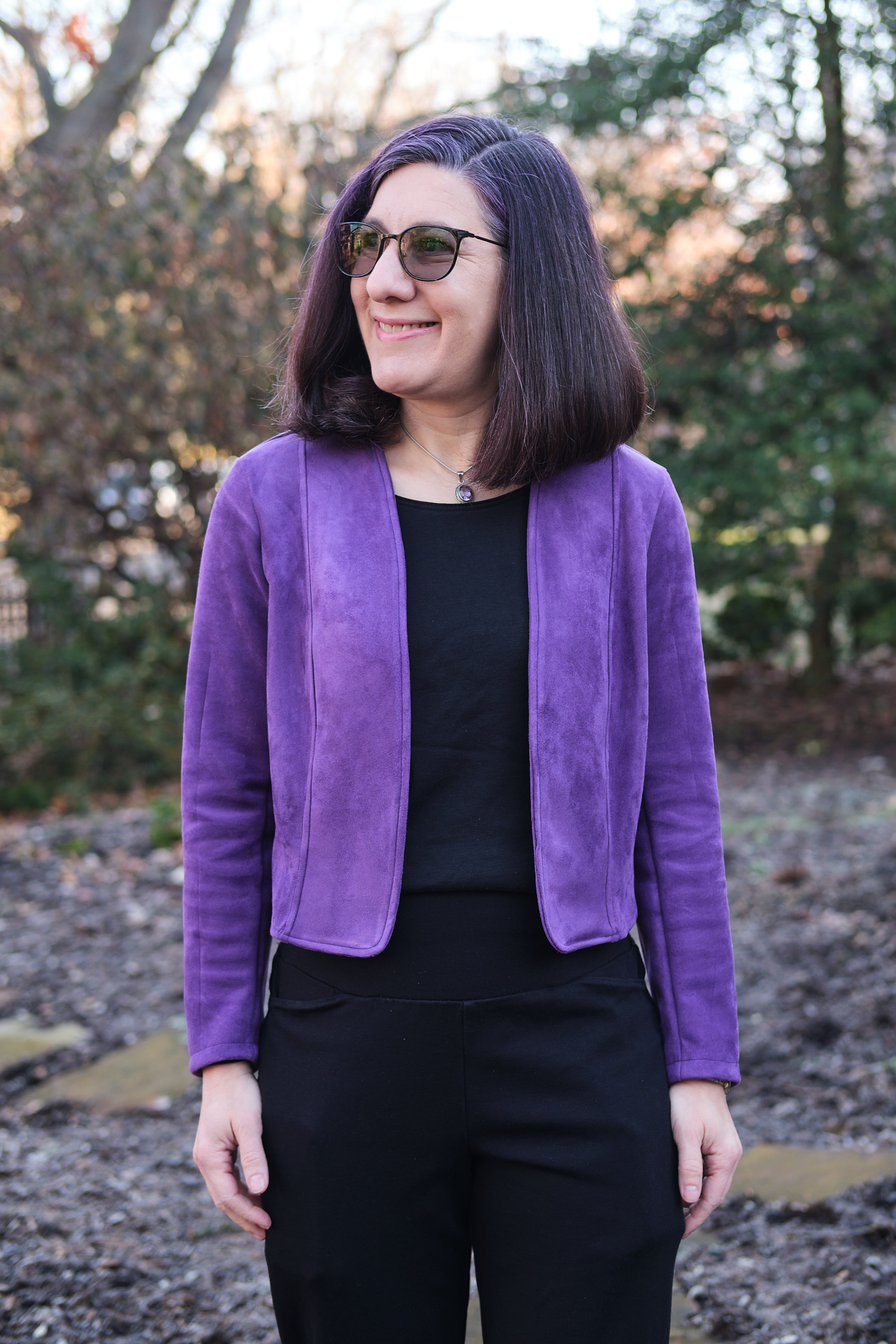
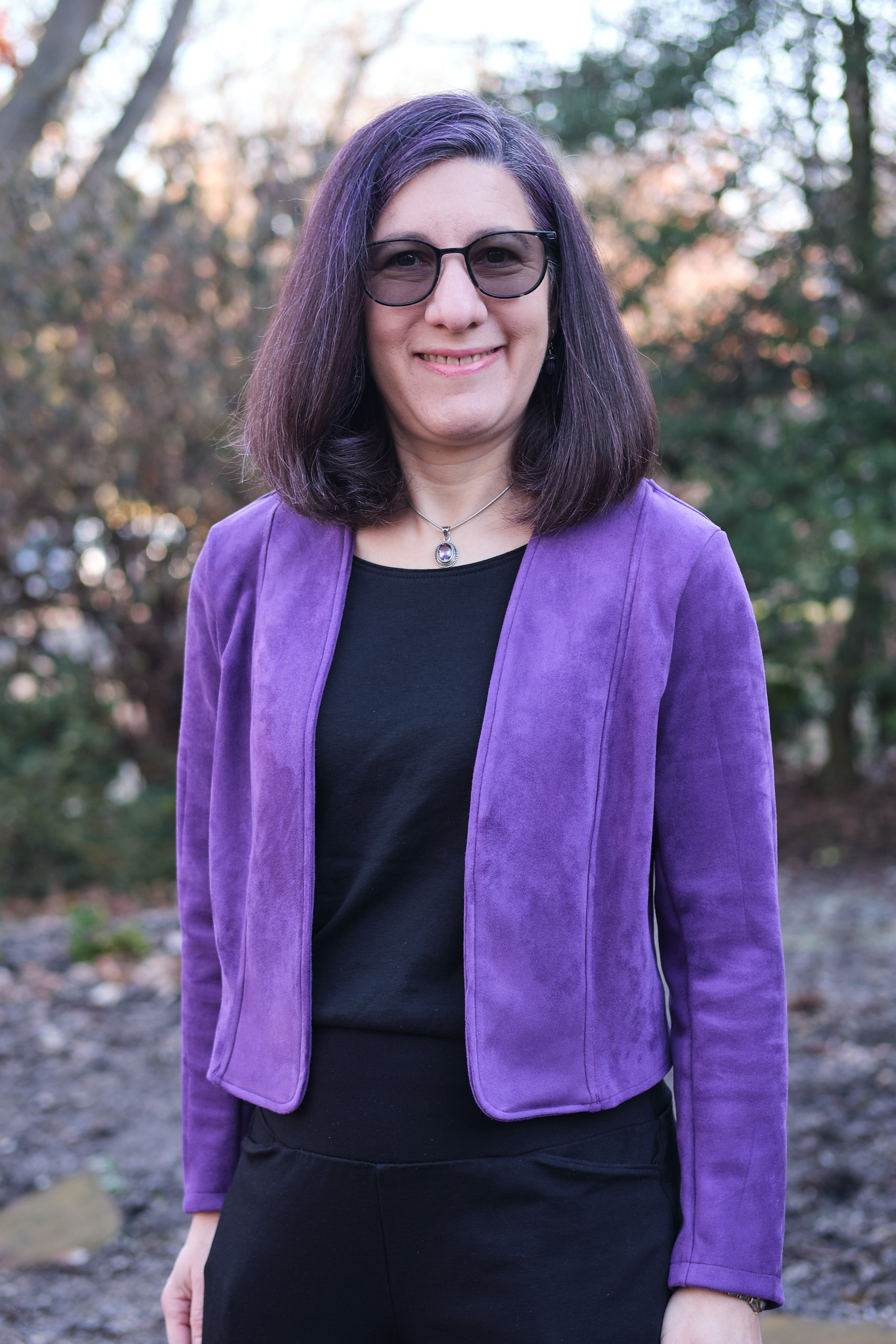
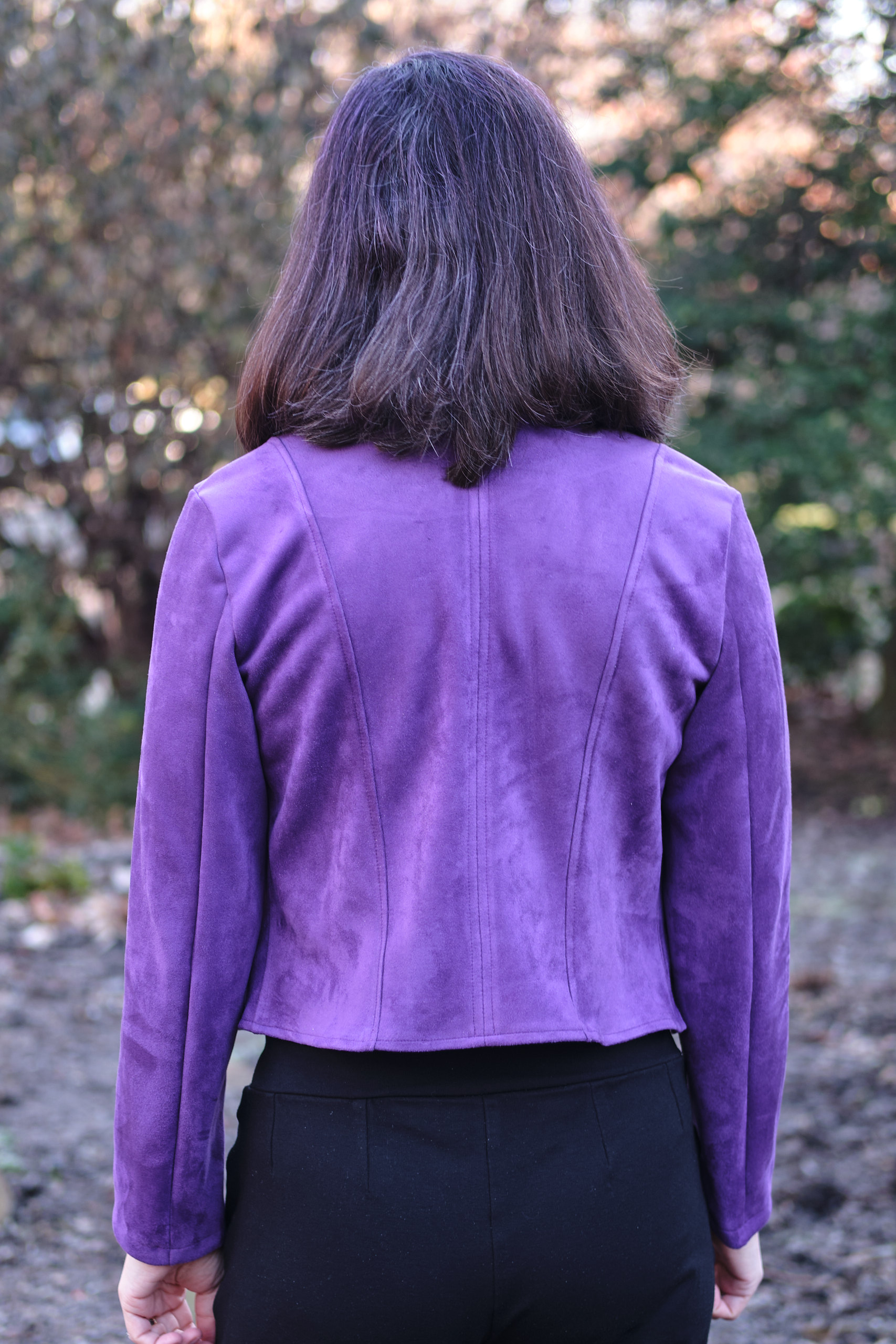
After making my tulip Onyx Blazer, I went down a rabbit hole of fitting adjustments. My first Boo & Lu Onyx fit reasonably well, but seemed too loose in the back. After much experimentation and sewing up an entire muslin of the hip-length version with pockets out of an old couch cover, I came to the conclusion that 1) a size 4 would fit me better than the size 6 that I sewed and 2) I need a round back adjustment. Although I have recently also discovered that I need sloped shoulders, broad shoulders, and sway back adjustments on some patterns, it wasn’t clear that these were needed here so I decided to proceed with my cropped purple scuba suede Onyx without these adjustments, although now I am reconsidering.
I finished the blazer yesterday and it was warm enough this morning to snap a few photos outside before I walked to work.
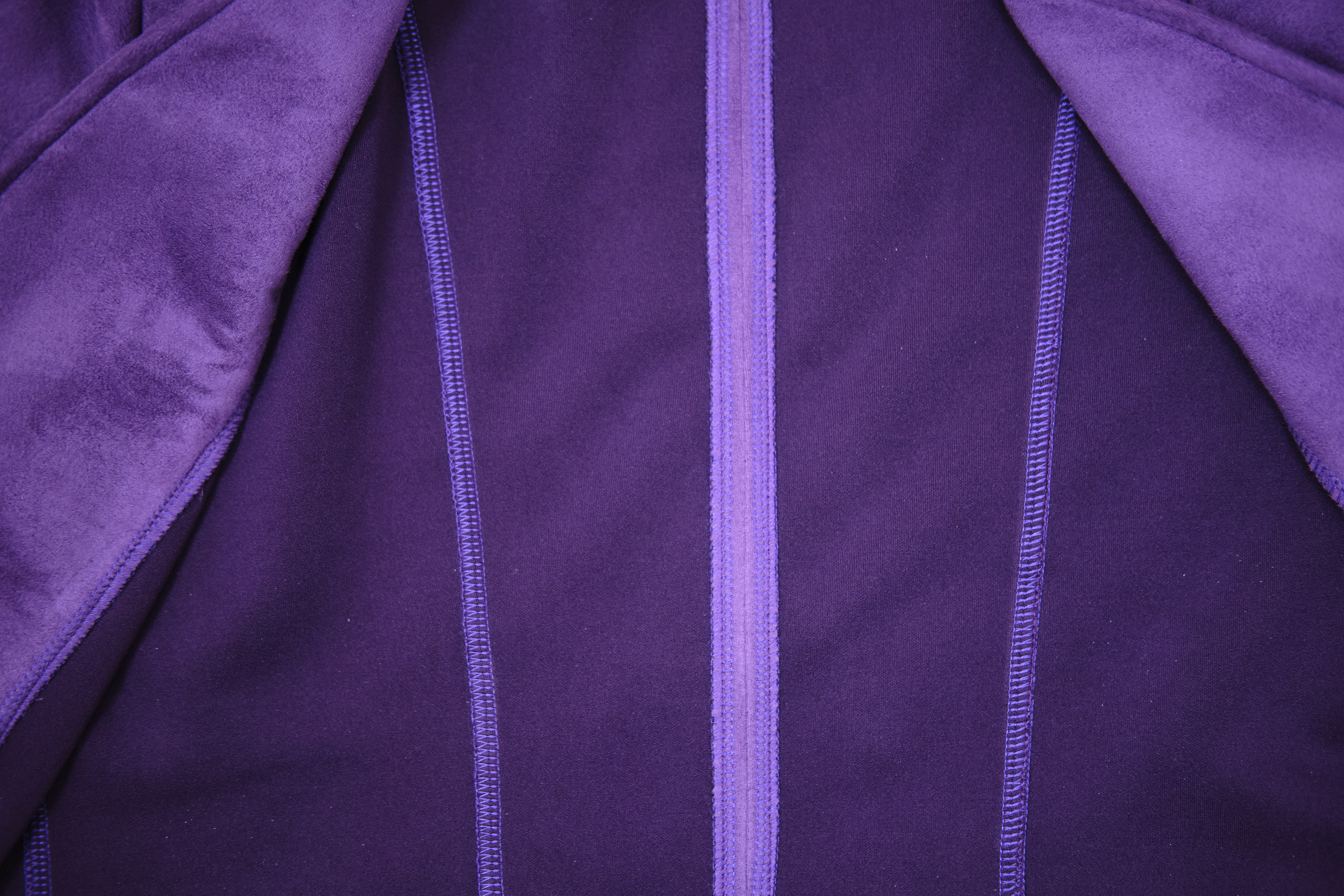
I started with the size 4 pattern, opened it in Affinity Designer, and added two 5/8-in round back adjustments near the top and bottom of the armscye. I had added a small-bust adjustment to the size 6 version that was a bit difficult to execute and did not result in the contour I really wanted. I read in the Boo & Lu Facebook group about an alternative SBA that involved simply redrawing the inner curve on the side-front pieces to have less of a contour, and then shortening the center front pieces to match the length of the new curve. This was easy to implement. I also slightly lowered the back neck line (I find this more comfortable, in part due to the round back issue) and adjusted the neck facing accordingly. I used the crop length and extended it by two inches so that it wouldn’t be quite so short. I shortened the sleeves by two inches because I am short and have short arms. Finally, instead of using the front facing pieces, I cut extra center front pieces to use as facing. This allowed me to solve the problem of the front facings not lying flat by stitching them down when I top stitched all the seam joining the side and center front pieces.
I cut out my cropped onyx from leftover purple scuba suede I had used to make a Sinclair Alana dress two years ago. This fabric is thick and stretchy, so wasn’t the easiest to work with. I fused ultra-light interfacing to the facing pieces, which stabilized them. However, even though I had stay-stitched as recommended, it was still difficult to join the facing pieces to the front pieces that did not have interfacings as the front pieces had a tendency to stretch more than the facing pieces I was trying to match them with. I had to unpick and resew one side twice until I got it right. I also wasn’t able to achieve a really sharp edge. After it was all sewn together I topstitched along the front and back seams, using my quarter-inch edge foot as a guide. My first attempt at this was a mess — the lines weren’t straight and the facing didn’t fully catch in the stitching. I unpicked the top stitching and used Steam-a-Seam 2 fusible tape to glue the edge of the facing to the inside seam it was supposed to align with. Then I carefully redid the stitching and it came out much better.
I’m pretty happy with the end result. It fits better than my first Onyx and the fabric is fun. The length works really well with dresses, but as you can see here it also works with pants. I don’t think this length looks as good with shirts not tucked in though, so I’ll probably make a longer one. It does go perfectly with the dress I made from the same fabric. The rounded back adjustment and lower back neck were a good improvement that makes the blazer more comfortable to wear and keep the back closer to my body. I feel like there is still something more I should be doing on the side back pieces to reduce the drag lines pointing to my armpits (which were not as prominent on my muslin, but maybe because it was made from a woven fabric with less drape). Maybe I do need a sloped shoulder adjustment? Also note that the front is fairly open in the photos and so you can see some fabric bunching under the right arm. When I pull the front pieces closer together that goes away.
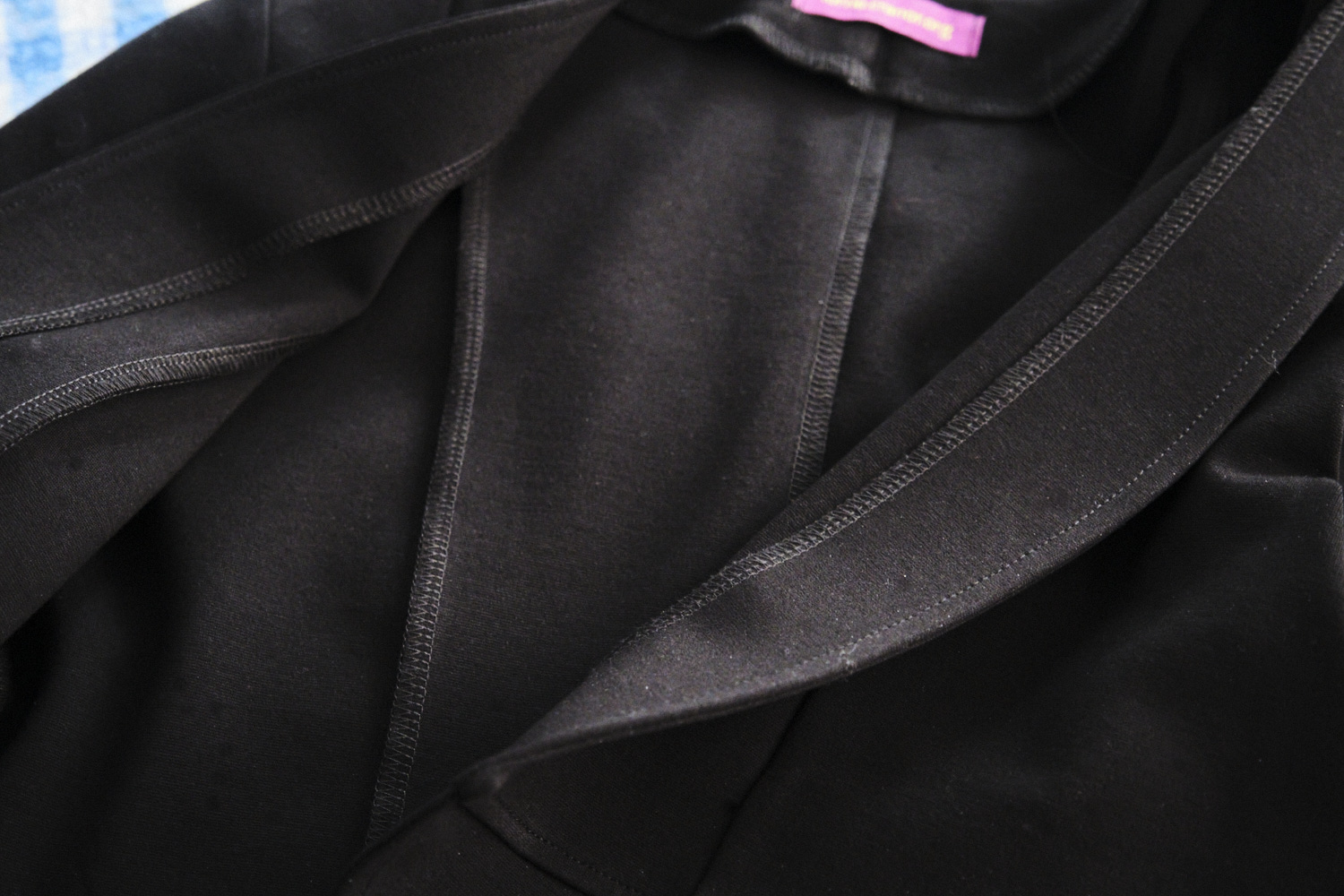
Even though I didn’t do any of the fancy seam finishes, I do like how the seams look on the inside, sewn with my serger and neatly top-stitched in place. I did sew the center back seam on my sewing machine and serged the edges so that I could press it open.
Now that I have a collarless blazer pattern that fits pretty well, I want to make more! (But maybe keep trying to address the back drag lines with a sloped shoulder adjustment?) Next up, the hip-length version with pockets.
I’ve collected a few Boo & Lu PDF sewing patterns but had not gotten around to sewing any of them until now. I’ve been thinking about sewing up the Onyx blazer since it came out because it has princess seams for nice shaping, can be made in either knit or woven fabrics, and it is collarless. I have a closet full of blazers with collars, but over the past few years have found that blazer collars are increasingly uncomfortable on the back of my neck so I’m looking to expand my collection of collarless blazers, which it seems are harder to find (both ready made and in patterns). The Onyx also has several options, including a hip-length version with optional pockets, a peplum version, a tulip-bottom version, and a cropped version. I may eventually try them all. The pattern also includes options for bows on the back of the blazer. While they are cute, I am less likely to add them to a blazer for me to wear. There is a kid’s version of this pattern and I think the bows would be super cute on a blazer for a child.
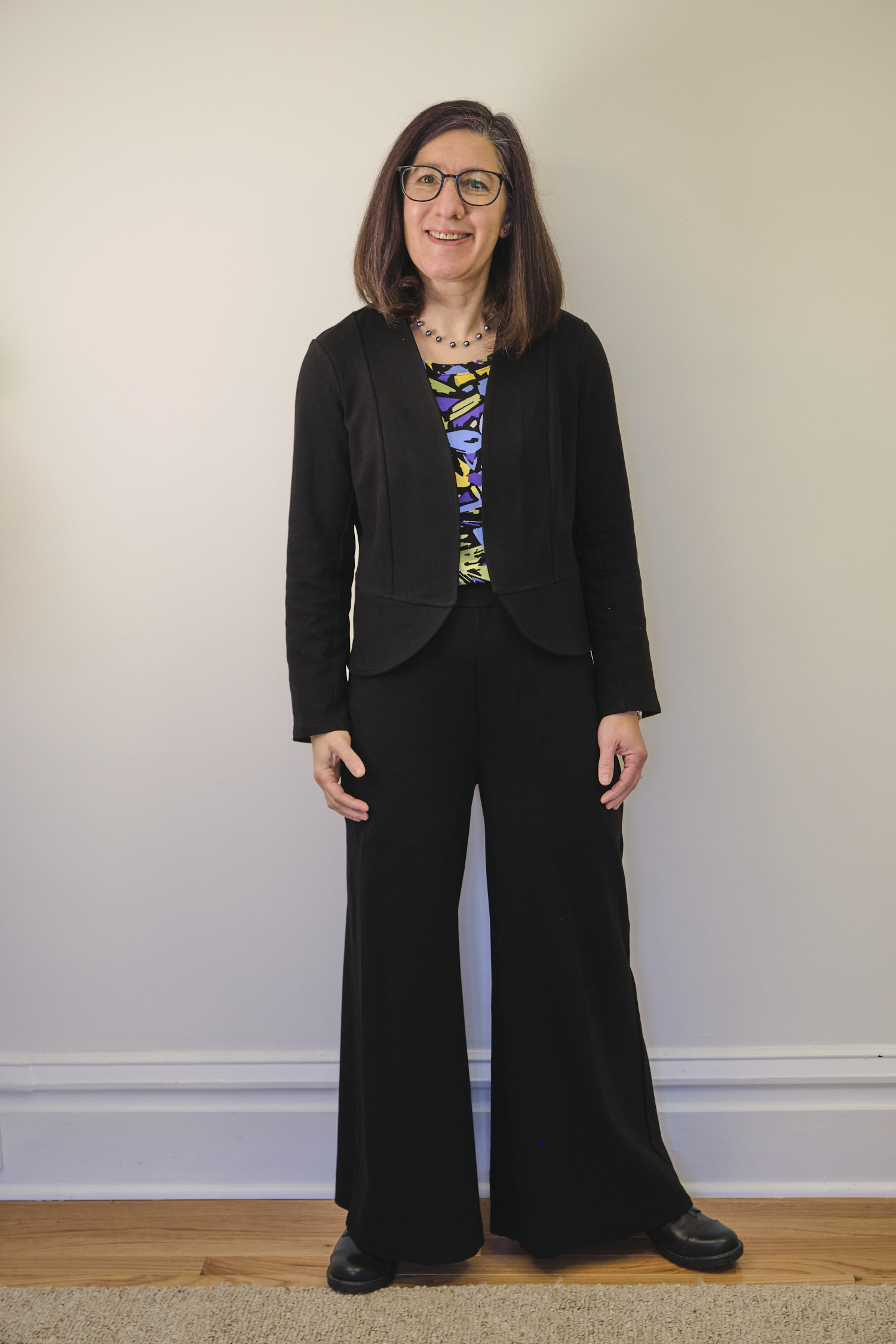
I started with the tulip version since it looked like a style I would likely wear a lot and it looked like I had enough leftover black ponte fabric from a pair of pants to make it. It has a lot of pieces, but they are all fairly small, so I was able to make good use of some of the scraps. This version requires only a little bit more than a yard of fabric (assuming ~58 inch width) in my size. I made a size 6, with a 1/2-inch small bust adjustment and sleeves shortened by 2 inches. (And it matches the pants — PE Walk Boldly — so now I have a suit!)
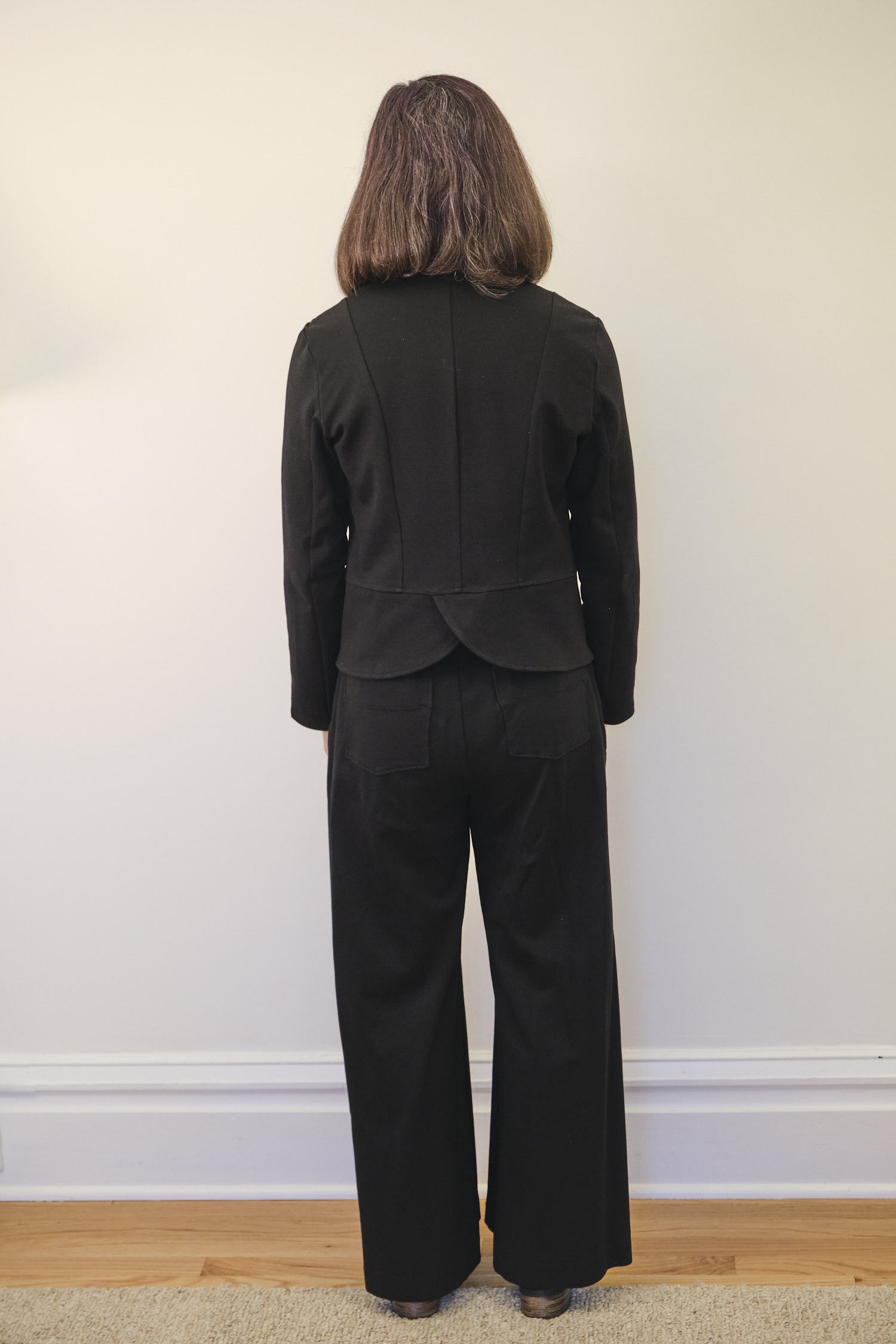
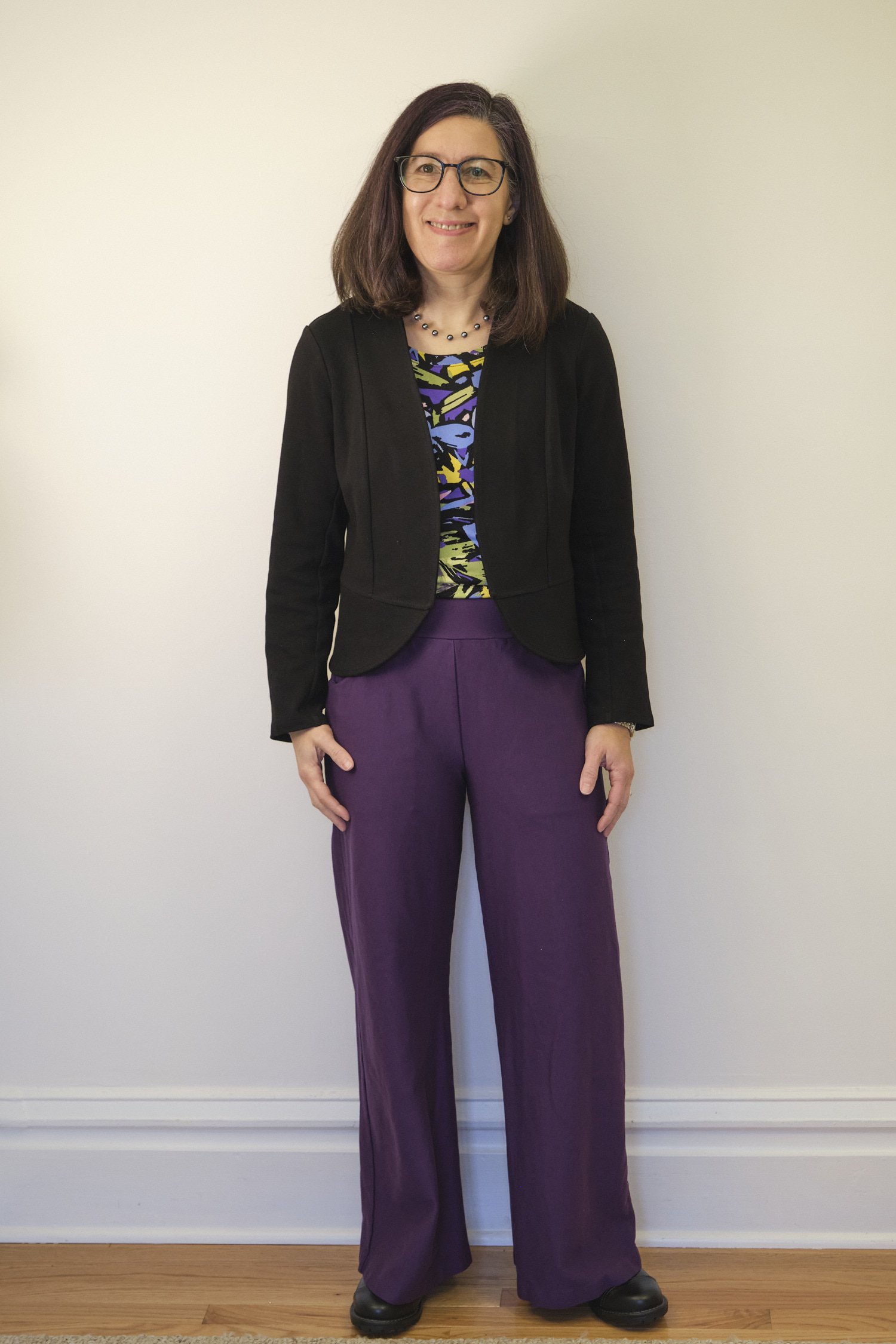
Boo & Lu Onyx blazer, size 6 with tulip bottom in black ponte, modelled with Sinclair Bondi top and PE Walk Boldly pants
The pattern includes a lot of instructions and notes, including suggestions for a full bust adjustment and small bust adjustment. In my case, I needed a small bust adjustment, something I had never attempted previously. The pattern has step-by-step instructions for the full bust adjustment, and then suggests doing the opposite for a small-bust adjustment. Most online tutorials take a similar approach. Bust adjustments are somewhat complicated as they involve making adjustments to a flat pattern piece designed to fit a round part of the body. Generally, you take paper pattern pieces and cut them apart and tape them back together. Since I am working with projected PDF files, I figured I should be able to do this electronically in Affinity Designer. I found an AD tutorial that explained how to do full bust adjustments. After watching the tutorial I attempted to follow the steps on my own, except the opposite. I realized that my AD skills are still fairly poor, but I learned quite a few things about using AD in the process — I should really watch more AD tutorials when I get a chance! I had trouble getting my head around how to execute this adjustment in the opposite direction, but after a lot of puzzling, I eventually figured it out and completed an adjustment that seems to have worked out ok.
I projected my pattern pieces with the adjustment and cut out the Onyx tulip pattern with no other adjustments. I knew the sleeves would be too long (they always are unless the pattern comes in petite sizes) but decided to cut the full length and adjust the sleeves on the finished garment after I tried it on.
The pattern has 3/8-inch seam allowances and offers five options for finishing the seam allowances. I chose the easiest, which was to just surge all the seams with a 1/4 seam allowance, trimming off 1/8-inch as I went. Since ponte is a knit, this works well and with all black fabric and black thread, it looks fairly neat too, although of course not nearly as nice as a bound seam allowance. The main downside is that ponte is fairly thick fabric and it would have been nice to be able to press some of the seams open rather than having them pressed together to one side. I think if I make another Onyx in ponte or other heavy fabric I might take the time to serge all the edges (without trimming) that will be seamed and then sew the 3/8-inch seam allowance on my sewing machine. But I am somewhat of a lazy sewist, so then again I might not!
For the most part, the blazer went together fairly easily, but I struggled a bit with attaching the sleeves. The pattern has great instructions and everything is nicely marked, but I still somehow clipped everything together backward, but realized something was off before sewing. I eventually figured it out, clipped everything together properly, and basted it with my sewing machine. Then I serged it together, but made the mistake of starting and stopping at the shoulder, which made it more difficult to smooth out the shoulder line. Next time I will start and stop in the armpit — or maybe just do this on my sewing machine and skip the serging.
Another problem I ran into was one of the front princess seams not lying as smoothly as I wanted. At first I thought it was a pressing issue, but after pressing again I realized one of my seams actually had an unwanted dip in it — it was only off by about an eighth of an inch, but it was enough to cause a noticeable bump in the princess seam right in the middle of the bust line. I resewed about 3 inches of seam on the correct seam line and that fixed the problem.
The instructions noted that the facings might not stay smoothly in place, and indeed mine did not. I tried their suggestion of fusing them in place with a few small pieces of fusible hem tape, and that did the trick. The interfacing I used on my facings was some leftovers from another project that I grabbed, and it was more of a medium weight than a lightweight interfacing. Next time I might try a lighter-weight interfacing.
Attaching the tulip pieces was fairly straightforward except for lining the corner of the tulip up with the front facing. Perhaps due to my heavy fabric and interfacing, I could not get the tulip corner aligned perfectly. I did try unpicking a few stitches at the bottom of the facing and clipping the corner, but it is not aligned as well as I would have liked. This is one downside of the tulip version that should not be an issue in the cropped or hip-length version of this pattern.
I made good use of several feet on my Bernina sewing machine. The patchwork foot with guide made the quarter-inch top stitching around the edges very easy. I also used my darning foot to stitch in the ditch to hold the facings down and my edgestitch foot for the sleeve hems.
Overall, I liked the instructions in the pattern and found the suggestions and photos helpful. I did find a couple of things that are probably errors. On page 11 the finished measurements for the four variations appear to be mislabelled. The crop version has the longest length, but clearly it should be the shortest. Even accounting for that, my finished garment was about an inch shorter than the measurements would suggest. The other error is on page 71 where dark lines are drawn on a photo of the facing to show the raw edges finished with a serger. I believe the lines on the top of the neck facing should be on the bottom of the neck facing.
The blazer fits me well and goes well with both pants and dresses. It has a really nice tailored look, but is less work than a fully lined tailored blazer. I expect I will wear it a lot. When I took photos of the back (see below with PE Walk Boldly pants in black and PE Urban Wide Leg pants in purple, Sinclair Bondi top) I did notice some drag lines beneath the back shoulders. After pondering the cause, I believe it is likely a shoulder slope issue so I plan to try a muslin with a sloped shoulder adjustment and see if it helps before I make another one.
I’m looking forward to making more Onyx blazers. I’m planning out a ponte suit in a bright color with matching wide-leg pants. I’ve already worked out how to cut the blazer and the pants out together from 3 yards of fabric. I love the length on the tulip version, but would also like to try the hip-length with pockets (I will certainly have to shorten it though). The cropped length is fairly short, but I might make it specifically to wear with a dress, and I might round the front corner more similar to the tulip version. The peplum version is also cute, although wonder if it will be too poofy around my waist. I could also see lengthening the cropped version to be the same length as the tulip version…. so many options!
(It’s too cold outside for outdoor photos now so will have to make due with indoor fashion shoots. I’ll try to improve the lighting though.)