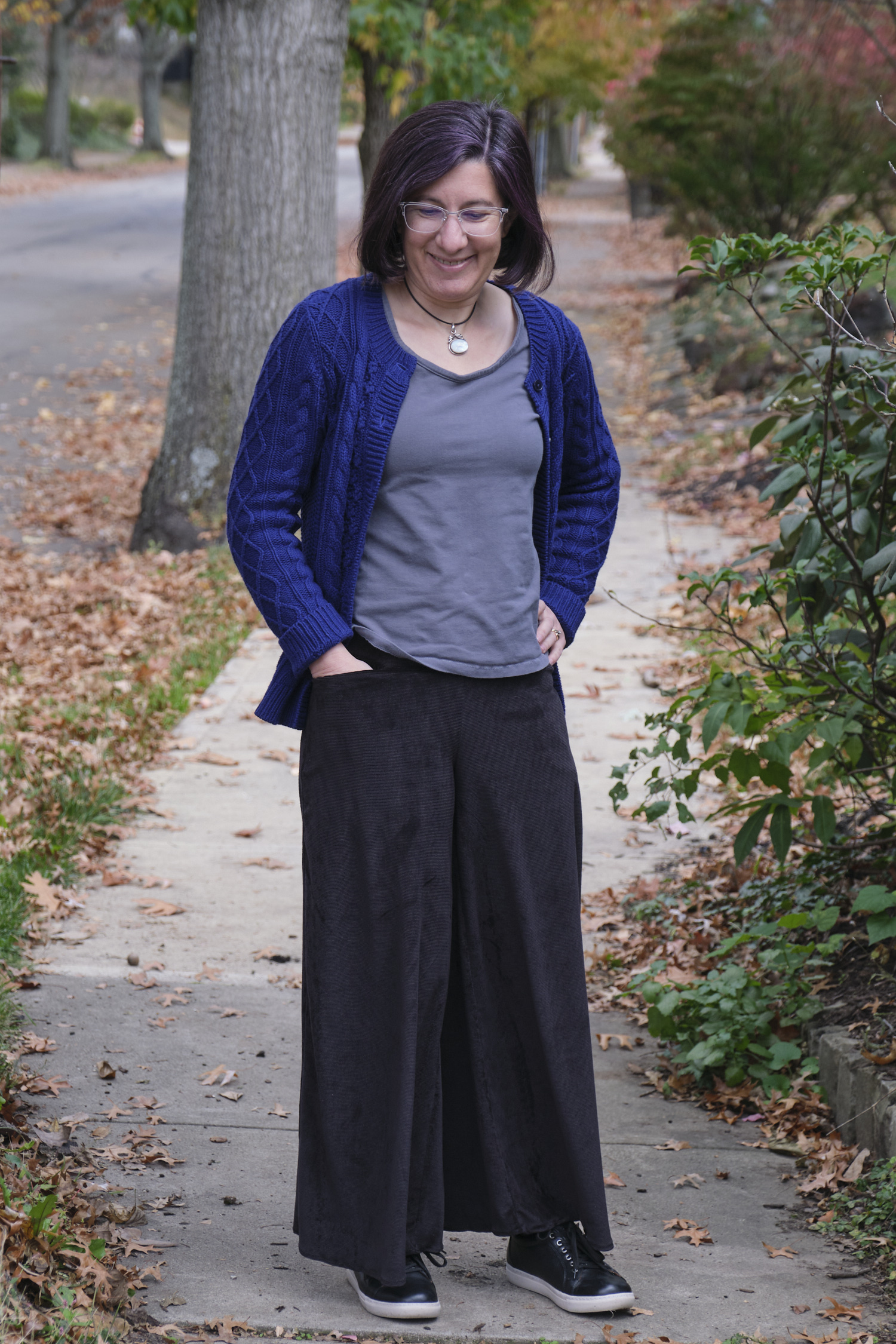
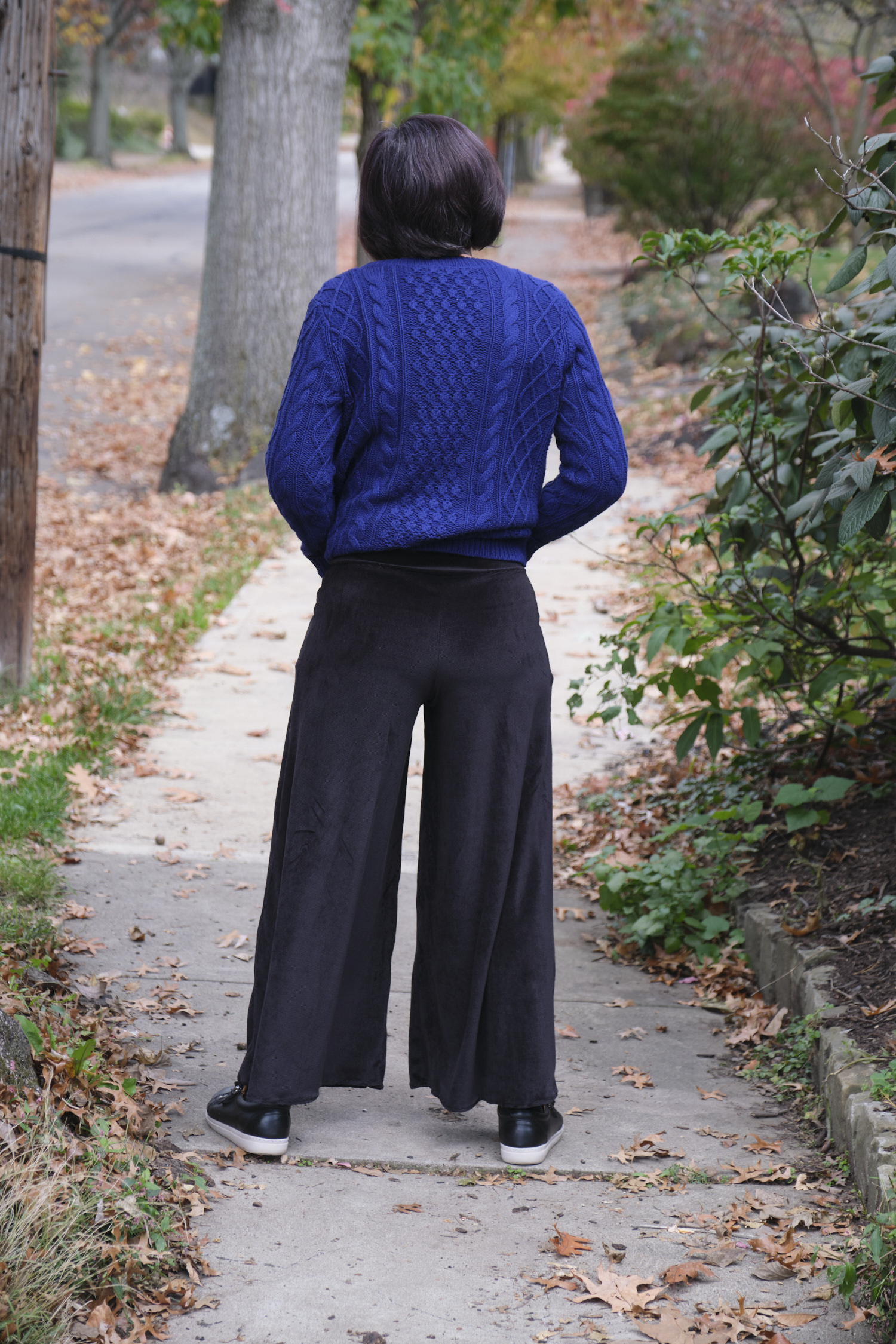
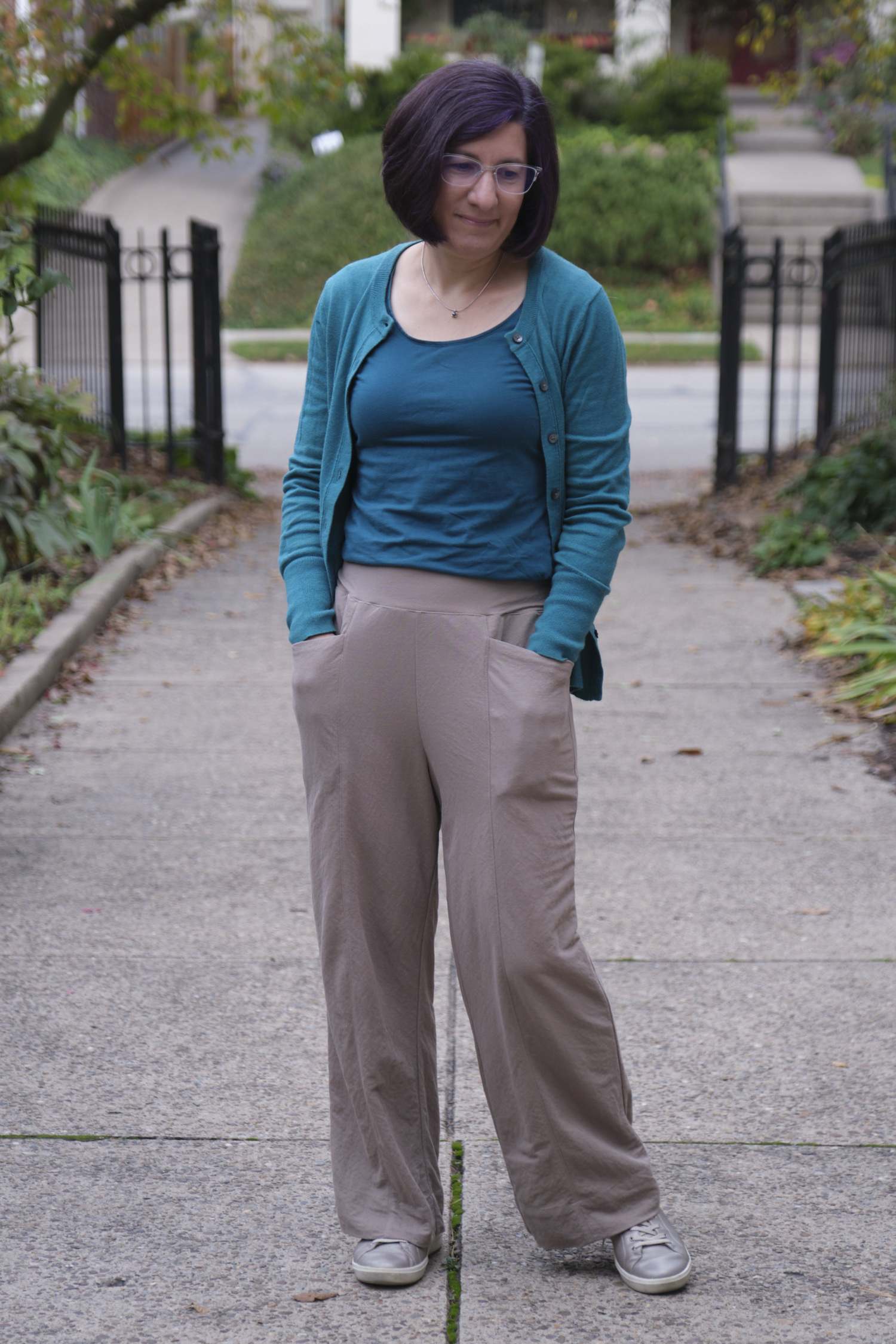
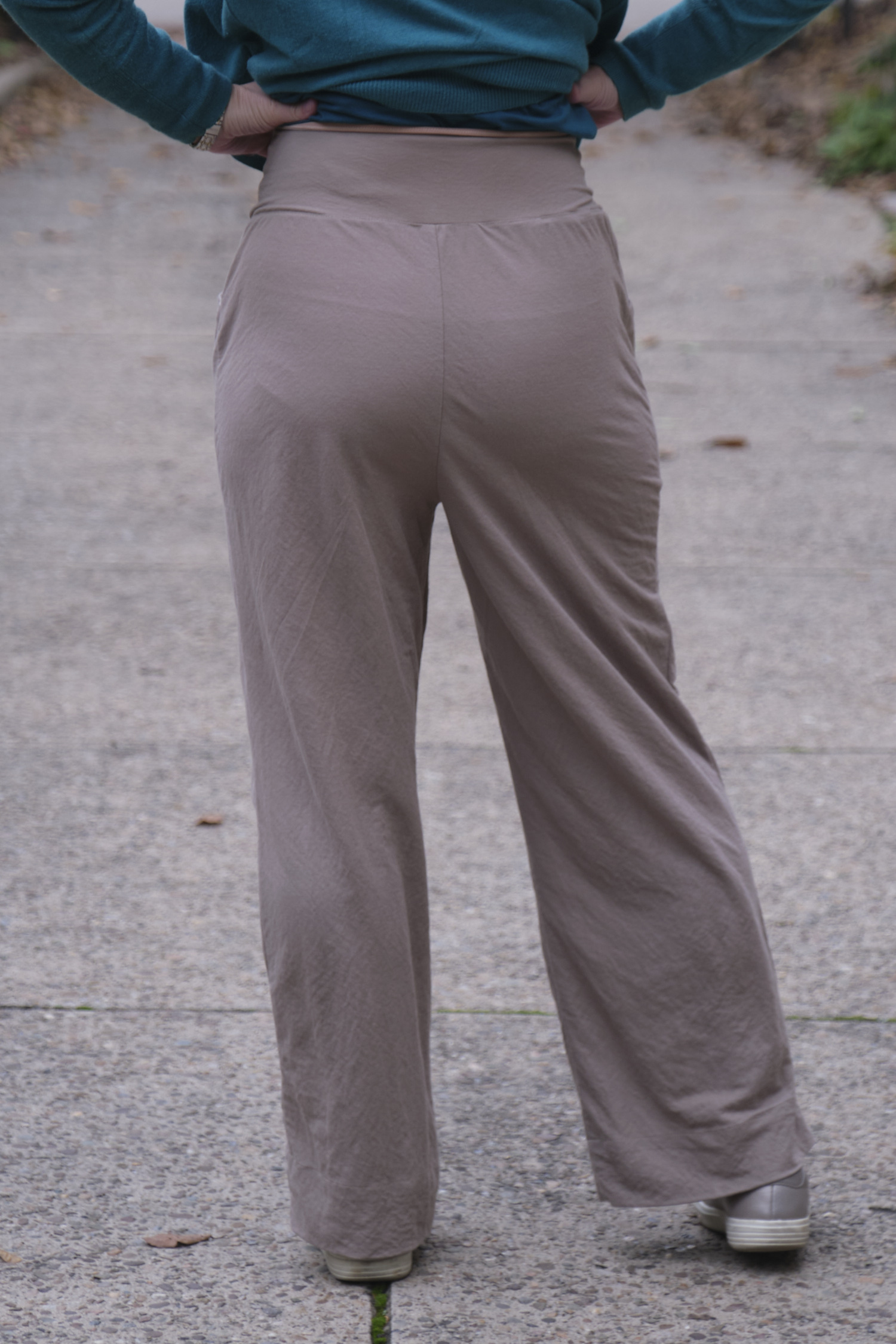
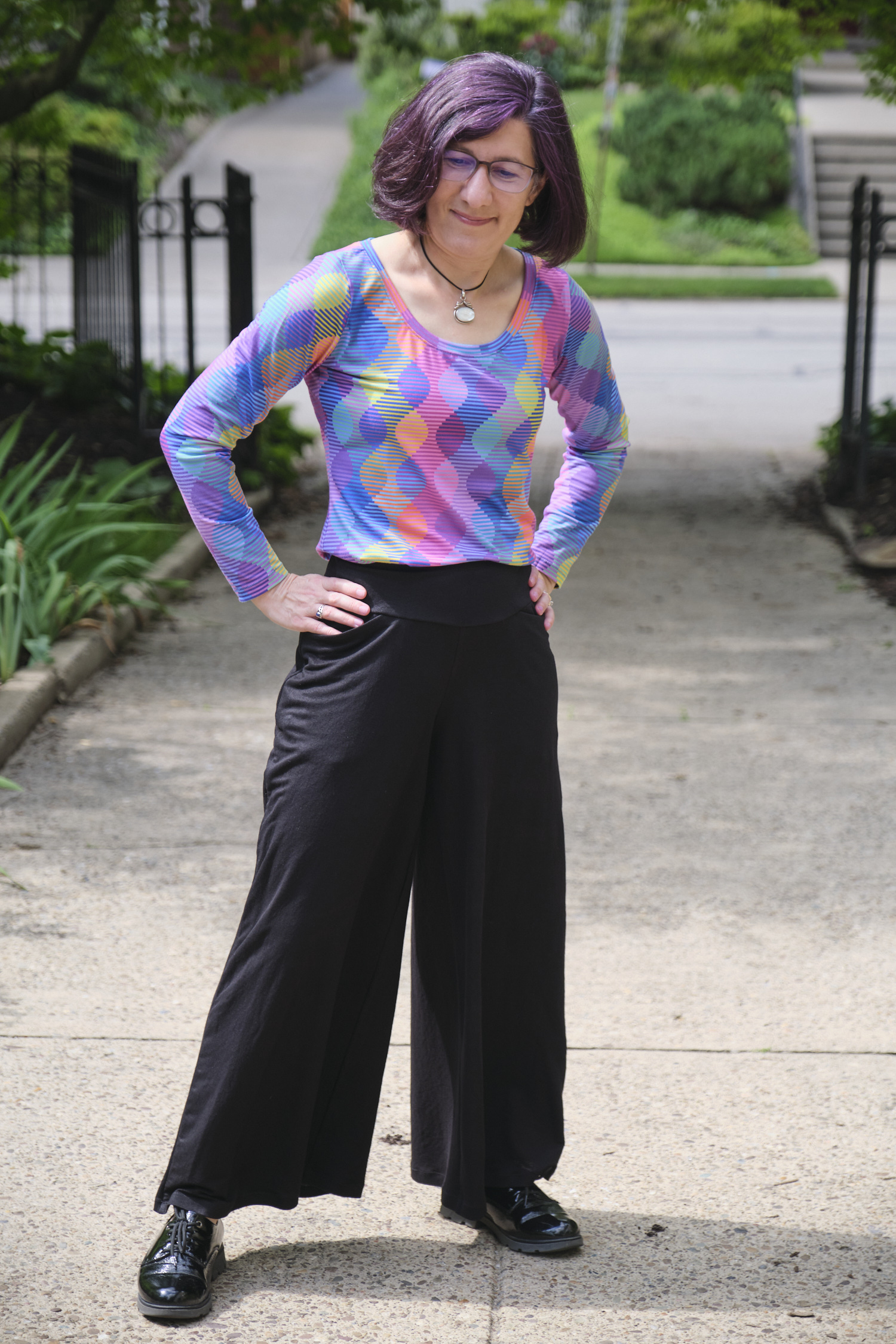
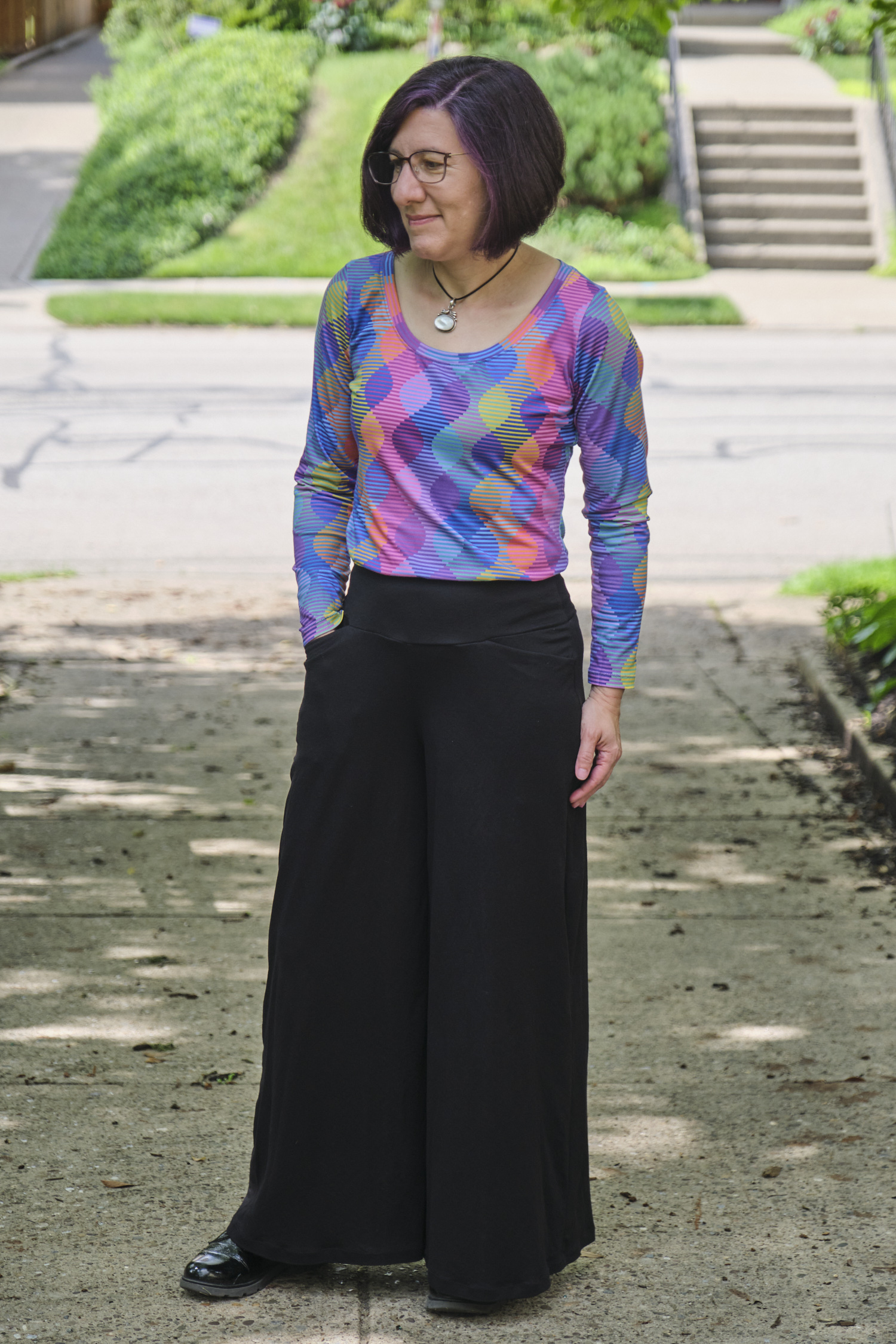
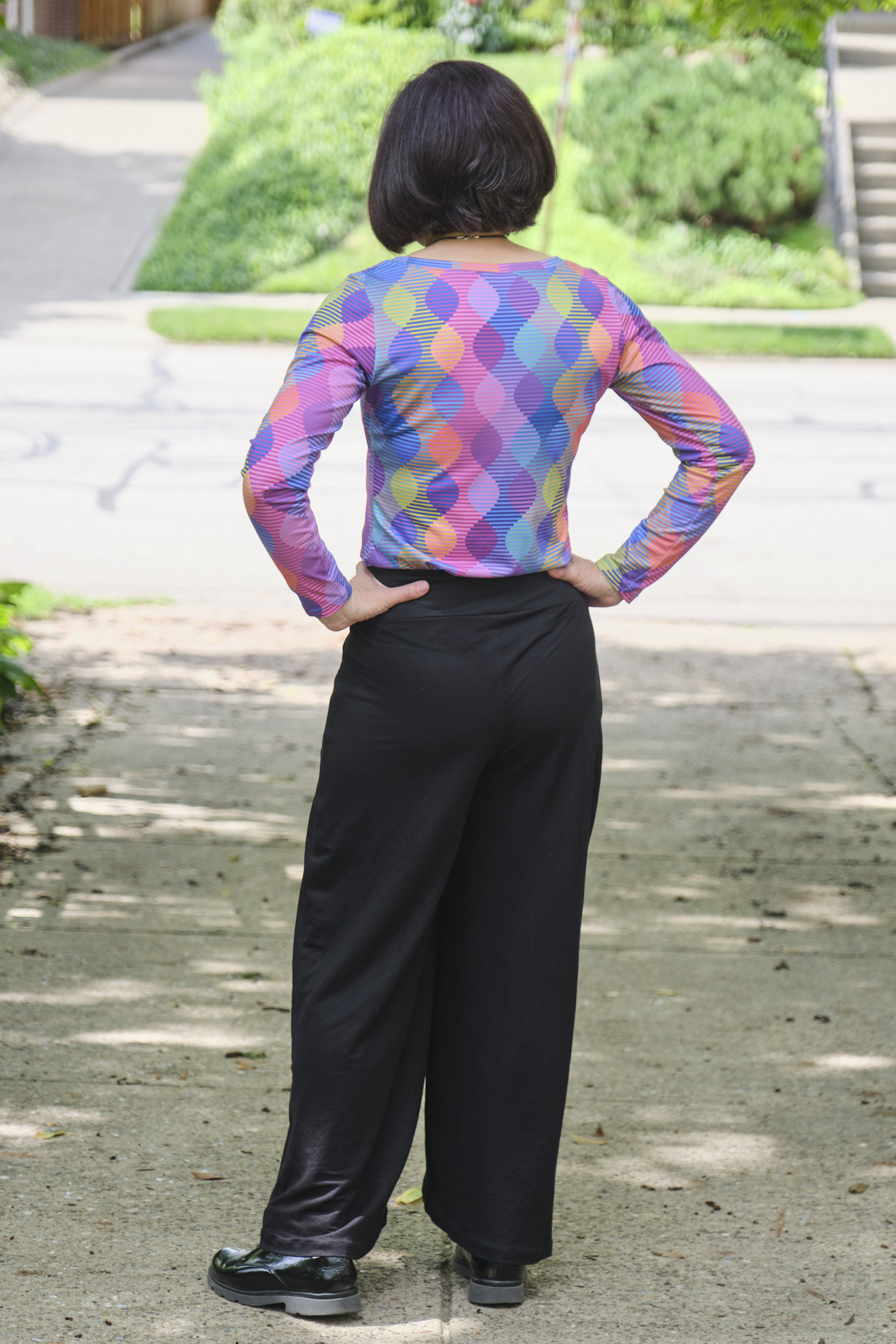
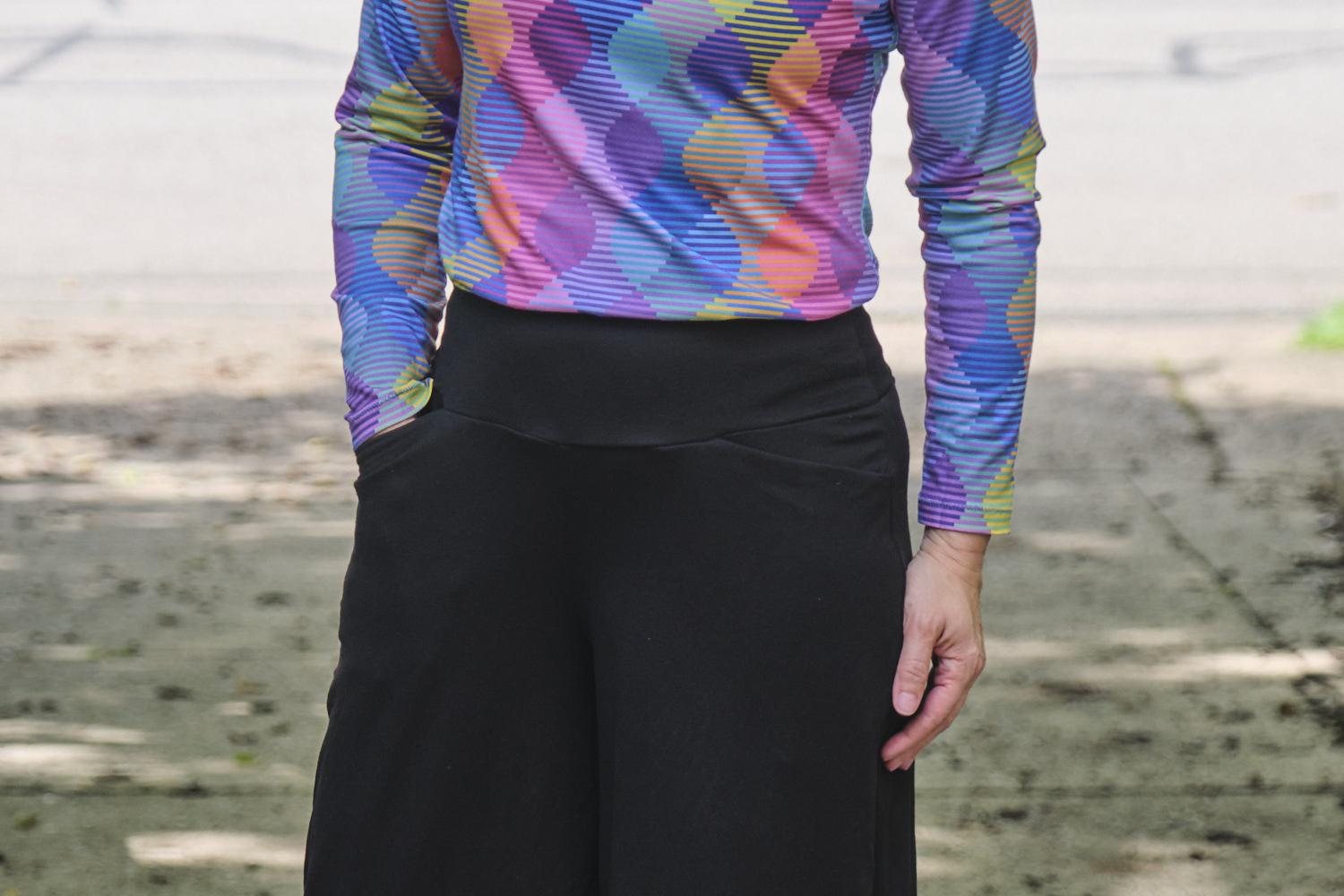
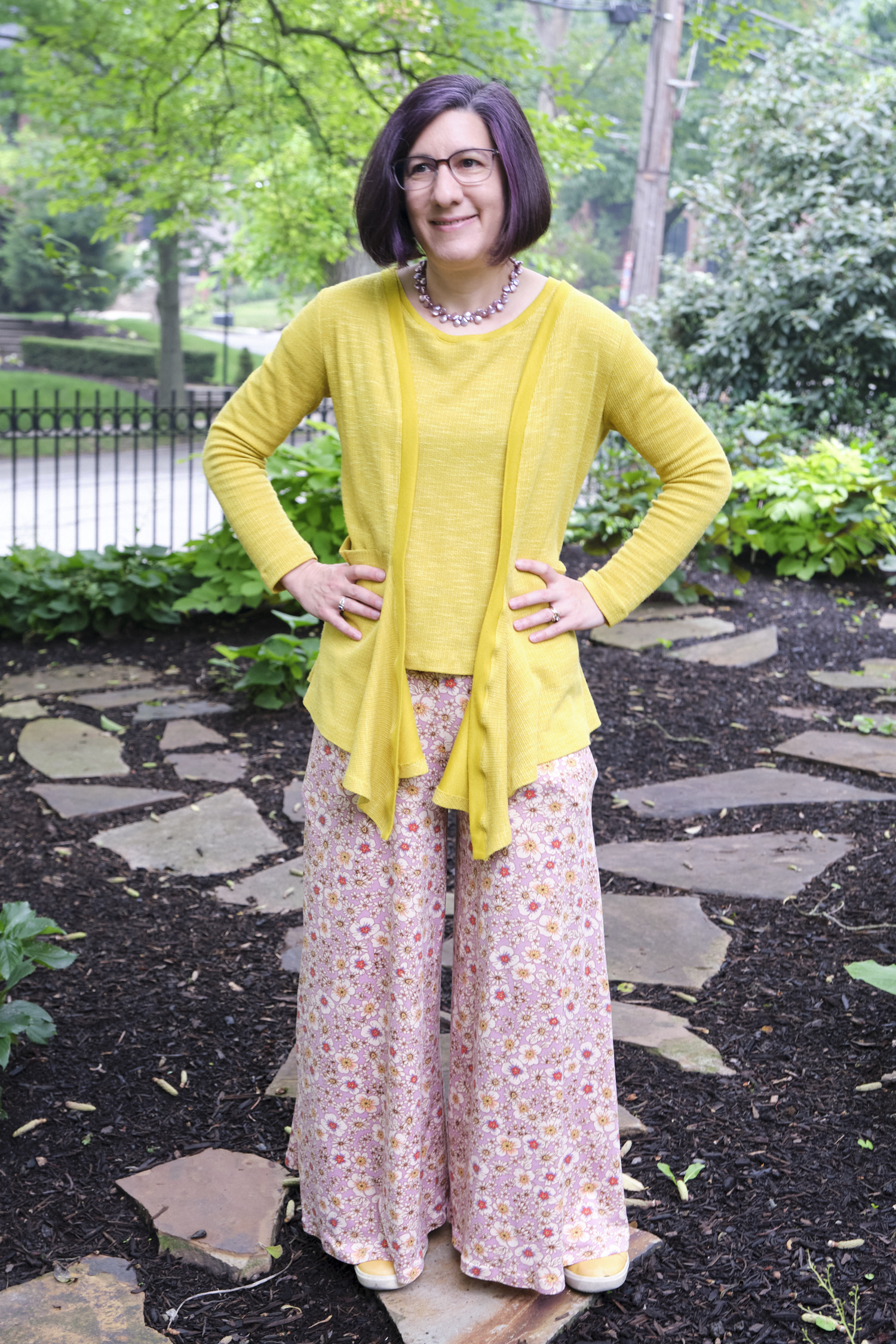
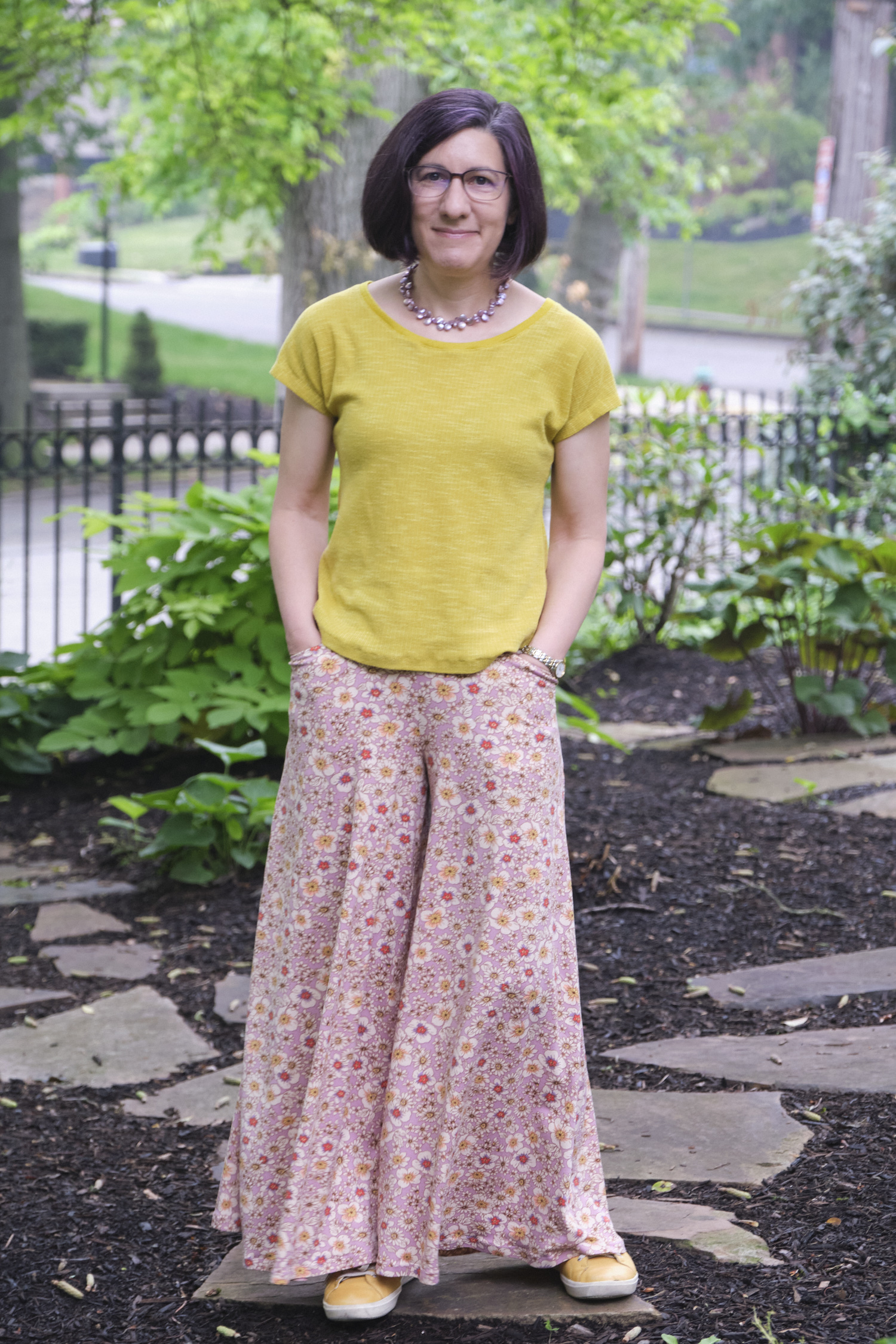
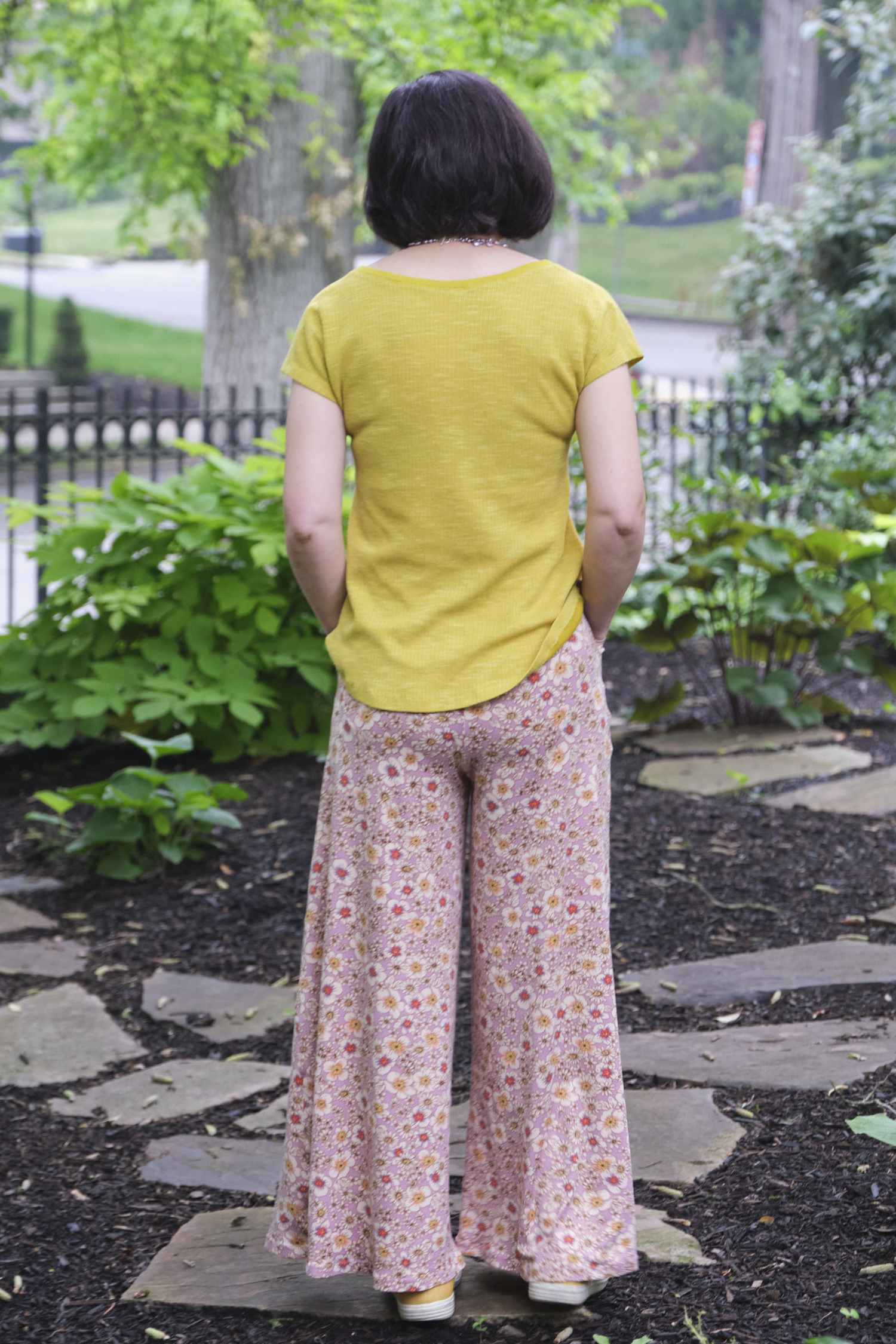
I love my Pylos LiKnit palazzo pants made with my adaptation of the Sinclair Cleo pattern, but they are more of a summer weight and not so good for our chilly Fall weather. So I made a new pair in black Surge’s stretch velour corduroy last week. This is a somewhat slinky corduroy, very soft and a medium weight and horizontal wales. It makes for a super comfy pair of Fall pants (with pockets, of course!), perfect to wear with a chunky sweater. When it gets colder I’ll probably wear tights or leggings under them. Wide-leg pants are very comfortable and cool in the summer because they let the air flow, but that’s less desirable for cold-weather wear and thus may require layering. But either way, these pants are comfy like my pajamas.
I sewed the pants using the same adaptations of the Cleo pattern I used previously, and lined the waistband with Surge’s black quad performance jersey knit. To keep the tops of the pockets from sagging I sewed a strip of clear elastic into the seam allowance of the diagonal seam at the top of the pockets.
I’m also wearing a Sinclair Bondi shirt here I sewed last year and never got around to photographing. This is a grey cotton-lycra fabric. I tried a binding rather than a band on the neck for this one.
Back in August I tried out the Pietra Pants and Shorts pattern from Closet Core Patterns. A friend made a couple of pairs of these pants and the pocket design immediately caught my eye.
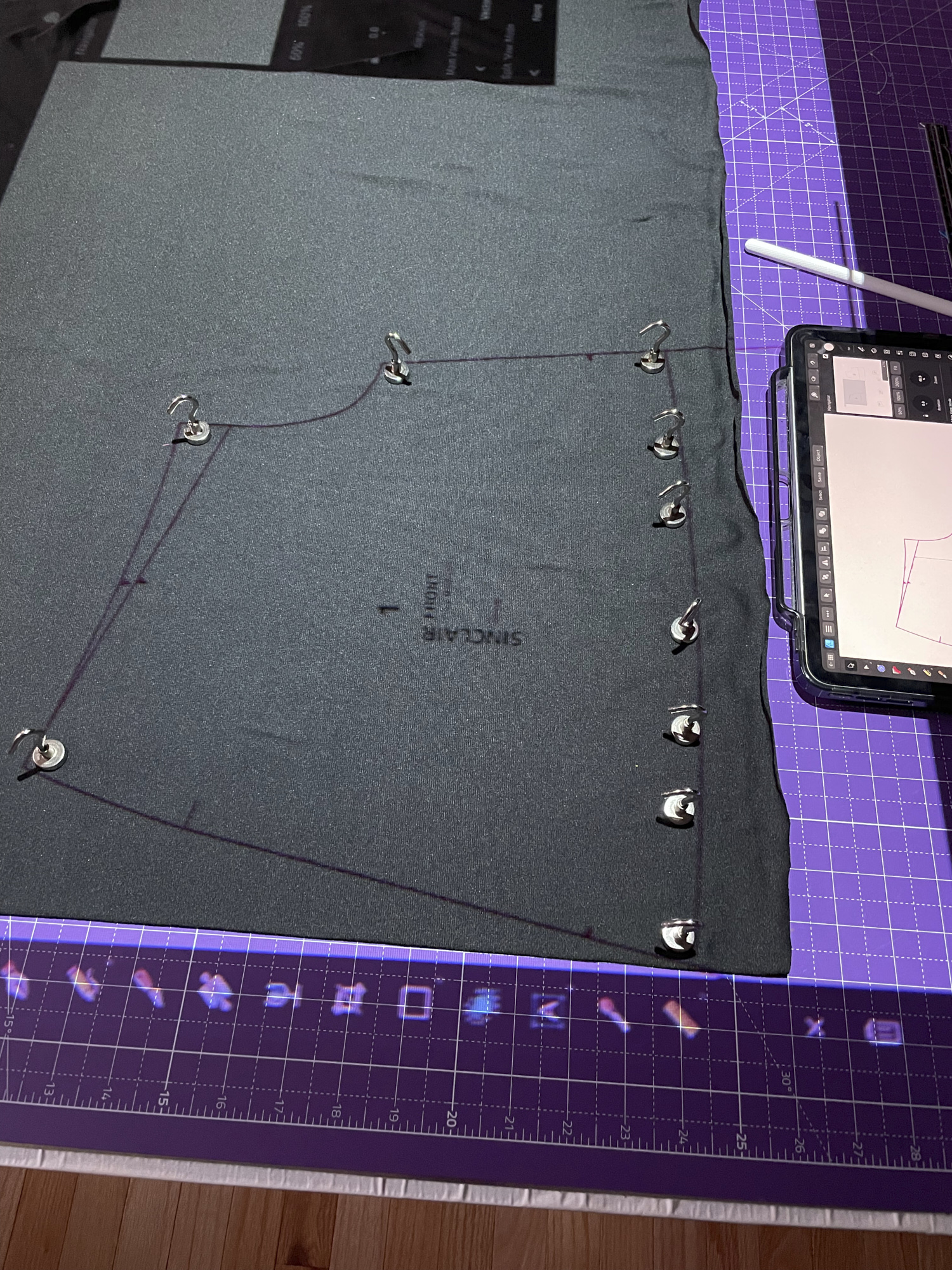
Closet Core does not seem to offer projector files, so I used their copyshop pattern, designed to be printed on two A0 pages. I used Affinity Designer to select the layer for the size I wanted, thicken the lines, copy and paste the pieces onto one large page, and rotate them all in the correct direction for cutting. This was pretty easy to do.
The pattern did not come in a petite size, but as I like high-rise pants, the only modification I thought would be needed for my short stature was to shorten the pants. I cut out size 6, but shortened the bottom hem of all the pieces by 4.5 inches. I made view A, the wide leg pants. There are also instructions for tapered leg pants and shorts.
Although the pattern was designed for lightweight woven fabrics, I used Pylos Liknit fabric, which is actually a knit fabric. But having used Liknit for two other pairs of pants, I knew it doesn’t stretch a lot and is fairly stable, so I decided to treat it as if it was woven. I used the linen colorway. The main part of the Pietra pants that you don’t want to stretch is the front waist band, and since that is interfaced, there wasn’t any issue with unwanted stretching. I think this fabric worked out well for this pattern. But I had a lot of trouble with the back of the waist band and it is possible the fact that it wasn’t actually a woven contributed to the difficulties I had, but I’m not sure.
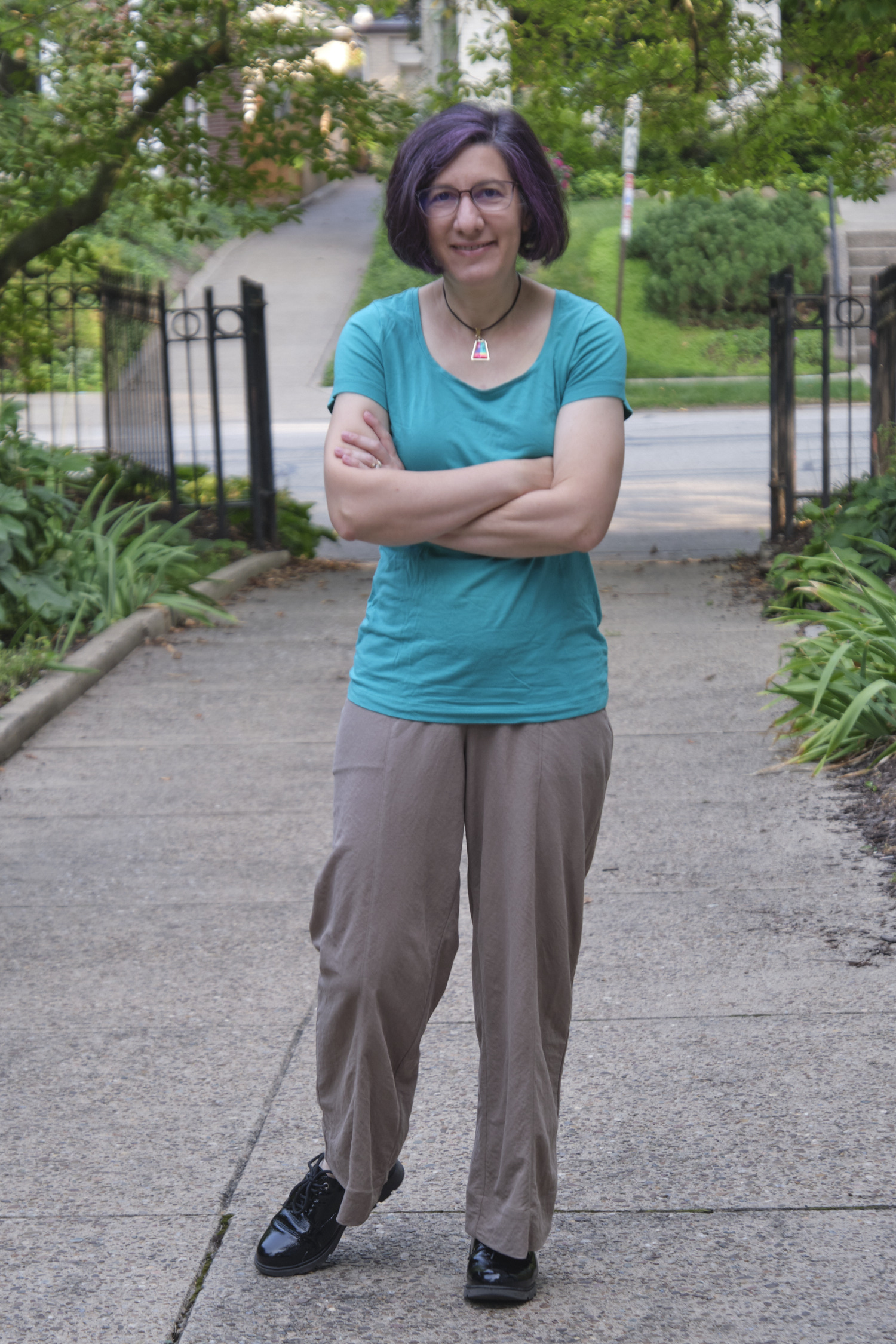
The instructions were clear and easy to follow for the most part and the pattern is nicely drafted. The pocket and waistband are a bit tricky, and some of the construction is not completely intuitive. However, I found if I carefully followed the instructions, used the diagrams, basted all the seams where the instructions recommended basting, and matched all the notches (I marked the notches on my fabric with my trusty Crayola washable fine-point markers), it all came together the way it was supposed to. The result is a very clean and professional look in the front. I topstitched the front leg seams, which was optional, but I thought it gave a nice finished look.
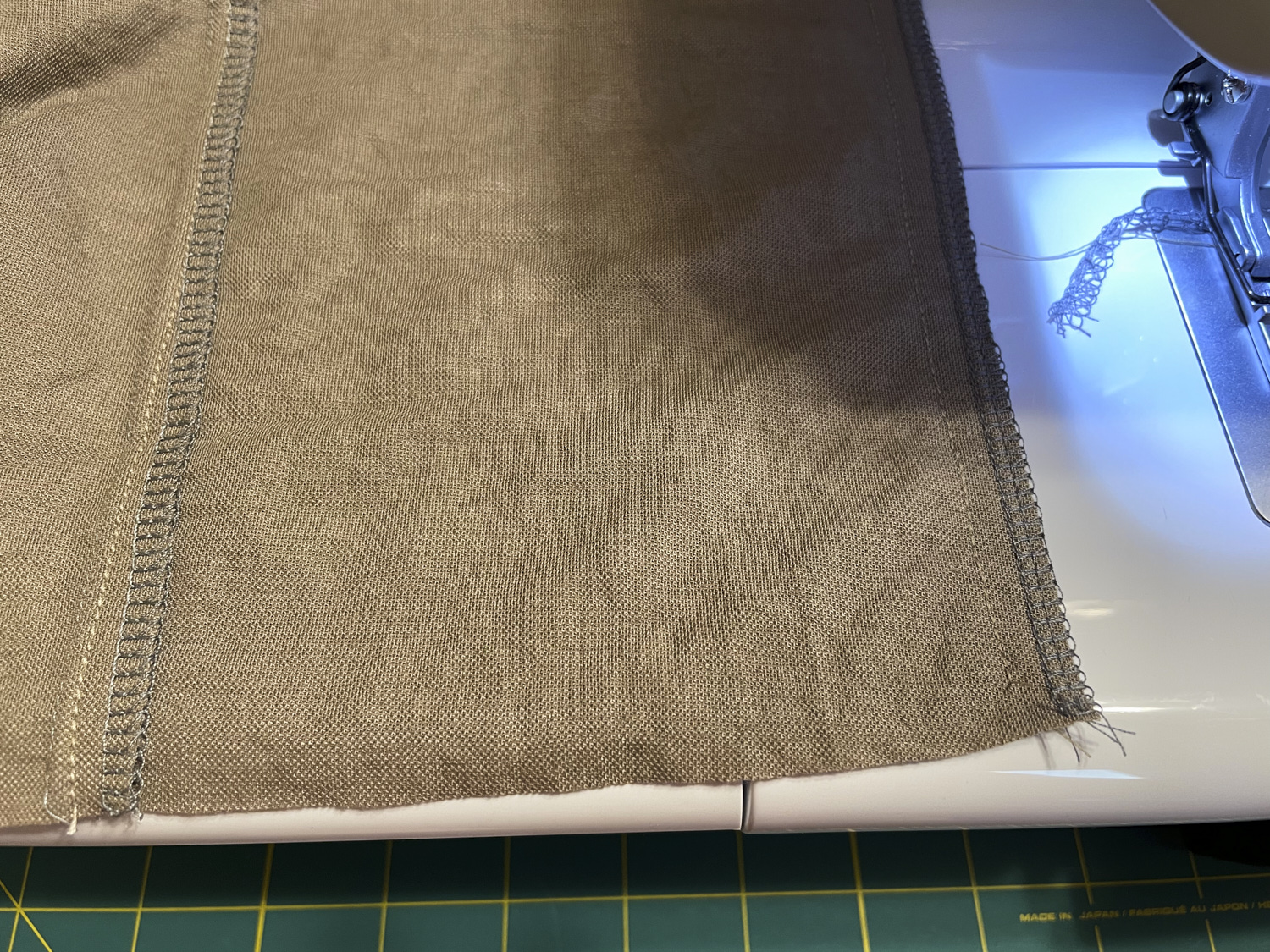
I sewed all the seams with my regular sewing machine at 5/8 inch as instructed, and trimmed to 3/8 inch and serged in one step with my serger. This is only my second serger project and the first one with any major amount of trimming, so I’m still fascinated by watching the trimmings slide into the bucket. The pattern didn’t specify trimming on the inner our outer leg seams but I went ahead with that as I had for the other seams.
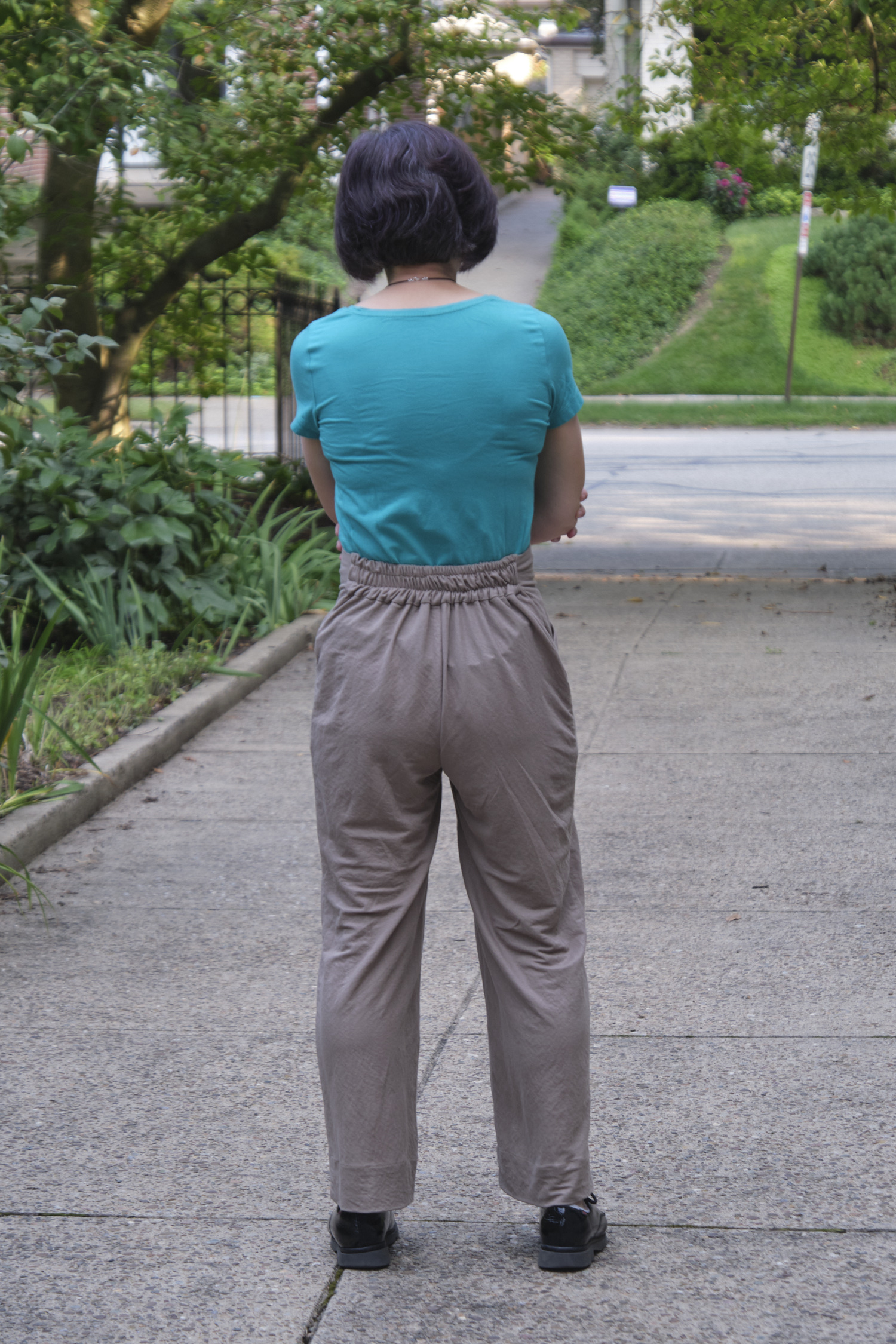
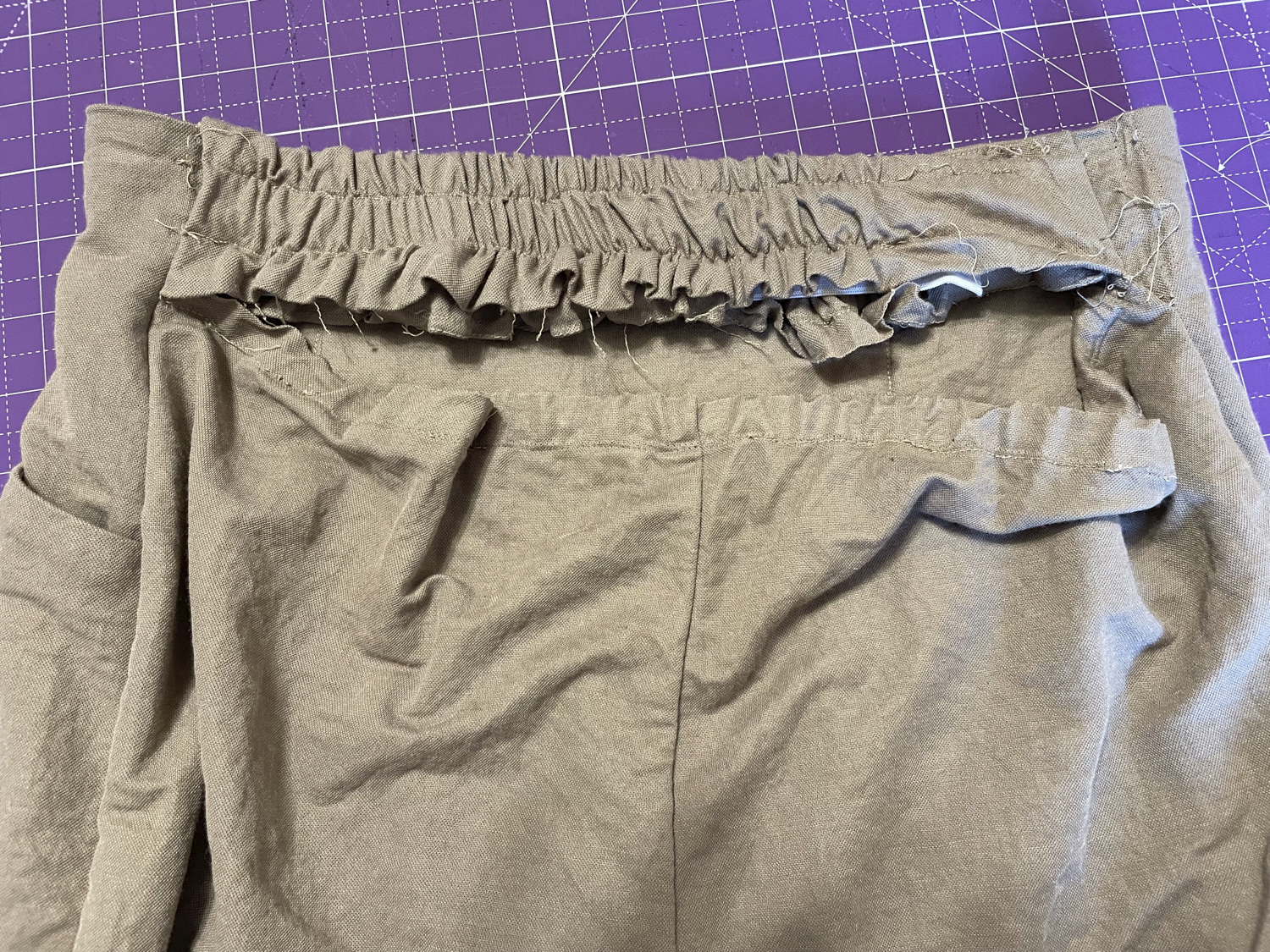
Everything went really well until I got to installing the waist elastic. For a size 6, the instructions said to use 12 inches of 2-inch wide elastic. I attached one side and pinned the other and tried on the pants. The waist was way too big. I pinned the elastic shorter, but the front of the pants pulled to the back. I decided some grading was in order. I unpicked part of the inner waistband seam so I could grade both sides of the waist by .75 inches, bringing the new line of stitching down about 6 inches to right above the pockets. I probably could have graded it even more. Then I shortened the elastic to 10.5 inches and sewed it into the waistband. The instructions direct you to sew two parallel rows of stitching in the back waistband, through the elastic, while stretching the elastic. This was easier said than done. I could have used some more hints about how to achieve this. In the end I got it done, but my back waistband looks messy. That said, even if I had sewn it well, I think this style of gathered waistband would look messy, and it pulls the front more than I would like, which is not very flattering. With an untucked shirt it looks much better.
The instructions call for a 2-inch hem, but I ended up doing a 2.5-inch hem to get it to the right length. Of course, I could have trimmed .5 inches off before I hemmed it.
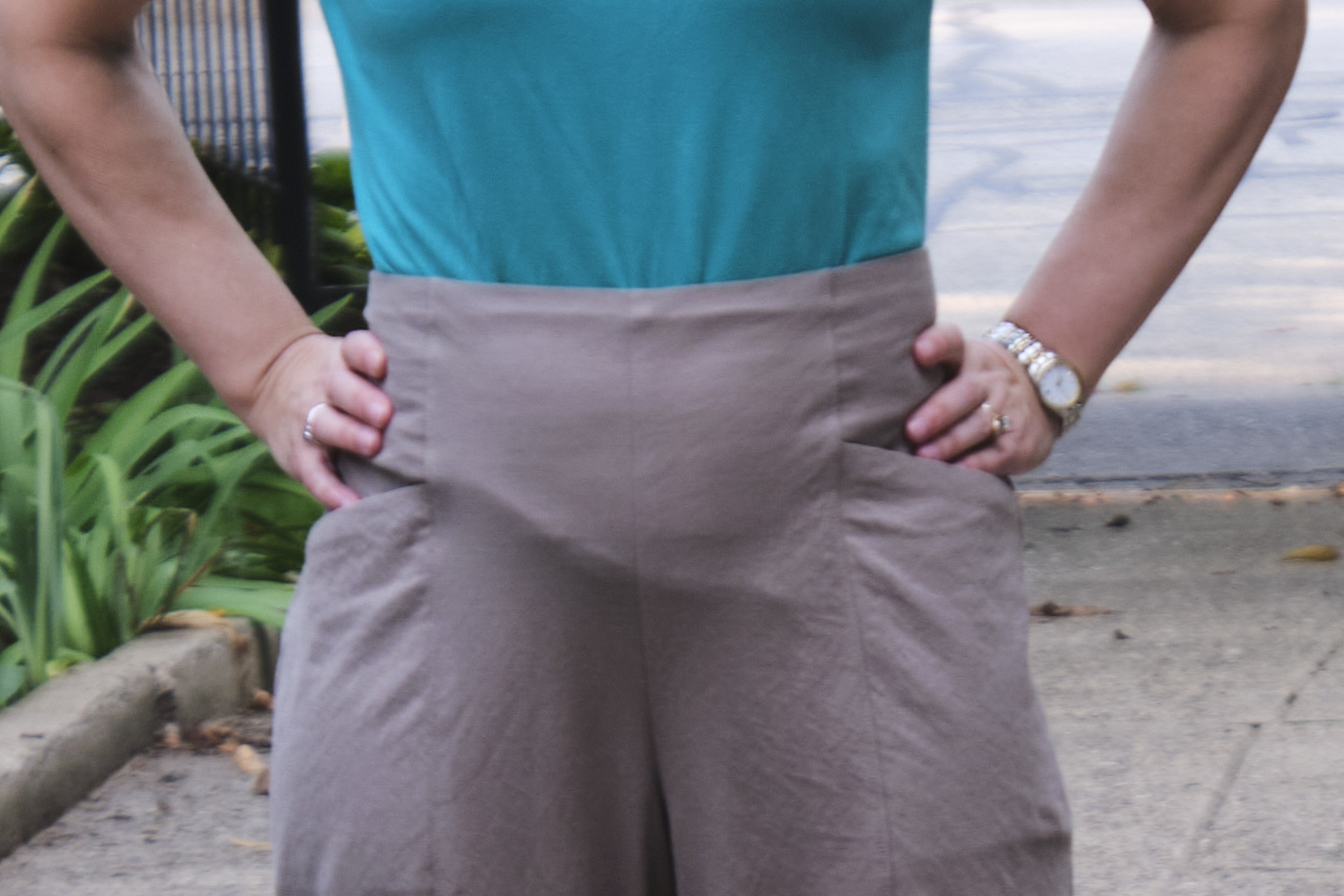
The pants didn’t take that long to make and they are very comfortable to wear. I love the fit of the high waist, but I really don’t like the look of the back waistband, and the way the elastic pulls the front in, it ends up not being all that flattering against my tummy. As long as I keep my shirt tucked in, I think the pants look pretty good.
I’m apparently not the only one who has had some trouble with the elastic waist. Closet Core offers instructions for adding a zipper, and other bloggers have reported having to redo the waist with darts. I think the elastic works better on some figures than others, and may also work better with some types of fabric. I considered adding a zipper, as suggested for those with smaller waists in proportion to hips, but figured it would make these otherwise comfy pants less comfortable. So Instead I decided to unpick the back waistband and chop off the top 2 inches of the pants so I could add a yoga waistband. It was a shame to cut into the beautiful finished front panel, but this seemed like the best way to turn these into pants I would actually wear.
I constructed a 3-inch yoga waistband using the Sinclair Cleo pattern I have used successfully for other Liknit pants. Since the Liknit has some stretch to it I was able to make the outside of the yoga waistband in the same fabric as the rest of the pants. I used beige QUAD Performance Jersey Knit for the inside of the waistband for a nice snug fit and didn’t add any elastic. I basted the waistband in place, tried it on, unbasted, made some adjustments, rebasted, tried it on again, and then surged the waistband to the pants. I topstitched the seam in place.
I think the pants look a lot better now. I still love the Pietra pockets and the front leg seam, but now the waistband looks good too. I might make another pair in another fabric (maybe a ponte) with the yoga waistband modification, perhaps only 2 inches next time. By the time I got around to doing this modification the Fall weather had kicked in so it is getting a bit chilly here for such light weight pants, but I expect I will wear them a lot next summer.
I feel strongly about pockets. When I sew my own clothes I make sure they have pockets large enough to hold my stuff. It is very frustrating when I buy ready-to-wear clothes with inadequate pockets. I’ve seen blazers advertised as having “adorable faux pockets” that make me want to scream. There is nothing adorable about faux pockets. But even worse, perhaps, is buying a pair of pants with pockets, only to find out that my phone does not fit in them, or that it fits but slides out every time I sit down. My husband can fit his phone, his wallet, his keys, a tube of chapstick, some change, and other odds and ends in the front pockets of every pair of pants he owns. I should be able to do that too!
What about the back pockets? Pocketing a phone in a back pocket may be ok while standing, but on me, back pockets are usually placed such that I end up sitting on my phone, which can be uncomfortable or cause the phone to fall out of my pocket. Plus, putting valuables in back pockets makes you more of a target for pick-pockets.
With pleated pants, a phone can often be completely concealed in a front pocket if the pocket bag is deep enough. However, with tight fighting pants made of stretch fabric, it is hard to avoid a phone bulge. I can sometimes fit my phone in the pocket horizontally, but it produces a bulge across my stomach that isn’t very flattering. I personally prefer to see that bulge further down the leg or more on the hip, but that requires deeper pocket bags.
I have started seeing some women’s pants advertised as having “utility” pockets. The best I can tell these are special pockets that are actually large enough to be used. Shouldn’t all pockets have utility?
I have started retrofitting the pockets of my pants that otherwise fit well, adding pocket bag extensions. It’s actually not that hard to do. Here’s how I augmented the pockets bags of a pair of black dress pants recently.
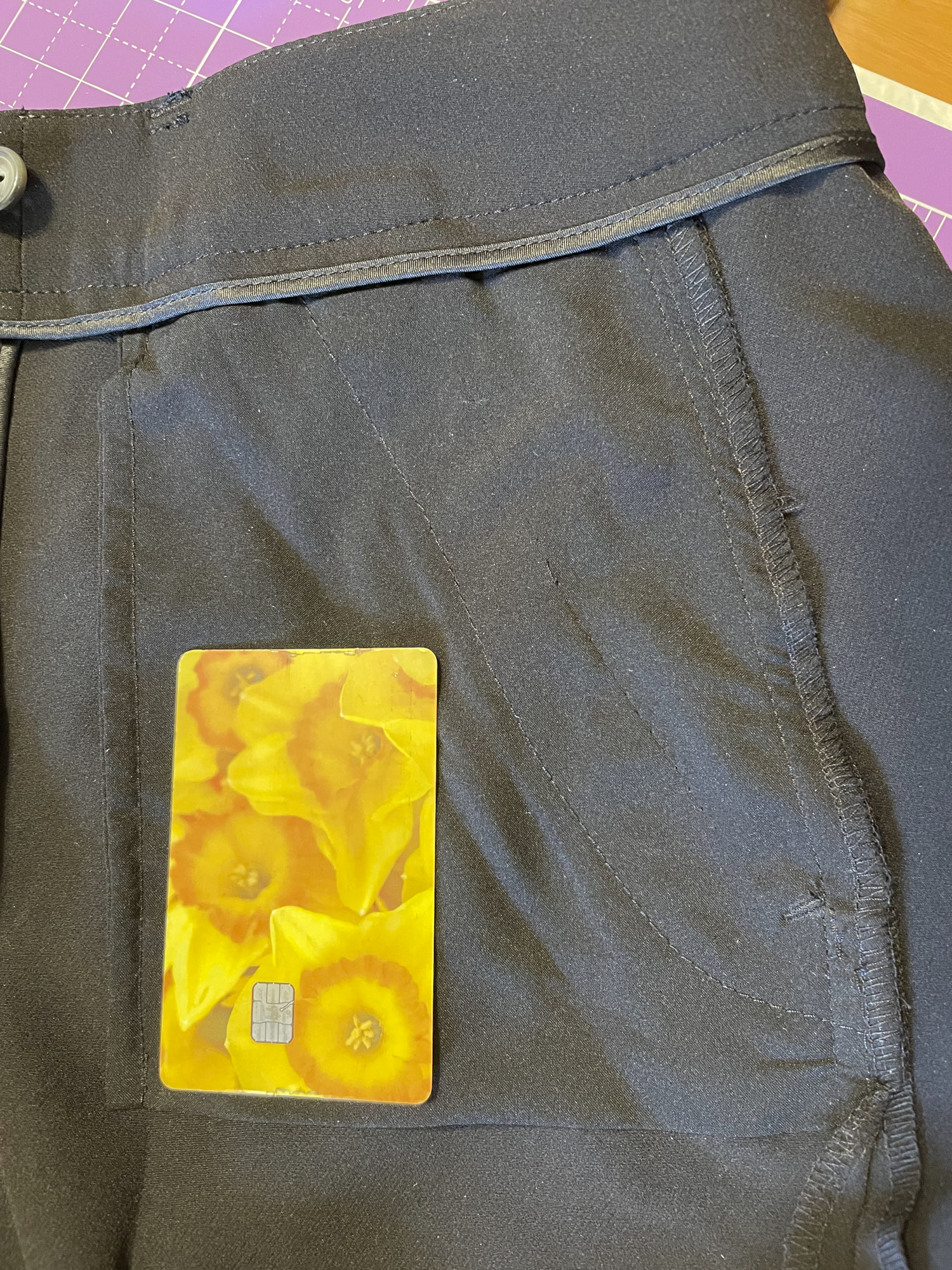
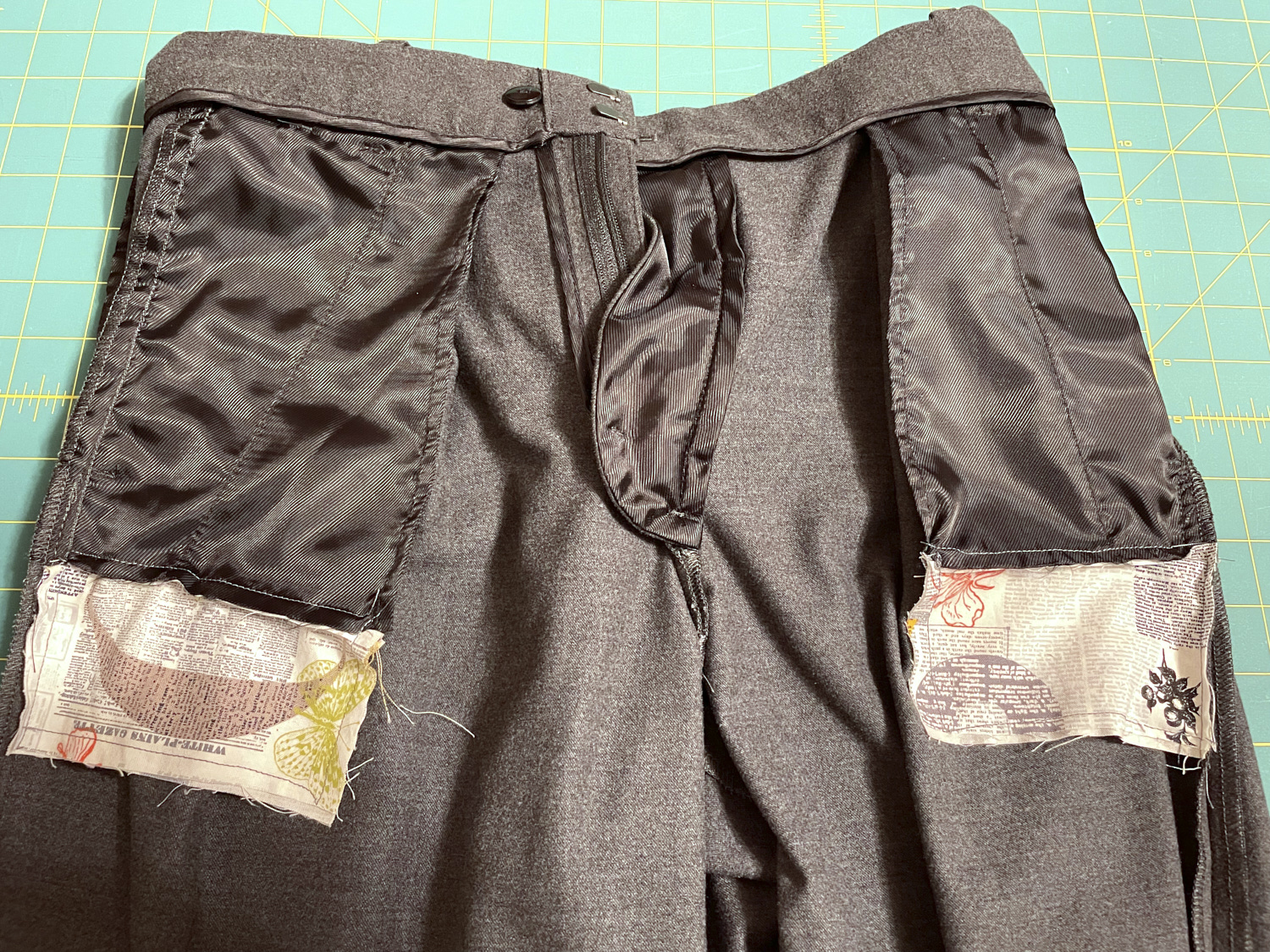
Here’s the pants turned inside out. You can see that the original pocket bag is big enough to hold a credit card and not much else. My cell phone fits, but as soon as I sit down it slides out.
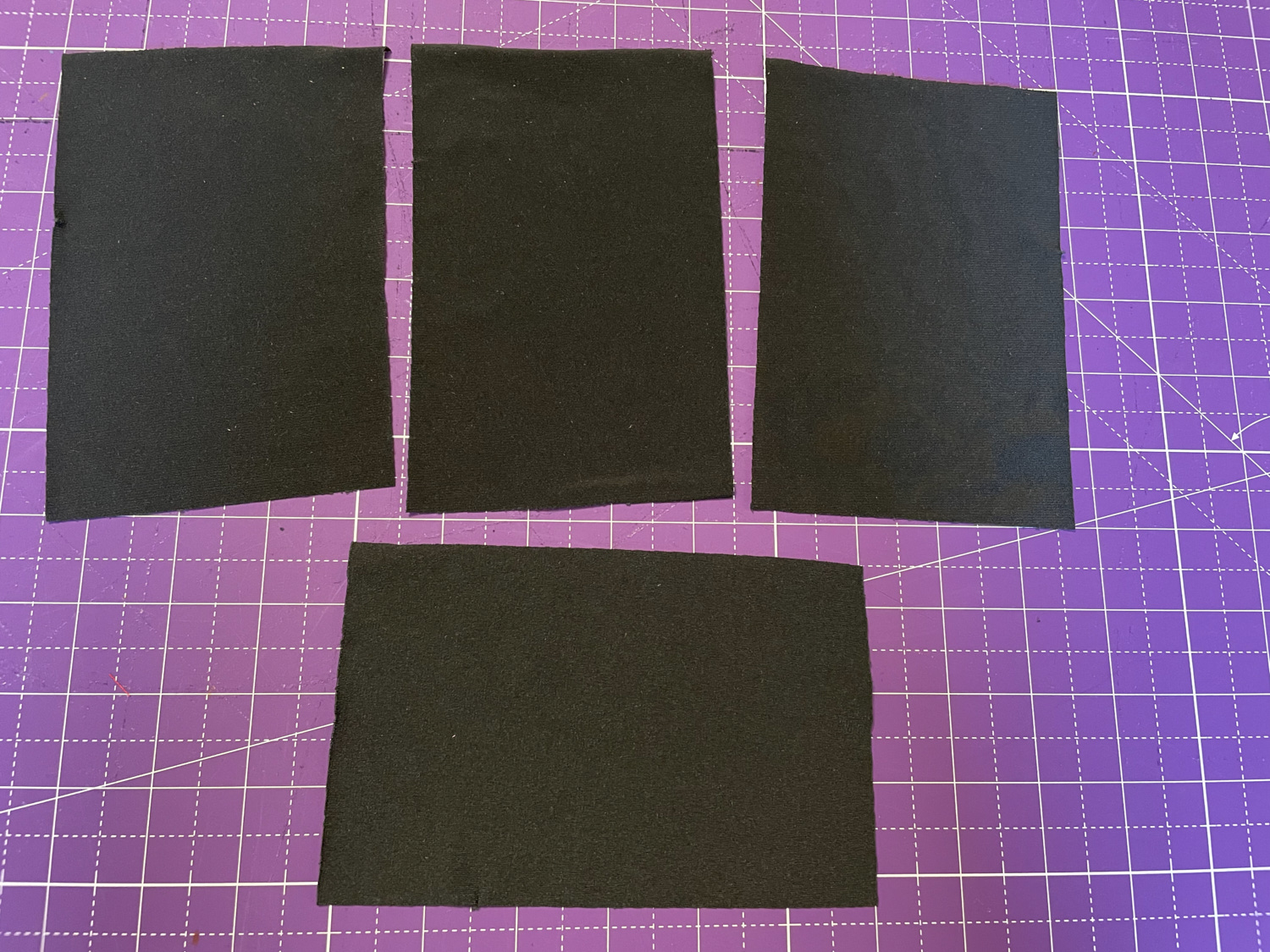
To improve this situation, the first step is to figure out how much you need to add to the pocket. I like my pockets to be long enough so that my phone will sit entirely below my hip crease when I’m sitting down. If my phone sits above the crease, it will fall out. If it sits in the middle of the bend, it will be uncomfortable to sit down. For this pair of pants, the pocket bag needed to be about 3.5 inches longer. So I cut 4 pieces of fabric 6 inches wide by 4 inches tall. You can use any sort of lightweight fabric for this. Generally people use woven fabrics for pocket bags. But I used some ITY with a little bit of stretch for these pants, which can be a little more forgiving as you sew.
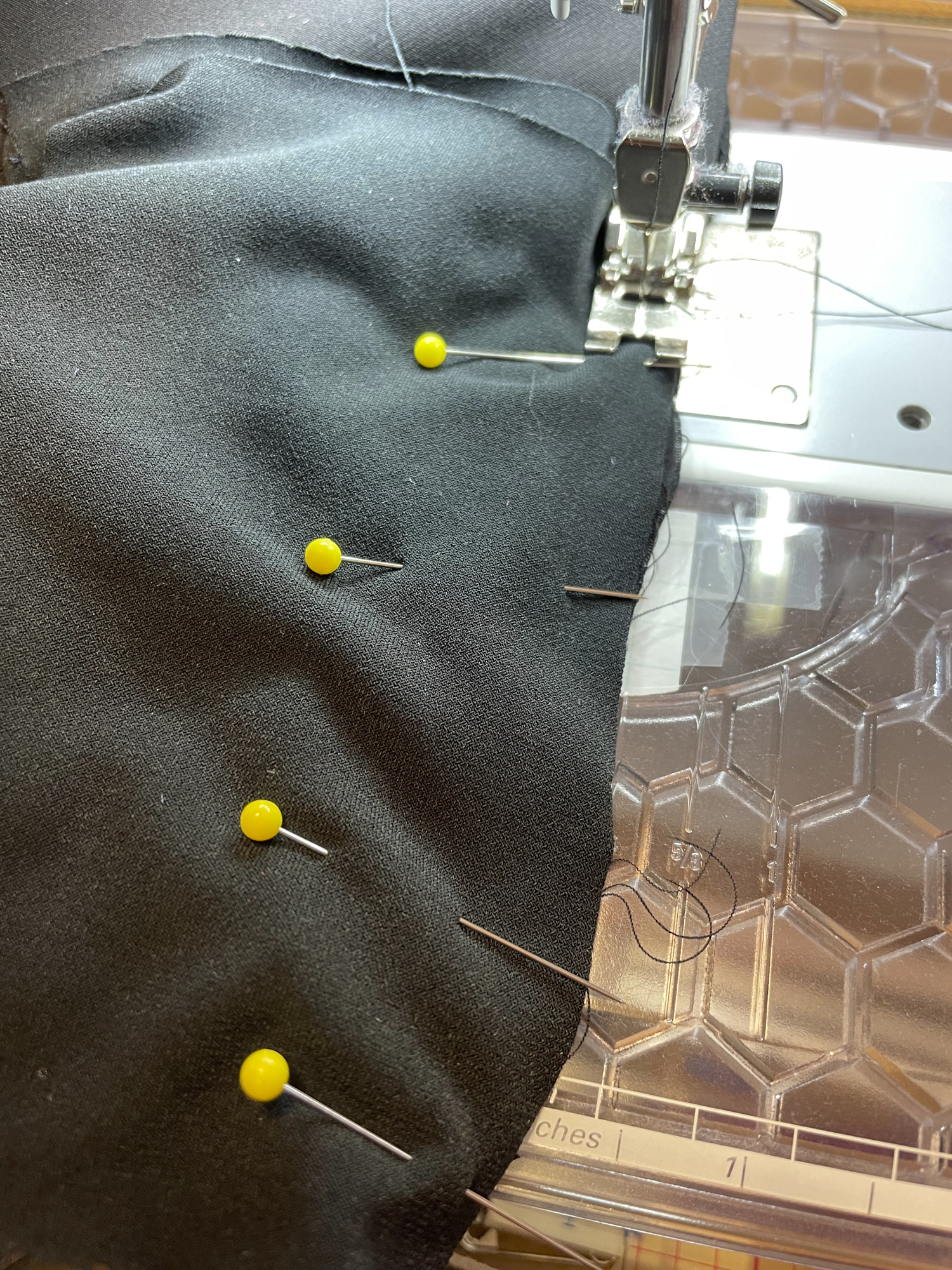
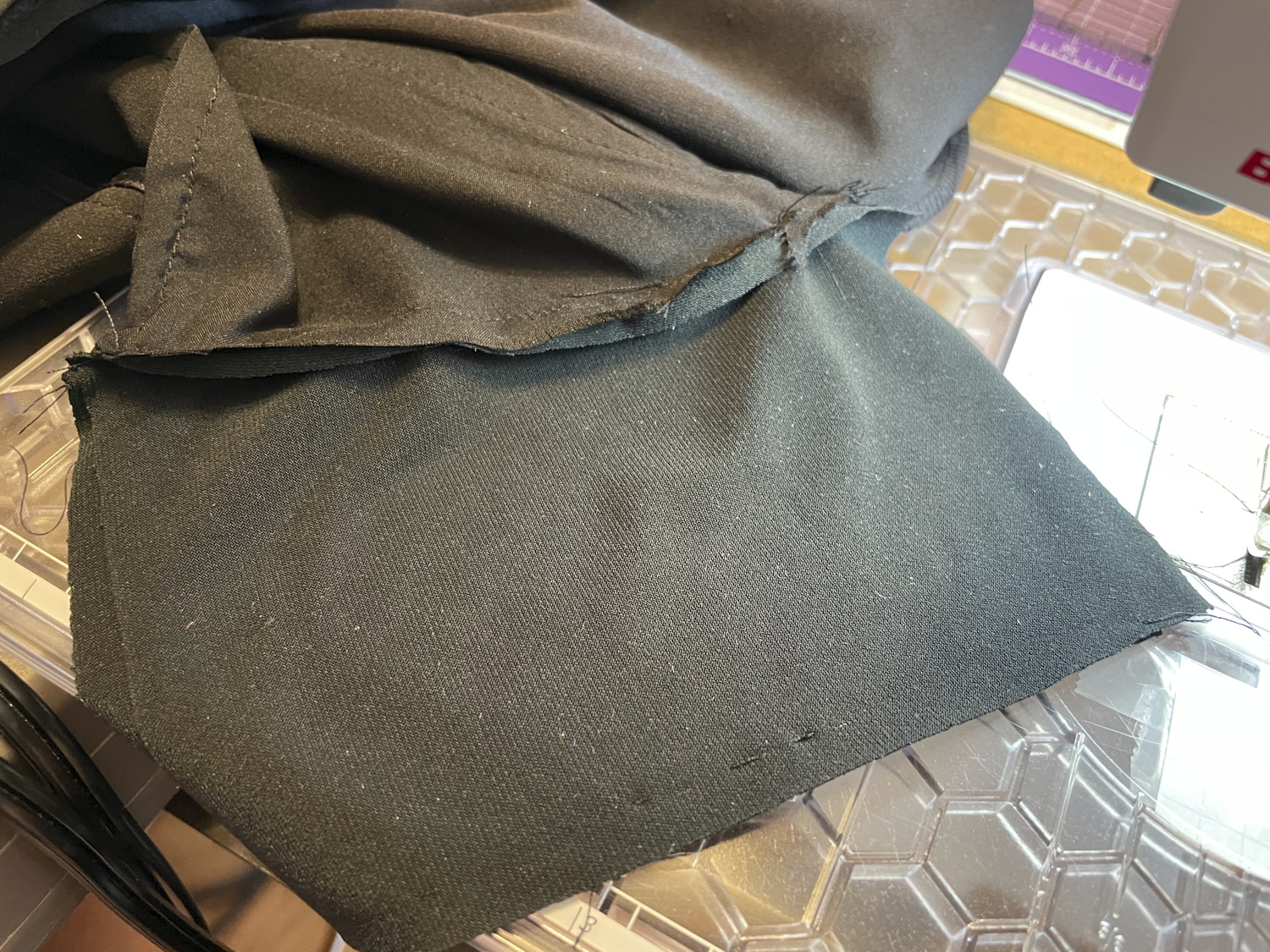
The next step is to turn your pants inside out, slit open the bottom of the existing pocket bag, and pin one piece of the new pocket bag material to the inside of the old pocket bag. If the bottom of the pocket bag is rounded, you may want to square it off. I think it works best when the seam is on the outside of the pocket so nothing catches on it when you put stuff in the pocket. Once the pocket piece is pinned, carefully sew it on. This requires some tight maneuvering with the sewing machine. Alternatively, you can use a fusible tape to fuse the old and new pocket pieces together, and then zigzag to secure.
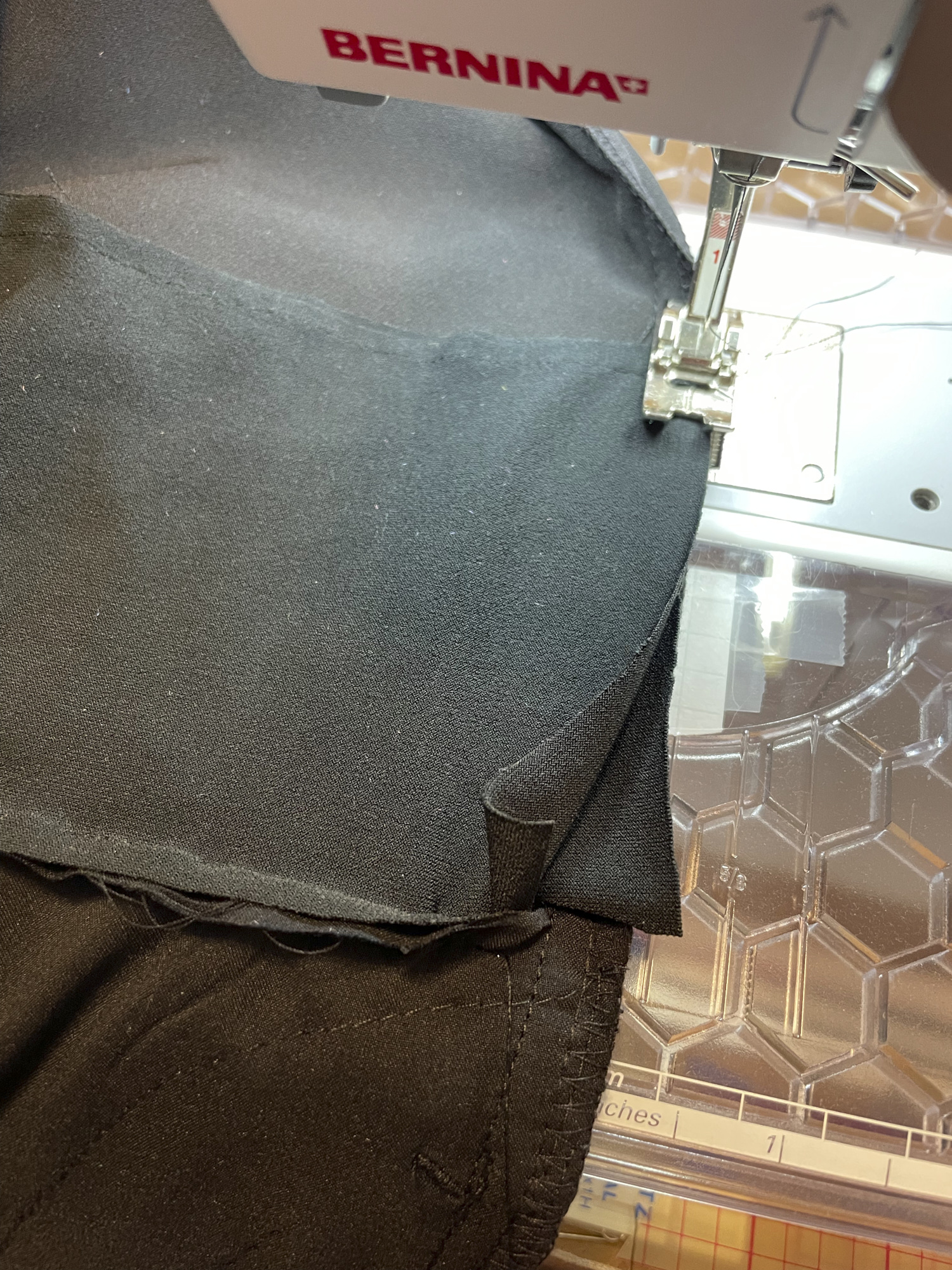
Then pin an sew the other new pocket piece on.
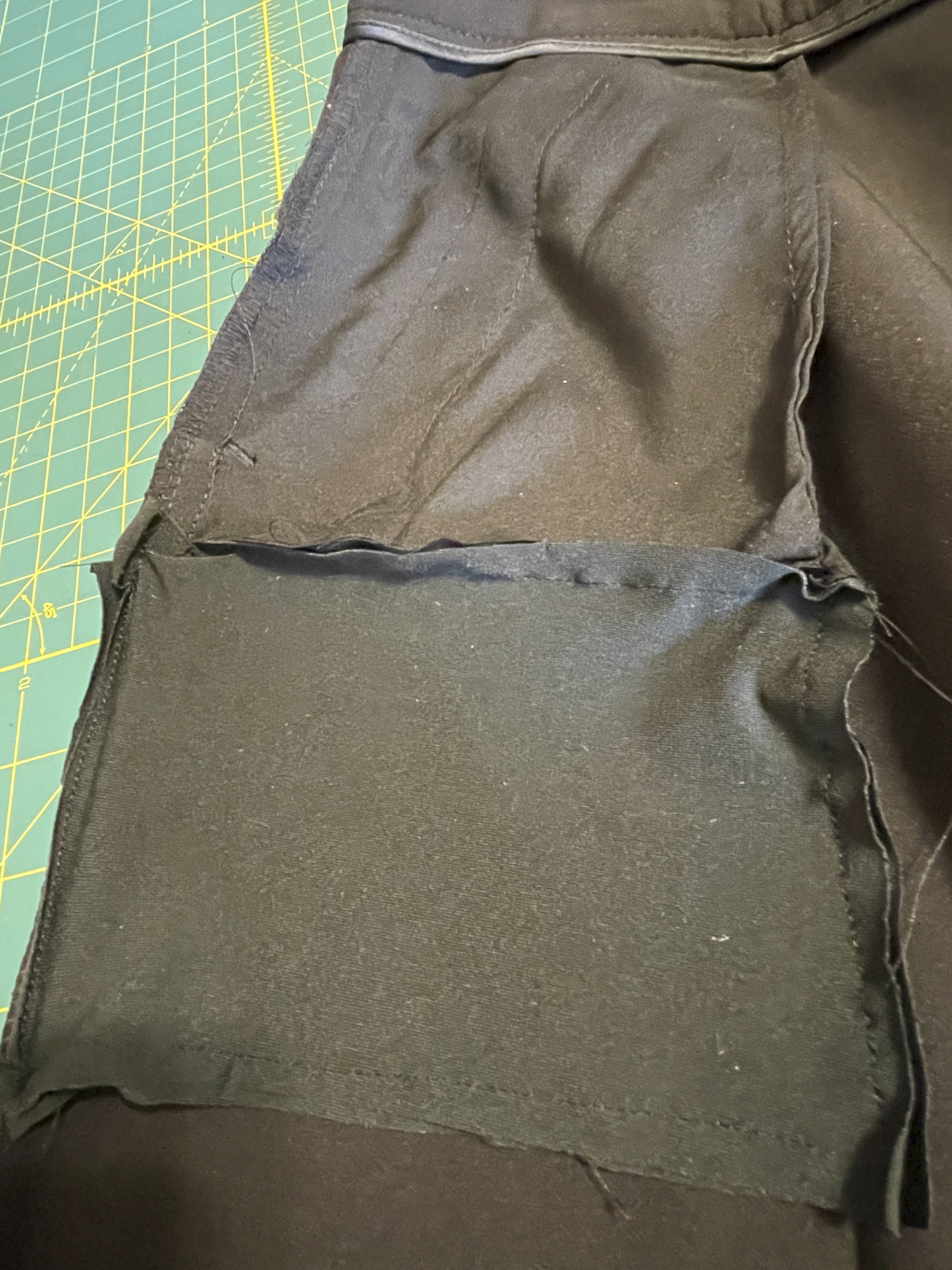
You will then have a pocket bag with two flaps on the bottom. It is not a very useful pocket at this point because it is completely open at the bottom. The next step is to sew around the three open sides. If the original pocket is anchored in the side seam of the pants, you can attache the pocket bag extension to the side seam too.
And that’s it. Now you have and extended pocket big enough to actually hold your stuff. Once you have sewn a couple of pockets this way, you will probably be able to do it without any pinning. It is important to realize that without a lot of unpicking, it is nearly impossible to make all the seams line up perfectly due to the limited space you have to maneuver, but it doesn’t really matter. As long as your pants are not see-through and any gaps you have are not so big that anything is in danger of falling out of your pocket, nobody is going to see the gaps in the pocket bag inside your pants and it will not impact the functionality of the pocket.
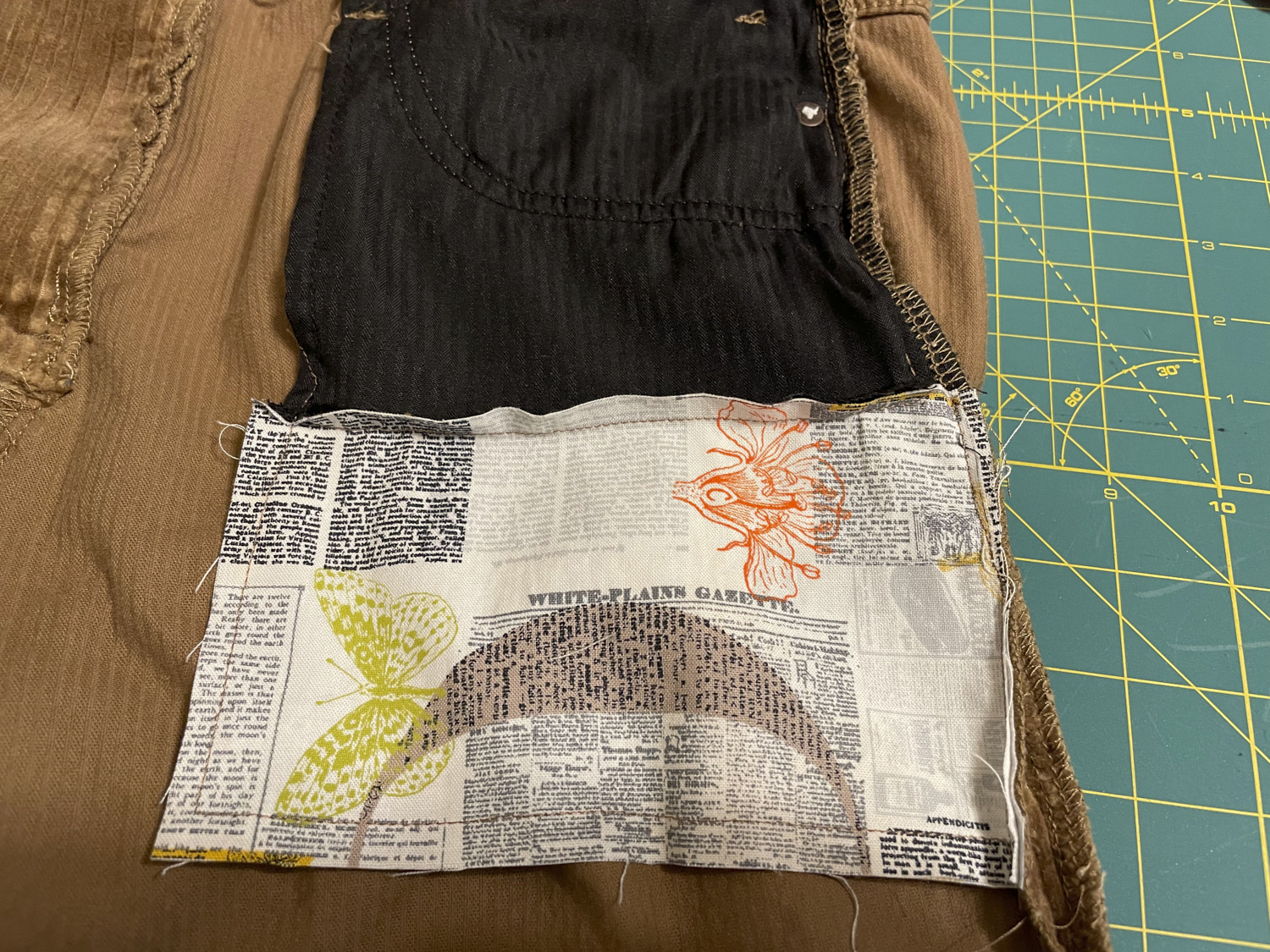
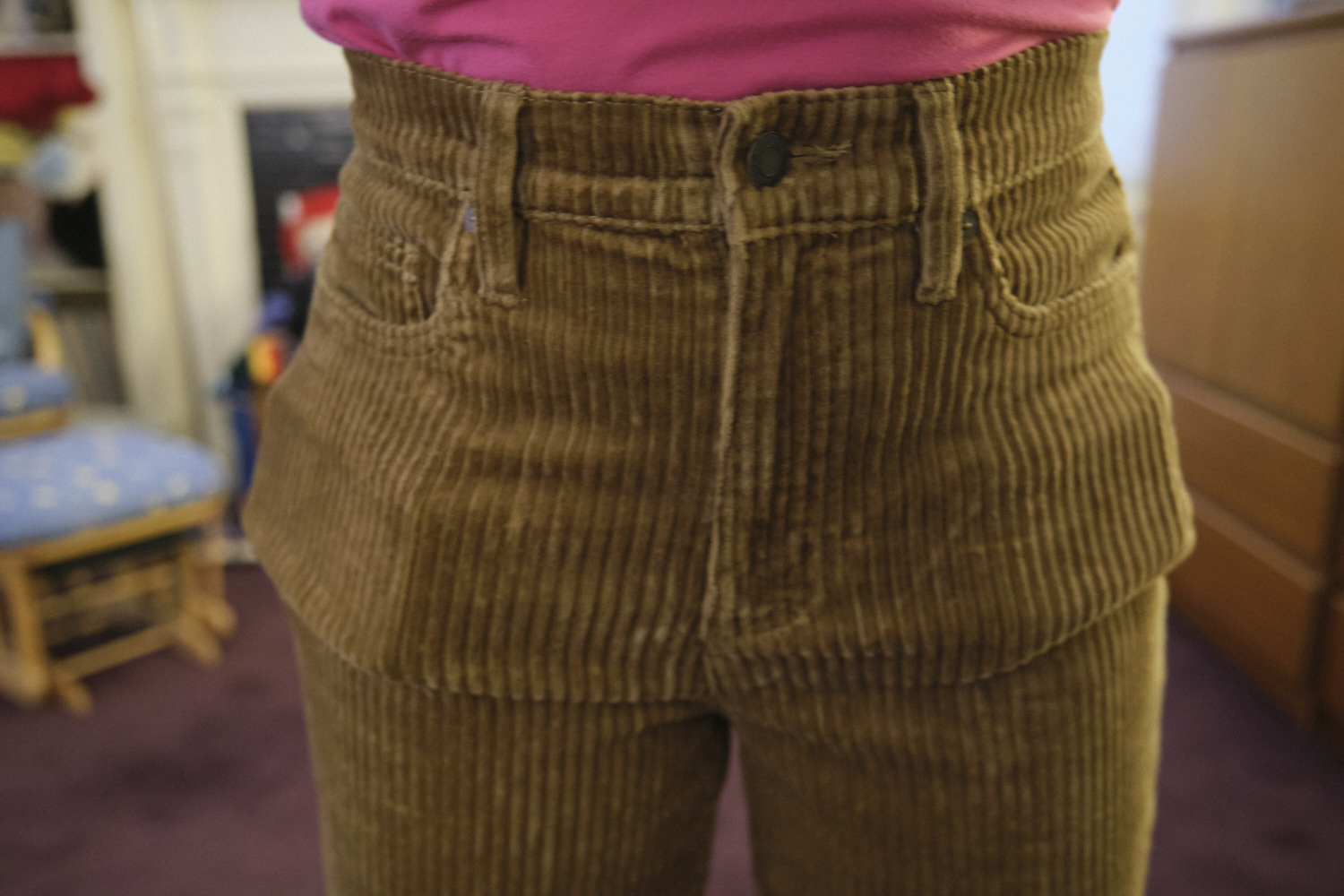
Here are two other pants with extended pocket bags: a pair of pleated flannel dress pants and a pair of wide-leg stretch cords. I used scraps of quilters cotton for these. The grey pants only needed a small extension, but it made a huge difference in having my phone sit comfortably and not fall out. When I wear this pants with a phone in my pocket, you can’t really tell. The cords needed a longer extension, Although these are wide-leg pants, they are fairly tight at the waist. With the original pockets, my phone produced that ugly waist bulge. Now the phone sits just below my hip crease — it is still visible, but I think it looks better there.
My college-student brought home a pile of jeans that mostly fit her but gap at the waist. She asked if I could fix them. I asked the Internet and found a number of complicated solutions. Then I found a really easy solution involving elastic. My daughter was skeptical but agreed I could give it a try on one pair. I mostly followed the instructions and It worked so well she brought me several more pairs to de-gap. I have a few pairs of my own jeans that will likely get this treatment too.
The technique takes advantage of the fact that most pants waist bands are basically a tube that goes around the entire waist. There is an inside and an outside and empty space in between. I have previously improved the fit of several pairs of yoga pants by opening up the side seam on the the inside of the waistband and threading elastic all the way around, and sewing the two ends of the elastic together. For jeans, you just need a piece of elastic across the back. So the problem is what to attach it to. The solution is to sew the elastic to the waistband under a belt loop so it is hidden. (Even if you don’t sew it under a belt loop, if you use thread that matches the jeans it is not going to really show. And of course, if you wear a belt, it is not an issue at all. But one of the reasons to add the elastic is so that you do not need a belt to hold your jeans up.)
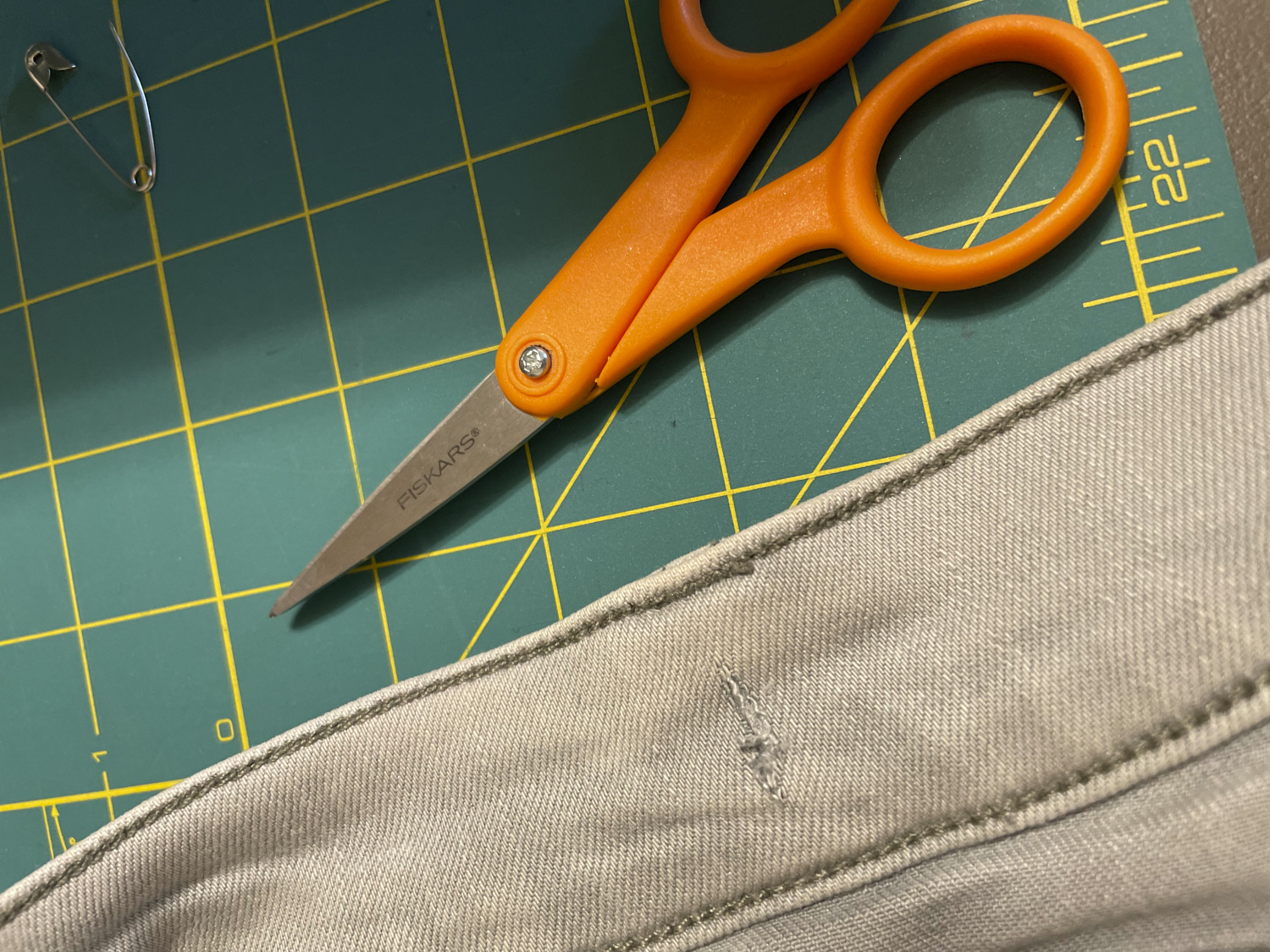
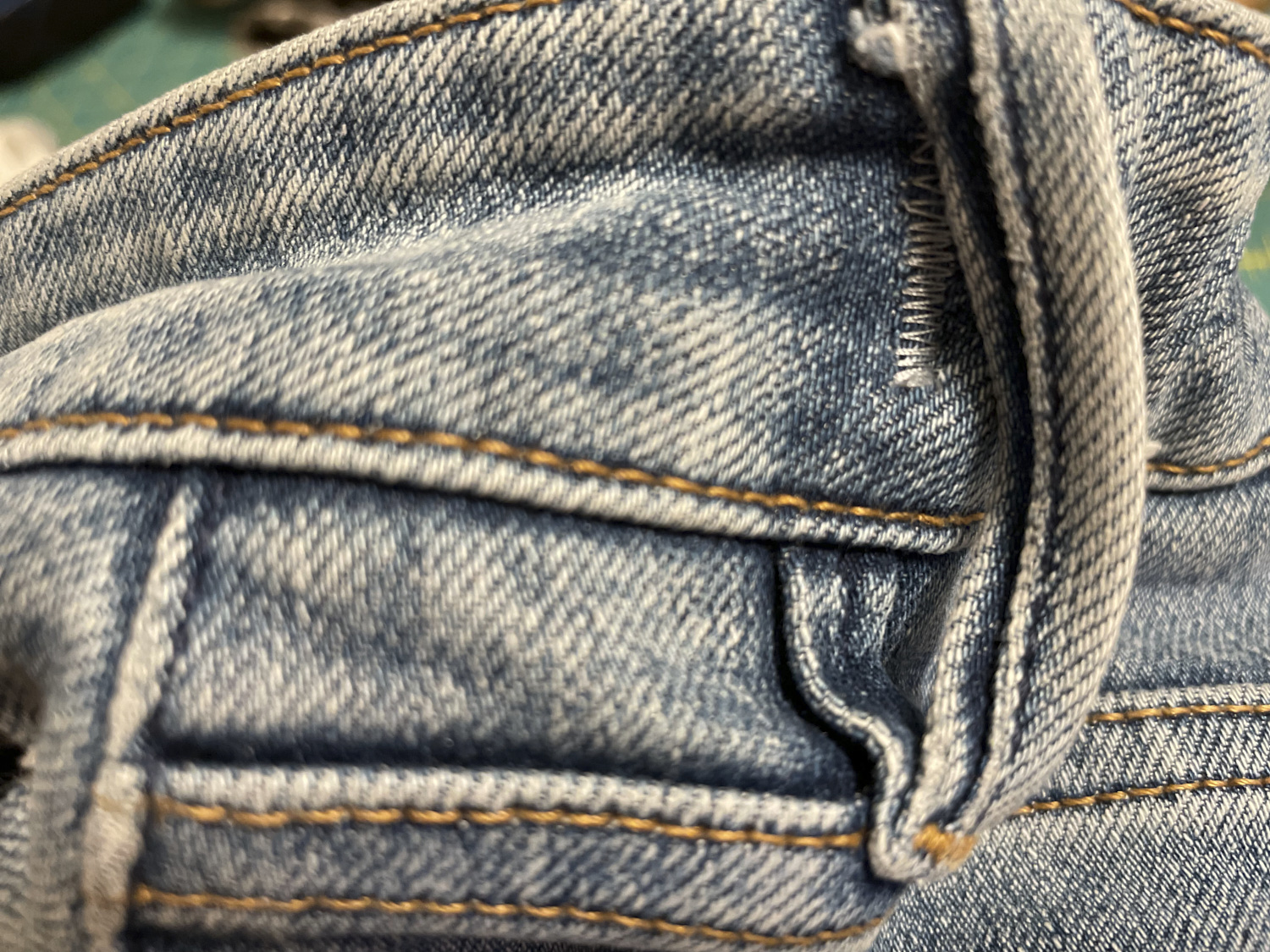
Most jeans do not have a convenient side seam as the inner waistband is a continuous piece (although one of the pairs of pants my daughter brought me were actually pants, not jeans, and they had a convenient seam that I popped right open with my seam ripper). So for the jeans, I just used a small sewing scissors to cut a little vertical slit through the inner waistband, positioned right under a belt loop on each side of the back.
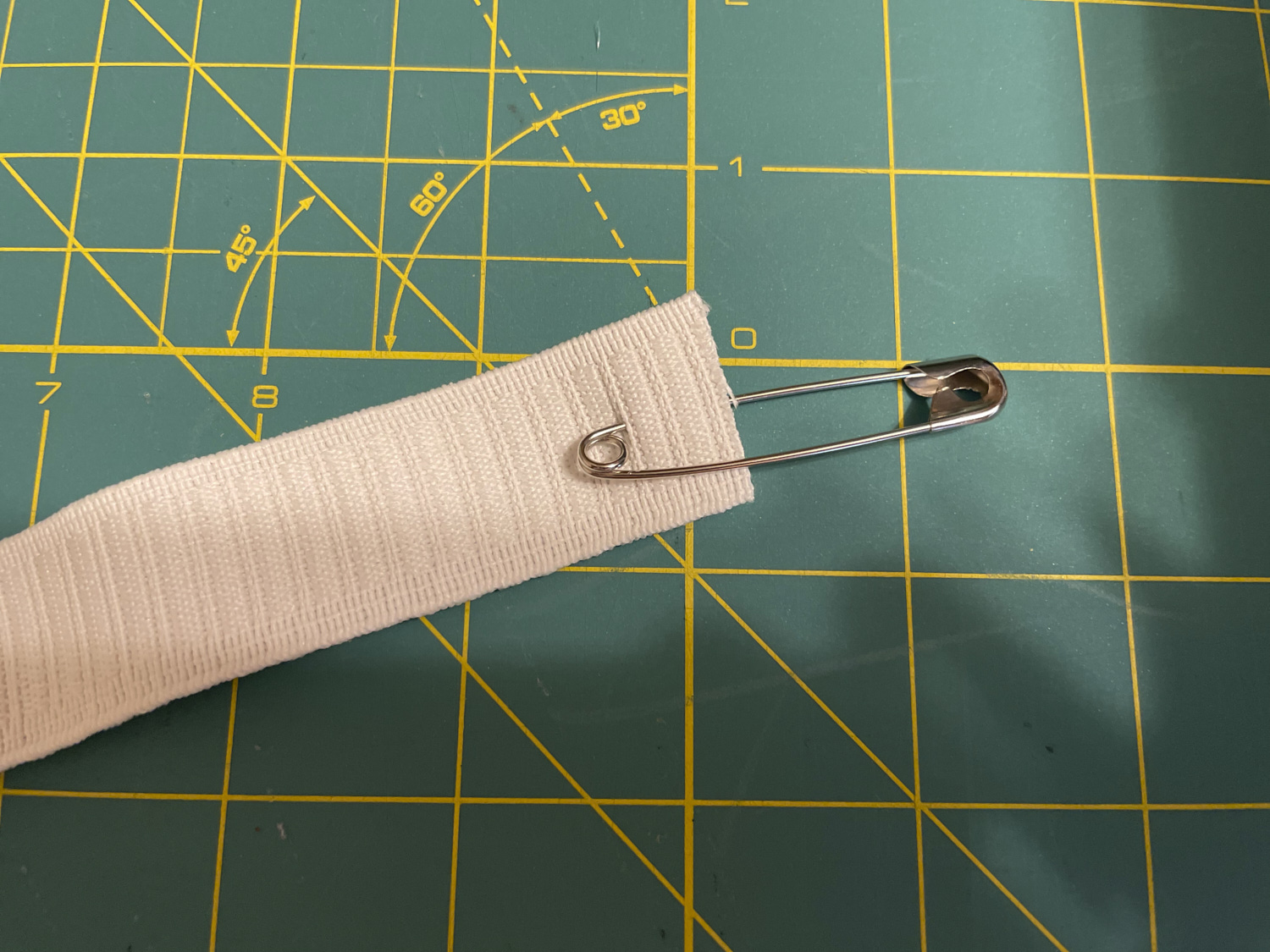
Then I used a safety pin to thread elastic inside the waistband between the two slits.
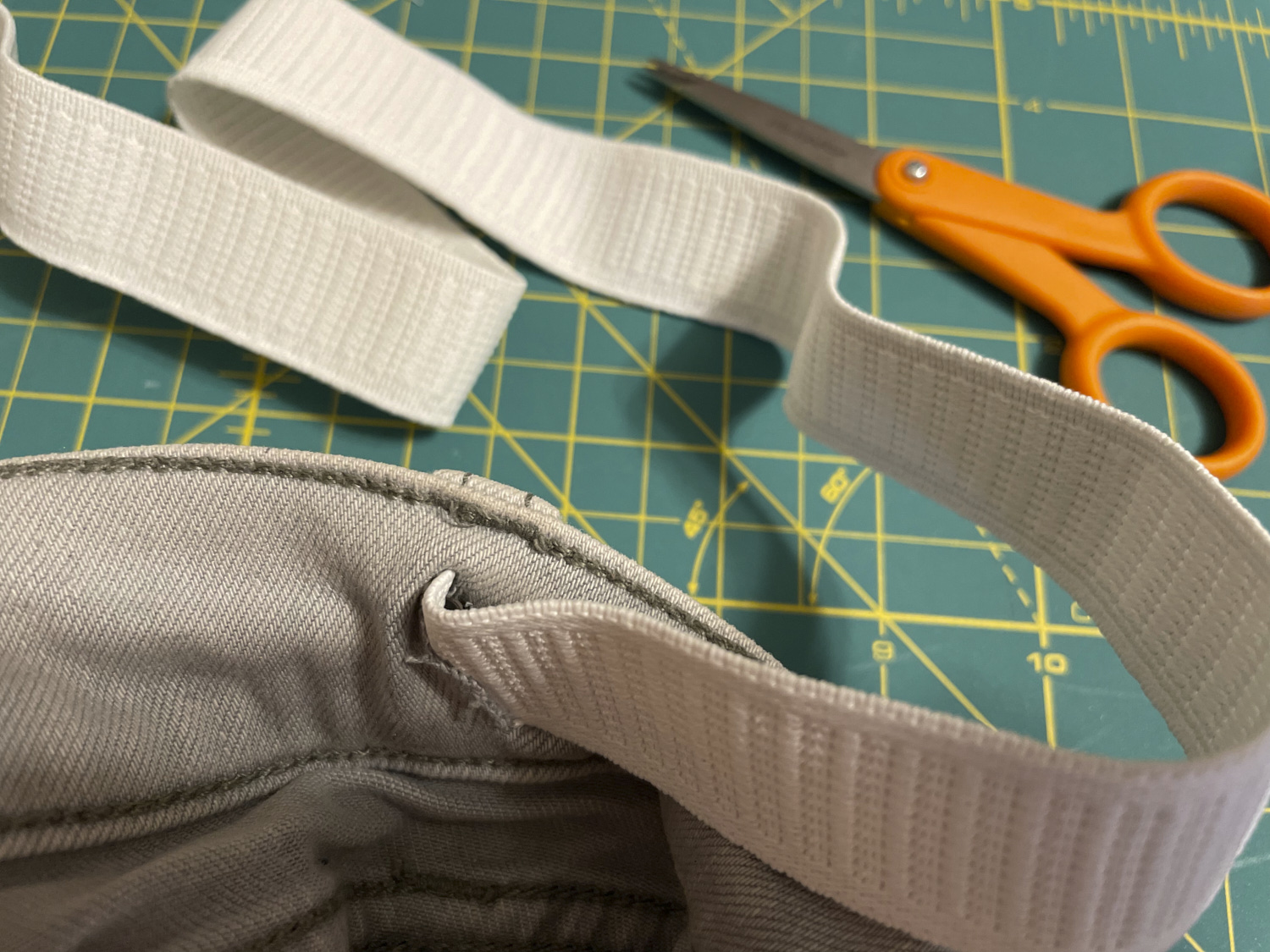
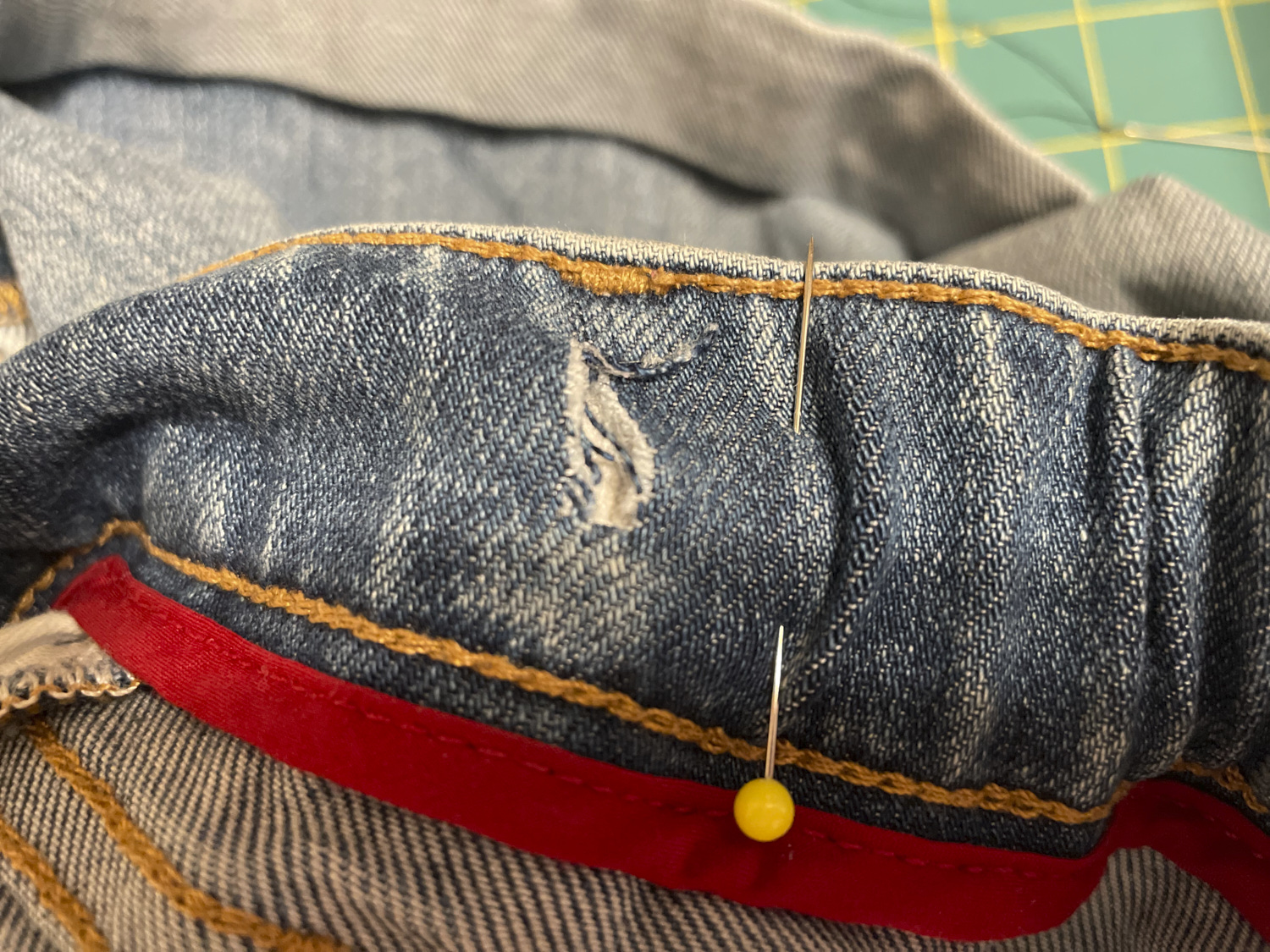
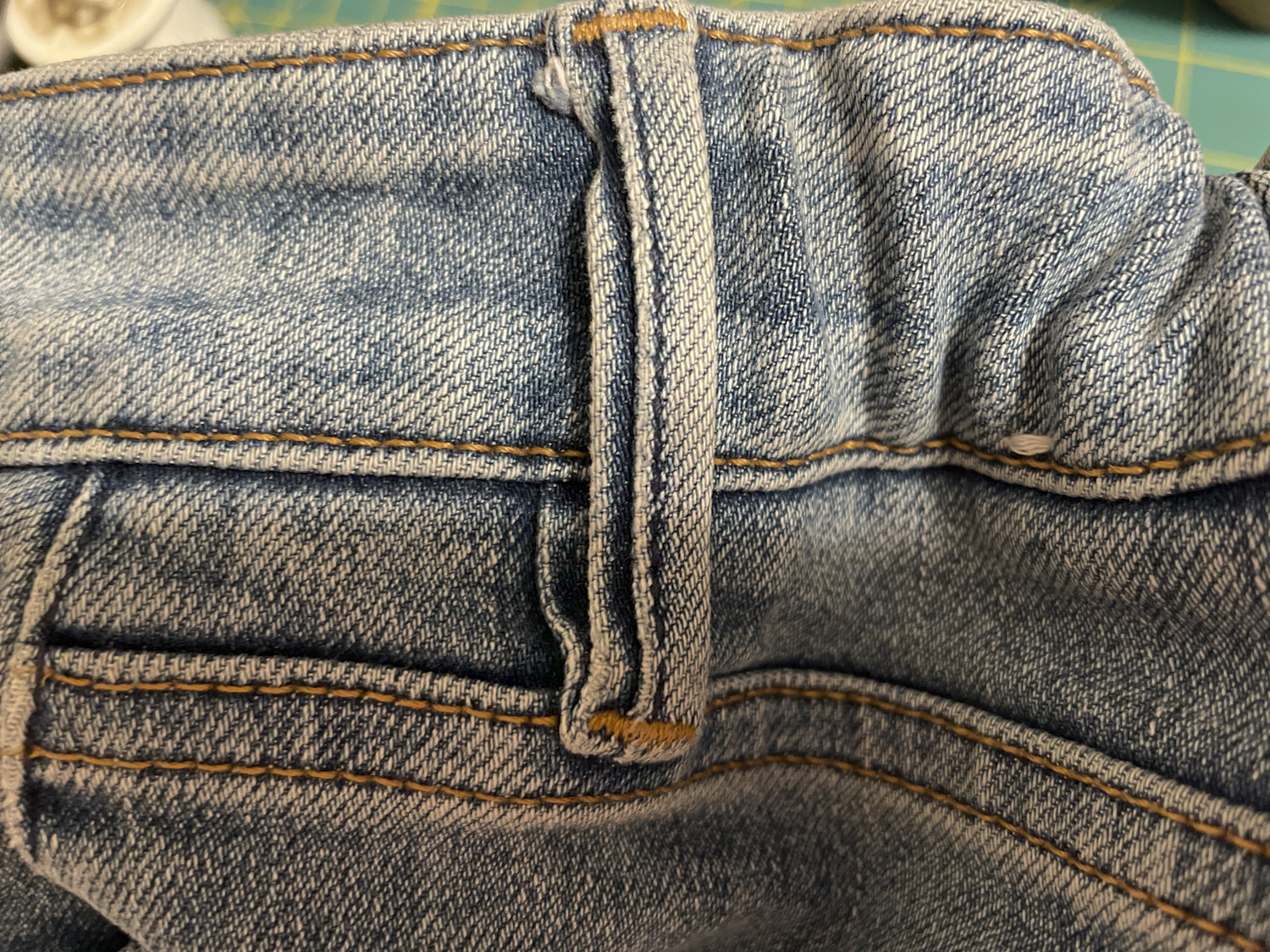
I trimmed the elastic, leaving the waist bunched up a bit (it will smooth out when you wear the pants). I pinned the elastic a bit inside each slit so it wouldn’t pull out while I sewed. (Yes I know the photo below is from a different pair of jeans than the one above, but trust me, I did the same thing on all of them.)
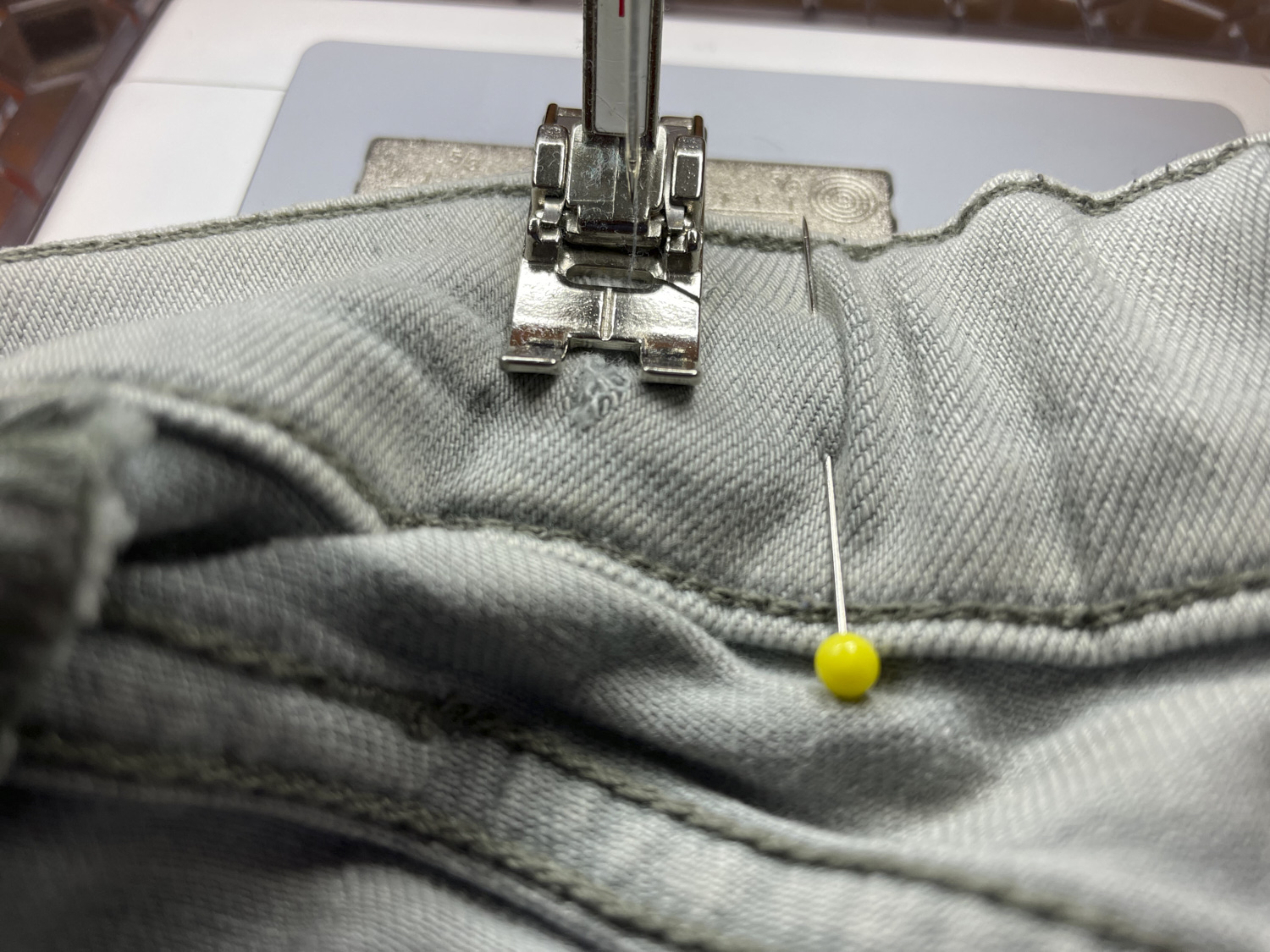
Then I used my sewing machine to sew a wide zigzag over the slit, holding the belt loop out of the way so it didn’t get caught in the stitches. I did this for both slits and removed the pins.
Now her pants fit and the stitches holding the elastic in place are hidden under the belt loops.
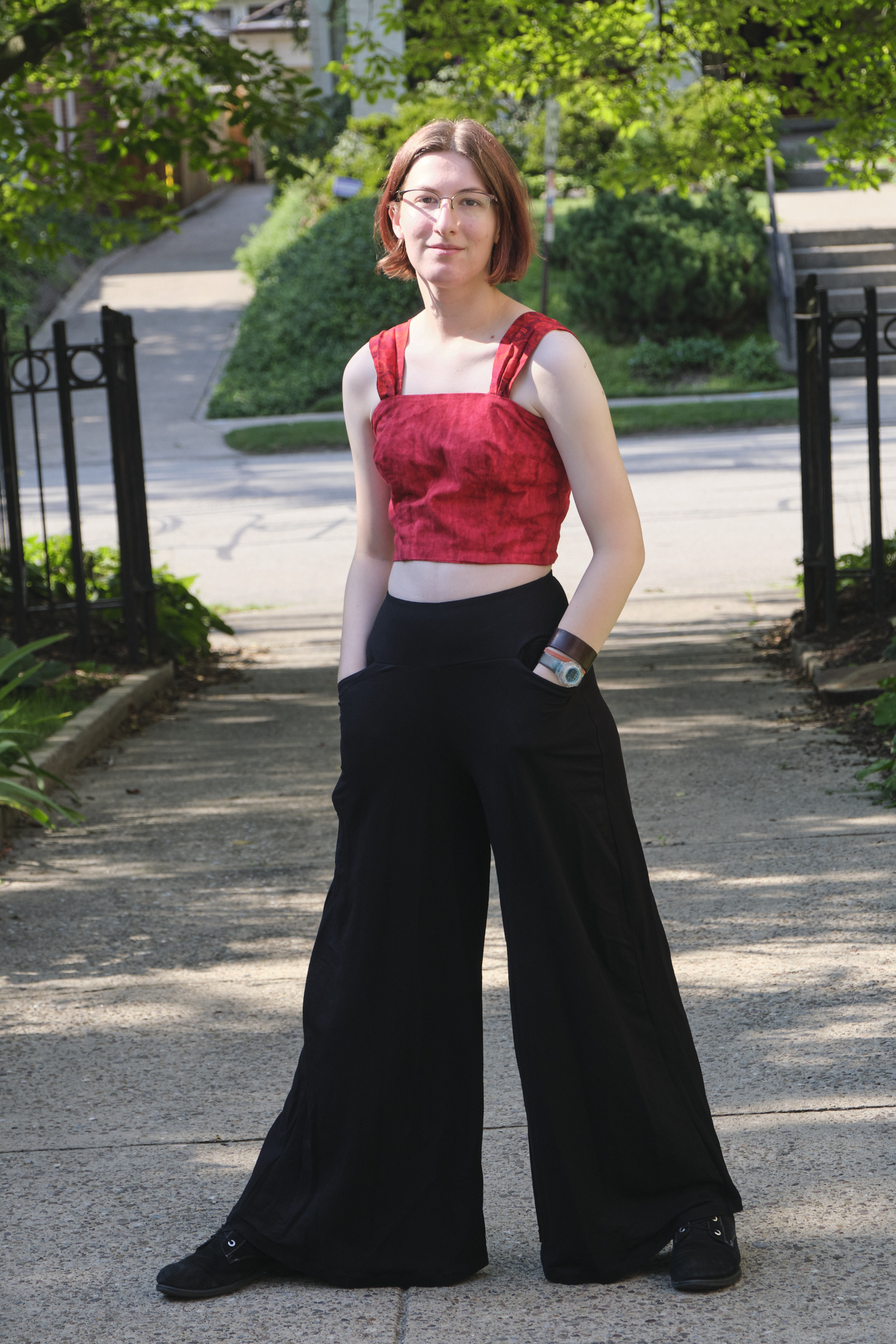
My resident teen daughter liked my Cleo PyLos LiKnit Palazzos so much she requested her own pair. They meet all her criteria for pants: feel like yoga pants, pockets, flowy, and black (she hates wearing jeans). She tried mine on and said she just needed them longer with a higher rise and they would be perfect. So that’s what I did. She put them on so I could take a photo and decided to wear them to her band gig.
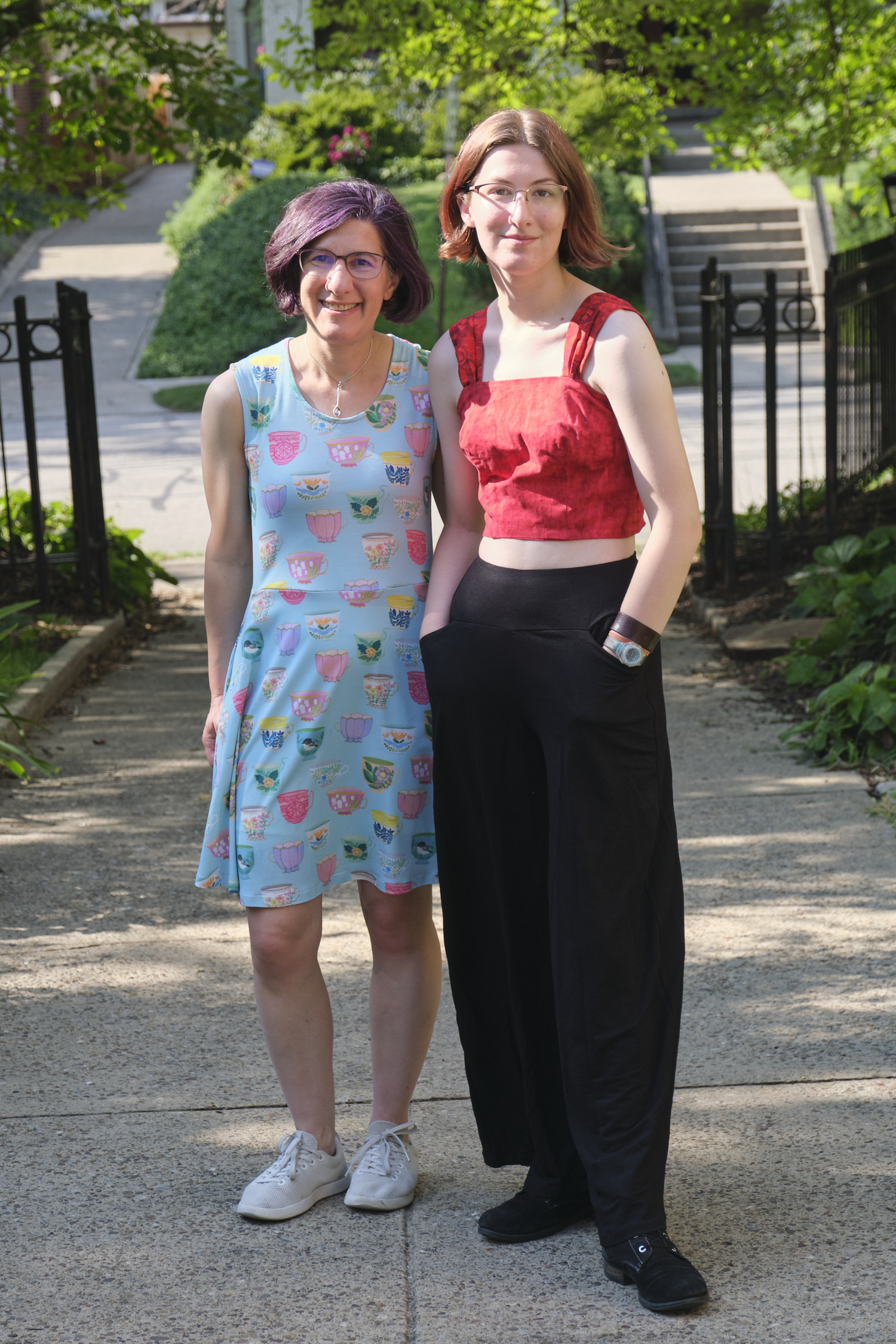
And here we are wearing all our me-made clothes. I’m wearing my self-drafted cups dress and my daughter is wearing the muslin top for her vintage sundress with her new palazzo pants.
I’ve always liked the idea of linen pants, but have never actually liked wearing and maintaining linen pants. They are cool and breathable, until they become a wrinkly mess and you have to iron them. Some have a texture that isn’t that soft against your skin. This spring I ordered several pairs of linen pants online from a popular retailer and ended up returning all of them because I wasn’t crazy about the fit and I could see they were going to need a lot of ironing. So when I saw a new fabric from Surge Fabrics described as a “faux linen knit,” I was intrigued. The fabric is called Pylos LiKnit, which is kind of a weird name that I struggled to pronounce until I realized the K is silent. I’m not sure if other fabric stores offer it under a different name; this one seems to be unique to Surge. It is 55% rayon and 45% nylon, with 50% 2-way stretch (it stretches side-to-side but not up and down). It comes in lots of colors, although some seem to be selling out. This fabric does not contain any linen. It is not a linen knit; it is a rayon/nylon (viscose) knit that looks and feels somewhat similar to a woven linen, but with stretch.
I decided to use black Pylos LiKnit for my second pair of Cleo palazzo pants. I used the same approach as last time to hack the Sinclair Cleo shorts and culottes pattern into palazzo pants with self-drafted slash pockets, with a couple of modifications. First, I wanted to reduce the fullness at the bottom of the legs a bit, so instead of extending the outside seam straight to the bottom of the leg, I curved it in starting at the notch below the hips and the sent it straight down parallel to the inseam. This reduced the circumference of the pants legs from 40 inches to 32 inches. Second, because this fabric is a lot less stretchy than double-brushed polyester, I did not narrow the waistband. I used a stretchy athletic knit (Surge’s black quad performance jersey knit) for the waistband lining. This 300 gsm fabric is 88% polyester and 12% spandex, with 75% 4-way stretch. This gives the pants a waistband that feels just like a pair of leggings or yoga pants, and that doesn’t slip down when I put my phone in my pocket.
The pants were a pretty fast sew. The PyLos is cool and comfortable to wear and the quad performance jersey knit keeps the waistband in place. I love the results of putting performance knit in the waistband lining, and will try that with other patterns too. The reduced leg fullness makes them look more like normal pants. But I wasn’t entirely happy with the drape of the leg.
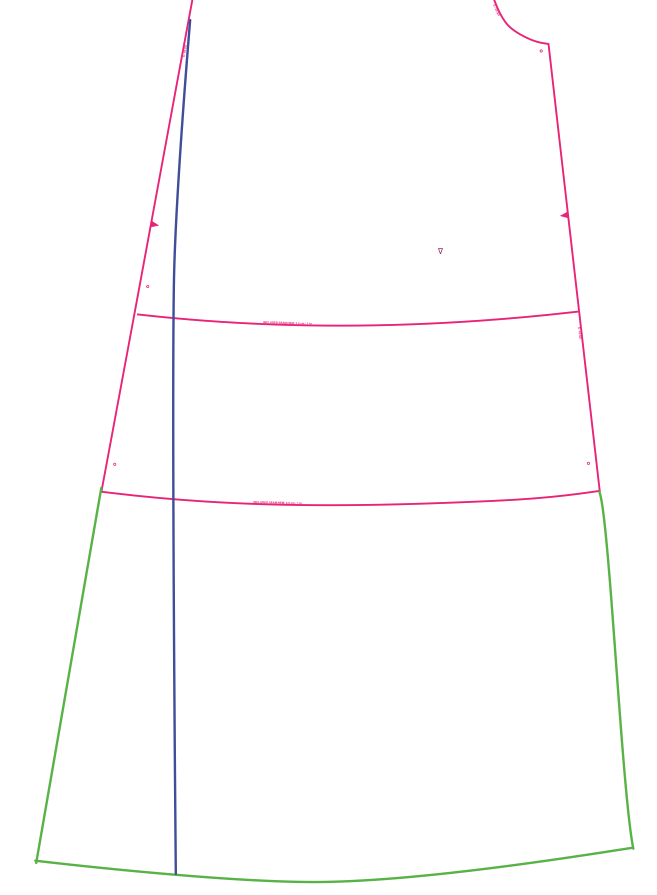
After finishing the pants one evening, I decided to work on the drape again the next day. I basted a new outside seam, starting the curve on the front pant leg about even with the bottom of the crotch, but ending up at the same place at the bottom. This seemed better so I sewed it in place. You can see on the image below part of the original front piece of the shorts/culottes pattern outlined in red. The green line is the full palazzo extension that I used for my first pair of Cleo pants. The blue line is the final narrower palazzo extension that I ended up with this time after a bit of trial and error (I started with a line that curved in from the notch, but ultimately ended up with the blue line you see here).
Even after getting the side seam the way I wanted it, I still wasn’t completely happy with the drape and realized that it looked a lot better when I hitched the sides of the pants up a bit. It seems in my effort to raise the rise to be more of a high-rise fit, I added too much fabric to the outside of the waist. The adjustment to the center of the rise was good, but the outside of the waist did not need that much adjustment. The right thing to do at this point would probably have been to remove the waistband, cut off the extra fabric, and sew it back together. However, the idea of picking out all those zigzag stitches was not appealing. So I basted a new seam connecting the pants to the waistband, taking the sides up about three-quarters of an inch and grading towards the center. That seemed to do the trick, so I sewed a zigzag along the basting line and pressed it in place. While the inside is not beautiful, the outside of these pants looks much better with this adjustment. I’ve marked my pattern so I can just cut it this way to begin with next time I make this pattern. I’m learning a lot about fitting pants and clearly I have more to learn.
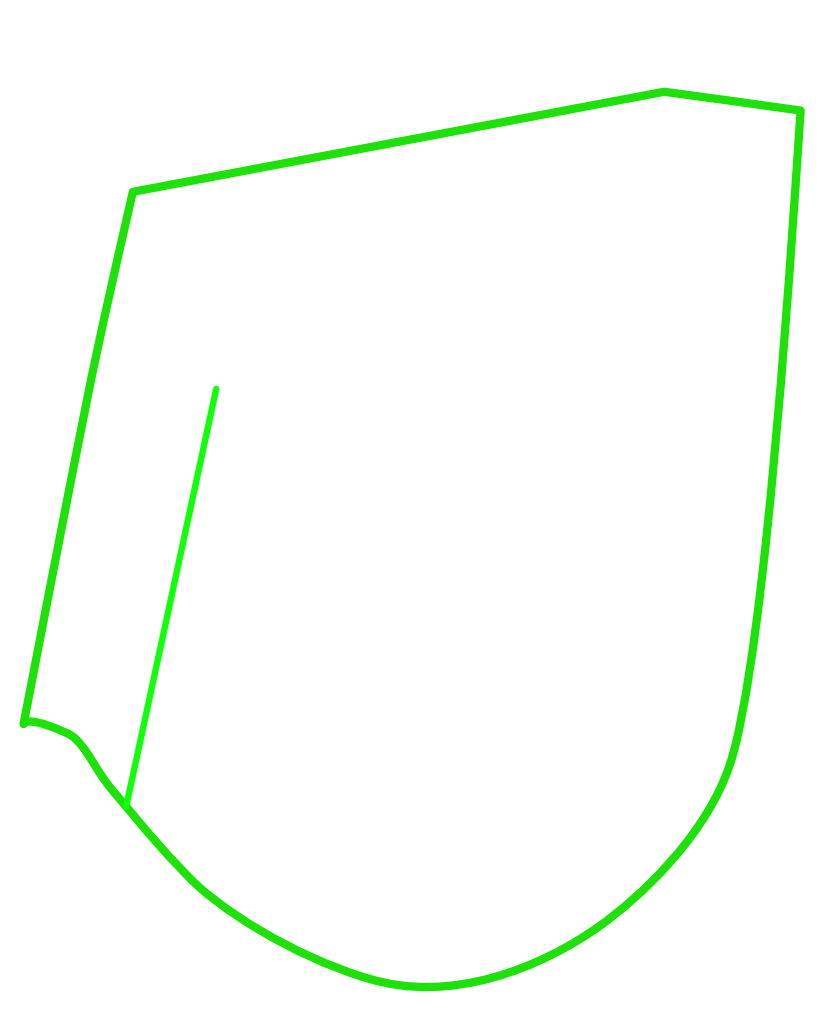
After wearing the pants with the phone in my pocket I realized that the phone tends to tilt outward and cause a bulge to the side. I added a zigzag seam to the pocket bag from the bottom up about 4 inches, placed about an inch in from the outer edge of each pocket. This is completely invisible on the outside of the pants but it keeps my phone more vertical. I went back and added this to my palazo pants too. Here’s the self-drafted pattern I used for the front part of my slash pocket bag with the extra vertical seam (the back part of the pocket bag is cut straight across the top without the slash).
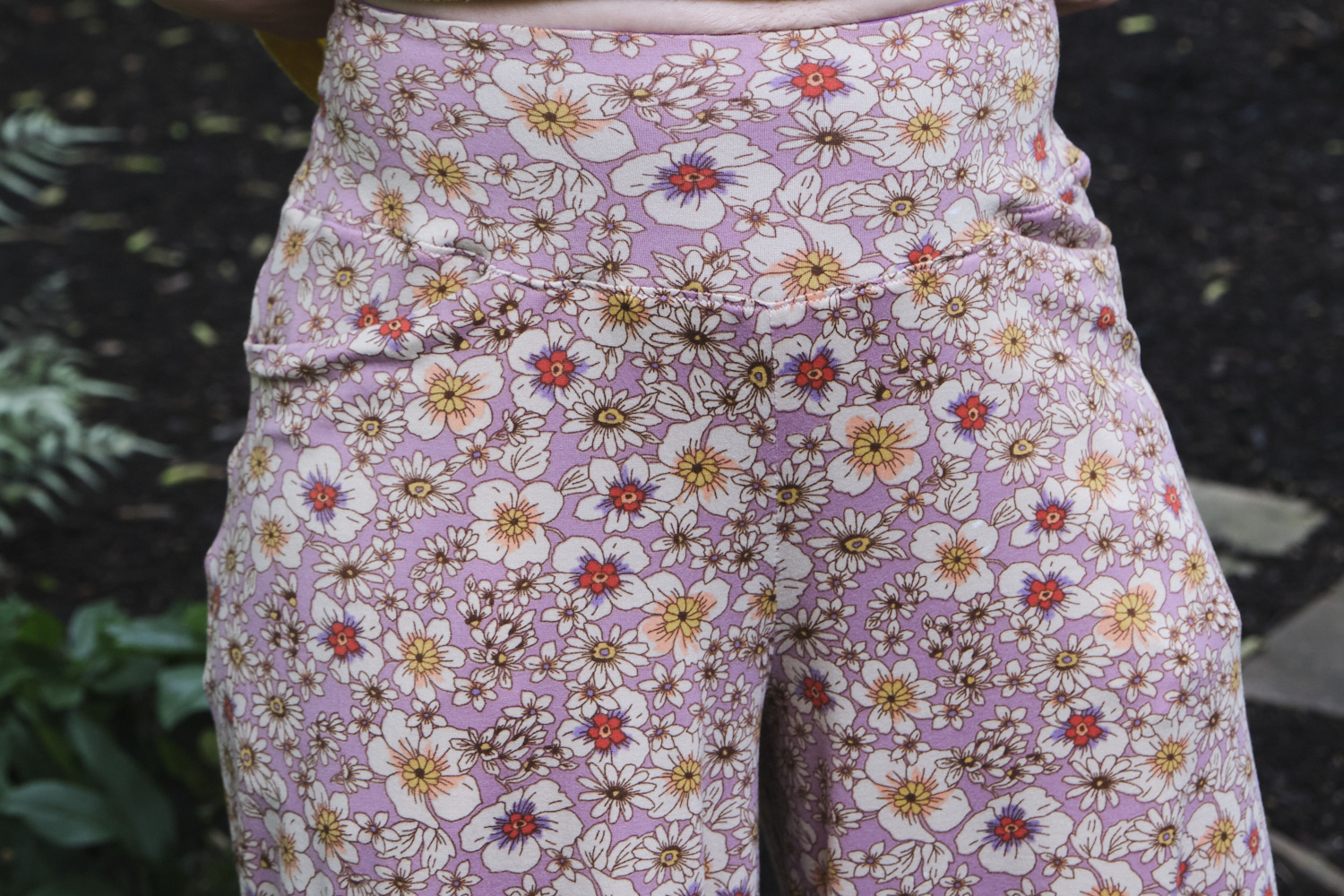
In any case, the final product looks and feels great. I took these pants on a business trip and they were very comfortable and did not wrinkle in my suitcase. I wore them for three days and the waistband did not stretch out. They were comfortable in the outdoor heat and kept my legs warm in the over air-conditioned meeting rooms. Here are the photos, modeled with a Bondi top I made last Fall. At the bottom I have a close up of the waistband, including the slash pockets.
In June I decided to try my first knit shorts pattern, Sinclair pattern’s Cleo knit shorts and culottes. These shorts have a comfy yoga-style waistband, optional side-seam pockets, and a full drape. I was intrigued by the comfy lounge shorts people were posting on the Sinclair Facebook group, and even more intrigued by the dressier looking long shorts and culottes. But what convinced me to purchase the pattern was the palazzo pants. This is not actually a pattern for palazzo pants, but I saw multiple sewists (especially Holly Stout and Kristi Käär) who simply took the Cleo culotte pattern, extended the side seams to pants length, and voila, lovely flowy palazzo pants. These sewists also executed and interesting pocket hack to get the pockets off the side seam.
Before cutting into 2 yards of fancy fabric for the pants, I decided to make a basic pair of soft knit shorts first so I could try out the pattern. Eighty percent of the work in making pants is in the top 20% of the pants — once you get past the waist band, pockets and crotch seam, the rest of the pants are a piece of cake.
I cut my size 4 petite shorts from one yard of plain black double brushed polyester (DBP) fabric. The DBP is super soft, so soft that I was concerned about keeping the waist band in place if I put my phone in my pocket. As the pattern advised, I sandwiched a piece of stretch mesh between the two DBP layers of the waistband. The waistband also has 1/4 inch elastic at the top, but that doesn’t provide a lot of support. Shorts construction was fairly straightforward, although as predicted most of the effort was in the pockets and waistband. The results look nice and are super comfy (will be great for PJs), but do sag when I load up my pockets. I also personally prefer shorts and pants with more of a high rise.
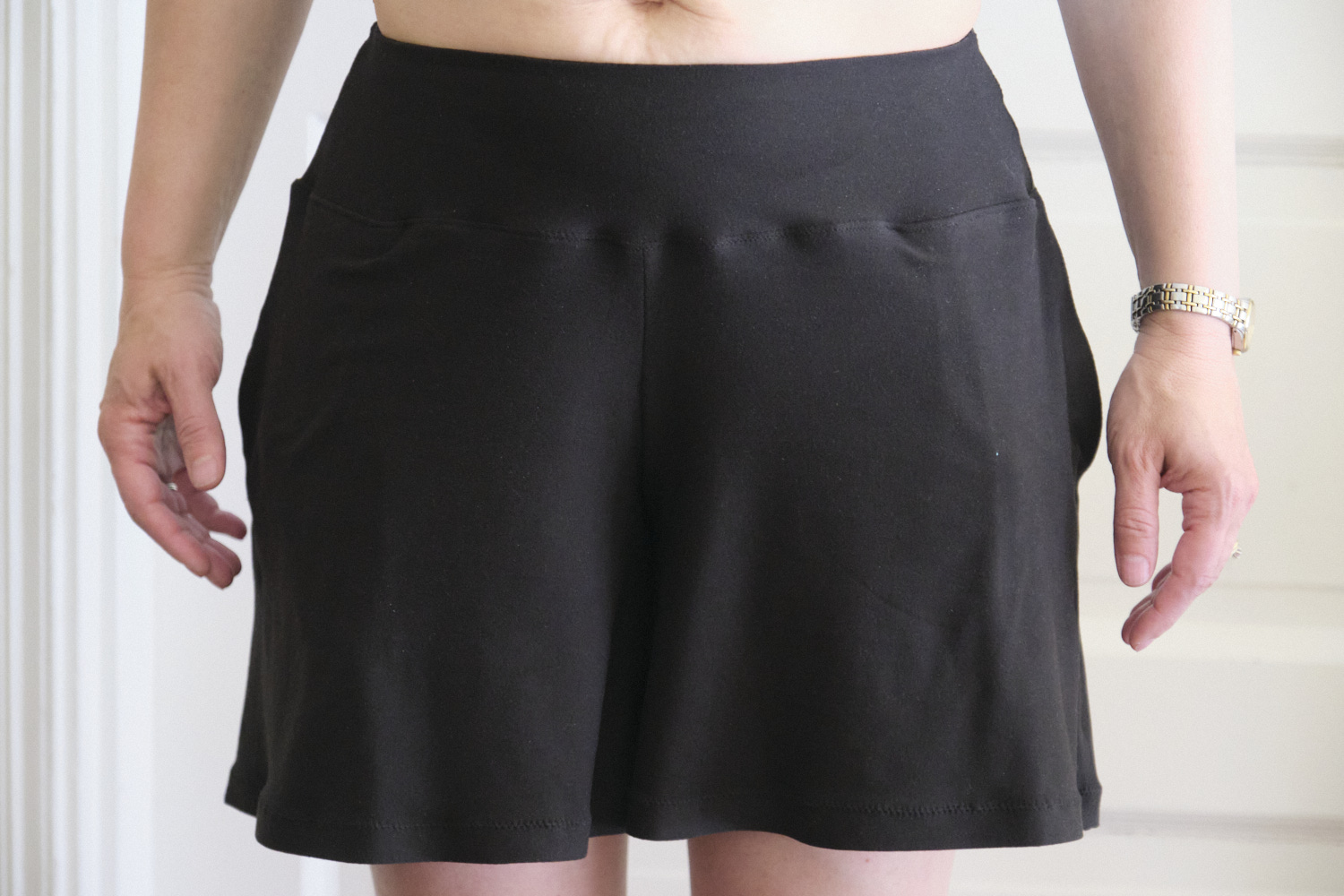
Here are my comfy black Cleo shorts. You can see how the side-seam pockets gap open a bit. The waist sits about an inch below my navel, and lower when I put my phone in my pocket.
I decided to alter the pattern a bit before attempting pants from a two yards of a lavender DBP floral print. I thought I might be able to get a higher rise by using the regular size pattern rather than the petite, but I checked and the rise was the same. I checked the tall pattern and saw the rise was about 3/4 inch taller. So I used the size 4 tall as my base and then added about half an inch to the top of the front and back leg pieces (drafting the alterations in Affinity Designer).
After debating a variety of solutions to the waistband sag problem, I narrowed the waistband by half an inch on the left and right side of both the front and back (subtracting 2 inches total from the diameter) in order to tighten it up. Instead of sandwiching stretch mesh in the waistband, I used a medium-weight cotton lycra for the waistband lining, providing more support than you get from DBP. I considered using wider elastic but stuck with the recommended 1/4 inch braided elastic. The result is a much more supportive and less saggy waist band than on the shorts. They still sag a little when my pockets are loaded, but not as much. I’m going to look for a more supportive athletic knit or possibly try wider elastic to see if I can make future pants even better.
While Holly and Kristi borrowed their pocket design from other Sinclair patterns that I don’t have (yet), I found an online tutorial on making slash pockets and just drafted my own, with a very slightly sloping slash. I found the slash pockets actually easier to construct than the side-seam pockets because you don’t have to deal with the awkward part where you sew the side seam just up to the pocket opening and stop.
Finally, I extended the inseam and outside seam on the legs to full pants length, keeping the same angles. The width at the bottom hem is about 26″. (I used HeatNBond Soft Stretch on the hem and zigzagged over the edge.) At 5’2″, I can just barely get full length wide-leg pants out of two yards of fabric.
The finished results (see pants modeled blow with my Cachet top and Laura cardigan) are fantastic light-weight swishy pants for summer. They are quite comfortable with pockets that easily accommodate a cell phone and small wallet. I’m eager to make more in other knit fabrics, and also try curving the outside seam at the hips so that the legs are straight and not quite so wide for another look.