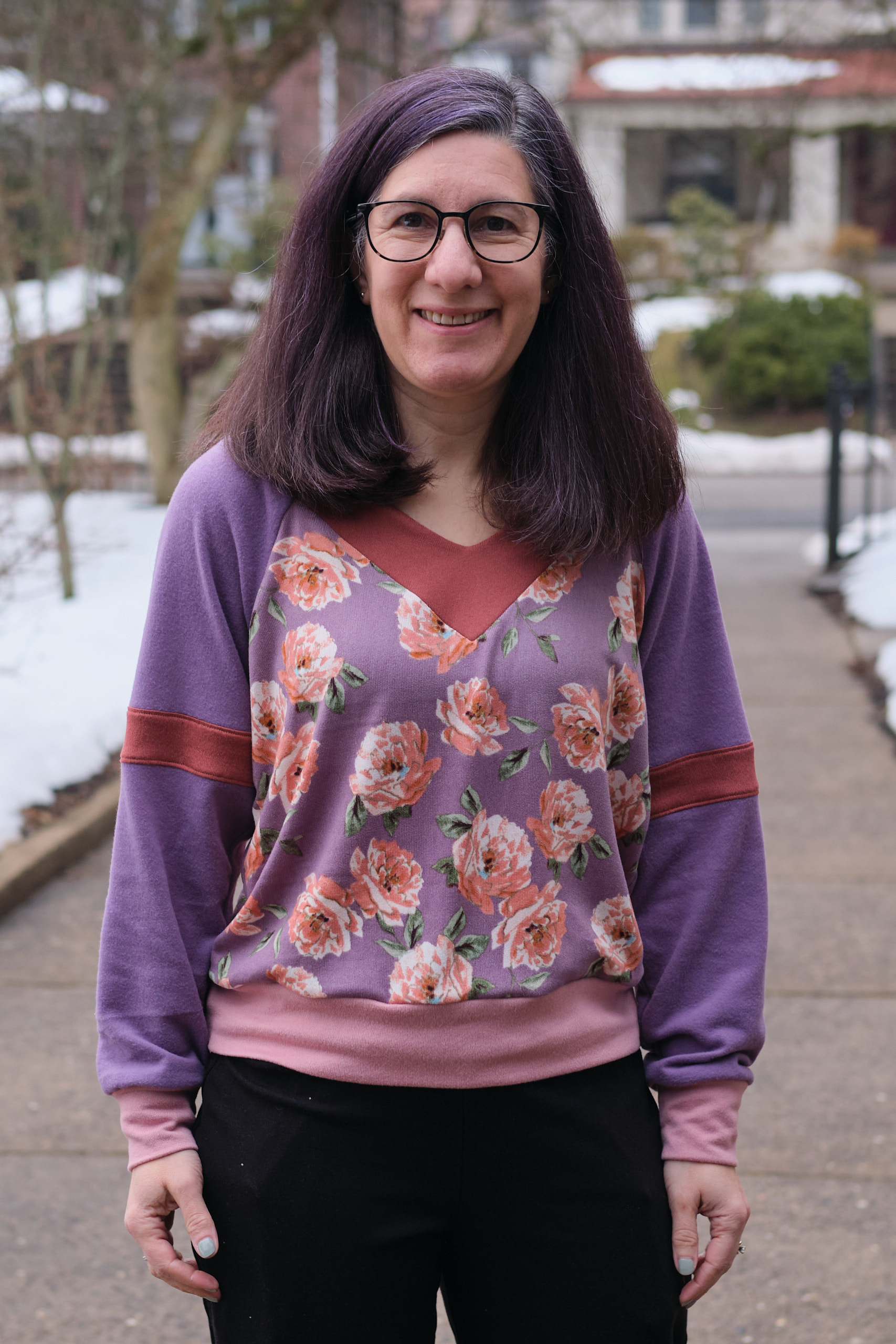
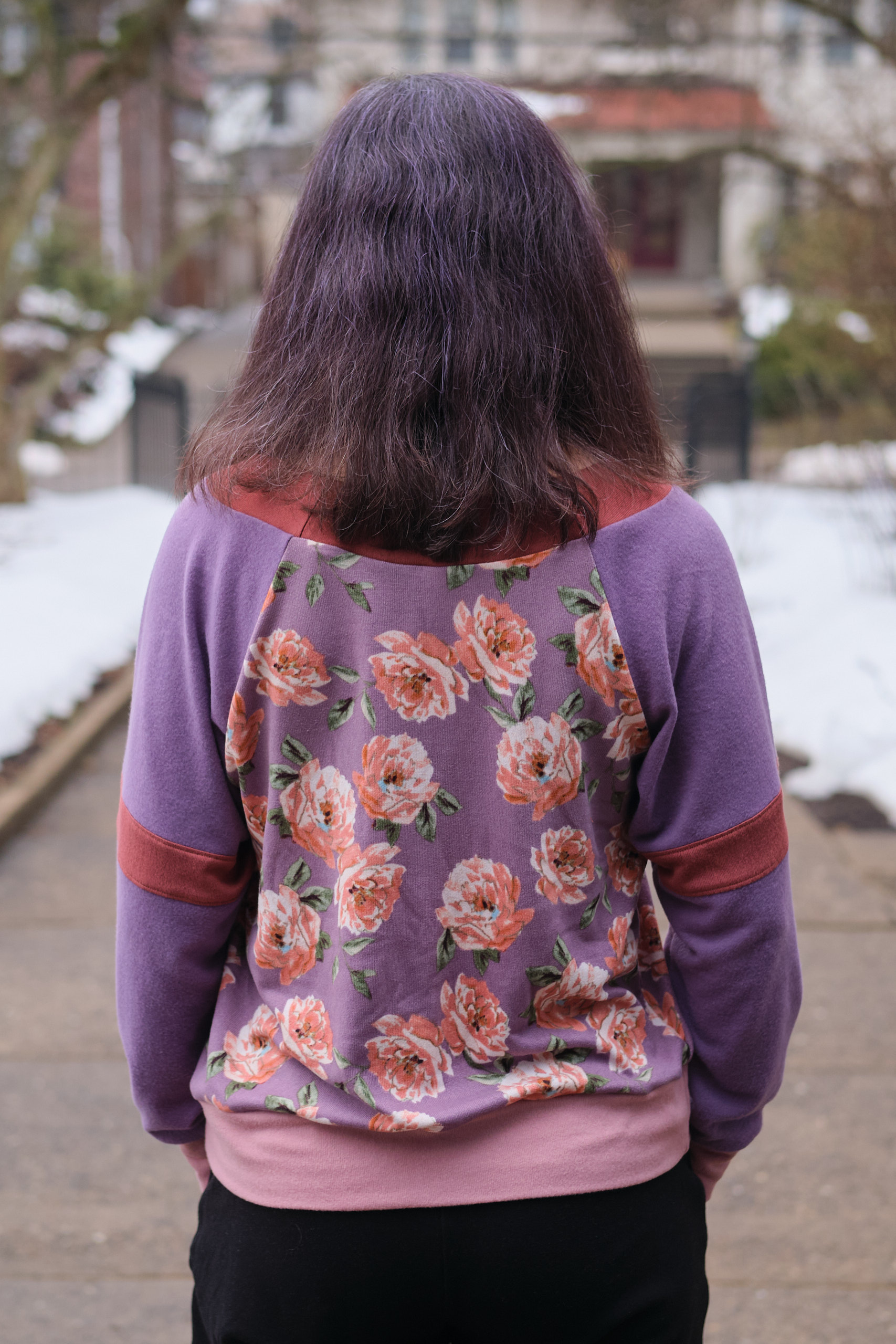
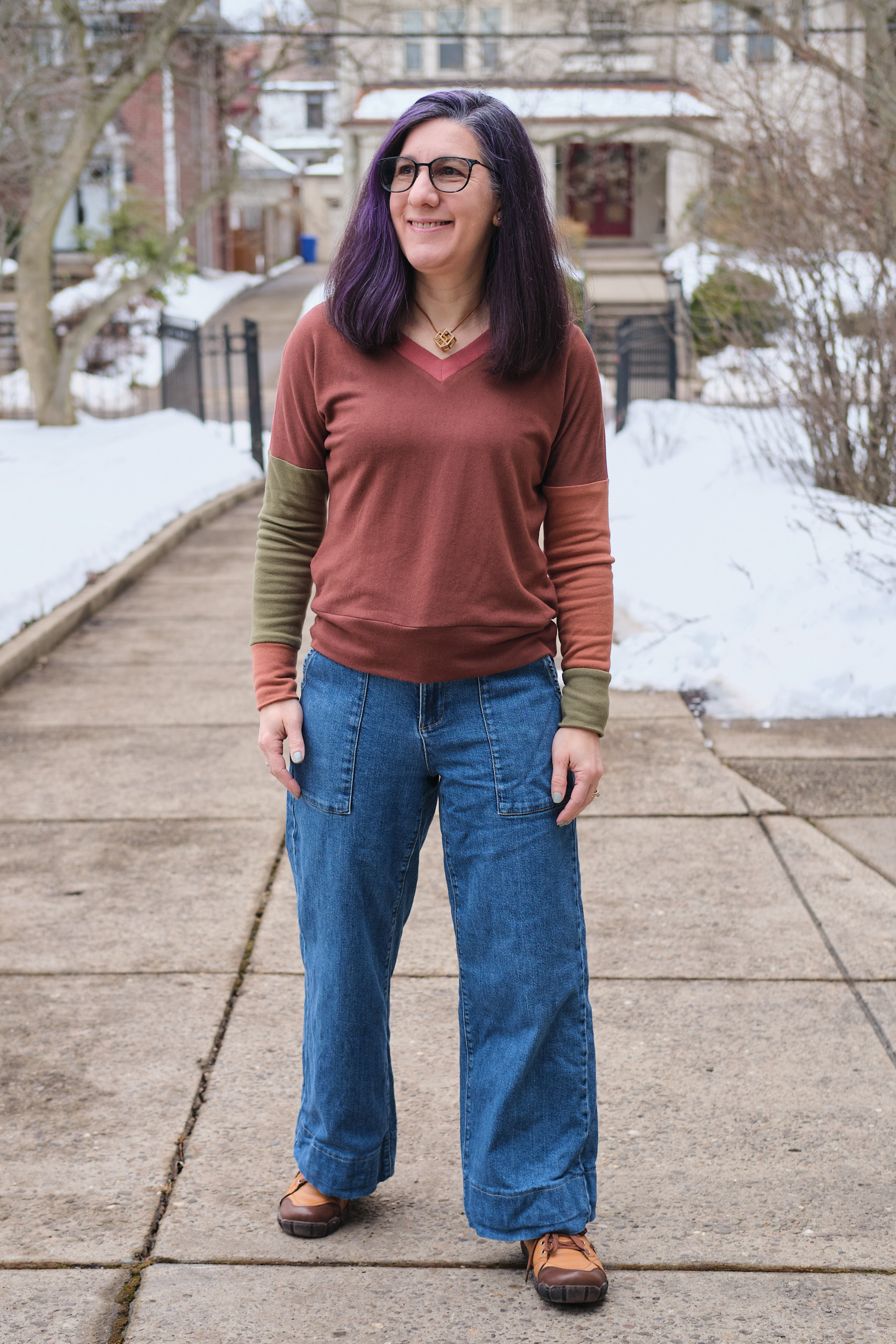
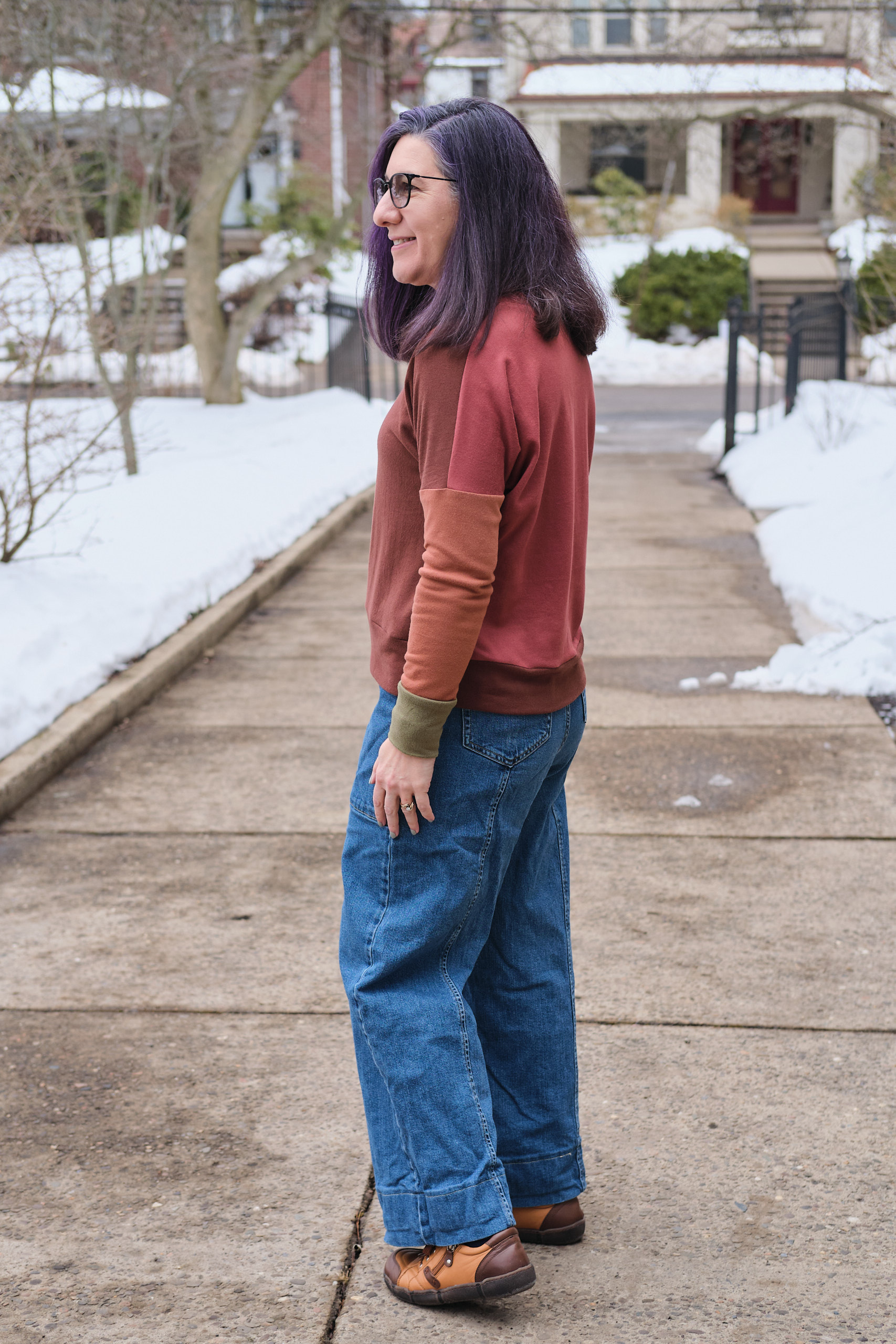
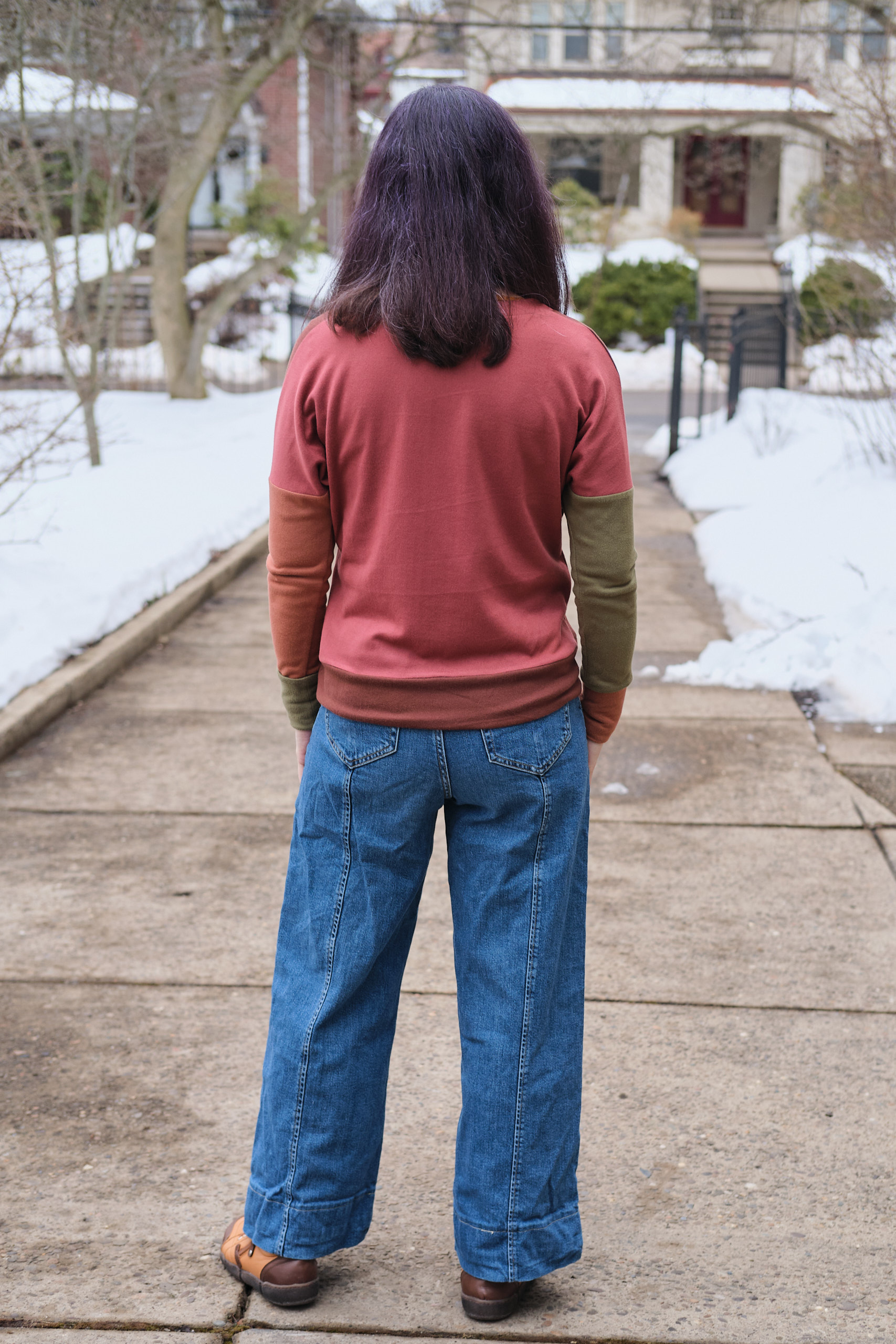
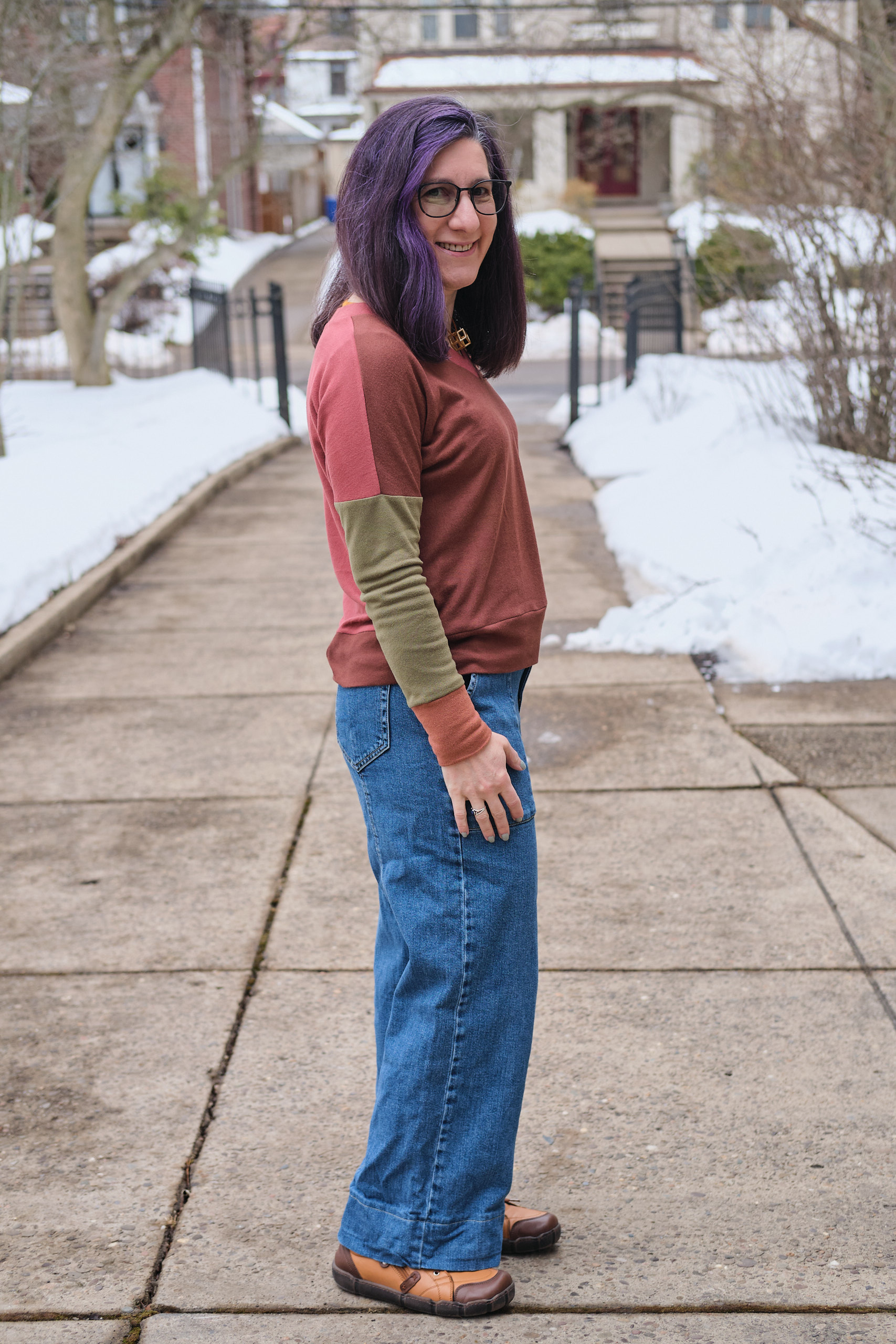
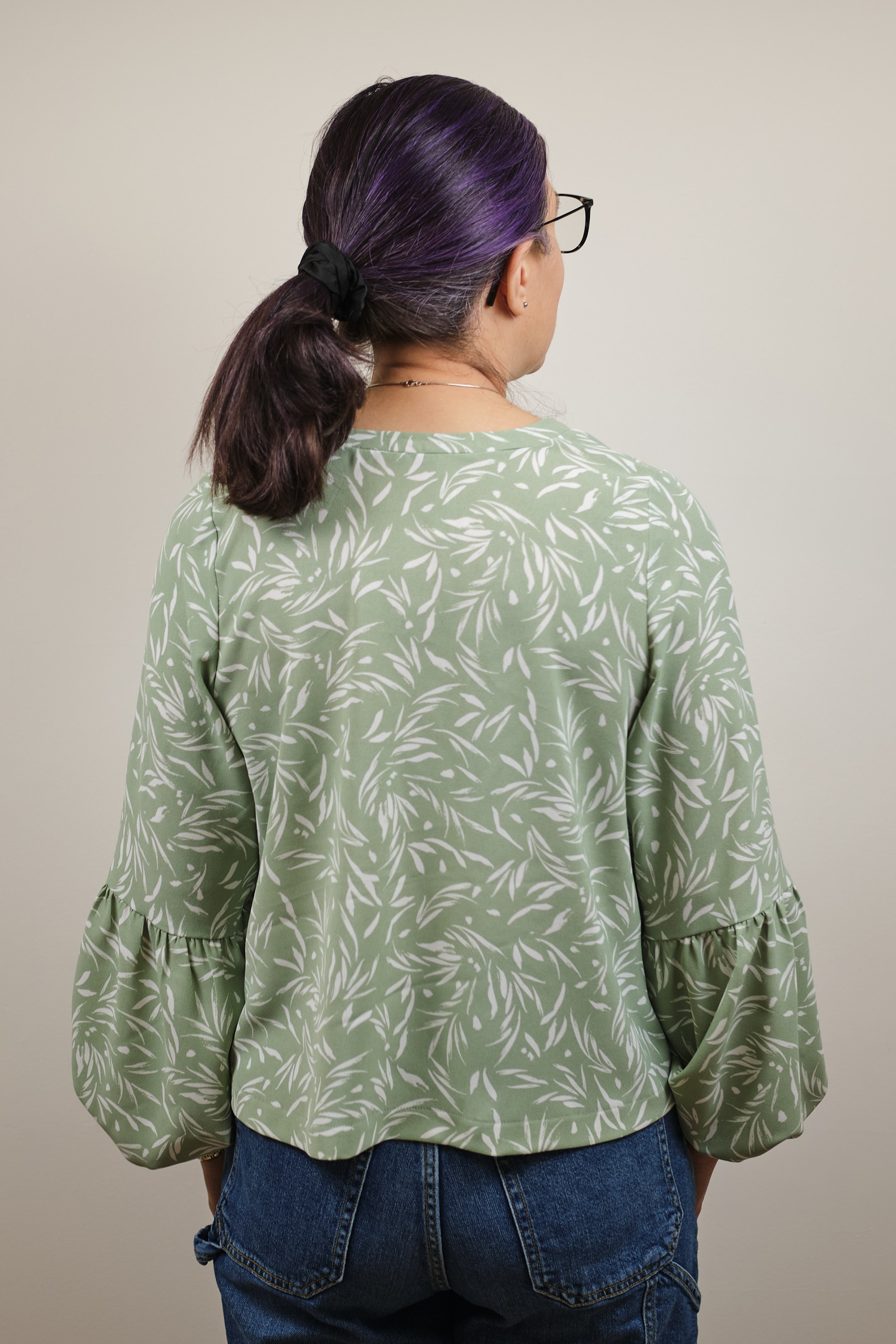
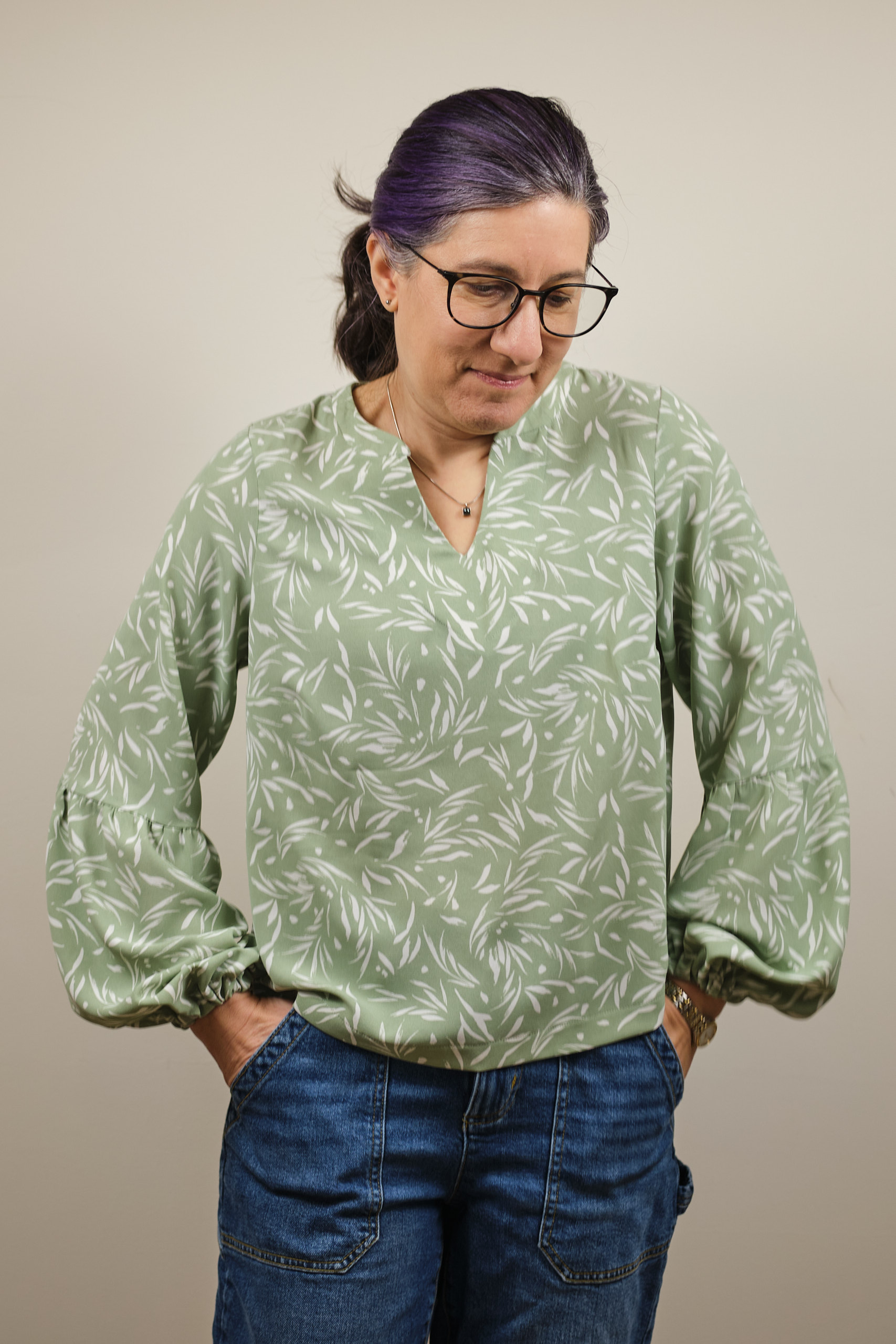
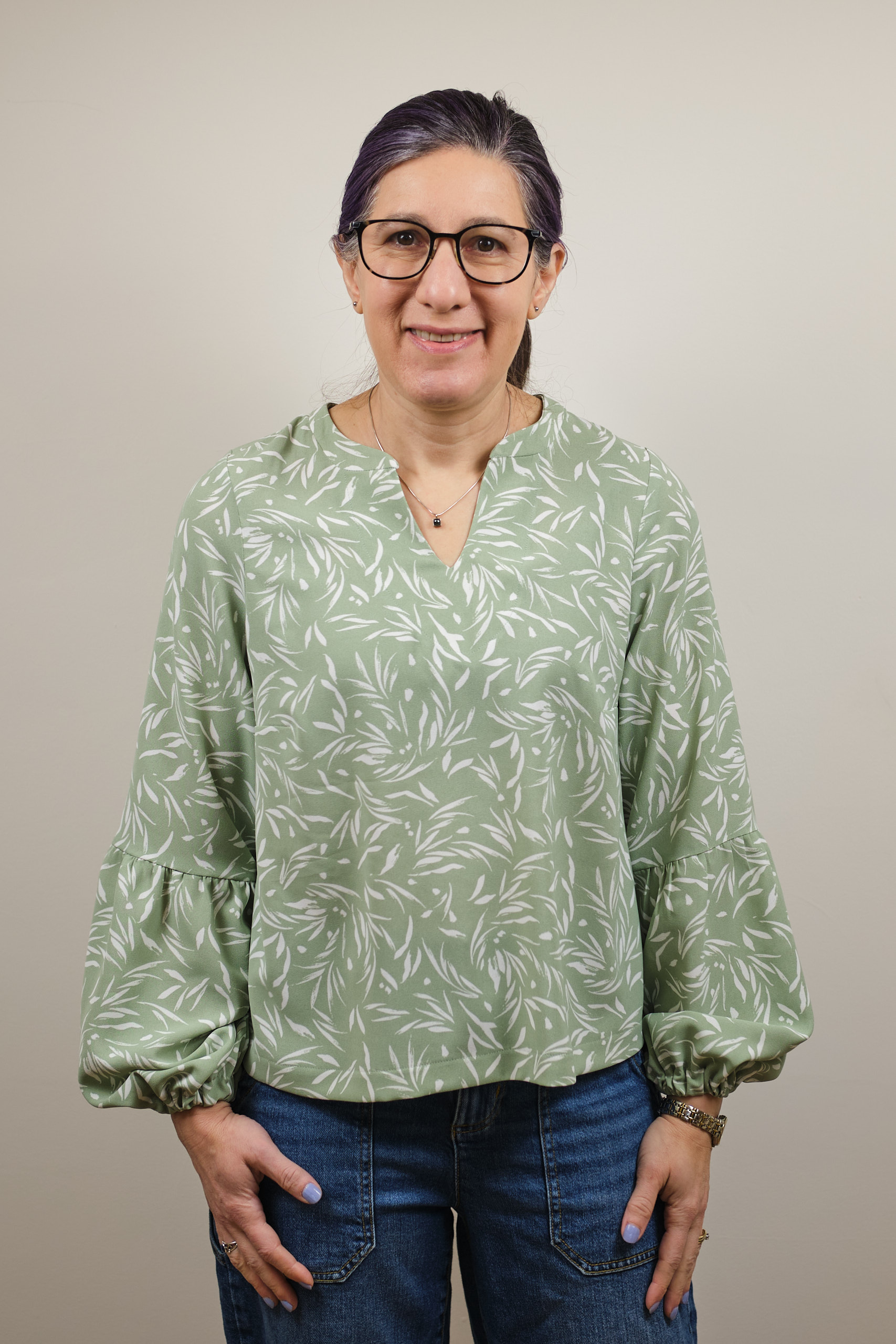
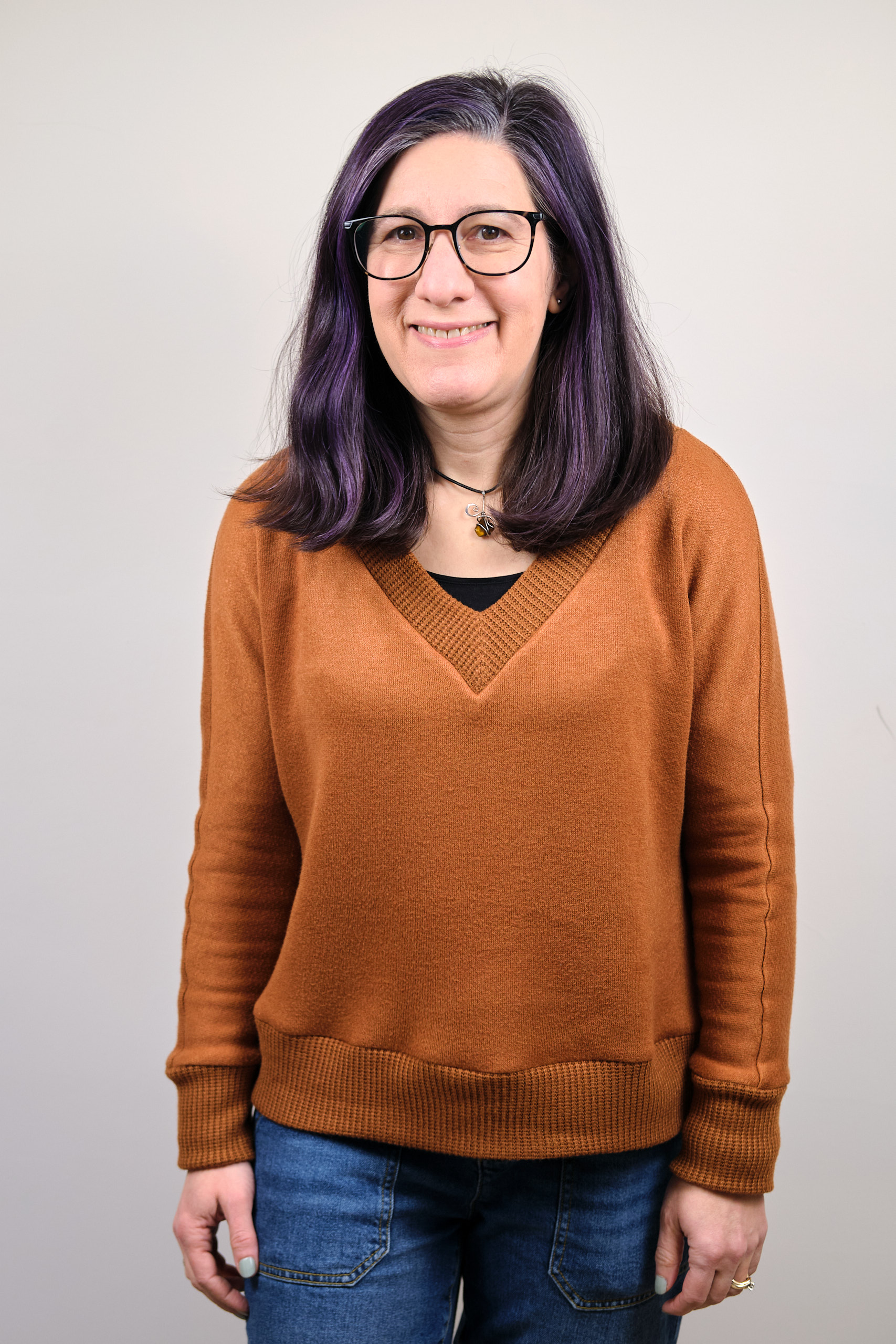
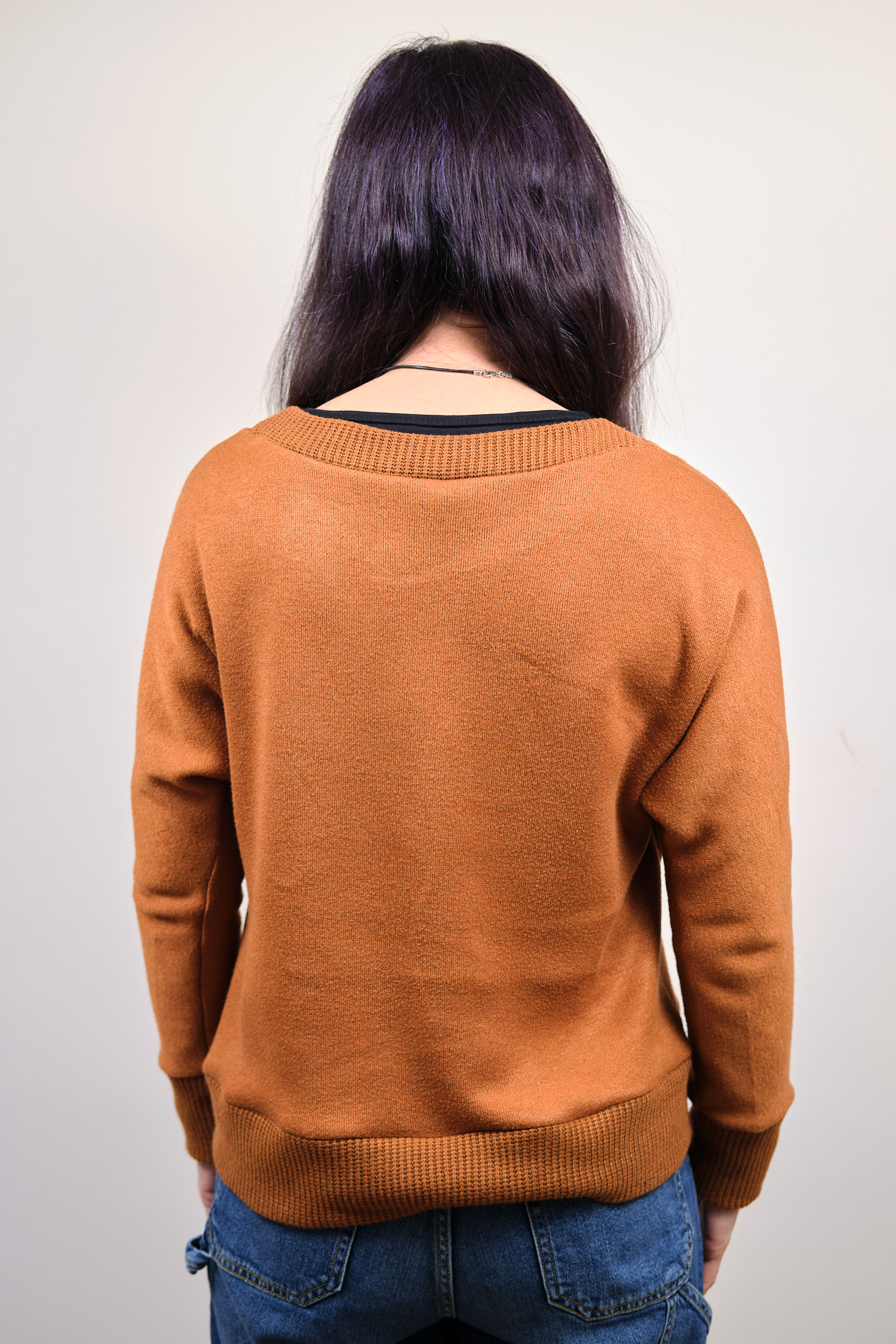
Petite Stitchery Adult Hollis Raglan, size small, top length, wide neckband, sleeves shortened by 2 inches. Made from four colors of hacci scraps.
I bought the Petite Stitchery Adult Hollis Raglan top pattern when it came out in 2024 and had plans to sew it up but never did. I was going planning to make one out of Polartec sweatshirt fleece, but never quite figured out a color combination that I liked. Last week while I was making another color blocked sweater from hacci sweater knit, I found a floral hacci that has been in my stash for a while and saw that I had other haccis that went with it. So I decided to take the plunge and finally make a Hollis.
The main fabric I used for the bodice is a purple “super soft large floral hacci” that I bought during a Mily Mae clearance sale for $3.50 per yard in 2023. It is 180 gsm poly/spandex and fairly stretchy. I paired it with a grape poly/rayon/spandex 200 gsm brushed hacci from Surge that I bought in 2024. I added scraps of 200 gsm poly/spandex sienna and rosy mauve hacci brushed on the inside, leftover from recent sweater and dress projects.
This is my second PSCO pattern, and like the Dovie dress that I made previously, the projector pattern files are sized at 10% of actual size. Not a big deal, but still a minor annoyance. The instructions were pretty easy to follow, but sometimes I wanted more details, for example, should I sew a particular seam with a straight stitch or a stretch stitch — often they tell you, but not always.
I cut a size small, top length, with the thick neckband. I shortened the sleeves by 2 inches, but otherwise made the pattern as written. The neckband construction is fairly unique. The front of the V is cut out in one piece, plus a facing, thus there is no seam at the point of the V. It’s an interesting construction technique and would lend itself to low stretch fabrics. I’m not sure it is any easier than other v-neck construction approaches I’ve tried though. I used my sewing machine to baste together the bands, sew on the cuffs, and top stitch the sleeve bands. Basting was essential to keep things from shifting. Everything else I sewed on my serger.
Hollis was a fun sew, and I would definitely consider making another to use up scraps. It is a loose, but not oversized fit, and I think it would work with a wide range of knit fabrics. I still might make a sweatshirt fleece version someday. In the mean time, I have a lot of the purple floral and solid purple hacci left over. Should I make matching pants?
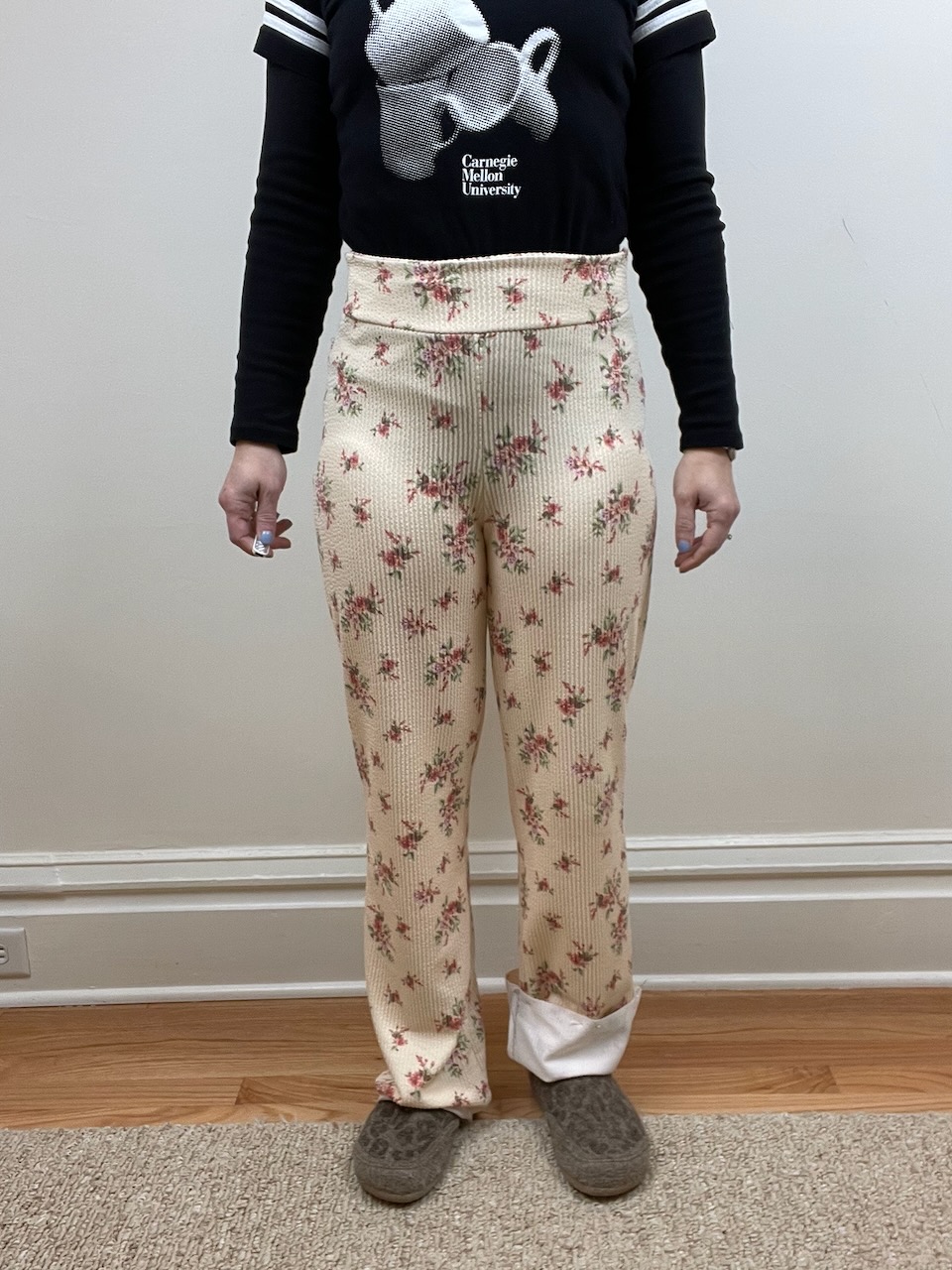
When Sanna Sinclair announced she was looking for pattern testers for a pull-on ponte pants pattern, I had to sign up. This is my most-frequently worn type of pant. Most of my ponte pants are wide-leg, so was eager to try this straight-leg version. This style also includes a back yoke for shaping instead of back darts.
Sanna introduced a new collaboration platform for this test, which I found somewhat frustrating to use, but hopefully will improve over time. Other than the platform glitches and confusion, this pattern test was fun to do and the pattern was very fast and easy.
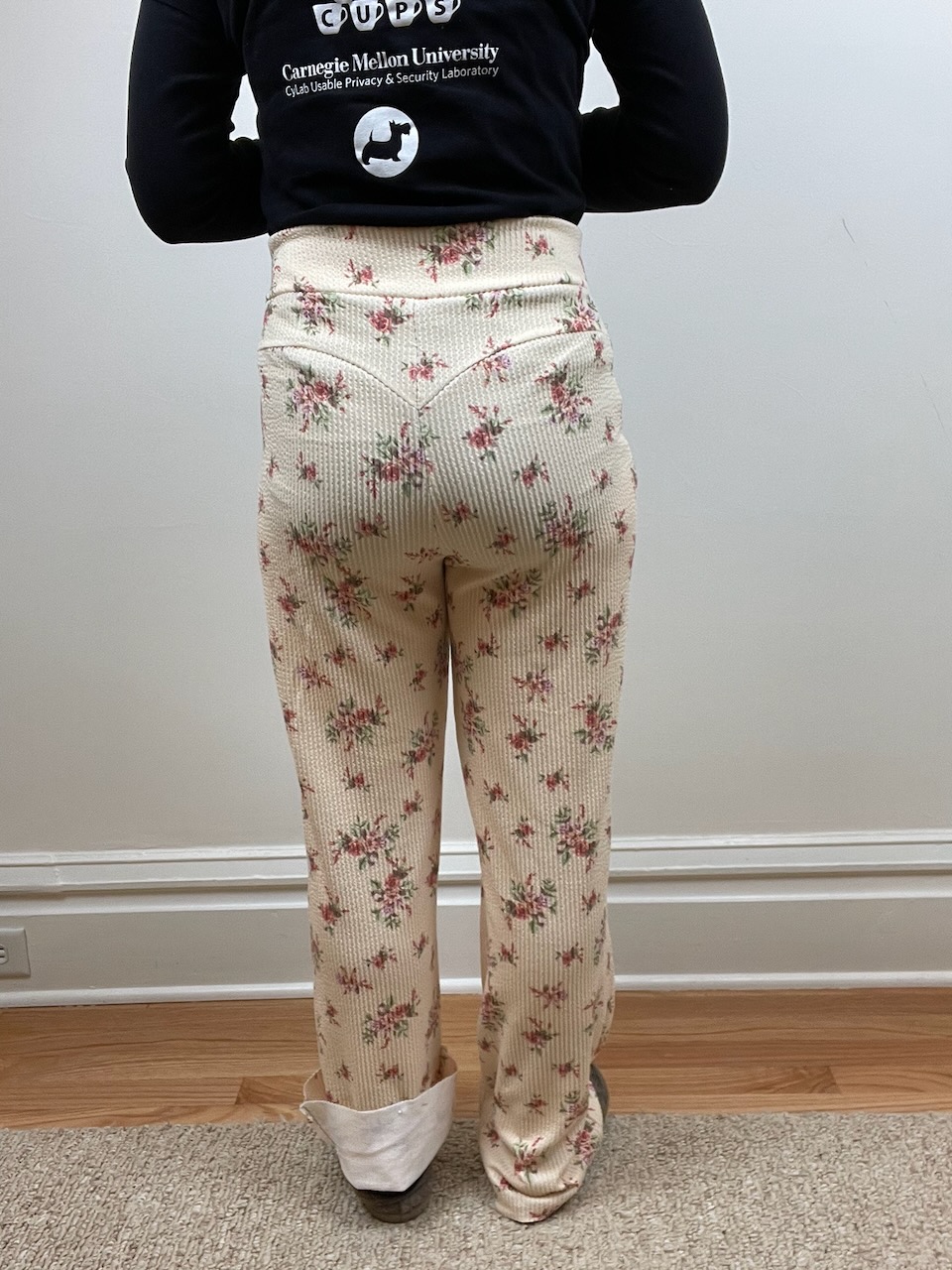
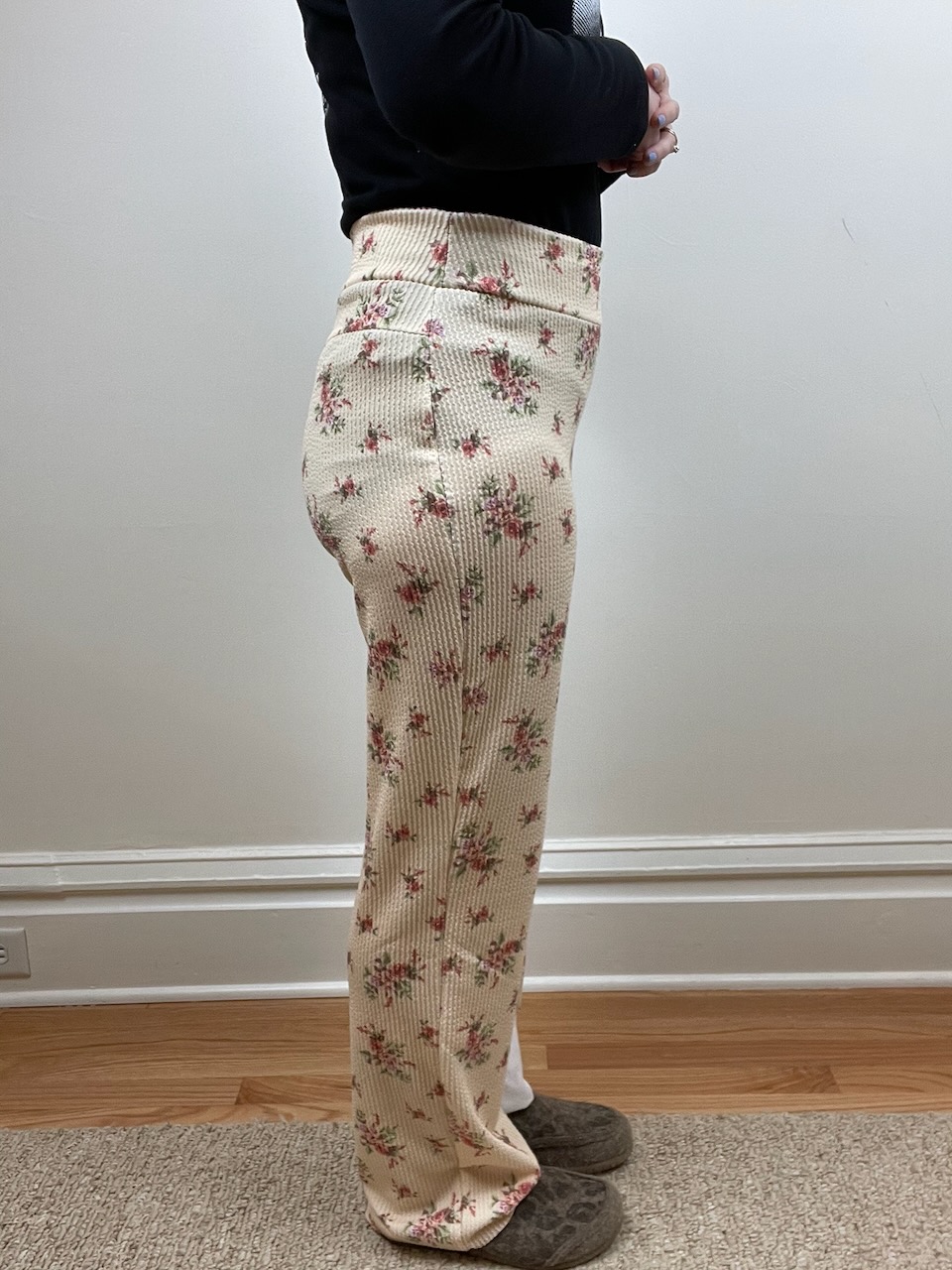
I decided to make a muslin before cutting into my ponte fabric. I have about 5 yards of a yellow floral polyester urban rib fabric that an online fabric store sent me by mistake with my order. Of all the surprise fabrics to find in your order, this was not one I was particularly excited about. I call it the “ugly fabric.” It is not actually that bad, but it is not a fabric that I would have bought. so I decided I might as well use it to practice. I cut out a pair of Helen 6p pants from the rib fabric and basted them together. Since I wasn’t planning on actually wearing these pants I didn’t bother with pockets or elastic. However, the fit turned out to be quite good so I decided I would finish them later and turn them into PJs.
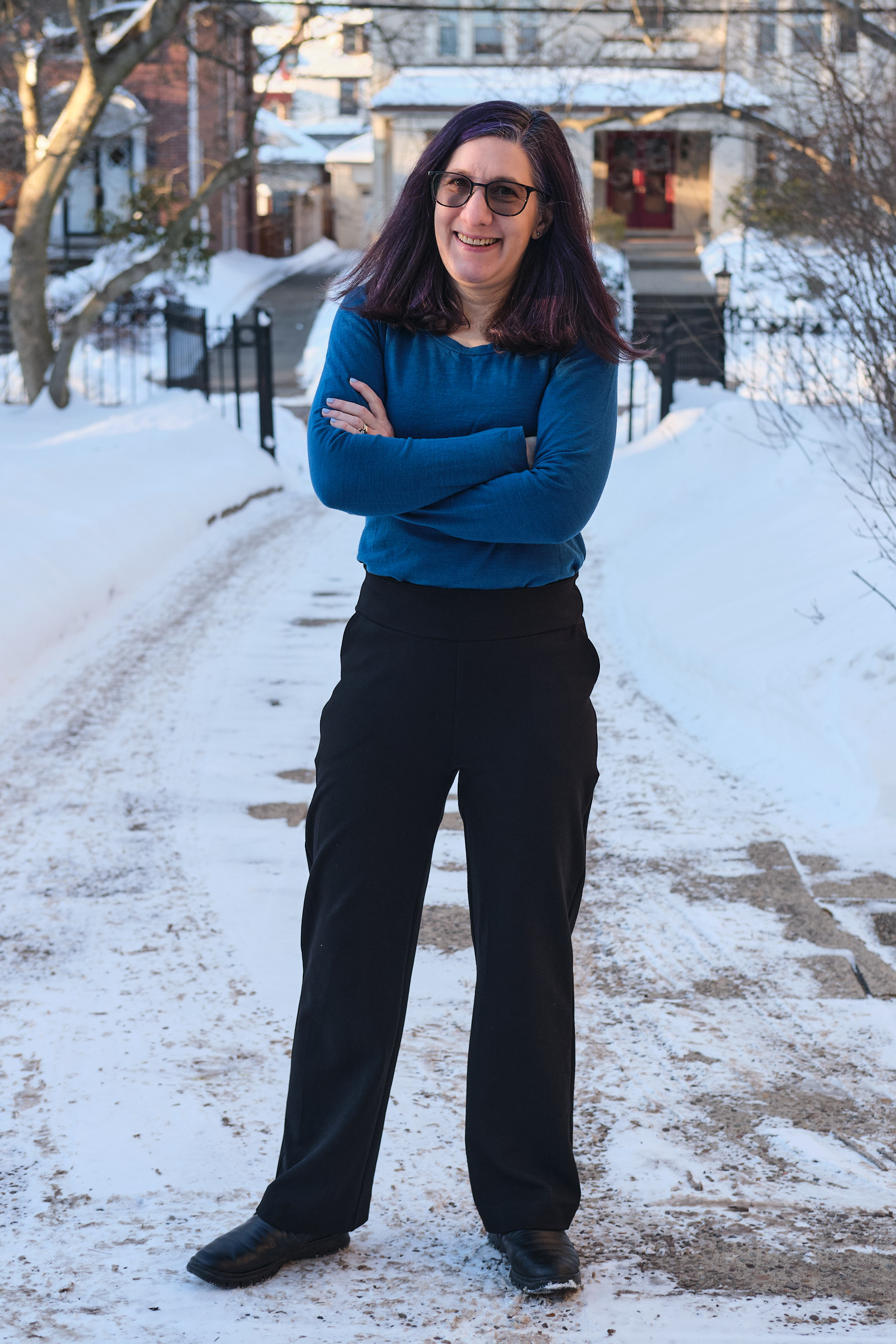
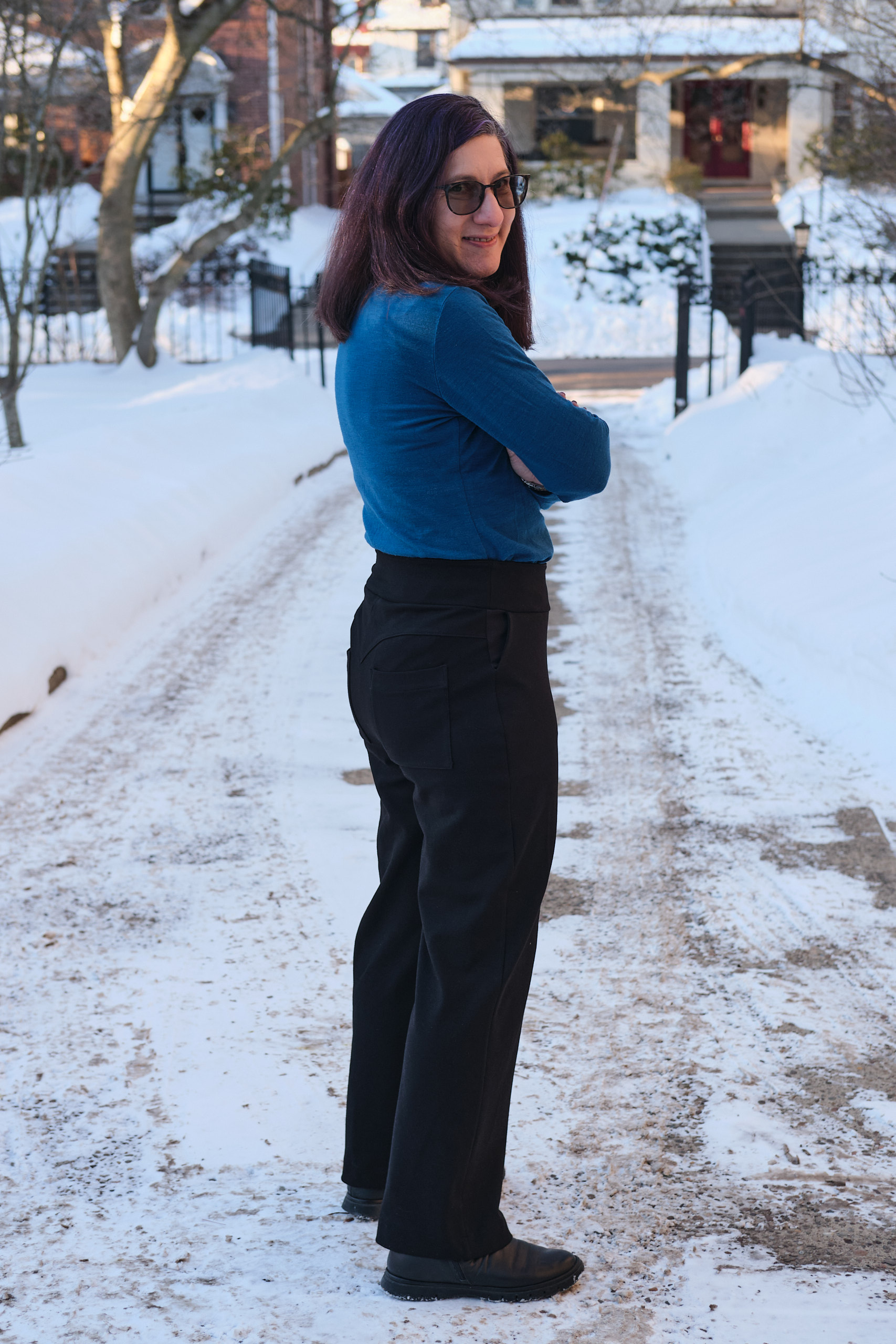
I moved on to making a good pair from black designer ponte fabric. I sewed both the front and back pockets on this pair, and shortened them by 2 inches when I cut them out. Otherwise, I followed the pattern as written. I found it to be easy to follow and overall a quick an satisfying sew. The order of sewing the pant leg seams is a bit difference than what the Pattern Emporium knit pants patterns call for, but this way seemed to work just fine. The pattern advises using a piece of 1-inch elastic in the contour waistband. I did that and the fit is good, but when I don’t tuck in my shirt it does slip a bit. Next time I think I will grade the waist to a 4p. The pockets were not that hard to make and I think both the front and back are a good size. However, I don’t love the shape of the rectangular back pockets and the front pockets gape open a bit, despite stitching clear elastic between the facing and the lining at the pocket opening. This was discussed during the fit test, and the final V2 version offers an alternate back pocket shape and changes the angle of the front pocket opening — both great improvements.
I took photos of my black V1 pants for the finals as I didn’t have time to sew up a V2. Taking photos of black pants is actually really hard to do, and it was really cold that day. I’ve worn these to work multiple times. I think they look great on, and they feel like secret pajamas. Modeled here with a wool Bondi long-sleeve shirt.
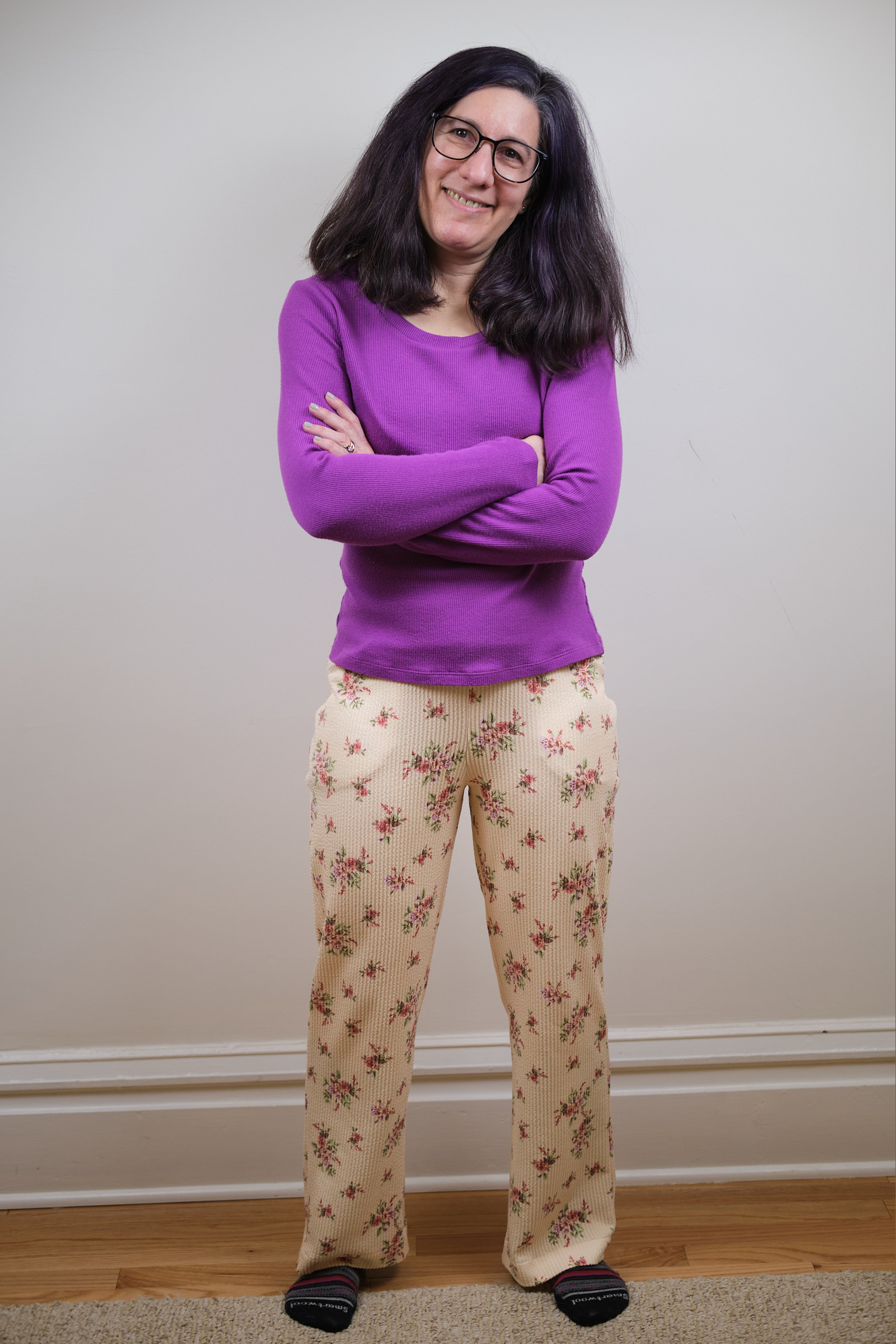
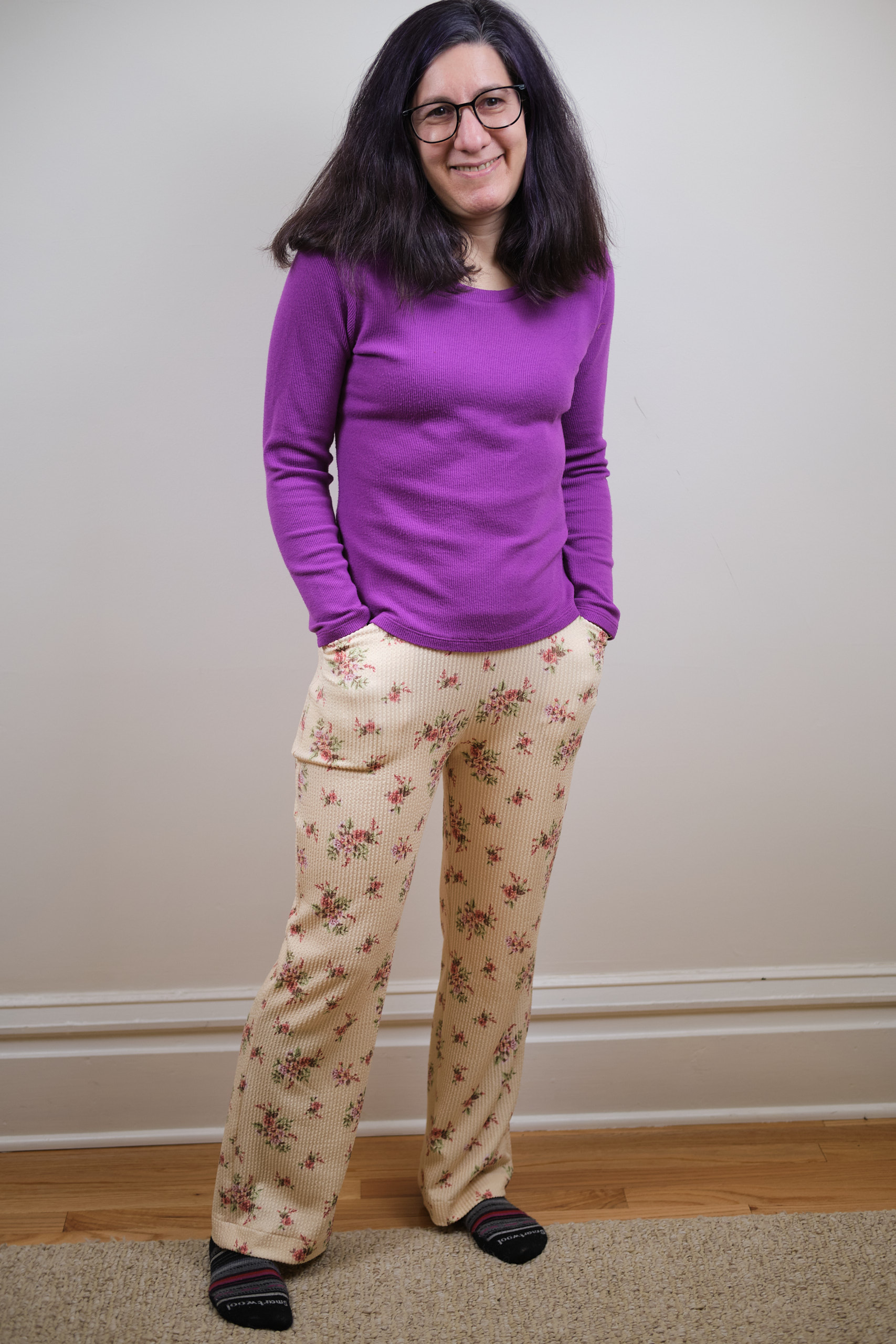
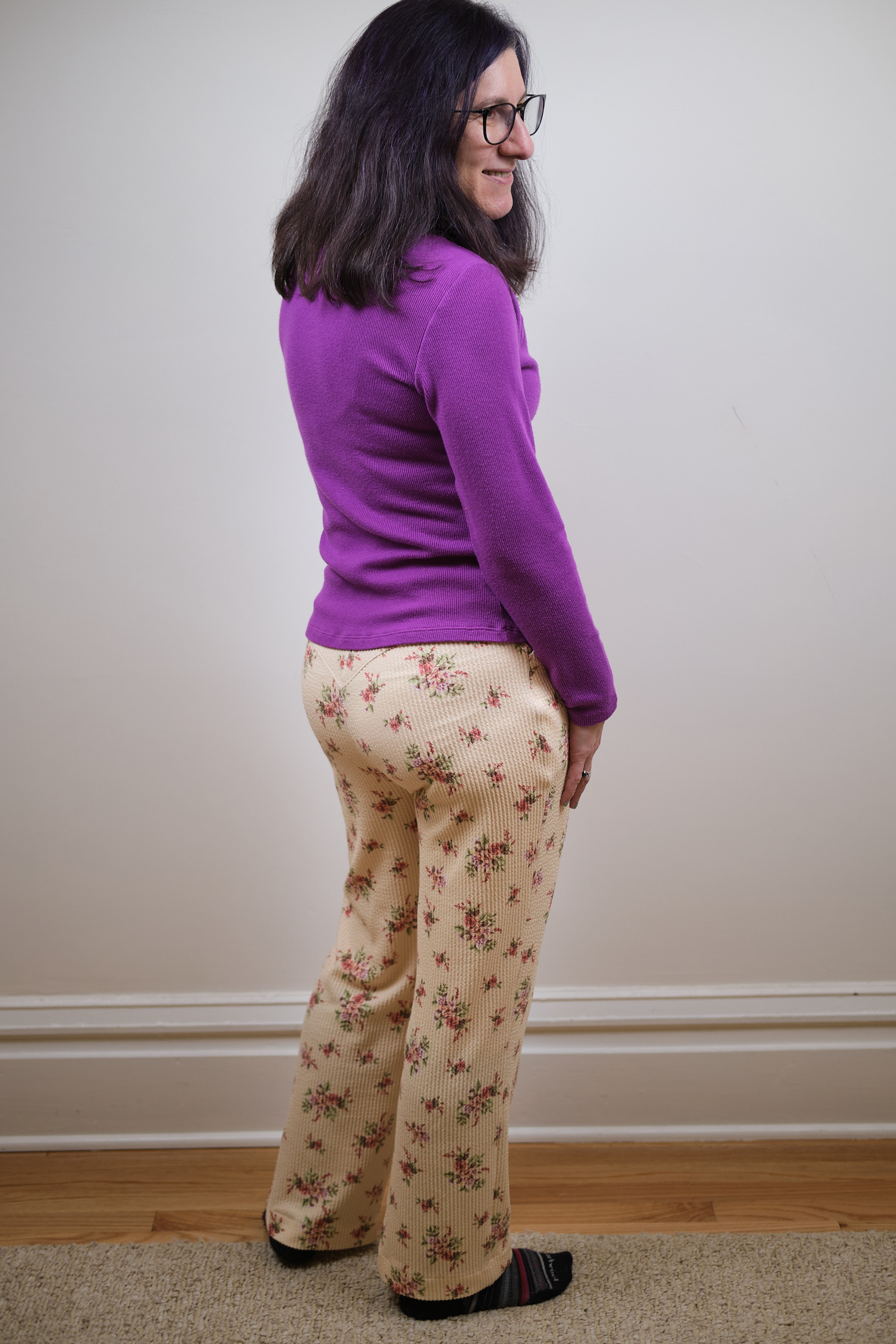
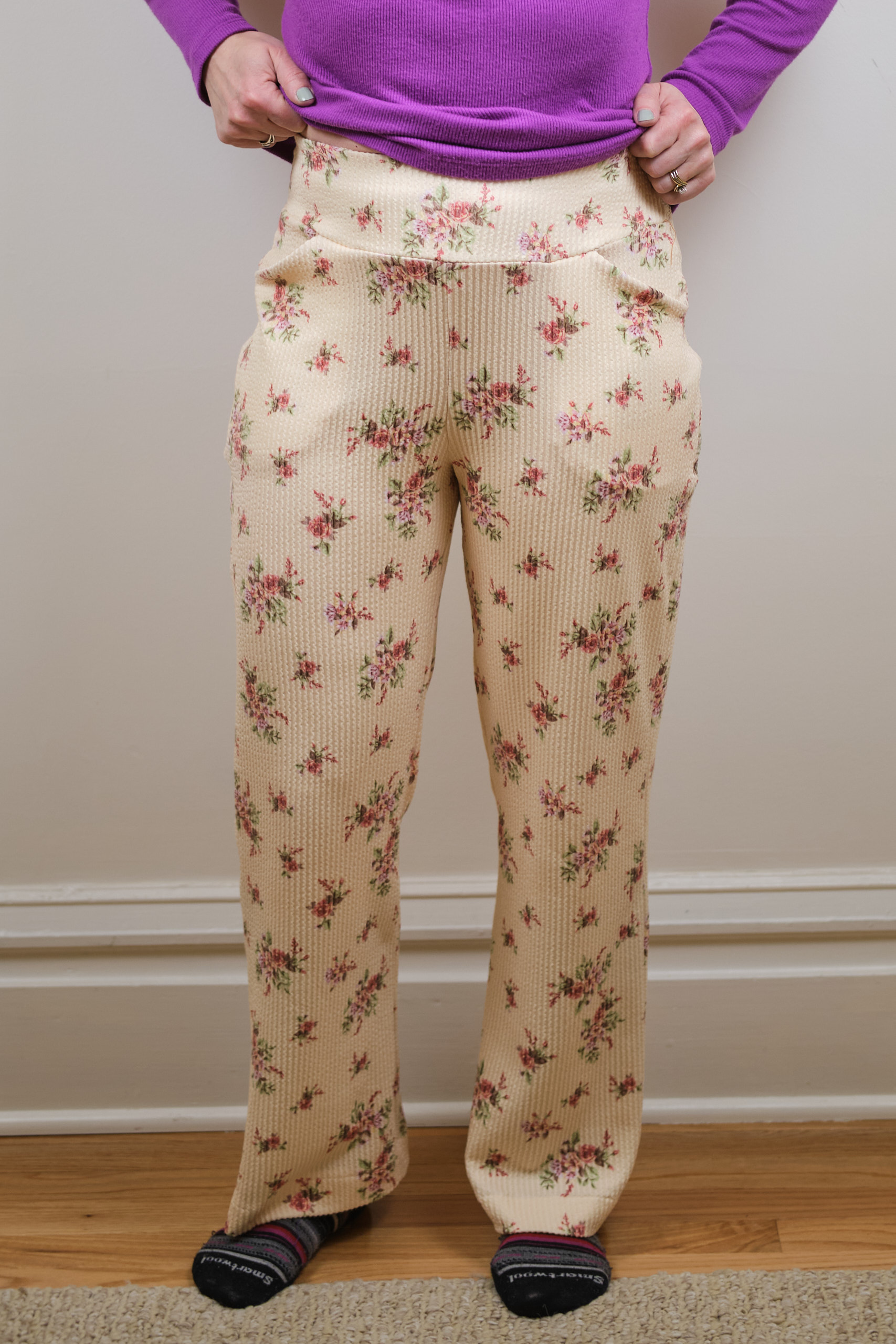
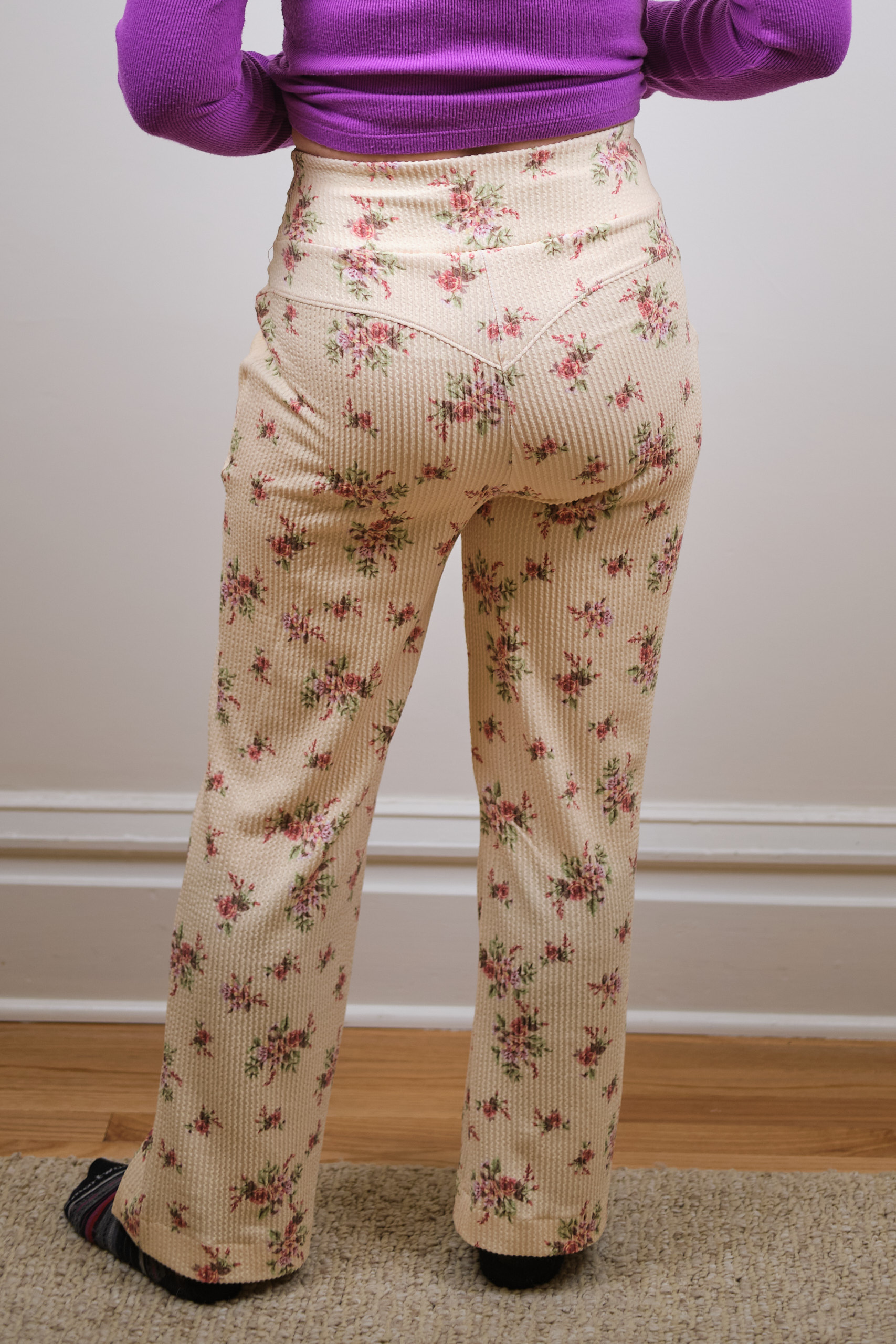
This week I returned to the ugly fabric PJ pants. I removed all the basting stitches, laid the pieces out on my cutting table, and projected the V2 pattern onto them. I trimmed the legs to match the minor changes that were made to V2 and also added the front pockets, because even PJs should have pockets. I recut the waistband pieces with the top graded to size P4, and I cut out the front pocket linings and facings. In a couple of hours, I had the whole thing sewn back together, this time with elastic and front pockets. The fit is very good, and I’m sure I’ll be wearing these a lot around the house. Modeled here with a magenta Bondi. The V2 fit is even better than V1, and the front pockets are great. I also love the back yoke on these pants: they make my butt look great! I look forward to making another pair in ponte or other office-worthy fabric and trying the new back pockets and the faux fly (which I usually skip, but I’ve seen it on pants made by other testers, and it is super cute).
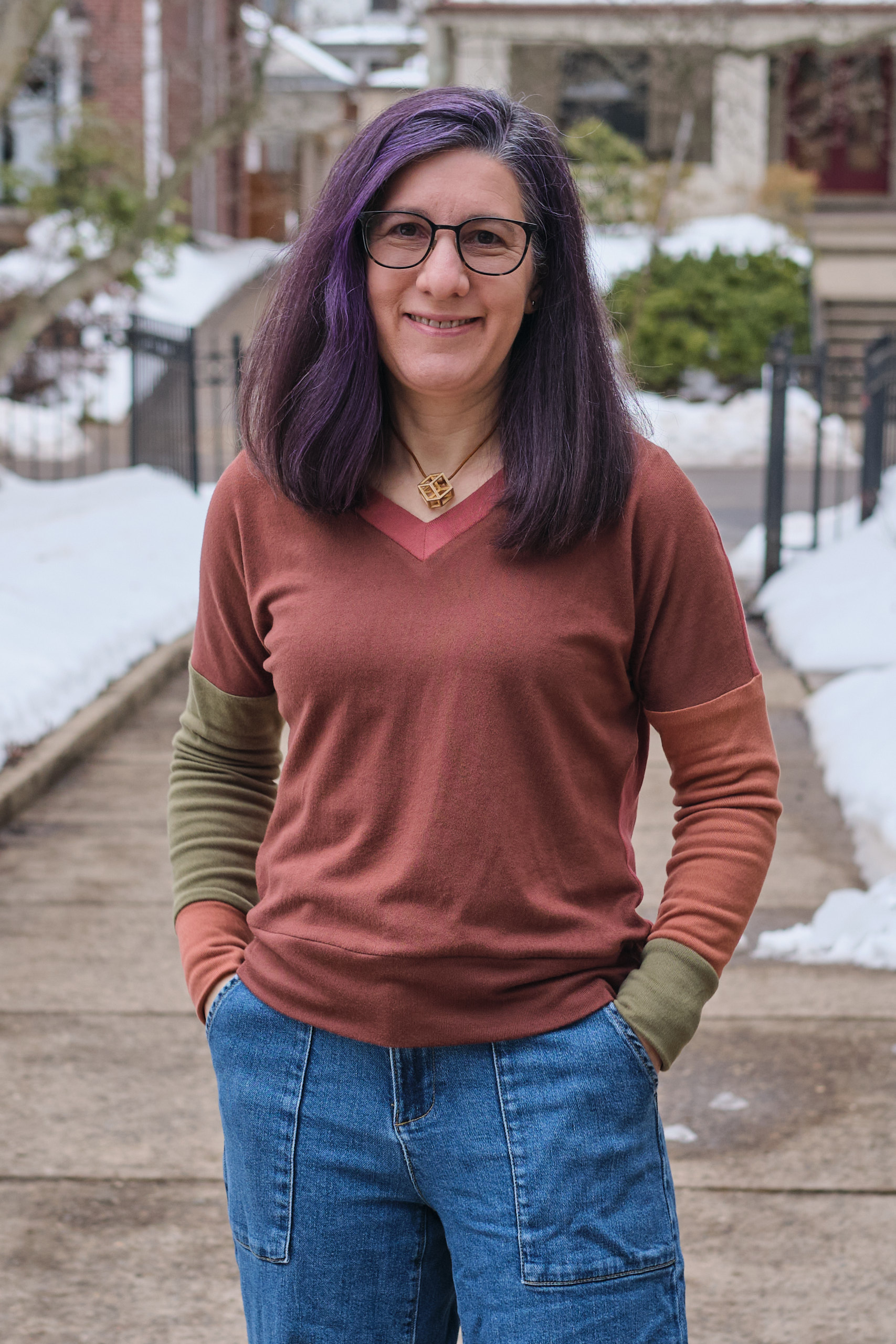
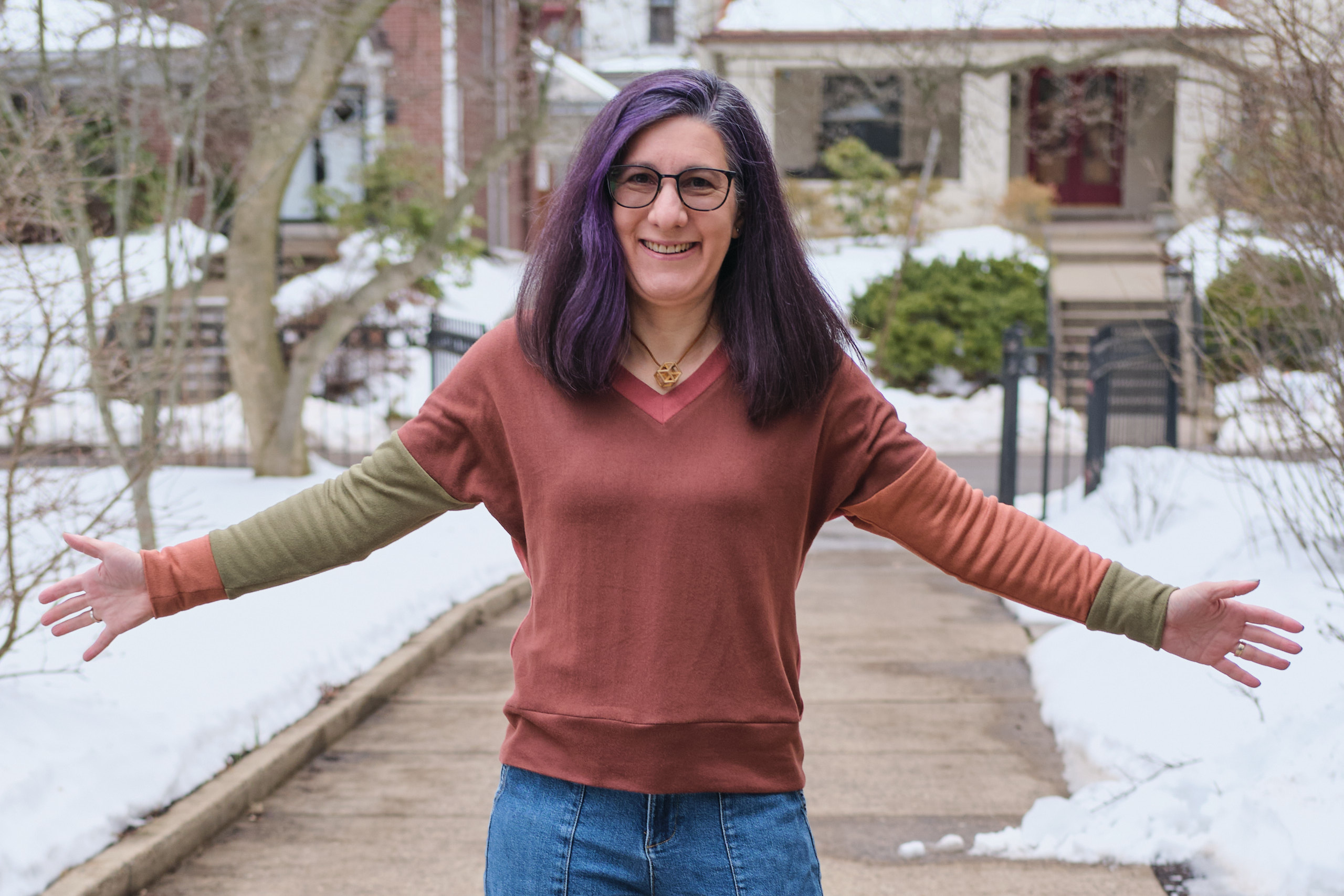
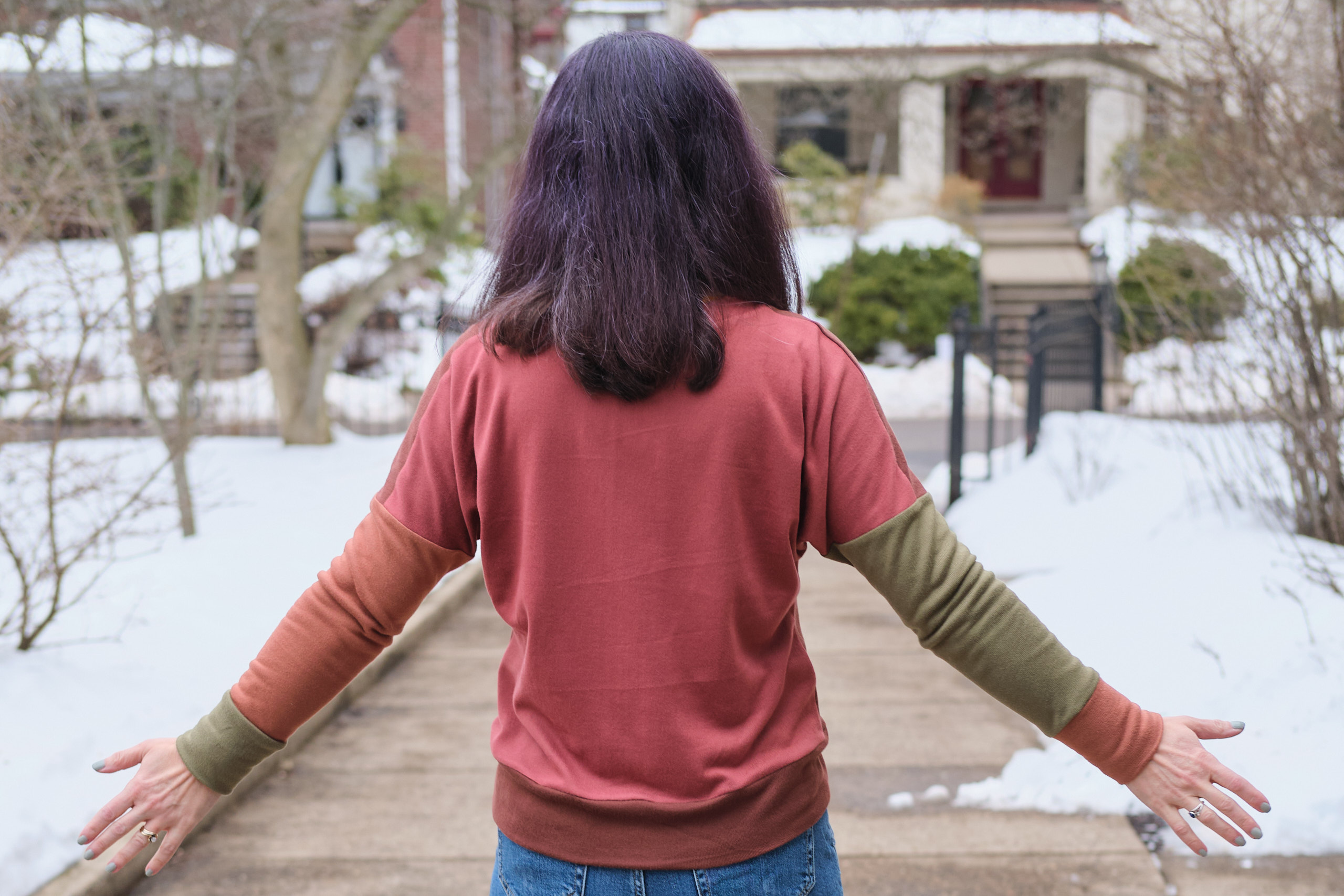
Sinclair Soho Relaxed Dolman top, 4p cut on the fold, cropped 6.5 inches above top length and banded, 3 inches shifted from bodice to sleeves, sleeves shortened and cuffed with Sinclair Crew pullover tall cuffs, wider v-neck band, Versailles brushed hacci color blocked with sienna (2/3 yard), nutmeg (1/3 yard), peat moss (1/3 yard), and teddy bear (3/4 yard).
I bought five colors of the Surge Fabrics Versailles brushed hacci sweater knit when it was on sale last year because I love it so much. It is 95%Poly/5%Spandex, soft and cozy on the inside, has a smooth sweater look on the outside, a nice drape, good stretch and resilience, and a great weight (200 gsm). It is comfy to wear and very easy to sew with. I’ve used it for a scoop-neck PE Sweet Cheeks sweater,v-neck PE Sweet Cheeks sweater for me, and another for a friend, and a Sinclair Joanne faux wrap dress. I’ve had the pile of Versailes sitting in my sewing room for a while and with all the colors stacked together I keep wanting to use them all at the same time to make a color blocked sweater. I’ve had a vision of this in my mind for several months, but hadn’t fully worked out the details until this week.
I thought about using the Sinclair Crew pullover pattern as I did for my family holiday sweater project, but the sweater in my vision was a dolman sleeve or drop shoulder design, not too oversized. After hacking the Sinclair Soho relaxed dolman sweater last week, I knew I could hack it into the color block sweater I imagined. For last week’s sweater I merged the sleeves and the bodice and added tall cuffs from the Crew pattern. This time I kept the sleeves but shifted three inches from the bodice to the sleeves so that the sleeves would begin above the elbow instead of below the elbow (which is how they sit in the first Soho sweater I made from a green rib sweater knit). I shortened the sleeves and added the Crew tall cuffs again. I also shortened the bodice by 6.5 inches before adding the band, same as I did last week.
I had five colors of the Versailles fabric and had to decide how to place them. I knew I wanted to use the teddy bear, sienna, and nutmeg together, but adding both the rosey mauve and peat moss seemed to be too much. I decided I would use one or the other, but not both. I think either would have been fine, but I eventually settled on the peat moss, rather than the much lighter mauve. My vision was to use a different color for the front and back and to have them meet a third color at the sleeve. I decided to do the two sleeves different colors and then make the cuffs from the opposite colors. I used the back color for the v-neck and the front color for the bottom band.
I switched out the Soho narrow v-neck band for the PE Sweet Cheeks wide three-piece v-neck band to make it work with my unruly rib knit last week. I didn’t think I would have the same problem with the Versailles, but I liked the idea of the wide band. So I decided to try to use the Soho band but just make it wider. It is supposed to be 1.8 inches wide and I cut it 2.8 inches wide. I followed the same instructions and first basted it in place just be sure. It worked perfectly and I ended up with my desired 1-inch wide v-neck band, which has a nice sharp 90-degree point and the heft I was looking for to balance the color blocks.
Everything was serged except for joining the short ends of the bands, sewing the point of the v-neck, and basting the neck band. As everything is banded, no need for hems and I decided not to topstitch anything. Thus, this sweater came together pretty quickly once I stopped obsessing over which colors to put where.
Earth tones are not my usual palette, and I don’t normally wear this much brown, but I really like this combo and it looks exactly like I imagined it would! I even had the perfect pair of shoes to match (these are the only brown shoes I own). I also really like the fit and drape of my cropped Soho, and it fits my shoulders without any adjustments. Note that in the photos here, I am wearing a long-sleeve t-shirt underneath because it is cold outside, so it clings just a bit to the undershirt, but you probably didn’t notice.
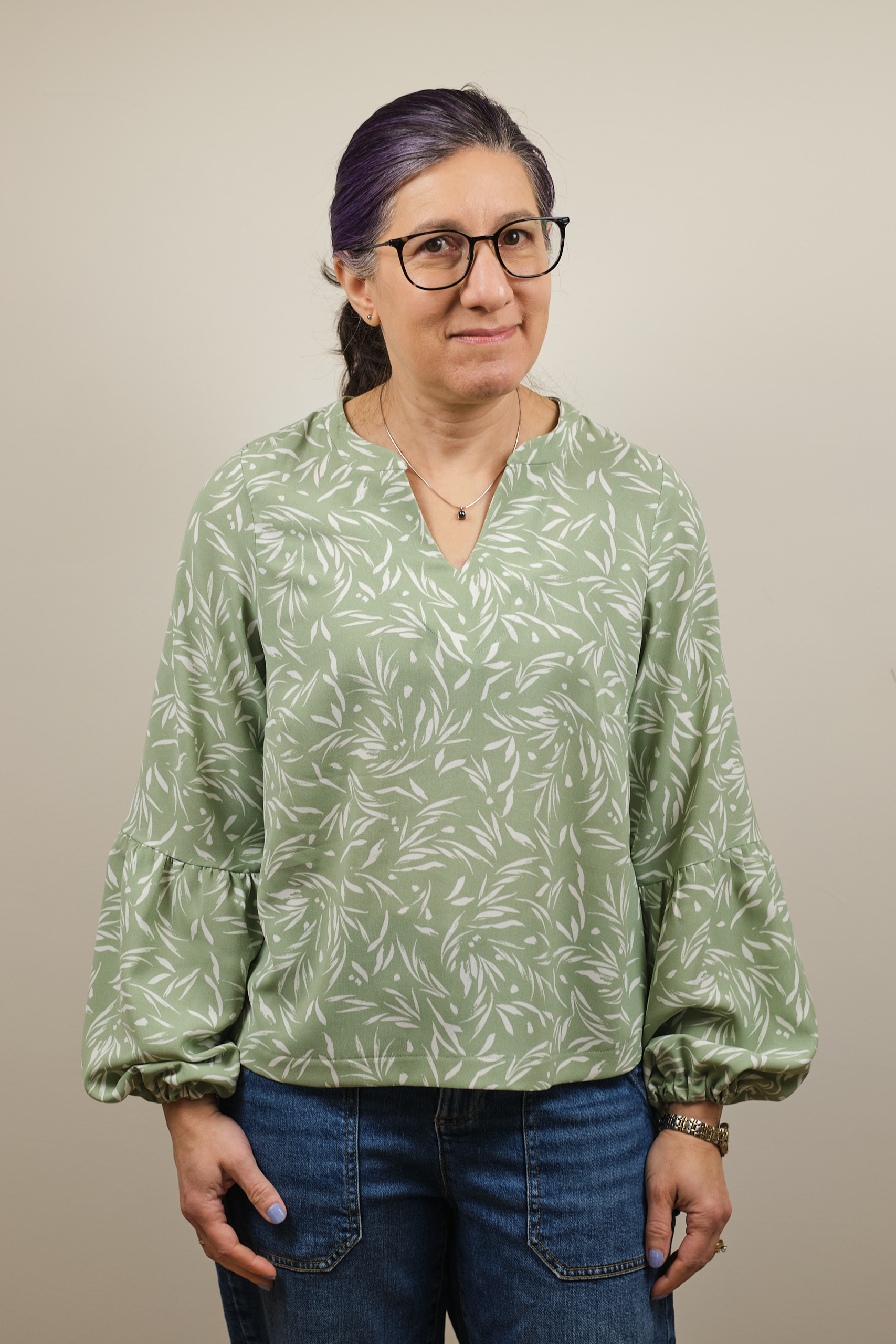
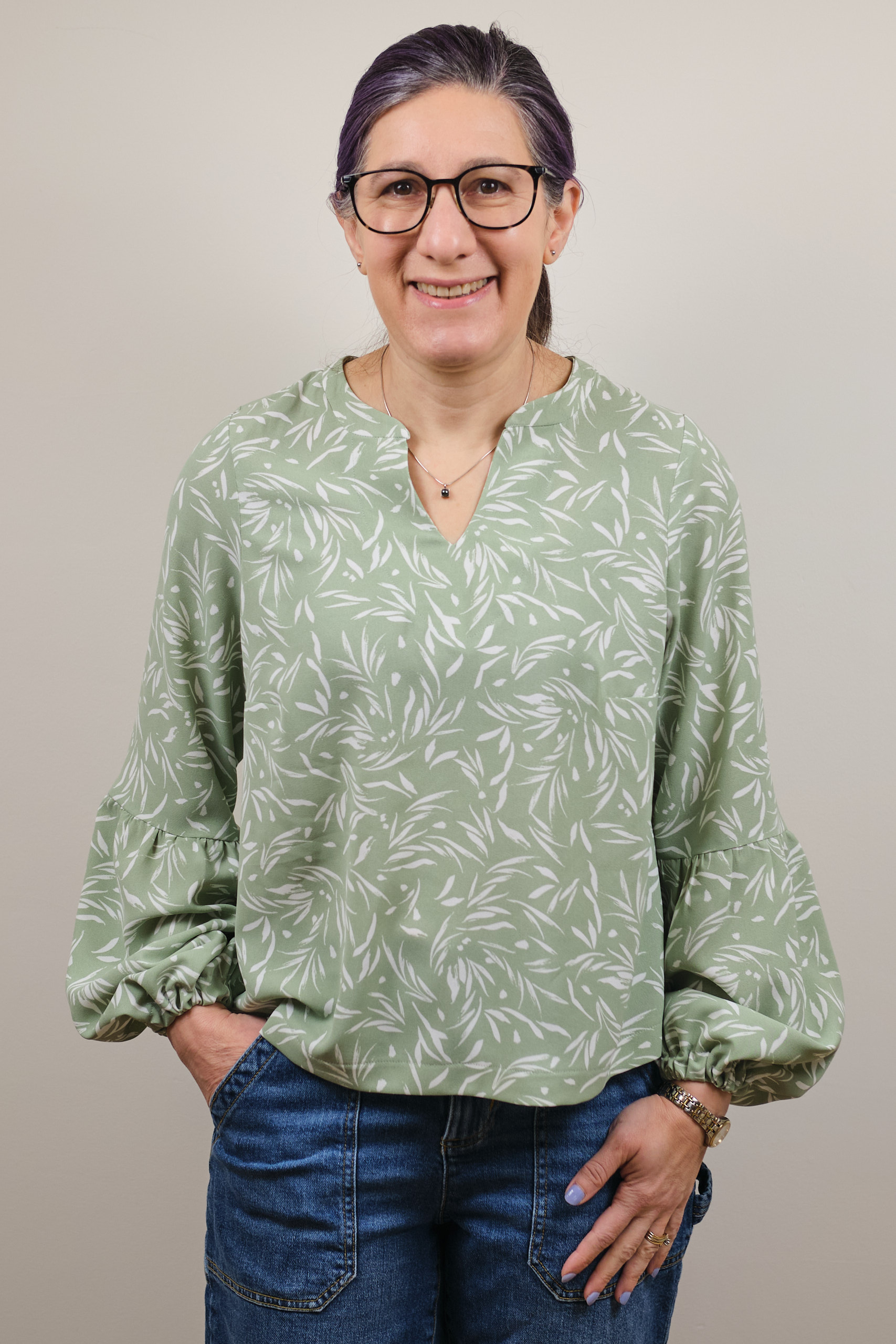
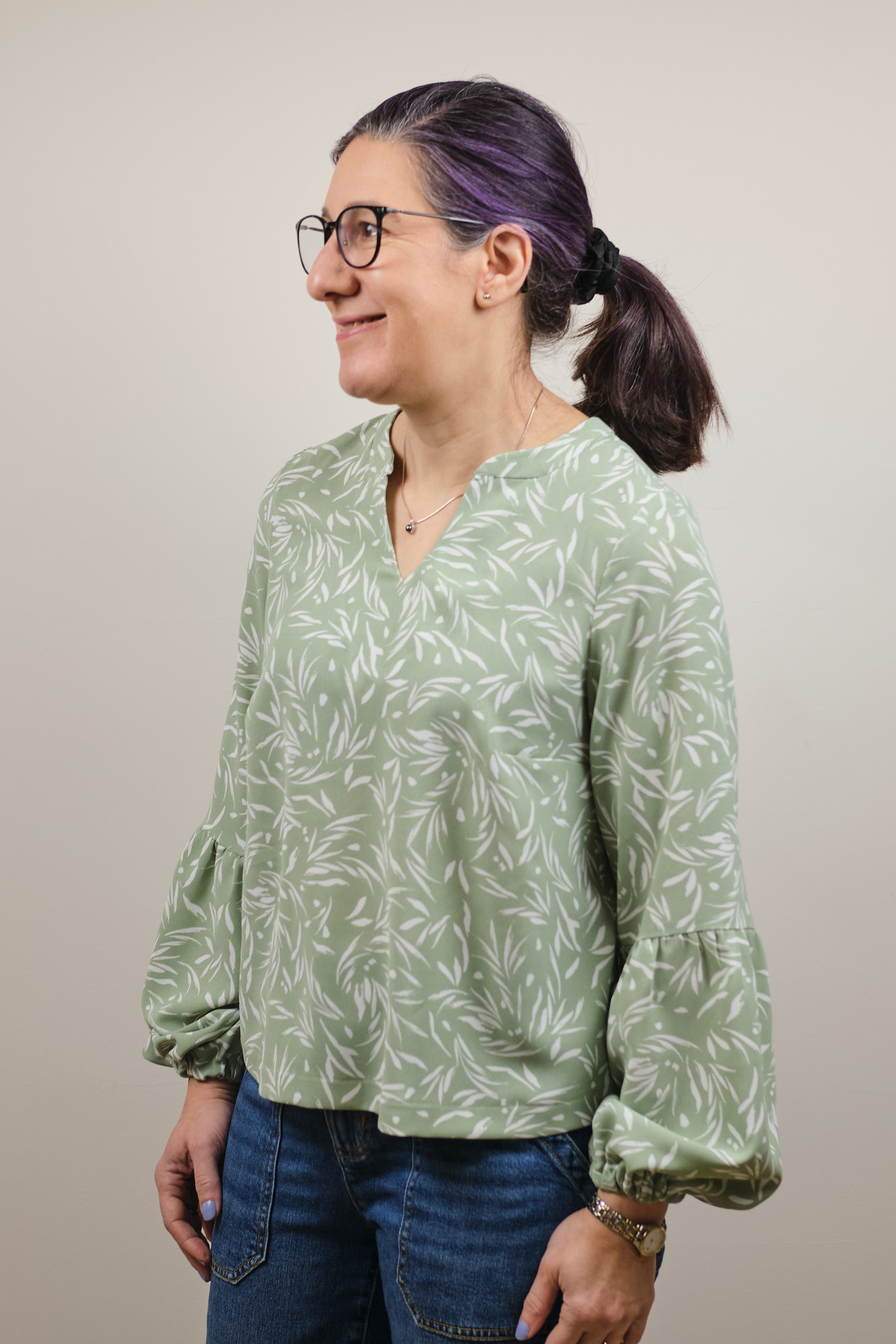
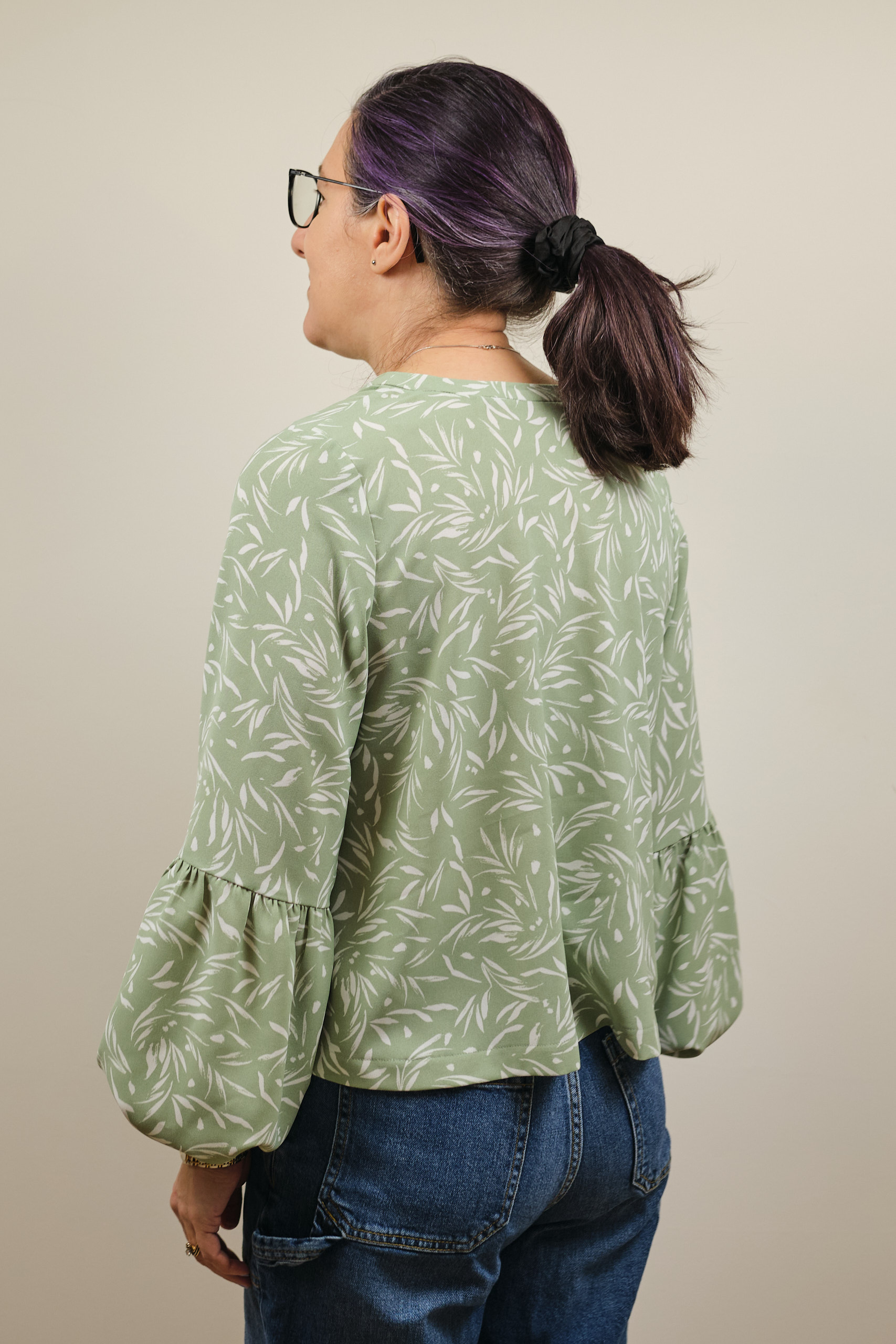
Love Notions Muse blouse, straight bodice, tiered sleeves, size small, shortened bodice and sleeves, from 2 yards or light sage Tess Cey.
In January, I applied to be a pattern tester for Muse, a new top pattern from Love Notions Sewing Patterns. (Here I am in the release video!) I have sewn a few of their patterns, but never tested a pattern for them before. I wasn’t invited to be a part of the main testing group, but was invited to join the later “finals” testers group. This group gets the revised pattern after the first group has already tested it and is assigned a size and features and asked to sew up and photograph the near-final version of the pattern.
Unlike past pattern testing I’ve done that uses a Facebook group for communication, Love Notions uses the Basecamp project management system. There is a section for sharing documents, another for uploading final photos, a to-do list for changes that need to be made to the pattern or instructions, and discussion boards. One of the fun aspects of pattern testing is communicating with and getting feedback and advice from other sewists. It is also nice to see the issues I’ve found with a pattern taken into account as the pattern evolves into the final version.
When I joined the Basecamp group, I could see there had already been a lot of discussion about certain aspects of the pattern and these had been addressed in the revised pattern. I also saw advice about trimming seam allowances and setting in sleeves that was not yet in the pattern instructions but that I could apply immediately.
The new pattern is called “Muse” and it is a woven blouse pattern that can be made with regular short sleeves, balloon sleeves, or tiered sleeves. It can be sewn with a straight bodice or a skirted bodice, optionally with a balloon hem. It is cold and snowy in Pittsburgh, so I asked to sew the long-sleeve version. I’ve also not loved the look of most skirted woven tops on me, so I requested to sew the straight bodice. I was assigned to sew size small, according to my measurements.
This pattern was designed for someone who is 5’5″ (as are most women’s sewing patterns that don’t come in petite sizes). The instructions recommended shortening the bodice by .5 inch for every inch shorter than 5’5″ you are, so I shortened it by 1.5 inch. The instructions didn’t offer advice about shortening the sleeves, but I know from past experience that I usually need to shorten sleeves by about 2 inches on most patterns. I asked in the Basecamp group about how to do this on the tiered sleeve and was advised to remove 1 inch from each part, which seemed to work fine.
I used a light sage polyester woven “cey” fabric called Tess Cey from Mily Mae Fabrics. I bought it when it was on sale for $3.75/yard. (Apparently, CEY is an acronym for continuous environmental yarn and refers to a type of polyester fabric made with sustainable practices that tends to be soft, drapey, and wrinkle-resistant.) This fabric is a little slippery to work with. It is not a stretch fabric, but it does have a little bit of mechanical stretch. It doesn’t tend to wrinkle, but it does hold a crease when pressed with an iron. I used about 2 yards of fabric.
Some testers described this pattern as a “quick sew.” I did not find it quick (and others also disagreed with that description). I think I spent between 5 and 6 hours on it. The main reason it took so long was that the collar construction instructions were confusing and it is a multi-step process. Now that I know how to do it, it would go faster next time, but it will still be an involved process, with inner and outer interfaced layers, top stitching, and stitch-in-the-ditch or hand stitching to finish. Sewing the point of the V is tricky because once you sew past the point in the fabric you no longer can see your 3/8 inch guide on your sewing machine. I ended up marking the stitch lines around the point in pencil so I could see where to stitch. I didn’t cut the facing around the v-neck 100% symmetrically and this was evident when I initially top-stitched the V. I removed the stitching and did it again and it looked a lot better the second time. Next time I will double check the facing before I sew it on. I pinned the collar pieces together backwards and the pieces didn’t fit together right. But I realized my mistake and repinned before sewing. The final version of the pattern instructions are a bit clearer on the process. It still takes soe effort but it is a really nice finish. The final version also now has a ruffled neck option.
The height and sleeve adjustments worked well for me. The tiered sleeves were pretty easy to construct and look nice. The pattern called for 5.5 inches of elastic at the wrist of each sleeve. I used 7 inches instead for more comfort, and could probably have gone even bigger. The final version of the pattern has adjusted the elastic lengths based on tester feedback, but it’s always a good idea to wrap the elastic around your wrist and adjust as appropriate for you.
I often do broad and sloped shoulder adjustments on fitted tops. I didn’t do that on this one because it seemed like more of a loose fit, but in hindsight, I should have at least done a broad shoulder adjustment, as the fabric at the shoulders pulls slightly. Other testers mentioned the shoulders were tight so the final version of the pattern has about 3/8 inch more room in the shoulders. I’m not sure about a sloped shoulder adjustment as that would require adjusting the bust dart, which was already set slightly too low for me. I will at least adjust the point of the dart up a bit next time or possibly leave it out altogether.
My complaints above are all minor issues that, especially with a print fabric, most people will probably not notice on the finished garment, which I think looks great! I’m sure I will get a lot of wear out of it and enjoy wearing it once the warm weather returns someday.
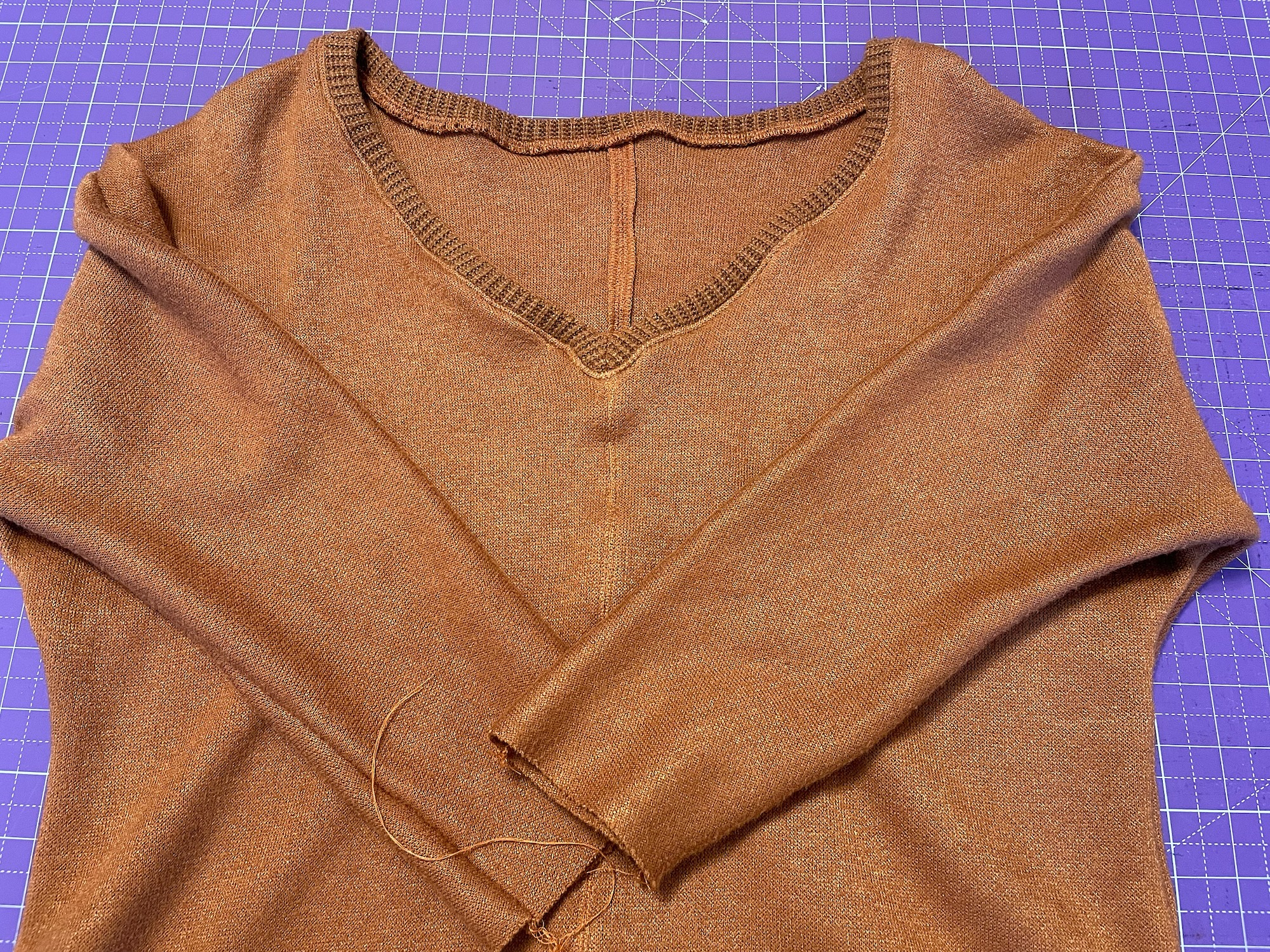
I cut out the bodice and sewed together the center seams (in the past I cut on the fold and omitted them) and then attached the ribbed V-neck. The center seam didn’t lie that flat with the bulky fabric, and when I top-stitched it down it was a little lumpy. The thin v-neck did not work well with the Banff rib and stretched out quite a bit. All of this would have worked fine with a different fabric, but it was not great with the fabric I was using. I thought about ways to save it, and I could have made it work, but I didn’t think I would be completely happy with it. I finally decided that since I had enough fabric left, I would make some modifications and try again. V1 goes into the scrap bin and will get turned into something else later.
The second time around I cut the front and back bodice each as one piece without the center seam. The sleeves are extended 7.5 inches and the bodice shortened by 6.5 inches from the top length. Instead of the v-neck that comes with Soho, I used the v-neck from the Pattern Emporium Sweet Cheeks sweater size AU6, which I had used before with the Banff. Since there are only two pieces, the bodice was very quick to assemble. The v-neck takes some time to get right. The bottom band and cuffs (the tall cuffs from the Sinclair Crew pullover pattern) went on pretty easily. I used my sewing machine for some v-neck basting, to sew the three pieces of the neck band together, and to join the ends of the cuffs and bottom band. Everything else was serged. The double-knit is the same on both sides, but the rib-knit is brushed on one side. I made the kelp sweater with the brushed side out, this time I turned it the other way for more define ribs.
So, in the end, this was a mashup of three different patterns plus hacking the sleeves. I’m quite happy with the result. I like the roomy, but not oversized fit of the bodice, which provides more shaping. It is a bit of an unusual sweater sleeve with seams on both the top and the bottom. It would also be cute to add a stripe to the top or to use different colors for the front and back.
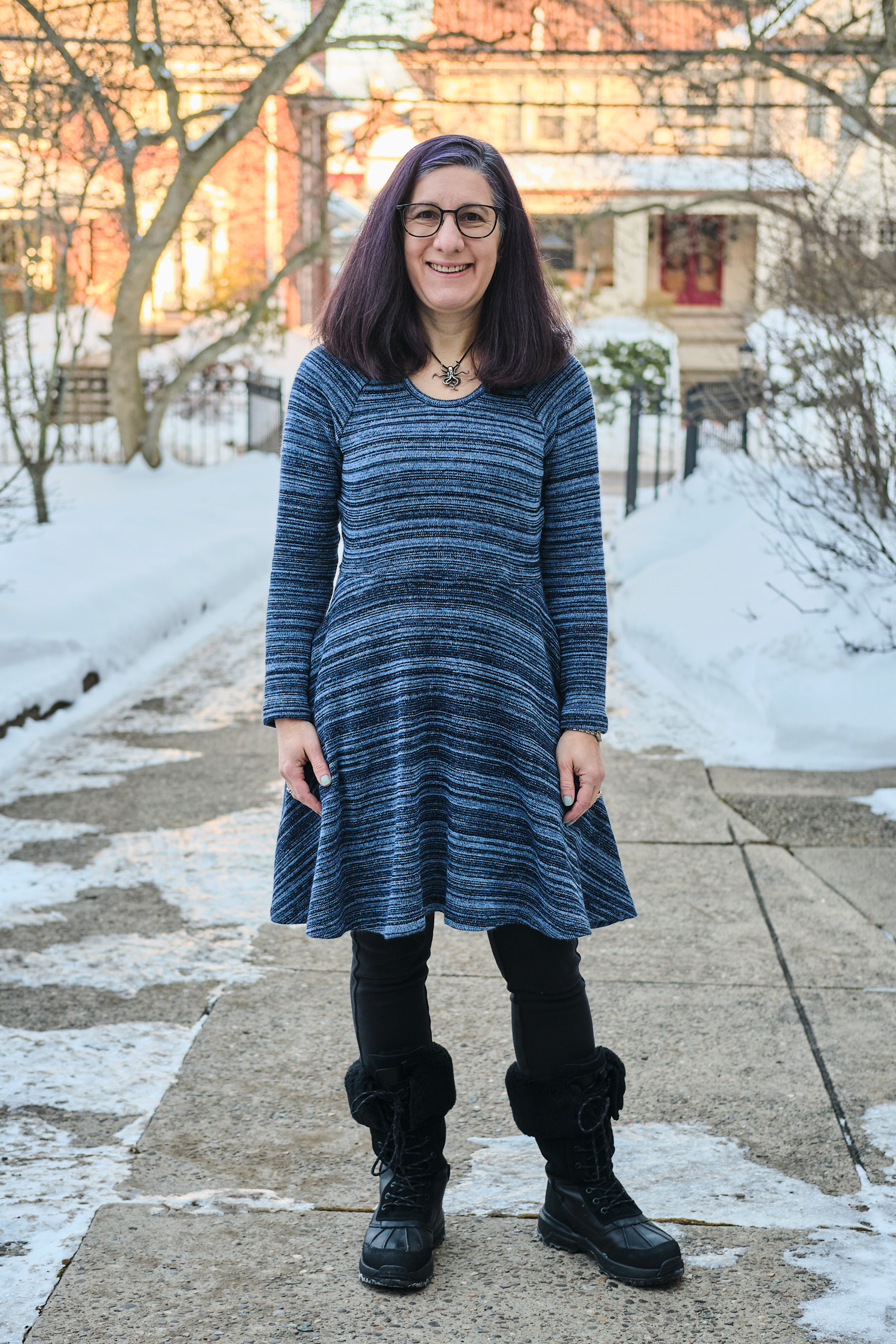
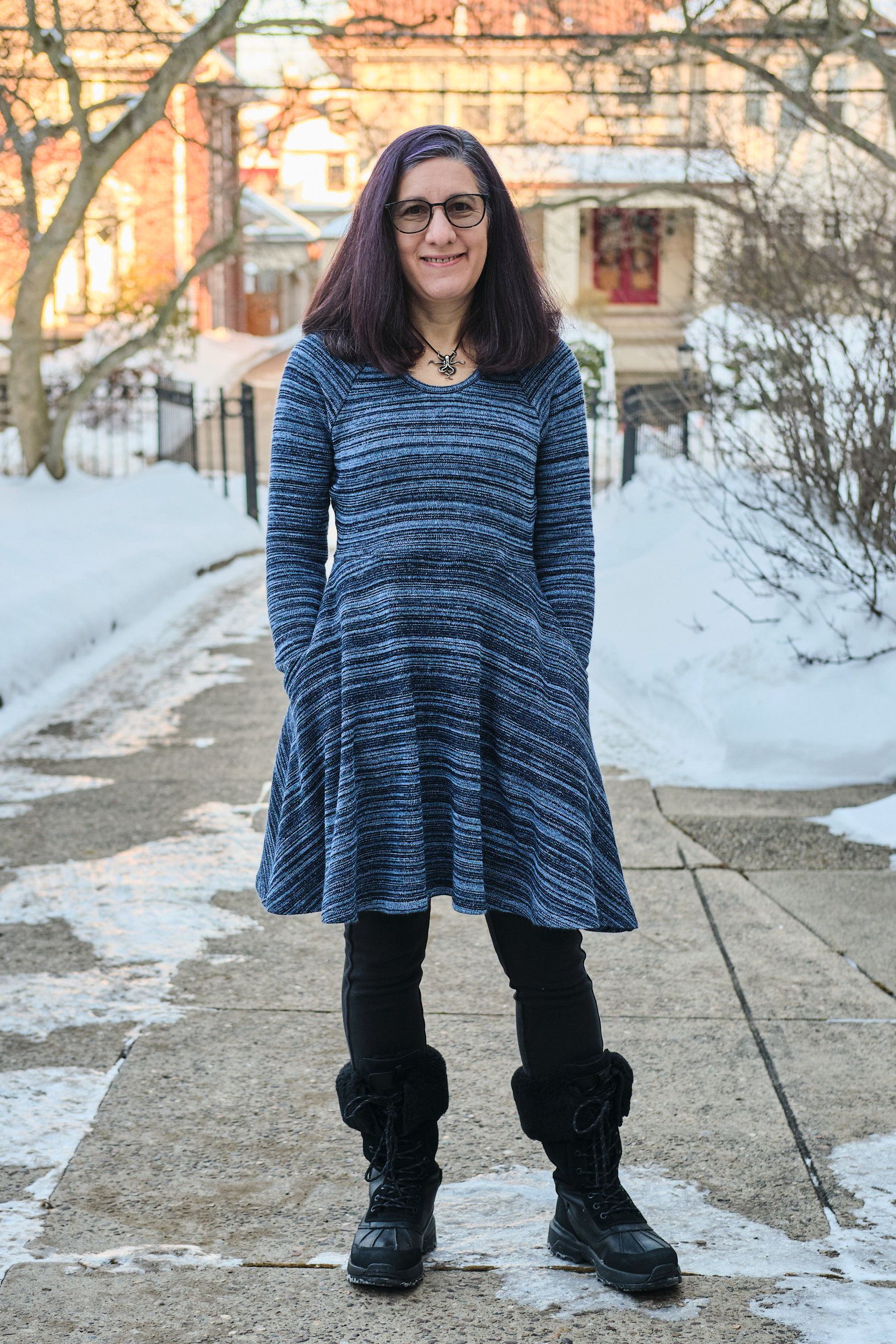
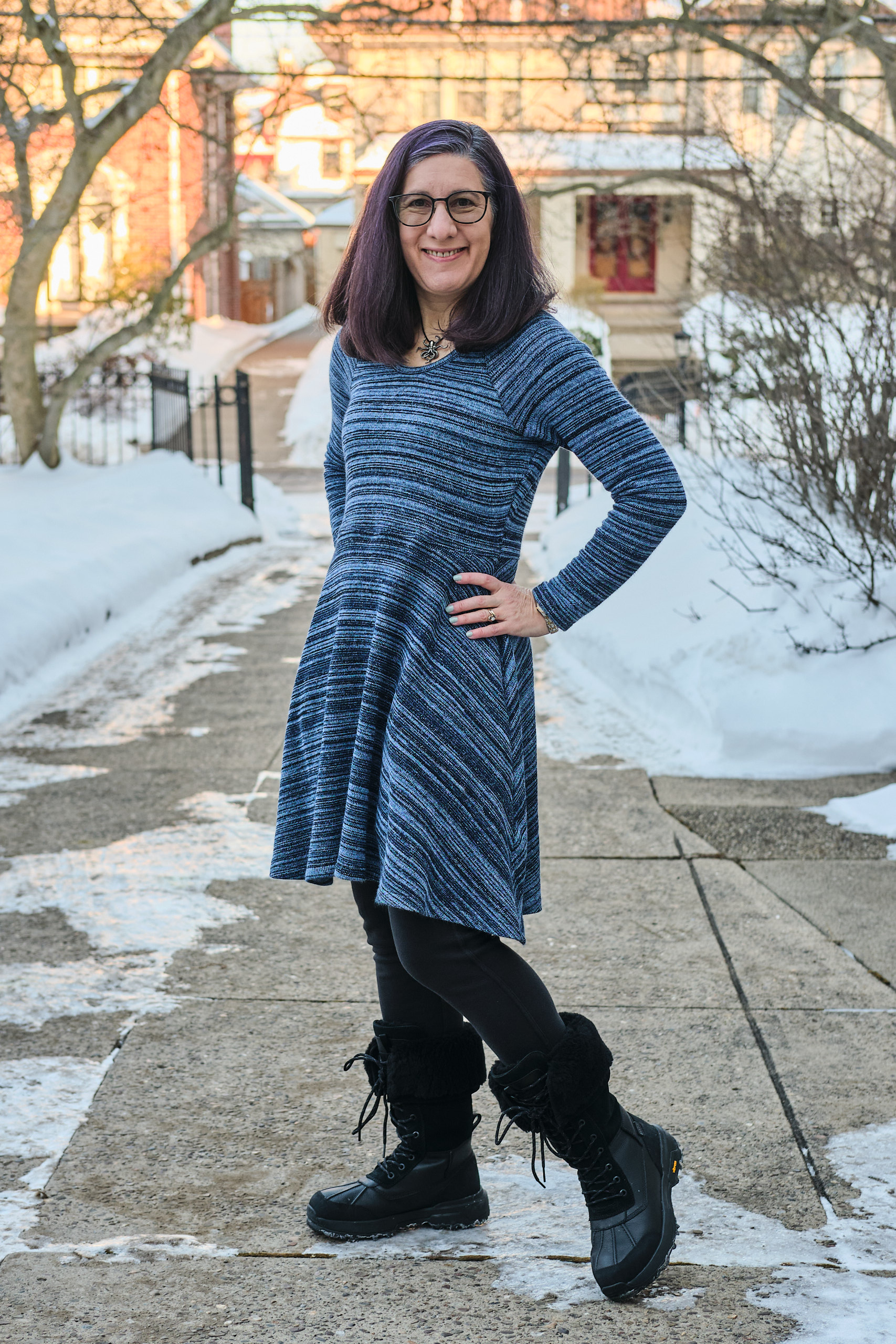
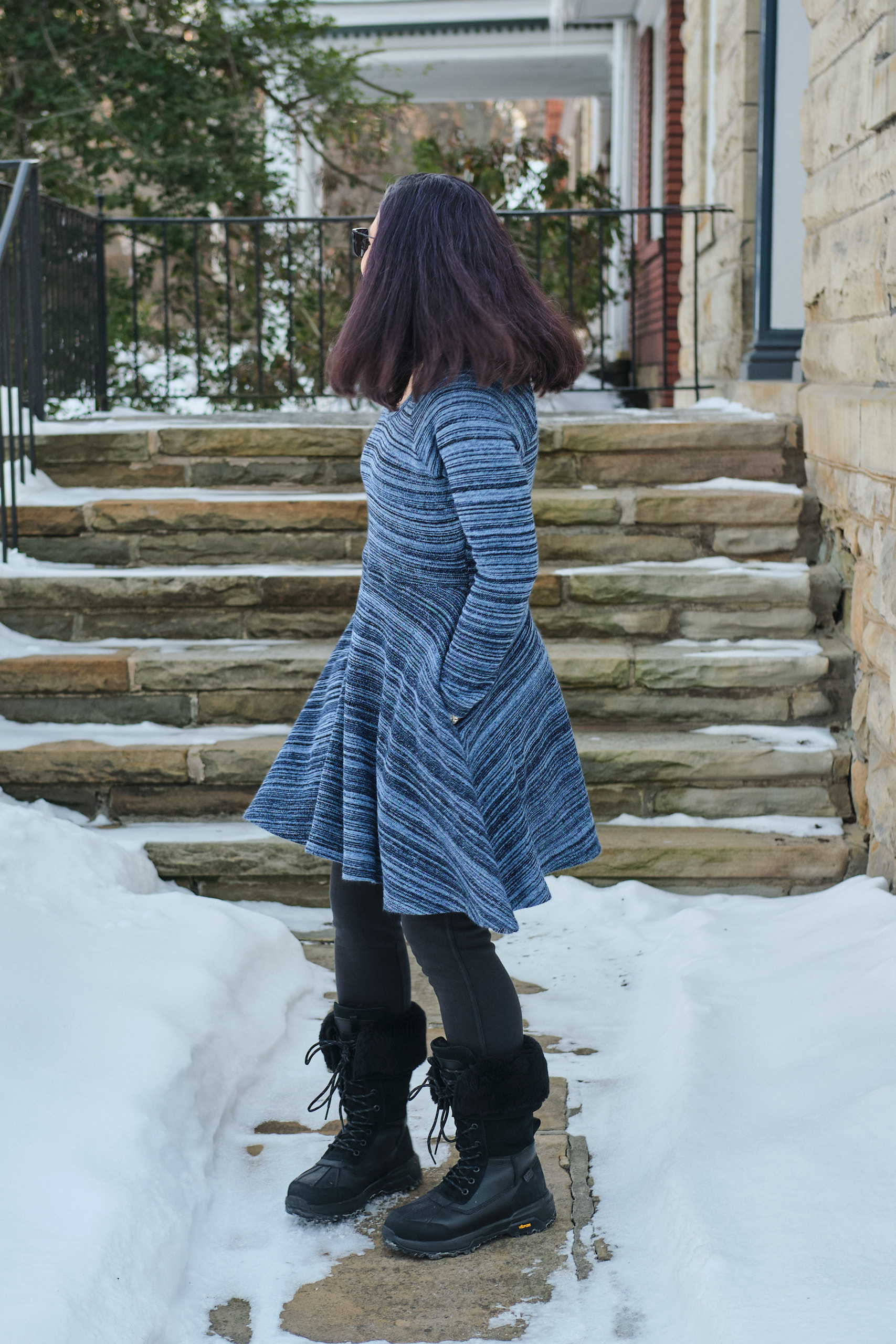
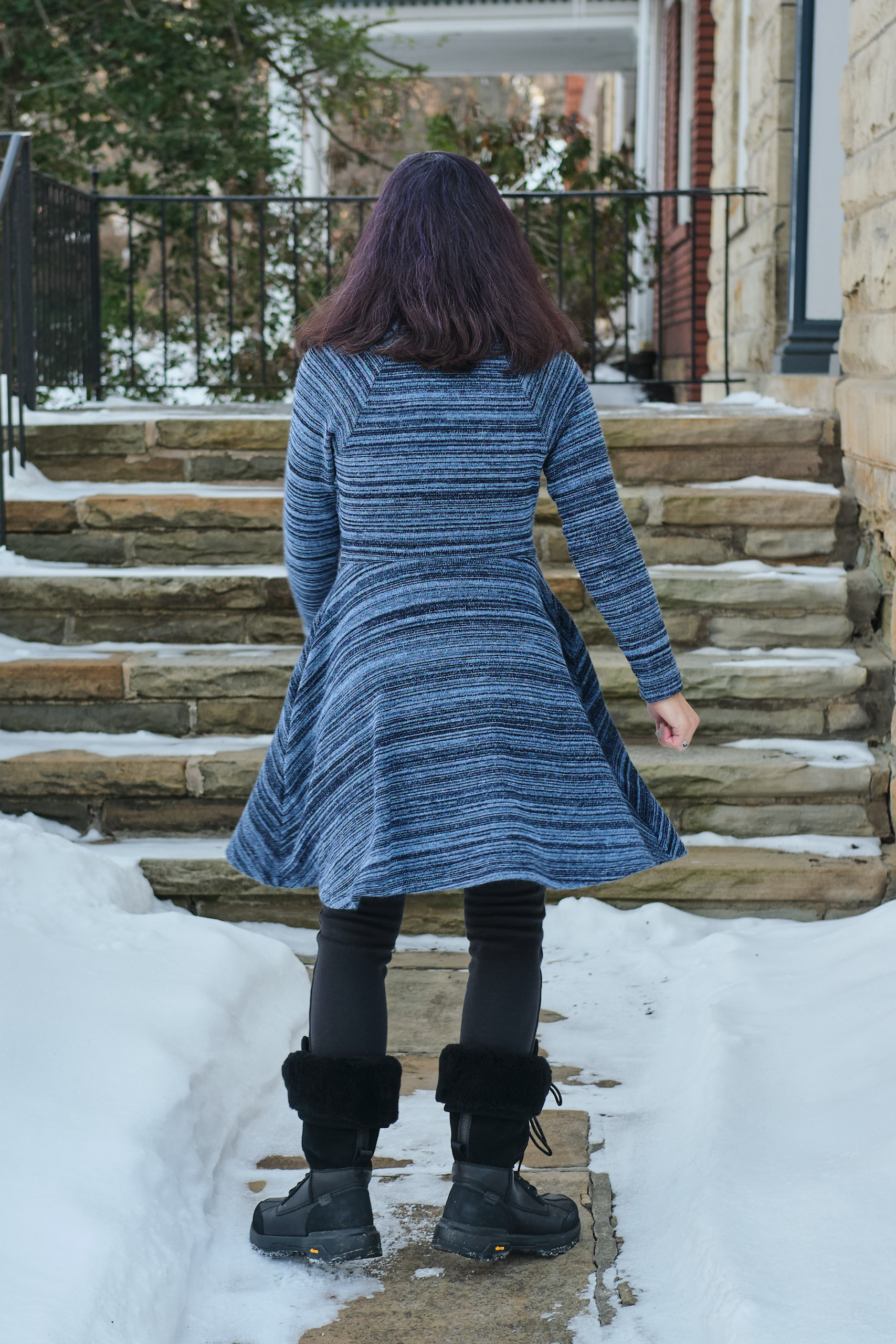
Rivet Patterns Senna Raglan Dress in size 6, high scoop neck, 1 inch above knee length half-circle skirt, sleeves shortened 1 inch, graded in at waist, from 2 yards brushed back polyester/spandex sweater knit.
I had never tried a pattern from Rivet Patterns before, but when they recently came out with an upgraded raglan dress pattern, I decided to give it a try. The Senna Raglan Dress is a standard skater dress, but with raglan sleeves (sleeves that have a diagonal line to the collar rather than set into the shoulders). This version comes with a choice of a gathered or half-circle skirt, three necklines, and optional inseam pockets. Some of the testers made cozy sweater knit versions that inspired me to make a Senna sweater dress to wear during our current frigid weather.
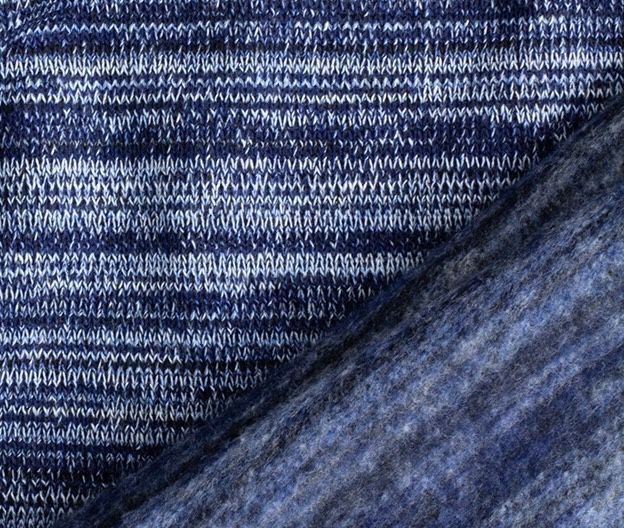
I tend to stock up on sweater knit when it is on sale, but I only want to sew it during sweater season. I found a lovely brushed back polyester/spandex sweater knit last Fall that was knit from blue, white, and charcoal variegated yarn. The front is smooth, and the back is very soft and fuzzy. It is 250 gsm with 50% horizontal and 25% veritcal stretch. The brushed back makes the fabric fairly thick and very cozy. I bought two yards, with plans to make a sweater, but I figured out how to tetris the Senna dress pattern to fit in 2 yards (the pattern suggests that at least 2.5 are required for the version I wanted to make).
I was between size 4 and 6 on the pattern size chart. Because the fabric is so thick, I decided to cut a size 6, but in hindsight a 4 would have fit better. I shortened the sleeves by 1 inch and cut the half-circle skirt 1 inch below the above-the-knee length, which I’ve found on me usually results in a skirt right at the knee — my favorite length. I cut the high scoop neck.
This pattern was pretty fast and easy to sew together, and the sweater knit was easy to sew on my serger, despite the thickness. I sewed the whole thing with black thread, which is what I already had on my serger and sewing machine. I thought about switching to blue, but the black actually blended better than anything else. There isn’t actually much stictching that you can see on the outside other than the sleeve hems, bottom hem, and top stitching at the waist. The pattern instructions are fairly terse, but pretty clear. This is a knit pattern with a 3/8-inch seam allowance, which is not my favorite, though, as it requires trimming 1/8-inch off your seams as you sew.
I did run into a problem with the neck band though. My sweater knit has some spandex in it and is appropriately stretchy, but it does not have great recovery, especially around the edges. It started stretching out around the neck as I was sewing it, and the neckband stretched a lot as I was folding it in half and pressing it. I realized I should have stabilized the neckline with stay stitching before I sewed the bodice together and that I needed to do something different with the neck band. The obvious thing to do was to make the neckband out of some other fabric with better recovery. I thought about looking through my stash for something in navy that might work, but I really wanted a band that matched the sweater knit fabric in the rest of the dress. I once had a similar problem with another sweater dress, but I didn’t fully realize it until after I sewed the neck band on and saw that the whole neck was too stretched out to be wearable. I saved it by threading some elastic through the neckband, but it never did lie perfectly flat. I thought maybe I could improve on that solution this time by sewing elastic to the neck band before I sewed it together. While I was looking for suitable elastic I found my 1-inch ultra-light fusible knit stay tape and thought that might do the trick. So I cut out a new neck band (1.75″ wide and 24″ long) and fused two 24″ strips of stay tape to the back. Then I joined the ends and folded it in half lengthwise and pressed. I could see it was now a much less stretchy band, but it had a little bit of give — hopefully enough to fit the slightly stretched out bodice. I used the quarter method, as advised by the pattern instructions, and pinned the neck band to the bodice neck. I could see I was going to have to stretch the neckband more than it really wanted to stretch, but I decided to try it anyway. I basted it with a zigzag stitch on my sewing machine, stretching as I went. Amazingly, it worked. After checking to see that it looked ok, I sewed the neckband on with my serger, trimming only about 1/16″ as I sewed. Then I pressed well, and voila, a well-fitting neckband that was not stretched out. This sweater knit definitely did not want to be a neck band, but where there’s a will there’s a way!
I’m a diehard pocket fan, but I have to admit that sewing a good set of pockets takes time and makes the project take a lot longer than it would without the pockets. I was intrigued by the pocket construction on this dress, which was a little bit different than what I’m used to. I actually hoped for a miracle and to discover that this was the secret way to make pocket construction less painful, but alas, it was not. The difference here was only sewing the pocket opening to the dress at first, and sewing the part of the pocket bag above and below the opening later when sewing the front to the back. I still had difficulty sewing at exactly the right place when I sewed front to back, and I still had to unpick a bit, but it all worked out fine in the end. The pocket bags are large, as I like them.
The pattern suggests adding 1/4-inch elastic at the waist for stability. I decided to do that, but used clear elastic threaded through the slot on my serger foot for easy attachment. I took their advice and folded the seam with the elastic up towards the bodice and topstitched it in place to encase the elastic.
I finished the dress right before bedtime, tried it on, gave it a twirl, and it was…. just ok. It was fine, but didn’t look as great as I had expected it would. The waist wasn’t sitting smoothly. I thought, maybe I should make a belt for it. I went to bed, and the following evening tried it on again. This time I figured out the problem: too much ease at the waist. Actually, too much ease everywhere, but a problem mostly at the waist. I probably should have cut a 4 instead of a 6. I went back to my sewing room and basted a seam from the top of the pocket opening to the waistline and then up about 3 inches above the waistline, taking it in about 1 inch at the waistline. I did this on both sides and tried it on. What a difference it made! I cut the fabric about a quarter inch from the basting line and then surged it. The dress looks so much better now. The waist is smooth and it hugs my curves a lot more.
The next morning when I dragged my photographer out to snap some quick fashion photos in our snowy driveway before work, I styled the dress with my new tall, warm snow boots and some fleece-lined leggings. Then I put on my coat and walked to work. The dress was cute, cozy and comfortable all day.