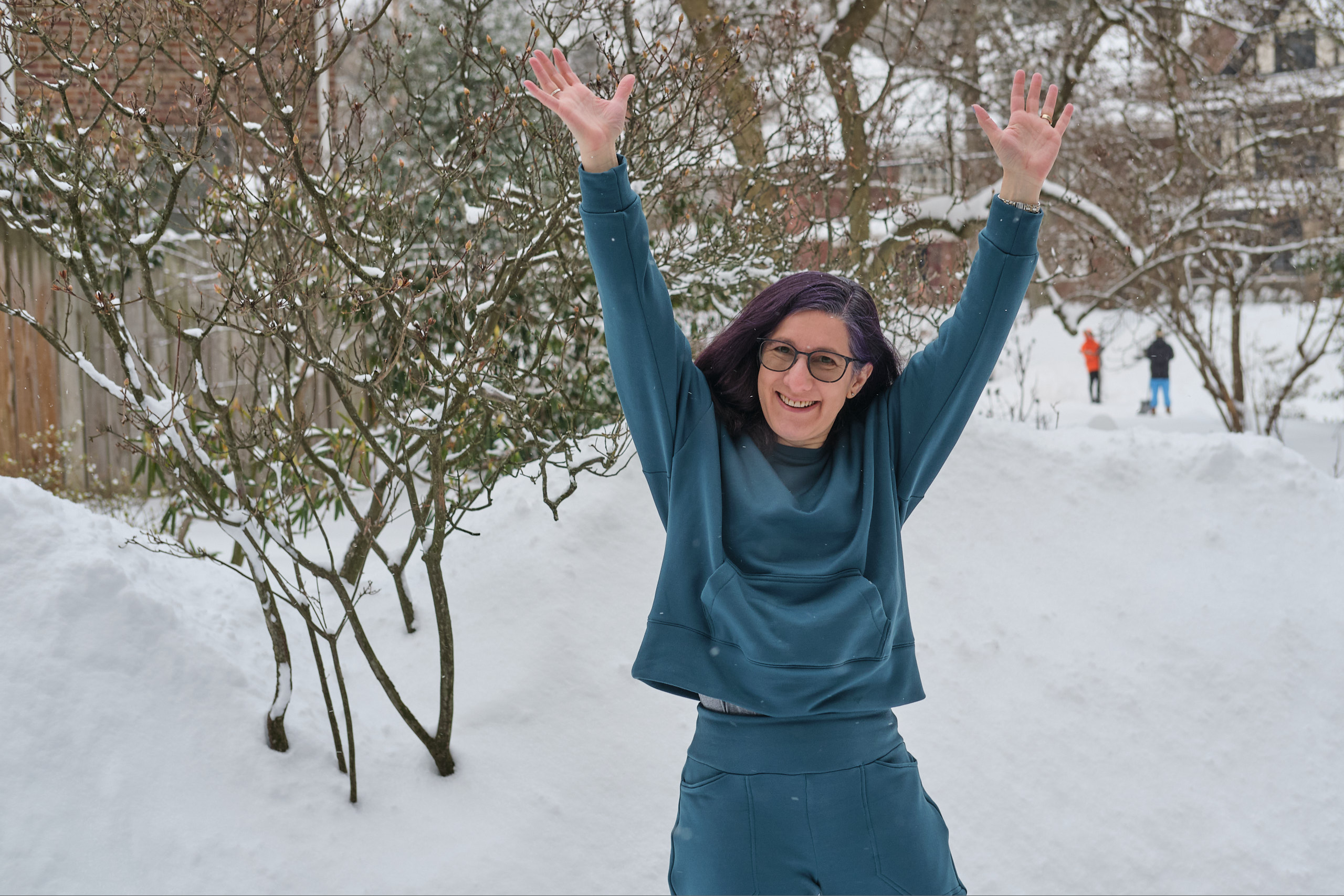
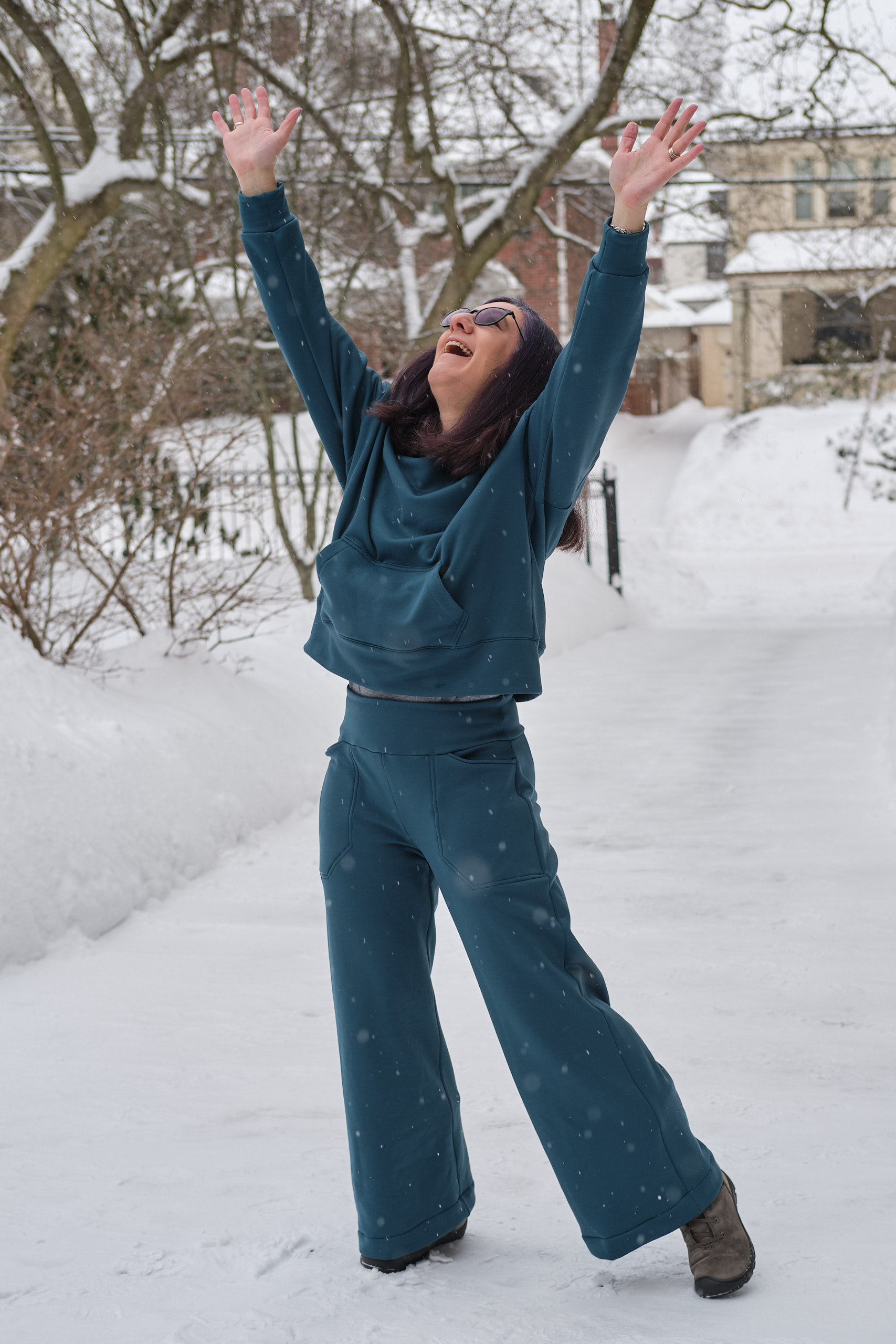
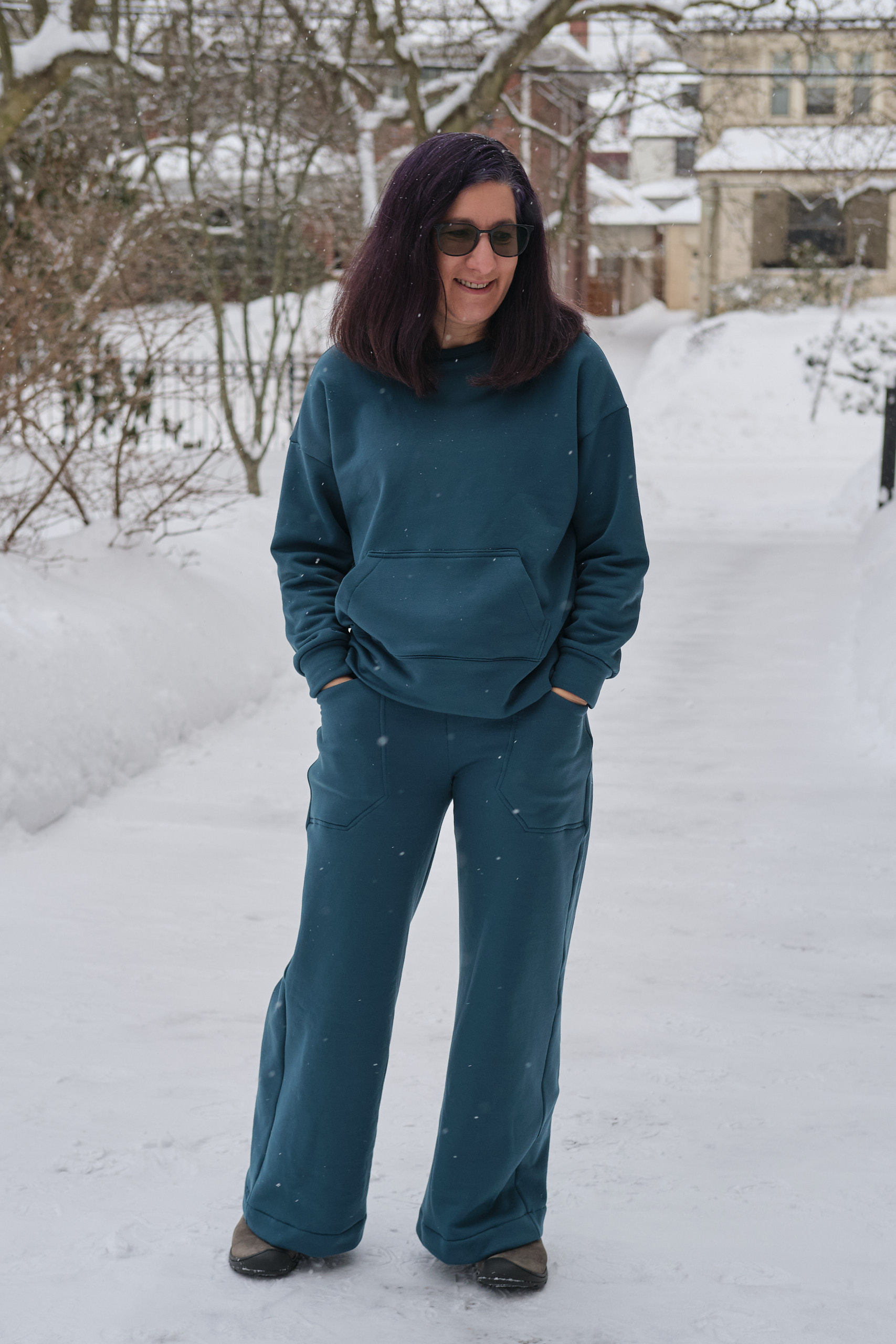
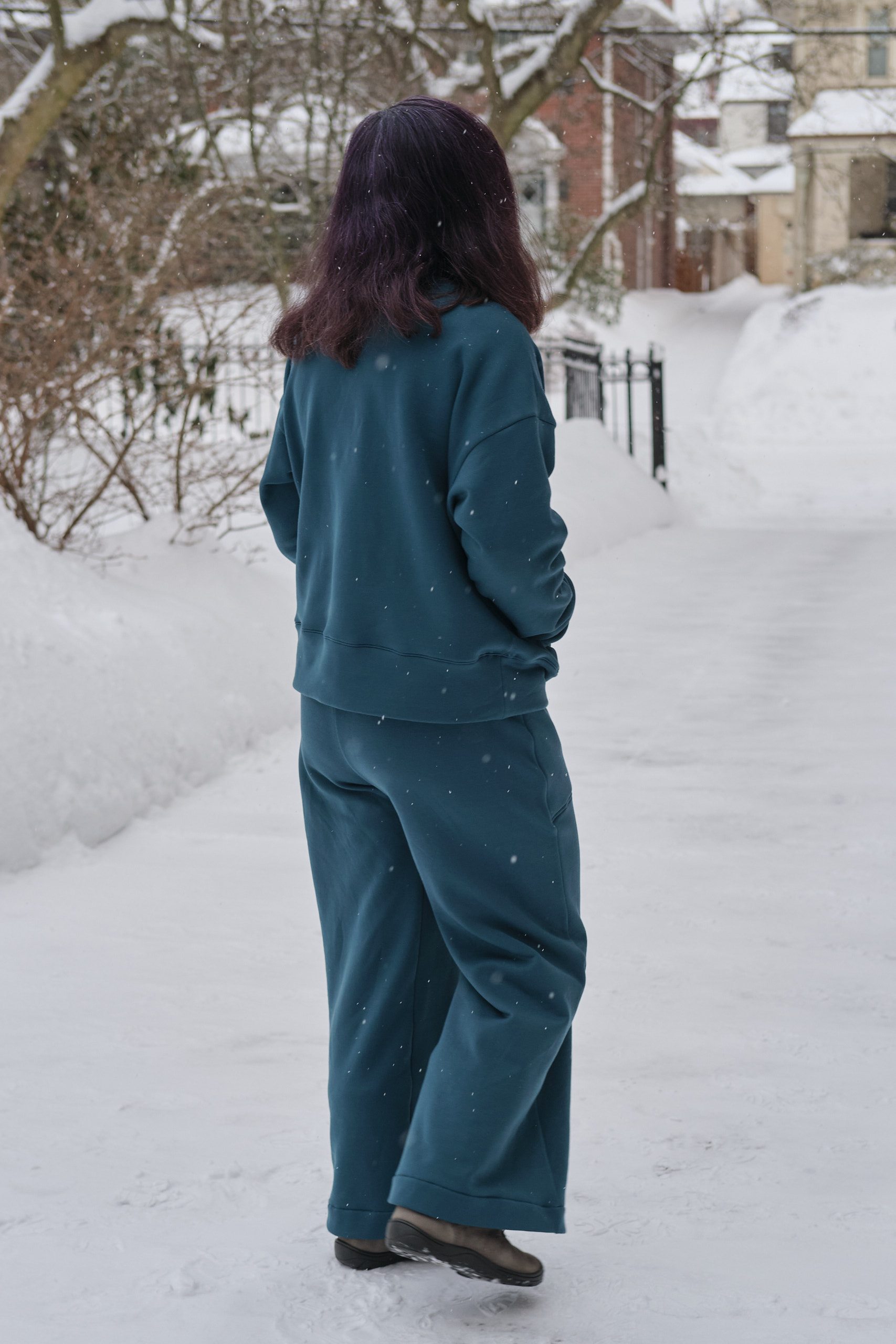
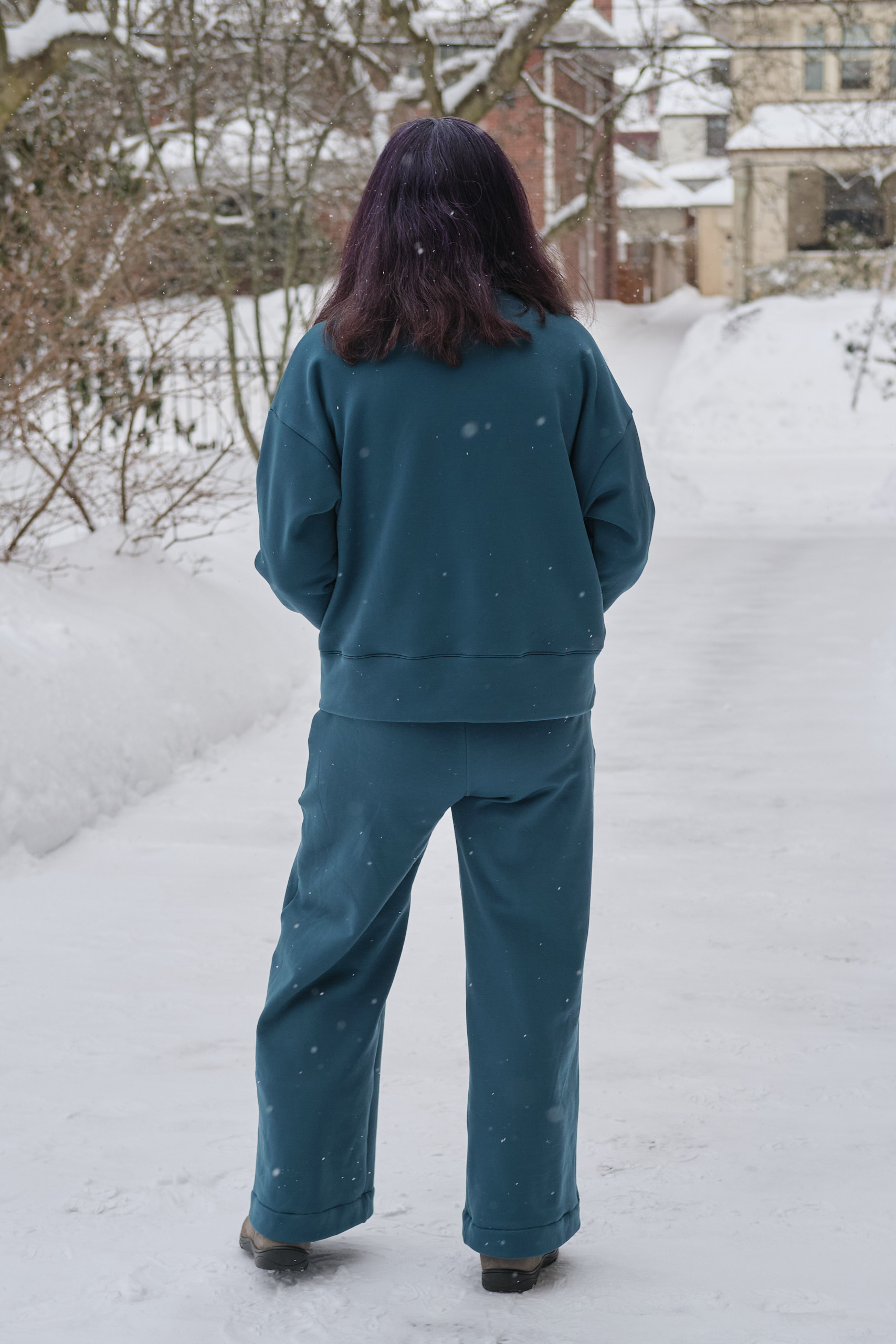
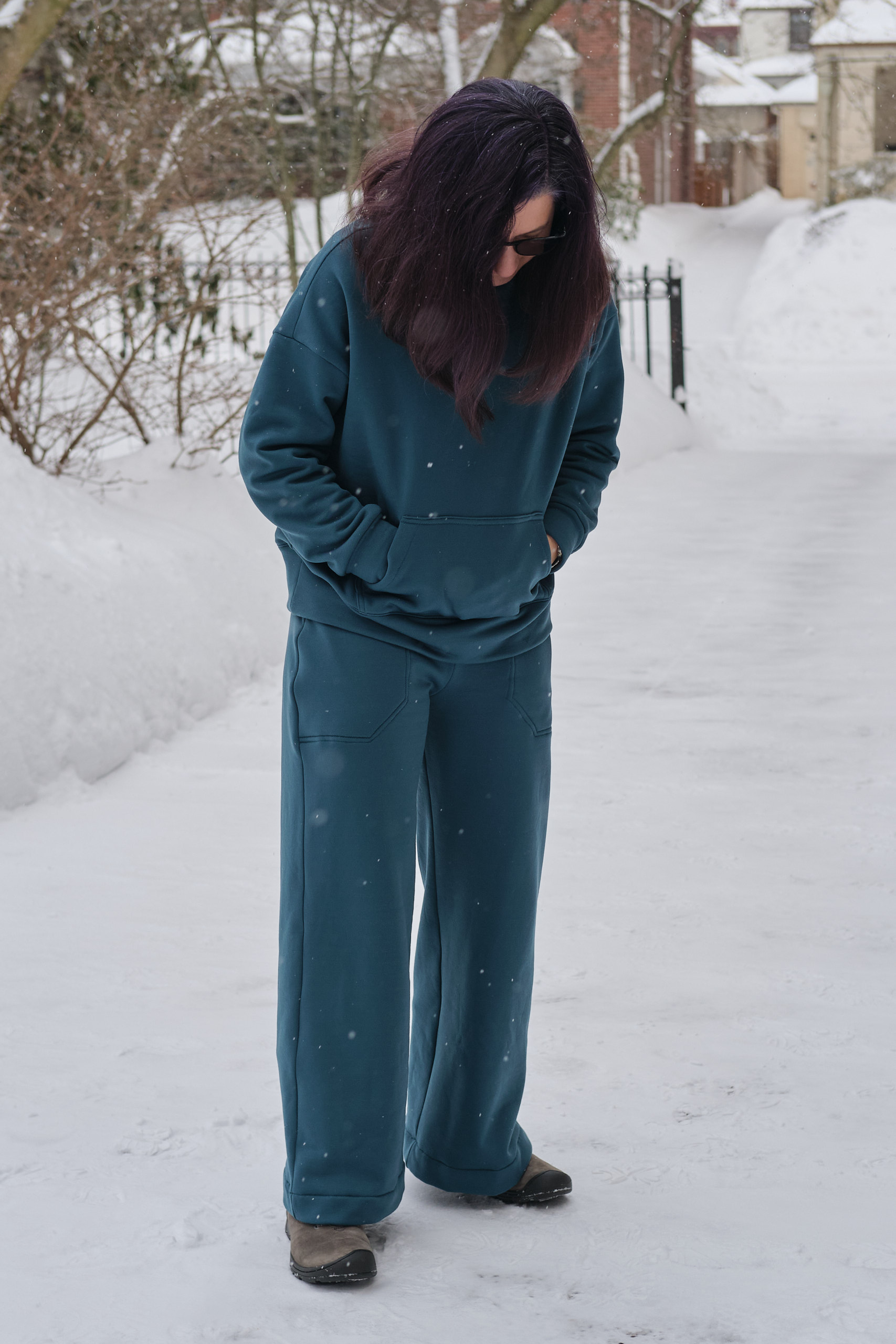
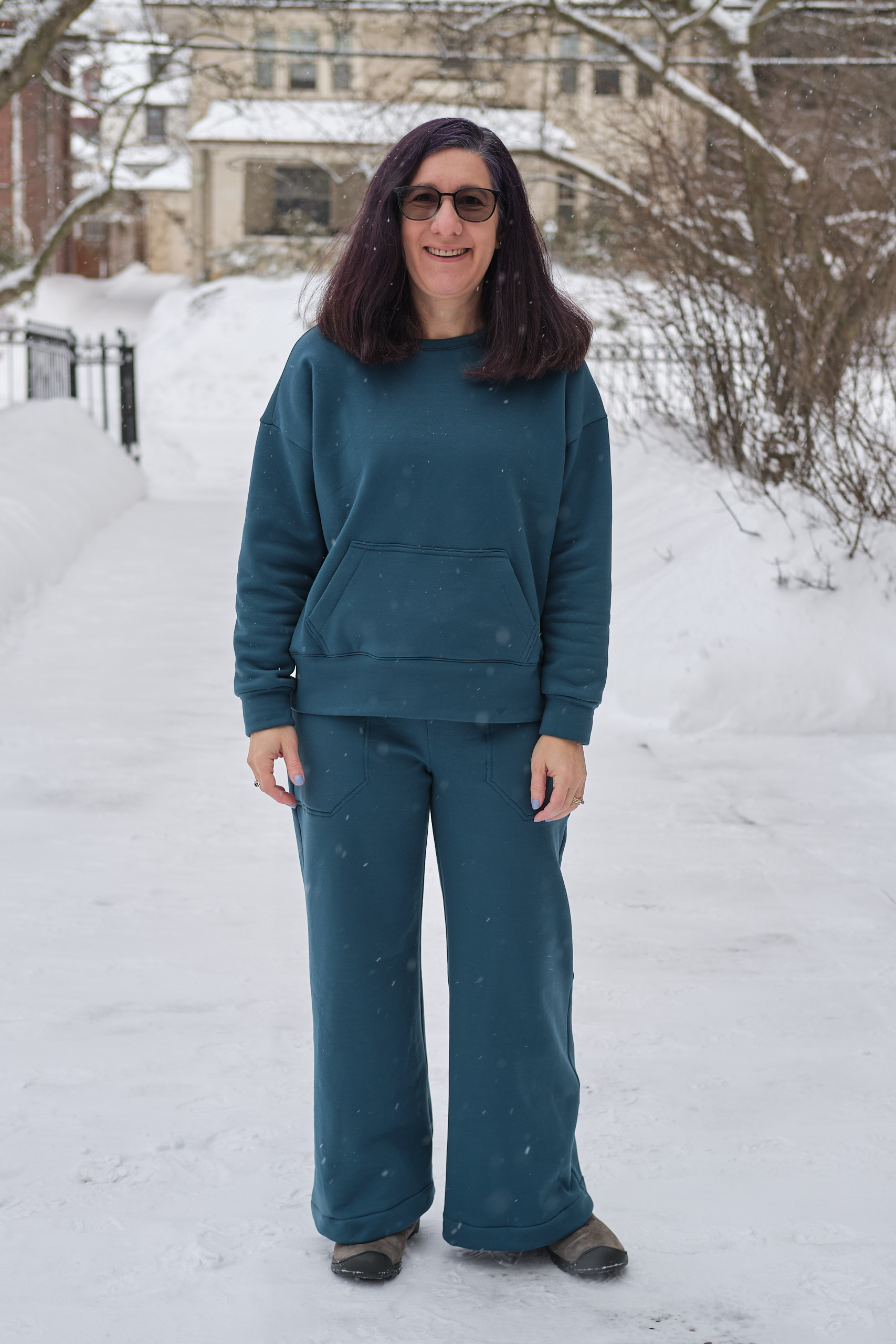
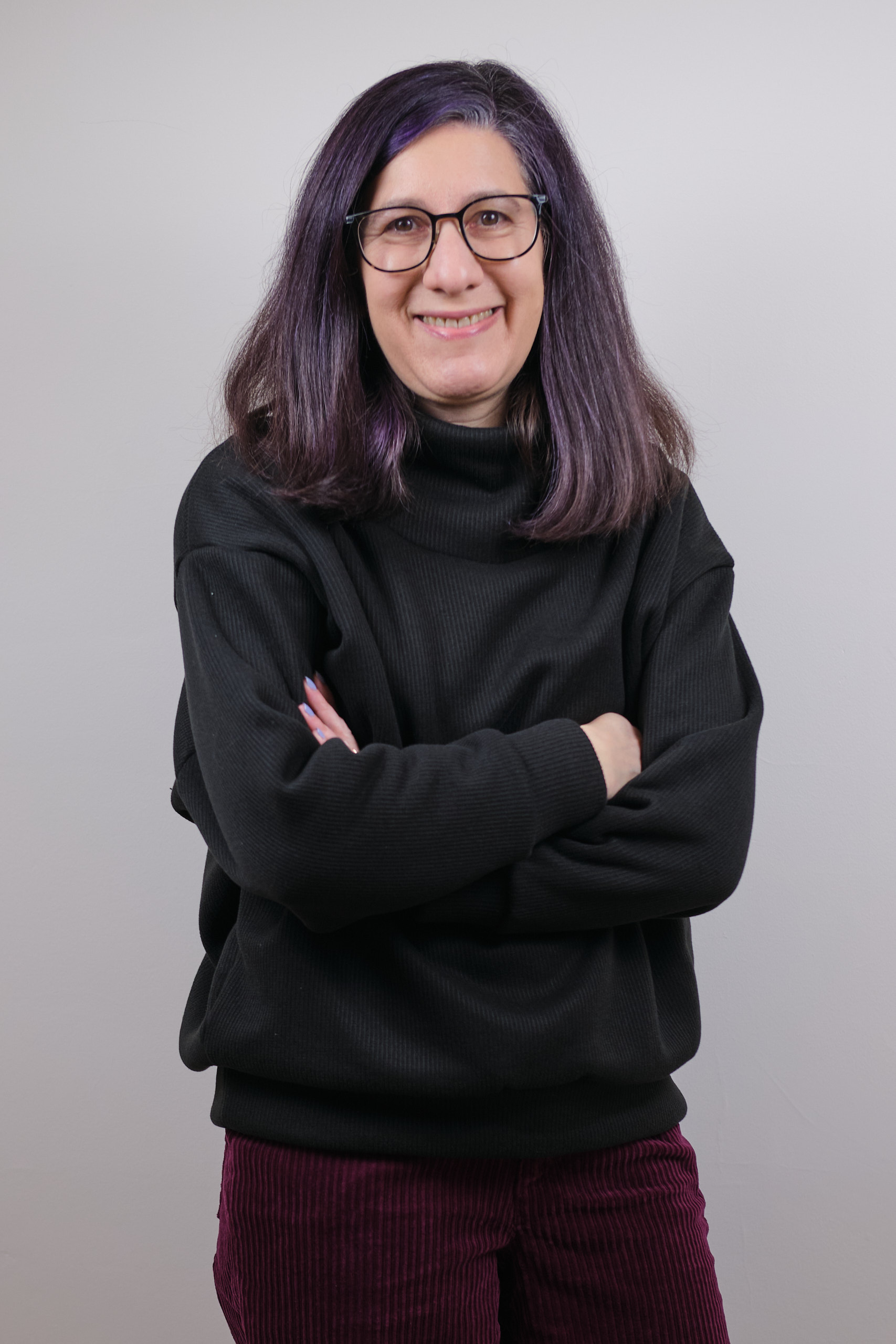
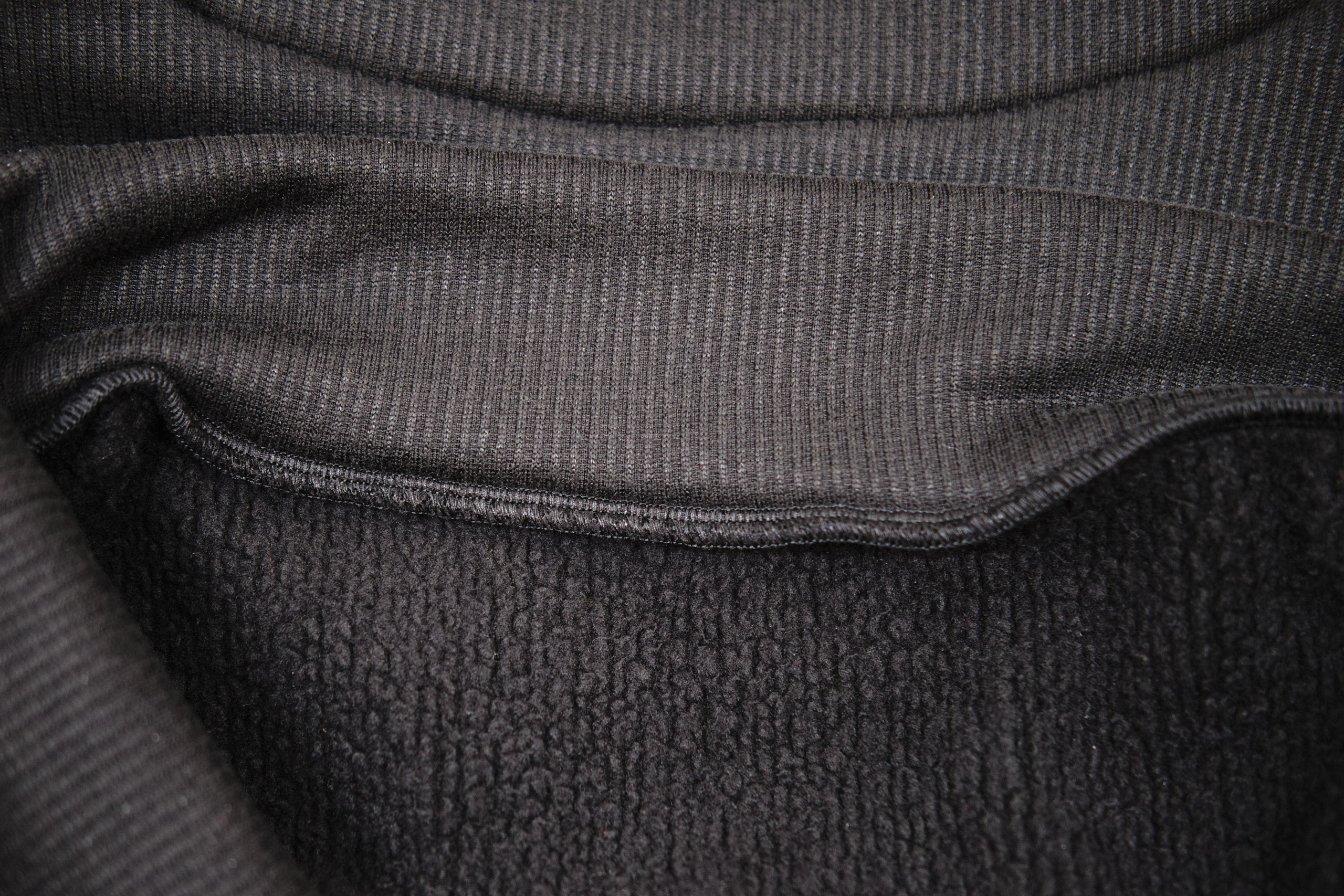
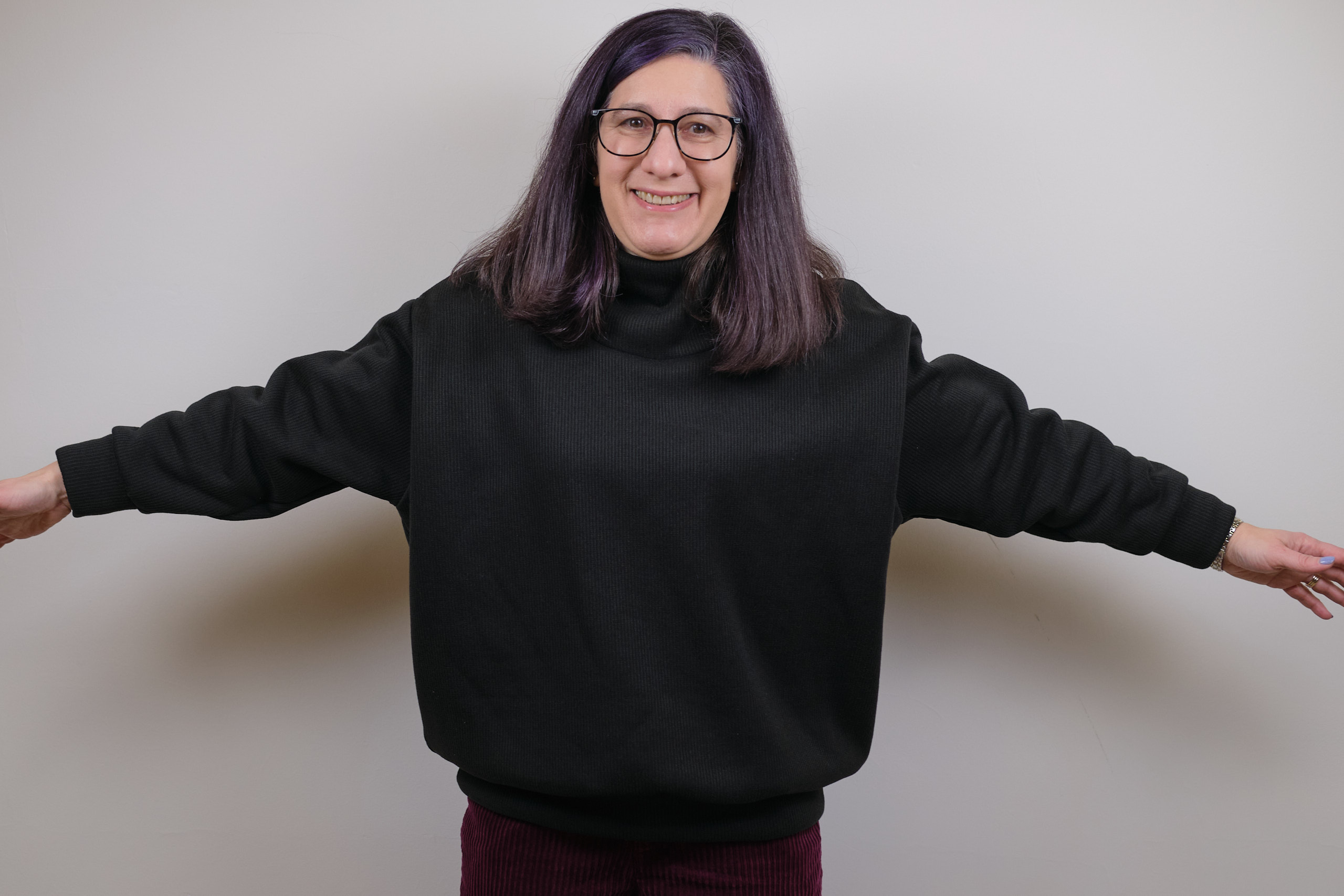
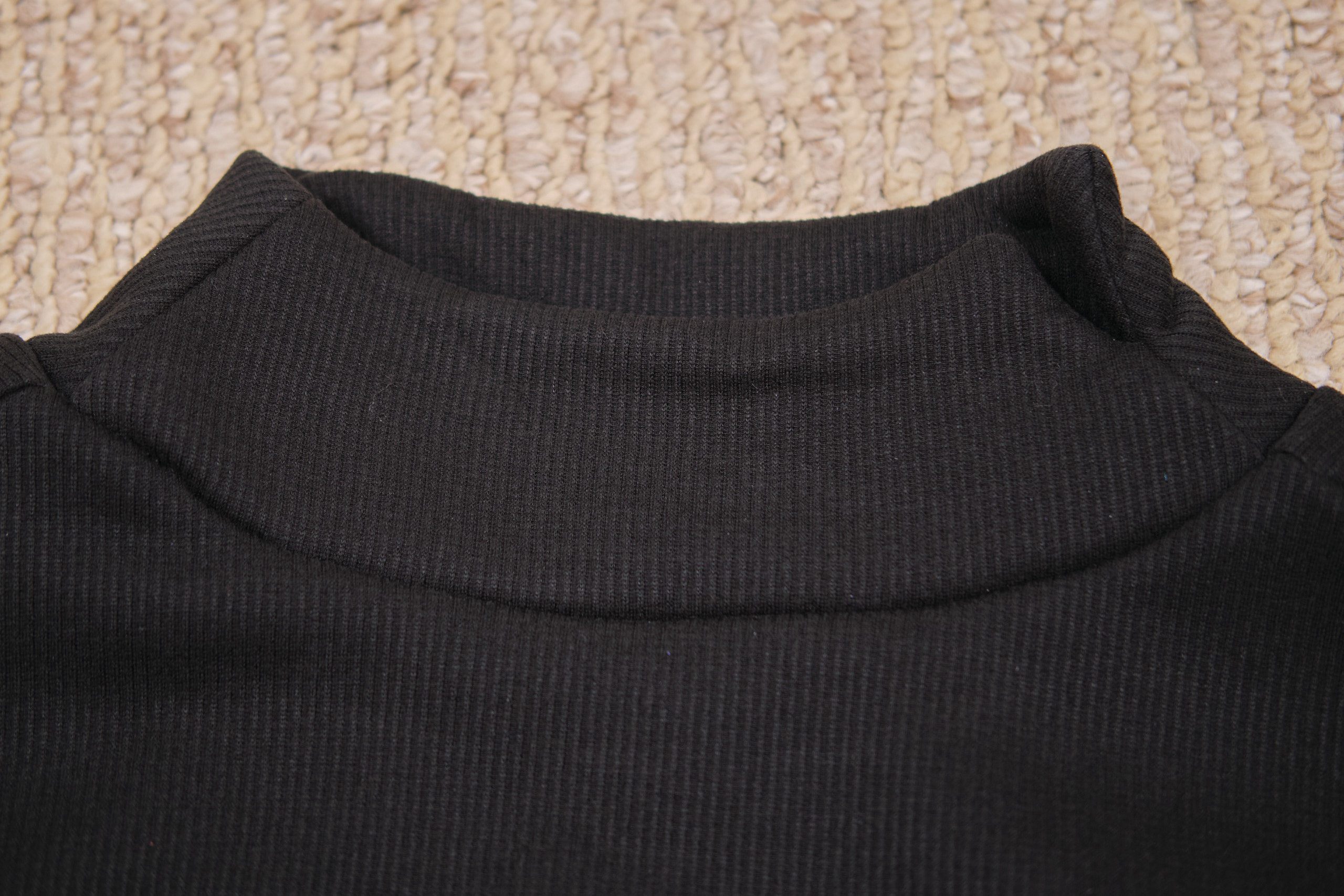
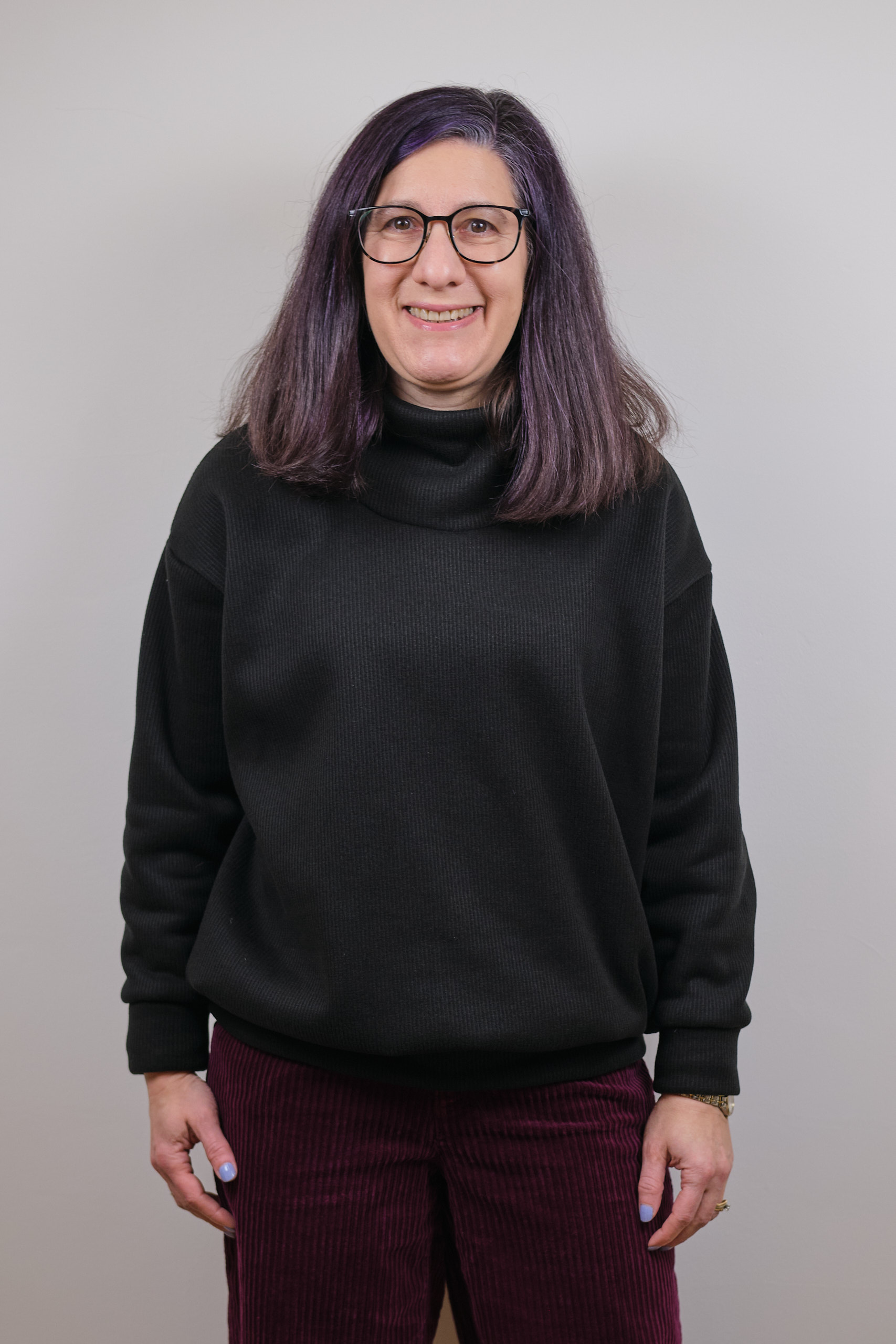
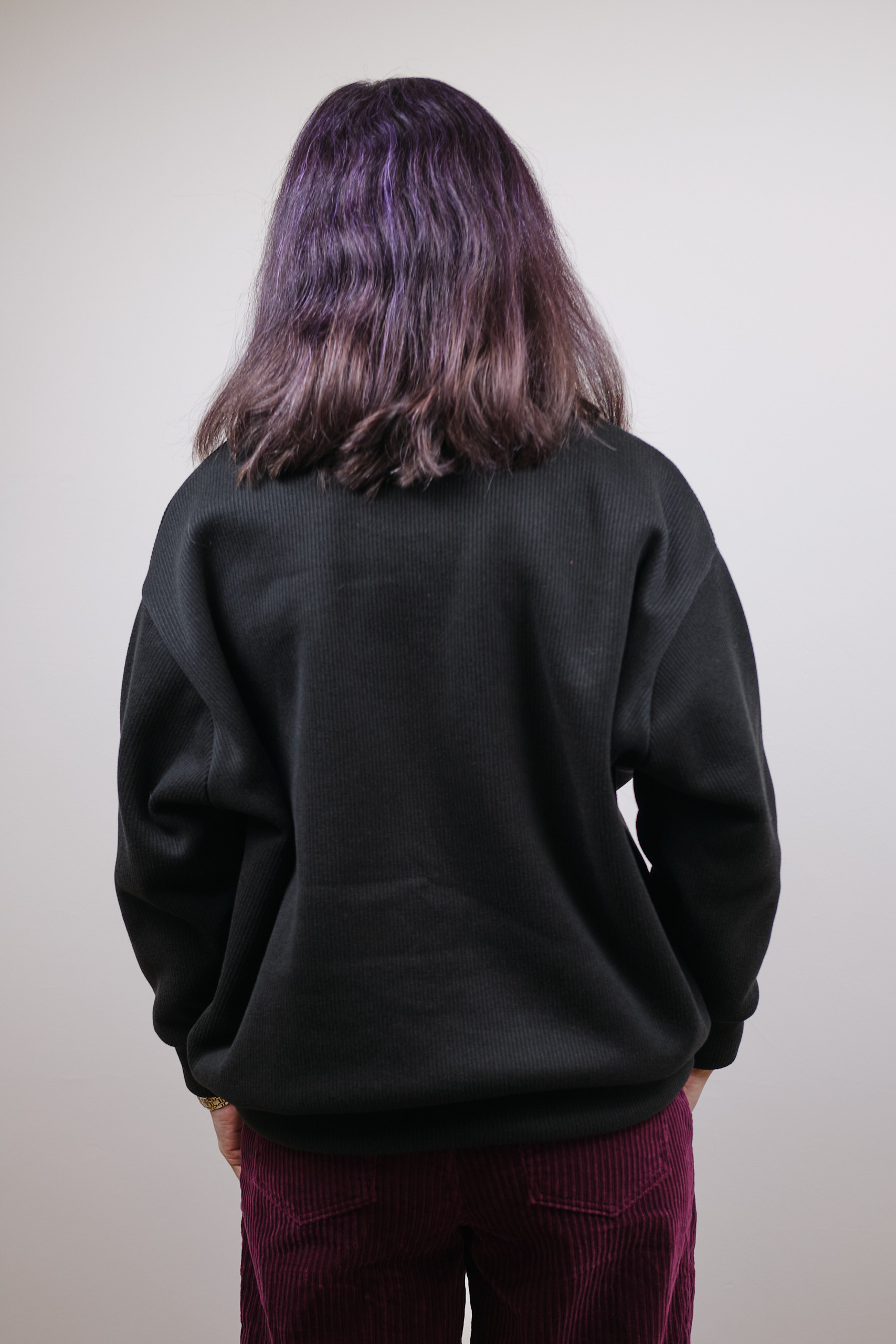
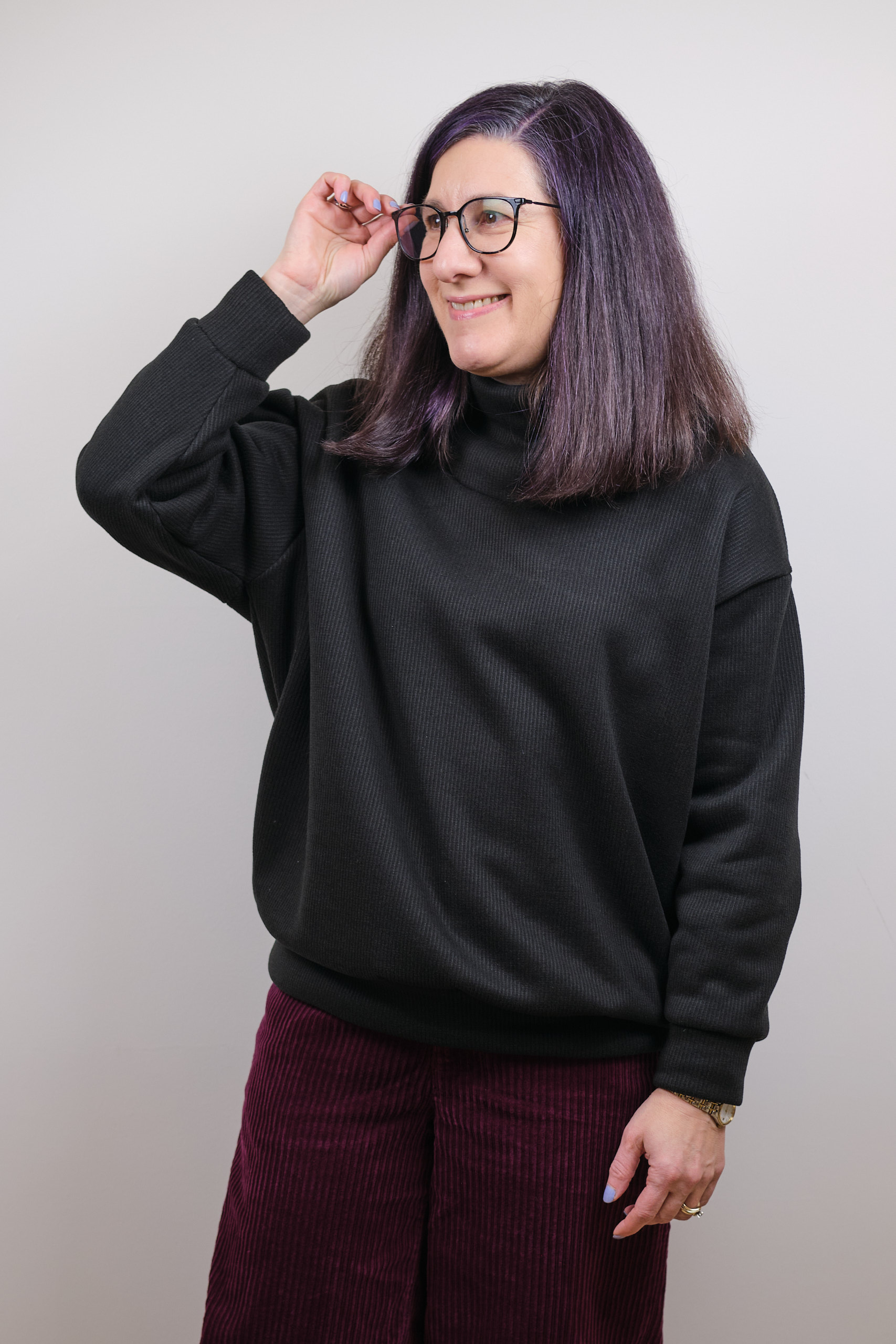
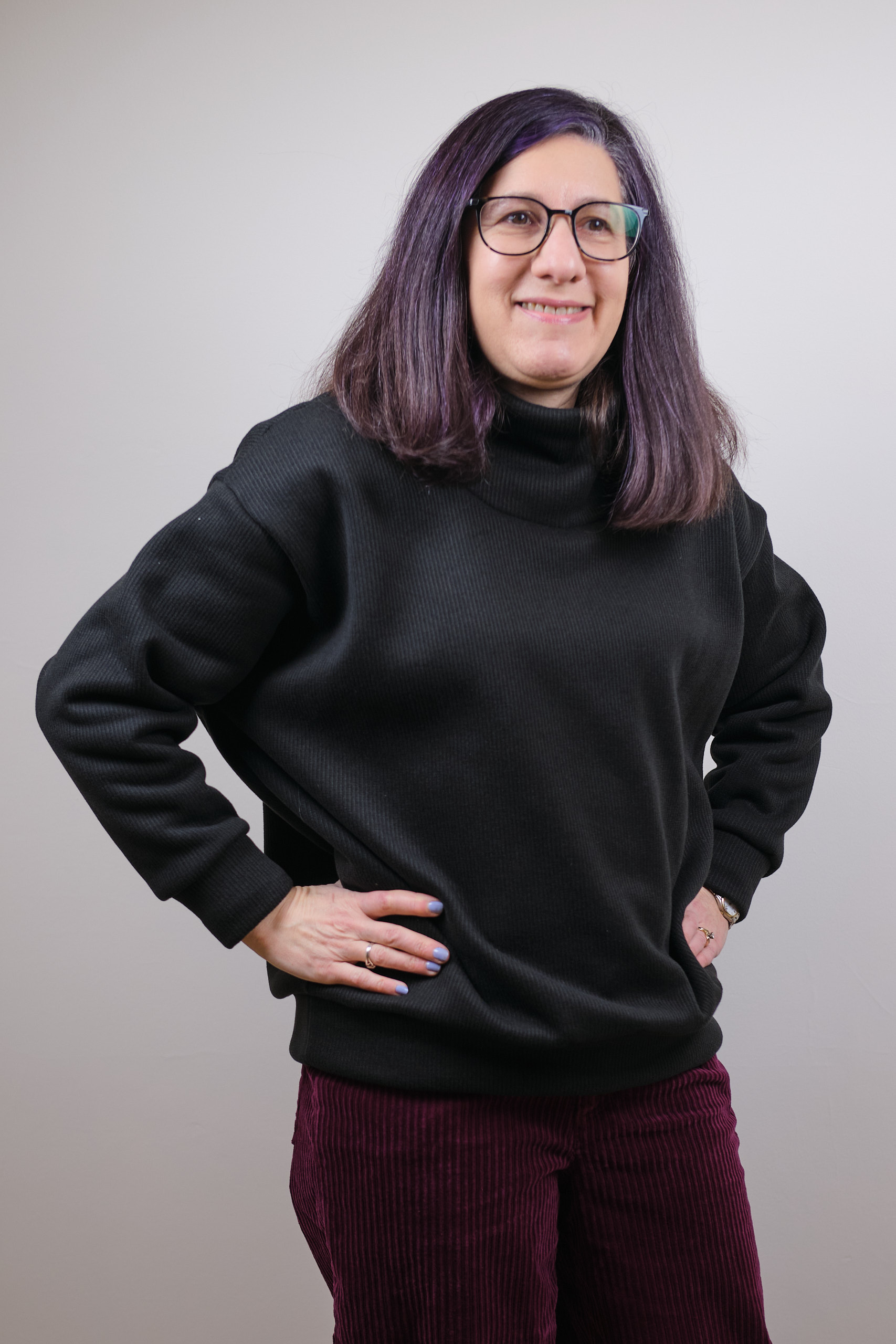
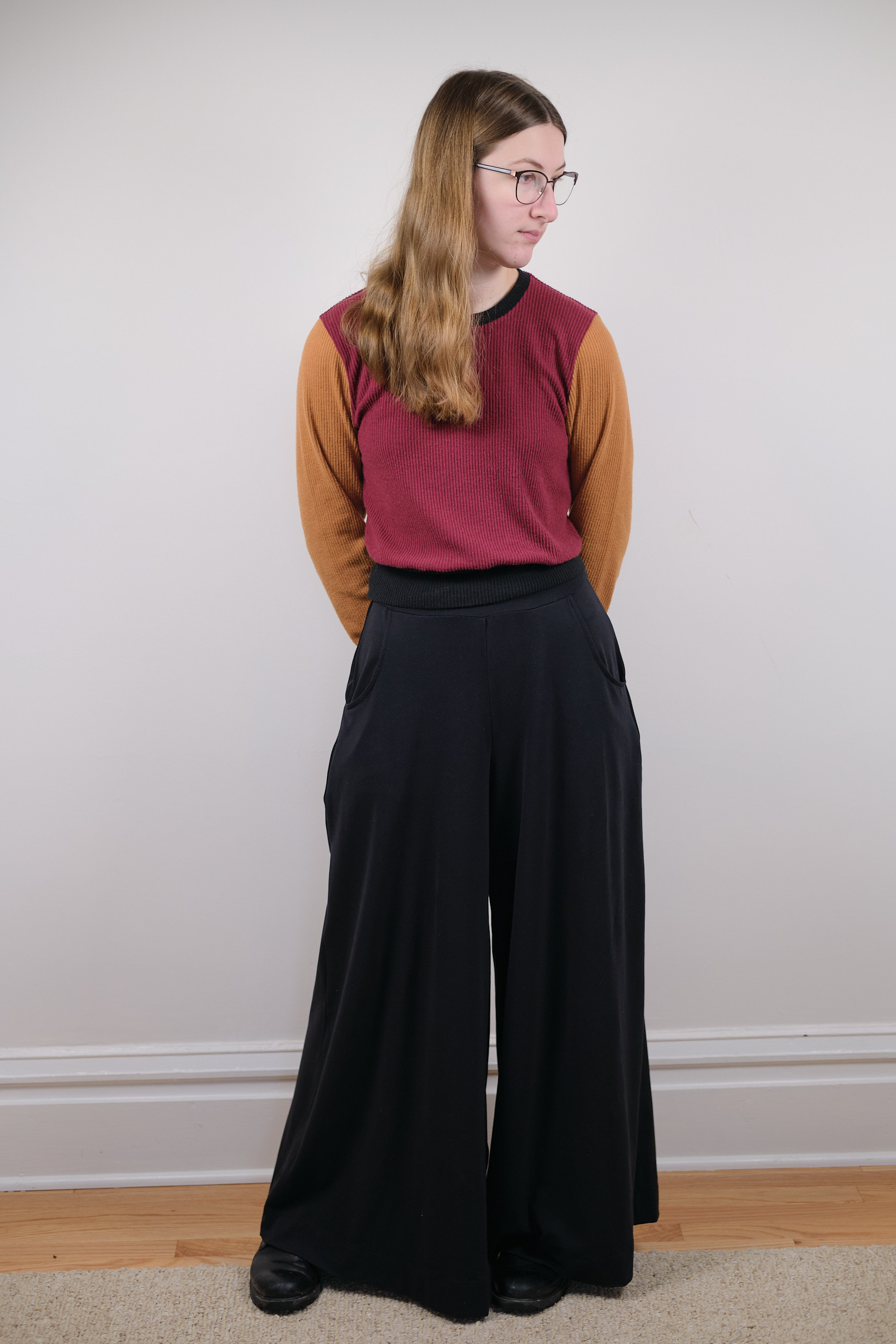
Greenstyle Bianca Pullover in size E, hip length shortened by 1 inch, sleeves shortened by 1 inch, kangaroo pocket, 1.5 yard spruce Polartec stretch sweatshirt fleece.
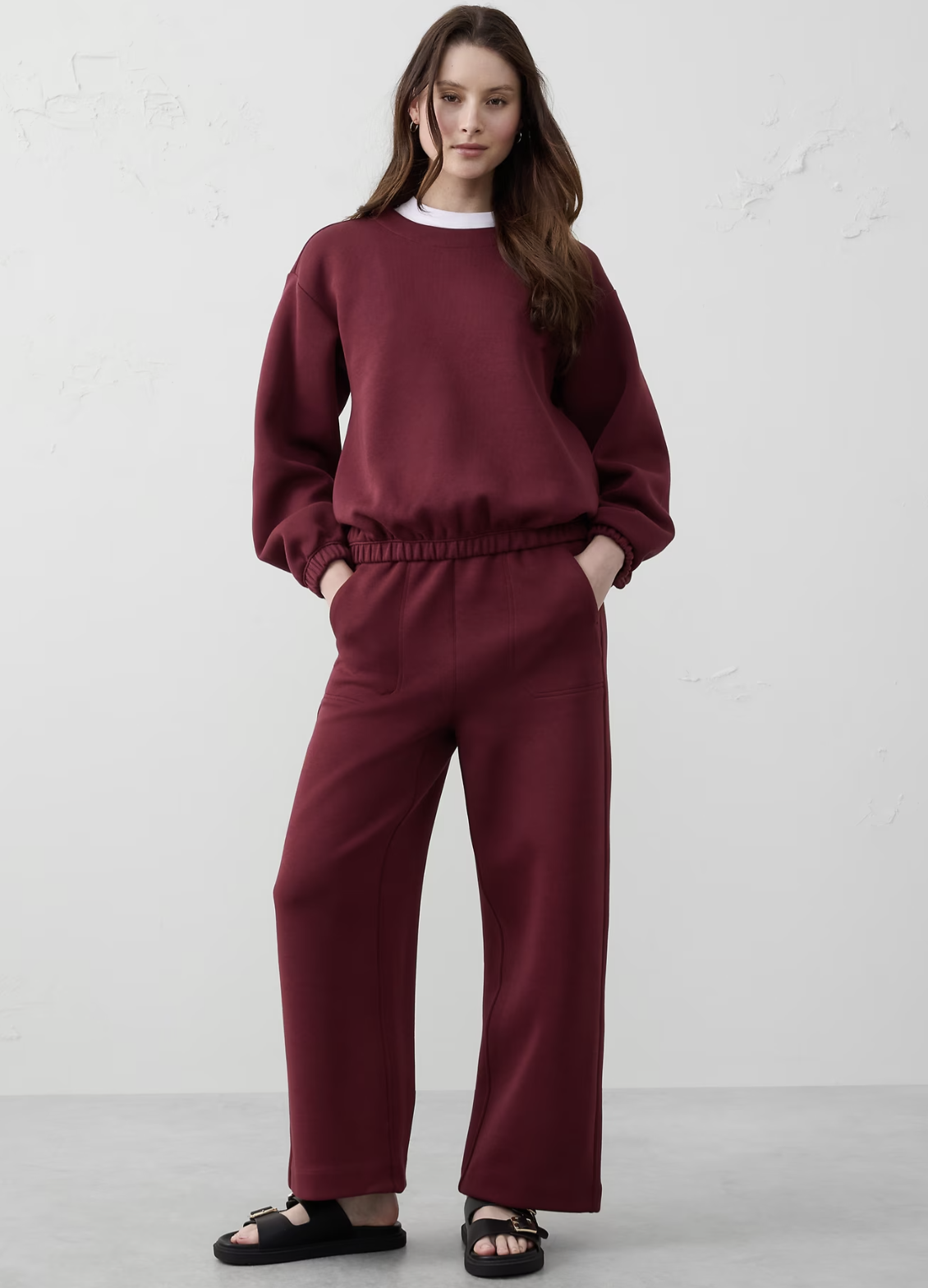
I wanted to make a fleece loungewear set similar to what I’ve been seeing from retailers lately. I started with the fleece wide-leg pants, and then debated about what top to make. I knew I wanted a sweatshirt-style top, but I wanted it to be a bit oversized, but not too long, and I wanted it to have a kangaroo pocket. I liked the fit of the Greenstyle Surge top I just made, although I didn’t want it to be quite that oversized and I wanted a different neck. So I took a look at the other Greenstyle top patterns and decided to try the Bianca Pullover. There’s a nice blog post with lots of Biancas on the Greenstyle website.
The Bianca pattern uses a different odd size scheme than Surge. This time my measurements suggested I was somewhere between D and E. Given the bulky nature of my fabric and the fact that the kangaroo pocket looked too small in the D size, I went with E. The only changes I made were shortening both the sleeves and the bodice by 1 inch.
Bianca was pretty easy and quick to sew, but the instructions were rather minimal. For an experienced sewist, this was fine, but the pattern might be more intimidating than it needs to be for beginners because it doesn’t explain what type of stitch to use where, when you should top stitch, etc. I decided to use a shallow zigzag (1.8 length, 1.1 width) for all my top stitching since this is a pretty stretchy fabric and I don’t want my seams to pop. The pattern specifies a 3/8-inch seam allowance, so I trimmed 1/8-inch as I serged most of the seams. This works, but I prefer knit patterns with 1/4-inch seam allowances so trimming isn’t necessary. I ended up sewing the neckband on with 1/4-inch seam allowance and not trimming because I didn’t want to make the neck band any narrower than it was already.
I’m very pleased with how the top came out, and I love how the complete lounge set works together. It is super comfy and cozy, and I even went outside in the snow for a photo shoot (we got over a foot of snow the day before). I will probably make more Biancas. It’s a great drop shoulder top that looks and feels roomy, but not enormous. For less bulky fabric I might go down to size D (but might keep the size E kangaroo pocket). It has options for a hood, side pockets, and for sewing with and without bands. Most commercial sweatshirts with kangaroo pockets also have hoods and I love the fact that when I sew my own clothes I can make it the way I want it with a kangaroo pocket and no hood.
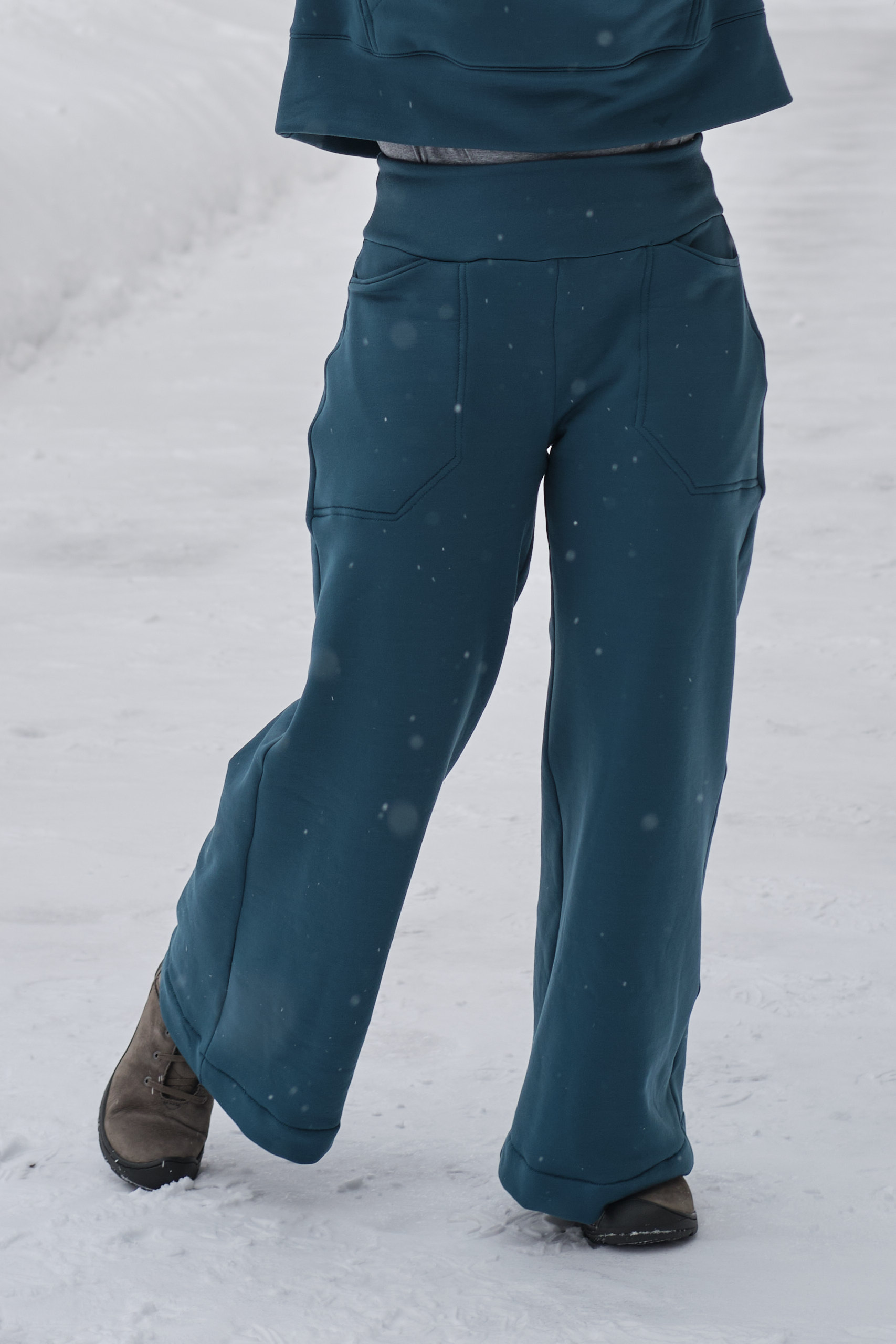
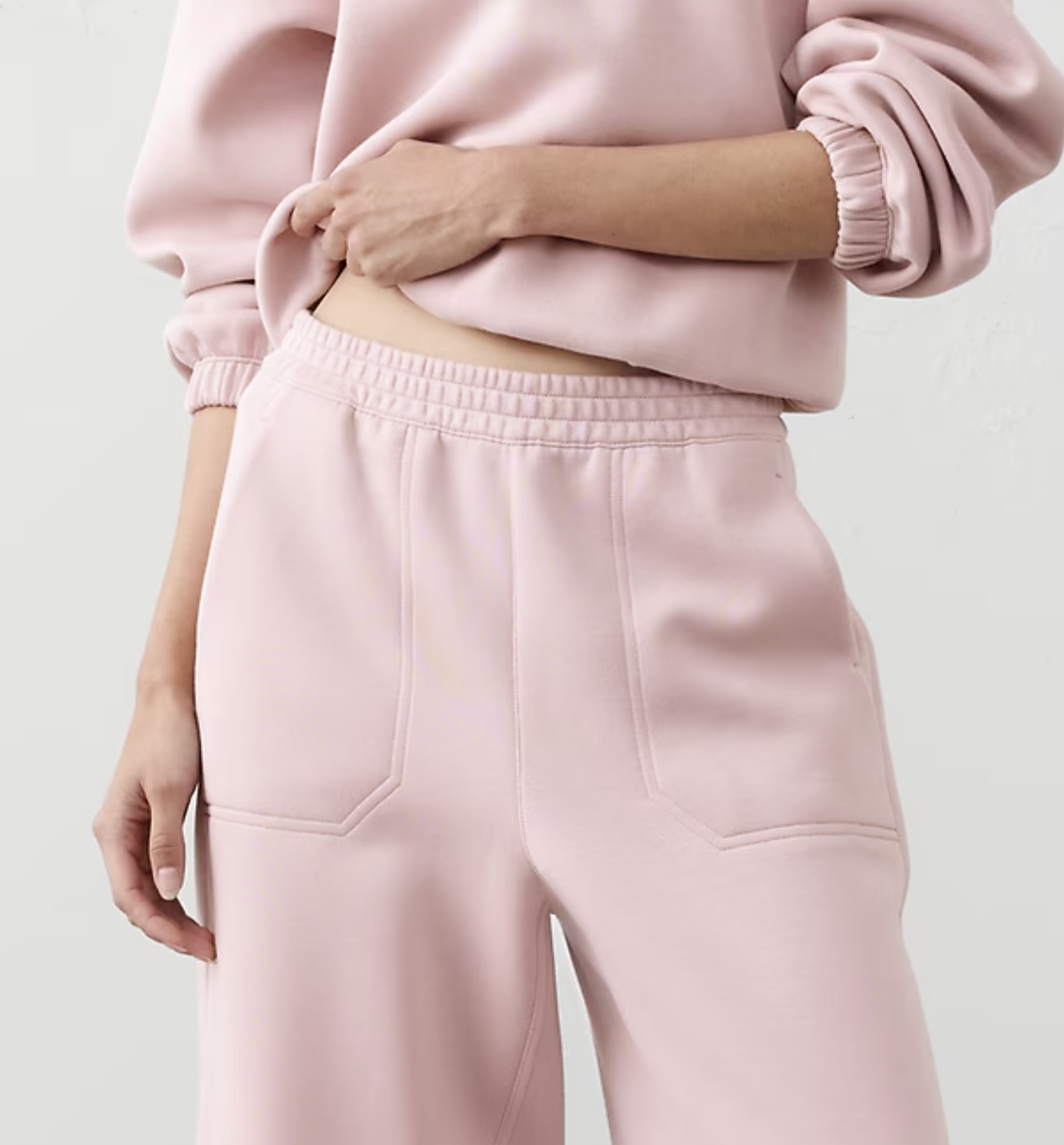
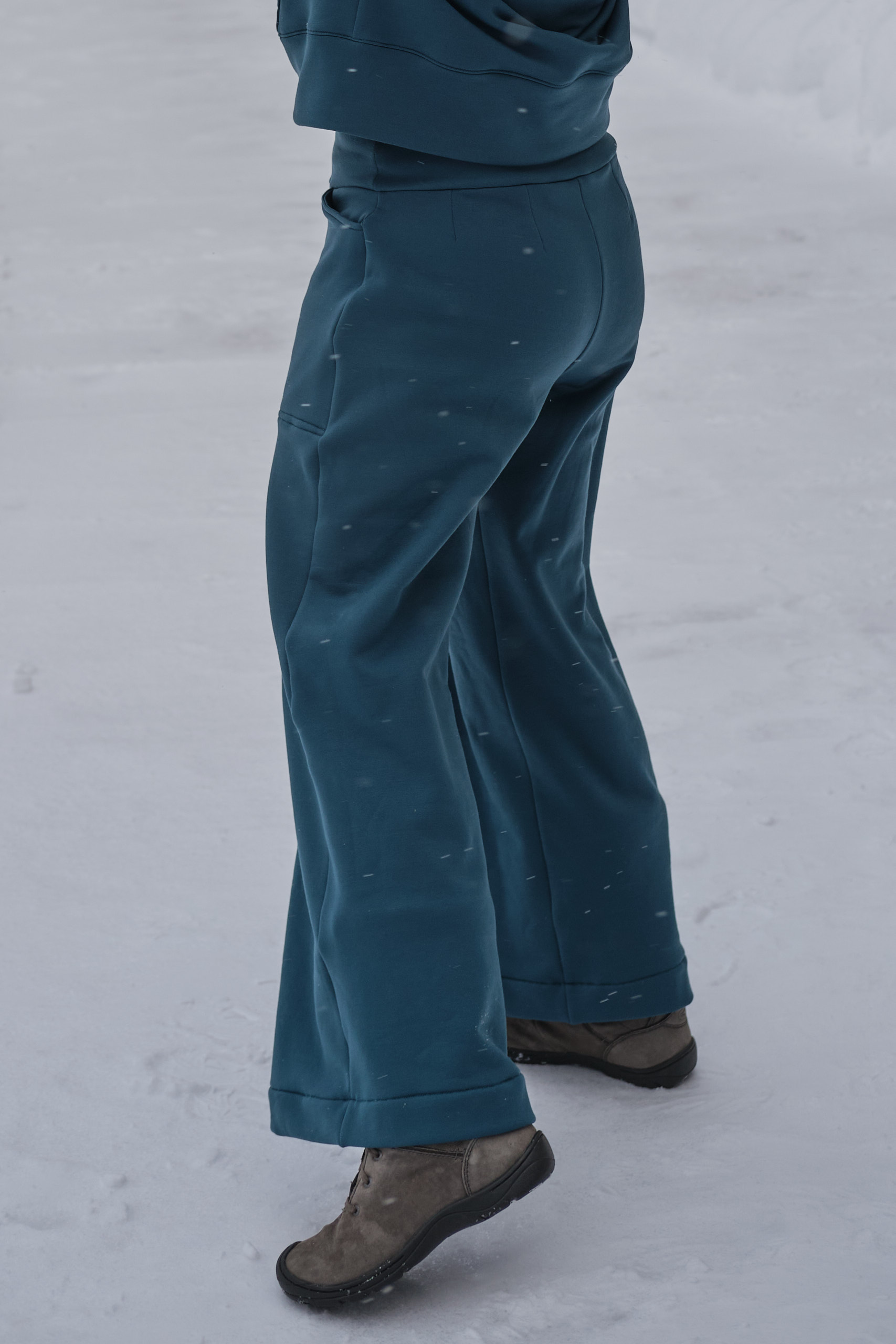
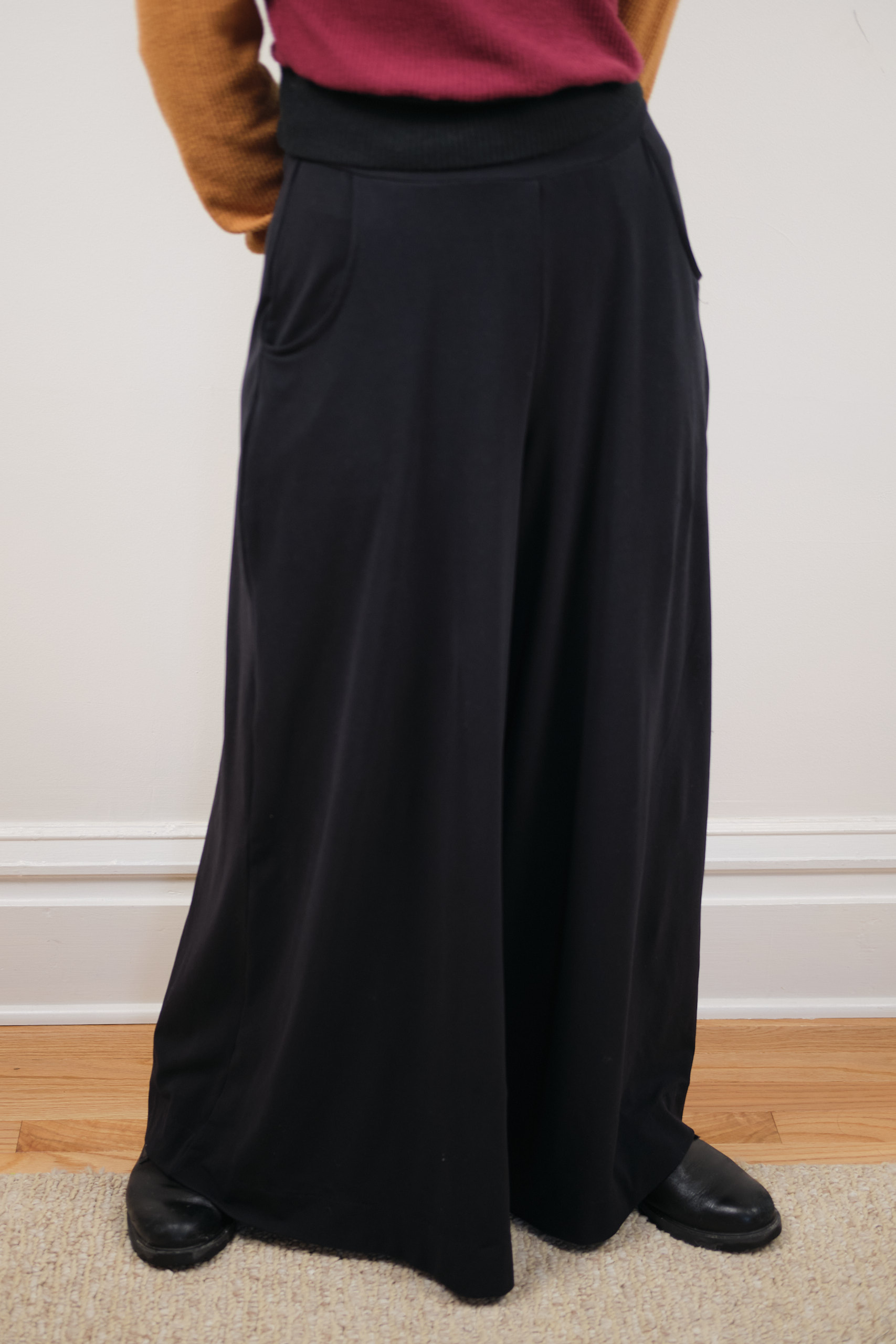
Here’s a photo of a fleece lounge set from a retailer and some more photos of my lounge set.
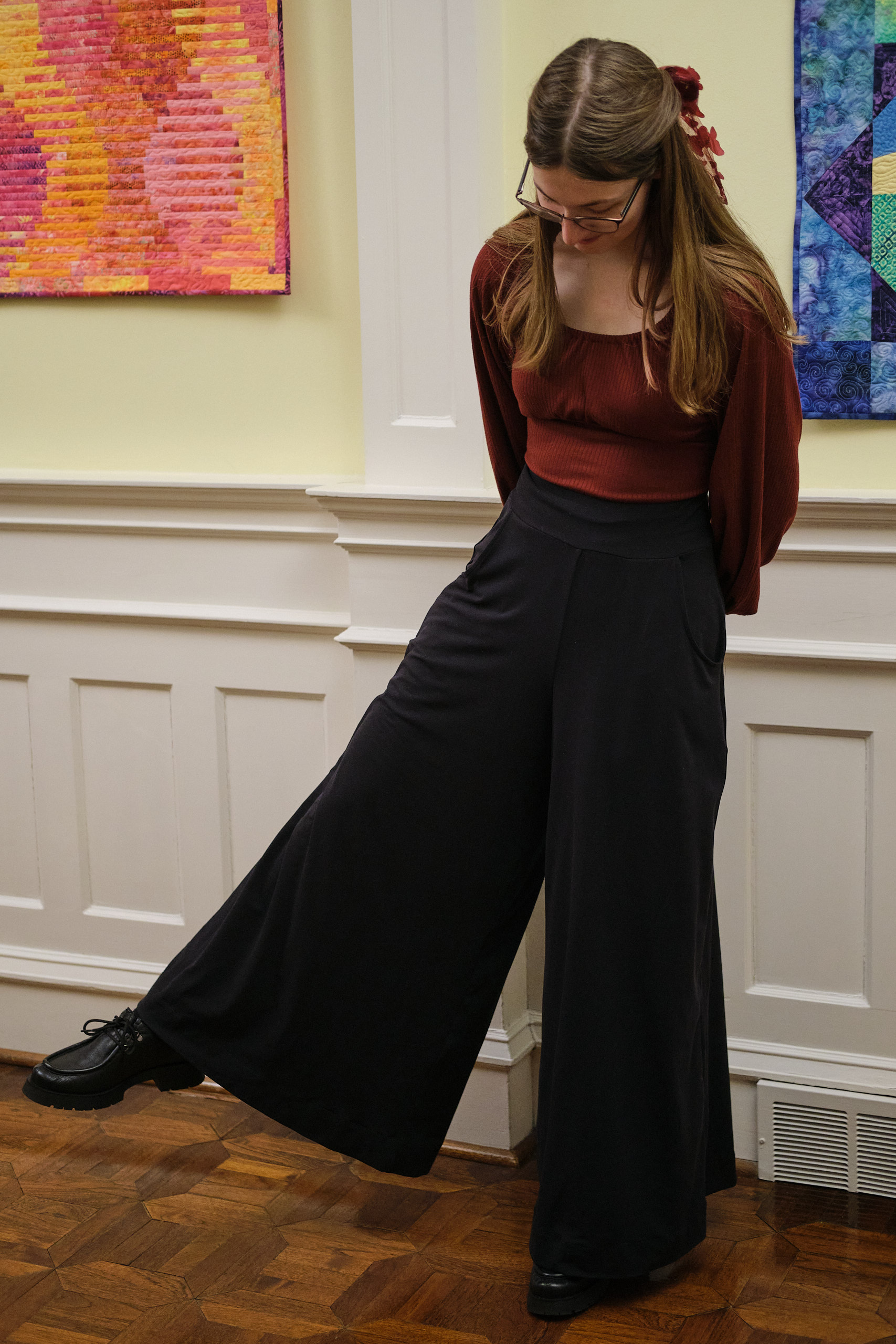
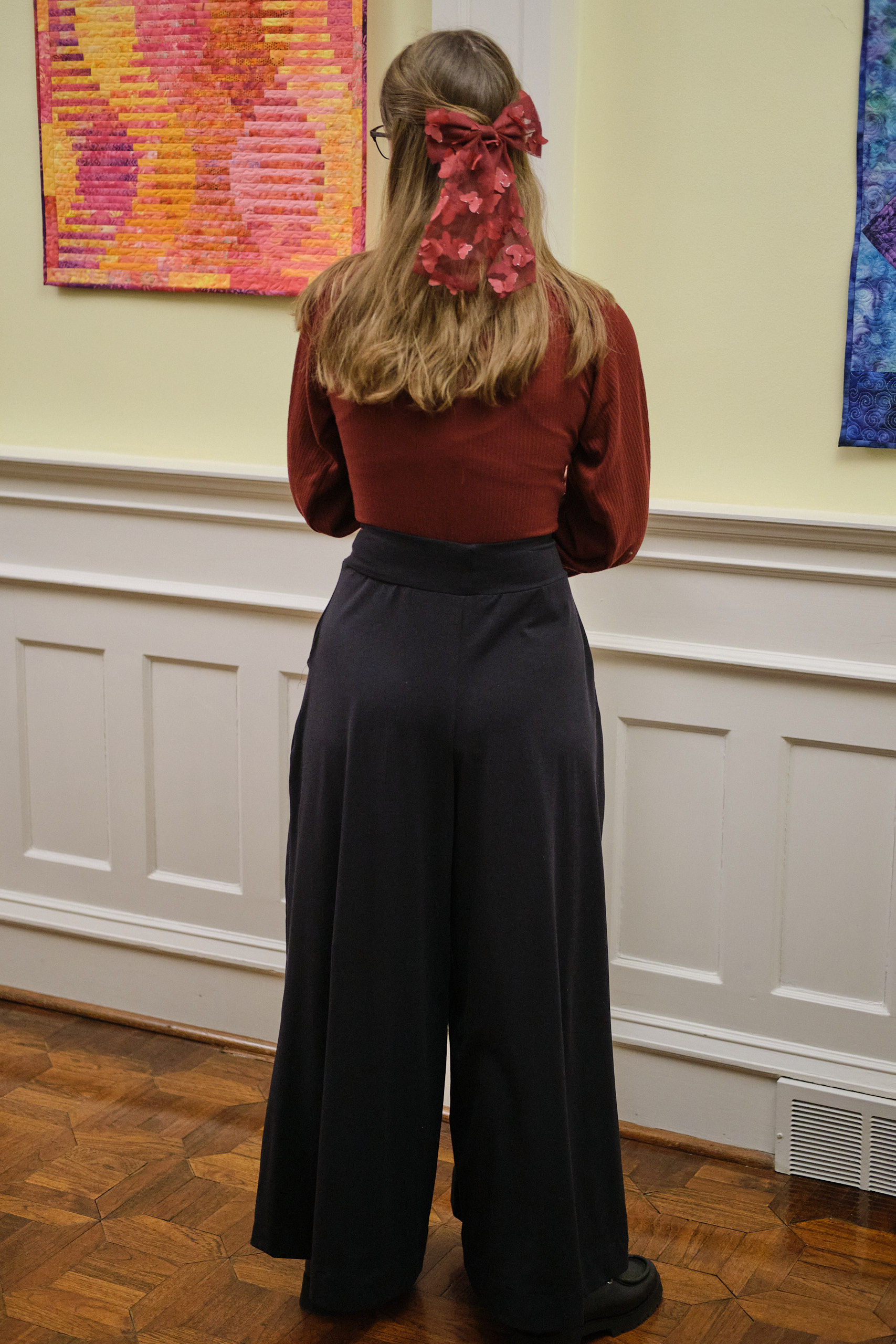
Pattern Emporium Urban wideleg pantssize AU 10, low rise, graded in at waist, modified contour waistband with sewn-in elastic, shortened by 1.5 inches, jeans pockets top-stitched down, 1.5 yard spruce Polartec stretch sweatshirt fleece
Two years ago, I bought some purple Polartec stretch sweatshirt fleece from Surge Fabrics and liked it so much that I subsequently bought three yards each of charcoal, denim blue, and avocado Polartec sweatshirt fleece when Califabrics got some designer deadstock in. The fabric is very soft and cozy on the inside, with a smooth finish on the outside that resists pilling and abrasion. The fabric has a lot of stretch, which adds to the comfort and makes it suitable for a lot of knit patterns. When the fabric arrived, I was disappointed that the denim blue was more green than blue and the avocado was the shade of green that avocados eventually turn when they’re a bit past their prime, or, more charitably, the color of green olives. I made a Pattern Emporium Sweet Cheeks sweatshirt from the purple fleece and a pair of PE Urban Tapered Pants from the charcoal fleece. I love them both: they are cozy, warm, and comfortable. Later, I made a pocket hood scarf from most of the rest of the purple fleece (with the fluffy side on the outside). I had planned to make some coordinating loungewear out of the denim blue and rotten avocado, but every time I looked at these fabrics, I was disappointed that they weren’t the colors I was expecting. But alas, it is cold outside this week (actually for the rest of the month), and I really want some cozy loungewear, so I decided that I would just accept that the denim blue was actually dark teal or maybe spruce, and go ahead and make a lounge set. I auditioned several threads to coordinate with the spruce, and found my blue threads were all terrible matches, so I settled on a green thread. So spruce it is!
Once I accepted that I had 3 yards of spruce fleece to work with, I decided that it is actually a lovely color and I was excited to figure out which patterns to use to make my lounge set. I started with the pants and in my next post I’ll write about the top.
I chose the Pattern Emporium Urban wideleg pants pattern, which I have made many times before, in purple, black, grey, and magenta ponte. These are easy to sew and I love the back darts. I’ve tweaked the pattern in a bunch of different ways, but have settled on the size AU 10 with a low waist (which is more of a high-waist on me) with the waist graded in and the waistband adjusted to be a contoured waistband with 3/8-inch elastic sewn in. I also like to extend the crotch seam a tad (but forgot to do it this time). I use the jeans-style pockets but raise the pocket openings and cut them straight instead of curved. I also cut them 1.5 inches shorter than the pattern and this time I gave them a 1.75-inch hem.
The Urban pants pattern actually works great with this fluffy stretch fleece fabric. The only bit that didn’t work so well was the pockets. The jeans pockets are folded to form a pocket bag, so you end up with three layers (two pocket layers and a pants layer). That was too bulky with this fluffy fabric. I should have used one of the pocket styles in which you sew one layer of pocket either inside or outside the pants leg. Rather than take them apart, I top-stitched the pockets down after assembling the pants, using two rows of very narrow zigzags a quarter-inch apart (1.8 length, 1.1 width on my Bernina). It would have been much easier to do this with only 2 layers instead of 3 and to sew it down before assembling the pants, but it worked out ok and I think it looks just like the pockets I’ve seen on pants being sold at retailers. My Triumph in cover stitch mode could also have done the topstitching and = would probably have been an even cleaner look, but it would have been difficult to do after the pants were assembled and would have required rethreading and converting the Triumph to cover stitch mode.
I’m very happy with how these pants came out, the color is great, and they are super cozy and warm! Now, on to the top….
Greenstyle Surge Sweatshirt, size C2 regular length, sleeves shortened by 2 inches, in 1 yard black Polartec Windpro ribbed fleece.
When Kayla Tarey hacked the Greenstyle Sav’s sweatshirt pattern into an oversized sweatshirt suitable for a heavy, low-stretch knit, I wanted to try it too. Kayla used Surge Fabric’s Polartec Wind Pro ribbed sweater fleece, which is 100% Polyester, 380gsm, with 25% horizontal and 0 vertical stretch. It has a 2×2 rib knit on the front side and soft sherpa fleece on the back. This seemed perfect for a cold-weather sweater. The folks at Greenstyle turned Kayla’s hack into the Surge Sweatshirt pattern, making it much easier for everyone to copy this style. The pattern works for a variety of knit fabrics, but because it doesn’t have a neck band and the bottom band and cuffs don’t require a lot of stretch, it works fine for heavy 2-way stretch fabric that doesn’t have a lot of stretch. I had 2 yards of black Wind Pro and decided to try it out.
I projected the pattern and cut it out. Kayla had suggested checking the projector calibrations on the fabric because it is so thick. I measured some of the projected pattern pieces with both one layer of fabric and two and noticed only minimal differences between the size of the projection on the fabric and on the cutting mat without any fabric. I also found the fabric cuts quite easily with a rotary cutter.
GreenStyle has unusual sizing, and the size chart for this pattern said I was mostly a size C2, but a B1 at the bust. This was my first Greenstyle pattern so I wasn’t entirely sure what to do, but as this is supposed to be an oversized pattern and the fabric is hefty, I decided to go with the bigger size. I debated grading parts of it down or shortening it, but ultimately decided to only shorten the sleeves with my usual 2-inch adjustment. Amazingly, I was able to cut the whole thing from just 1 yard of fabric! I think this is because the drop sleeves are actually pretty short since part of their length comes from the width of the bodice. Now I unexpectedly have an extra yard of this fabric to make a sweater for someone else.
Most of the sweatshirt came together pretty quickly. The pattern has a 3/8-inch seam allowance so I trimmed 1/8-inch off with my serger as I sewed. My Triumph serger was able to sew and trim the heavy fabric without a problem. I used my sewing machine to join the seams on the bands and cuffs. I basted the bottom band and the cuffs to the shirt with a long zigzag stitch after stretching them (just a little bit) and pinning in place. I was able to easily serge the bottom band through three layers of fabric, but the cuffs were too bulky to get under my serger foot. Perhaps I could have made it work if I switched to a smaller foot (I have all the feet so there was probably something that would have worked), but I decided to just sew them with a zigzag on my sewing machine. The neck band construction looks complicated but is actually pretty easy, and is sewn on a sewing machine and finally attached with a serger. It has a cute little notch on one side that nobody will ever see because my hair hides it, but maybe if I wear a ponytail, it will show.
The finished shirt is definitely oversized, but not too oversized. It is very warm and comfortable. I find a lot of turtlenecks and cowls uncomfortable, but this neck band stands far enough away from my neck that it doesn’t bother me. I almost didn’t make this shirt because I didn’t want a high neck. I debated trying a V-neck, a quarter zip, or a scoop neck with facing, but eventually decided to just make the pattern as written, and I’m glad I did.
If I were making this out of a lighter-weight fabric I might go down a size or two, and I might also try this a few inches shorter, or use the pattern for the cropped version and make it a few inches longer. The pattern also has optional pintuck accents that I did not use. I think it looks better without them. Or maybe I would try the Greenstyle Bianca pullover pattern, which is less oversized, has a similar shape, but comes with neck and pocket options. It’s going to be cold here for a while and I have more cozy fabric in my stash, so let’s see!
I made this shirt yesterday and wore it to work today. I walked to work in single-digits and with a coat on top it did the job!
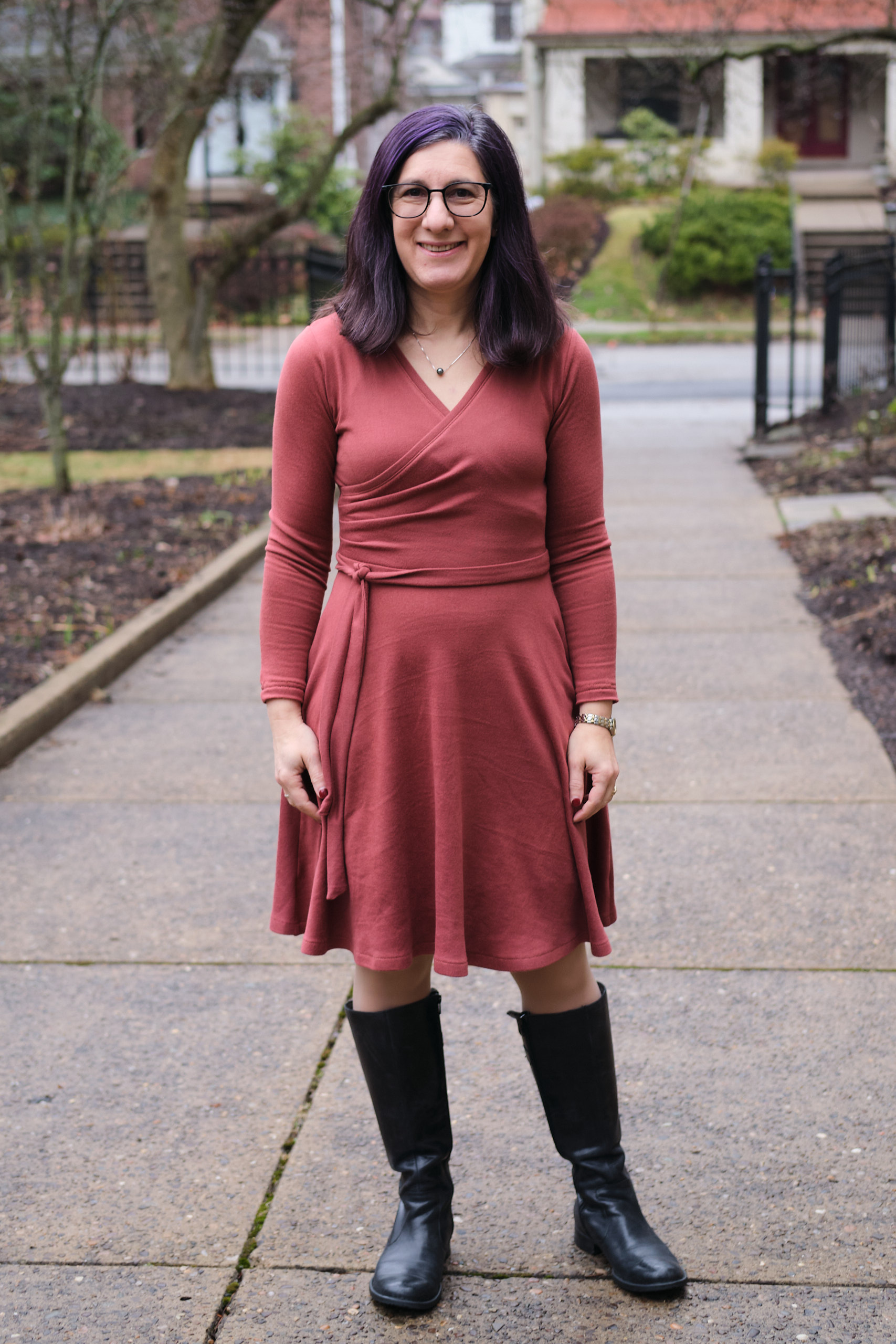
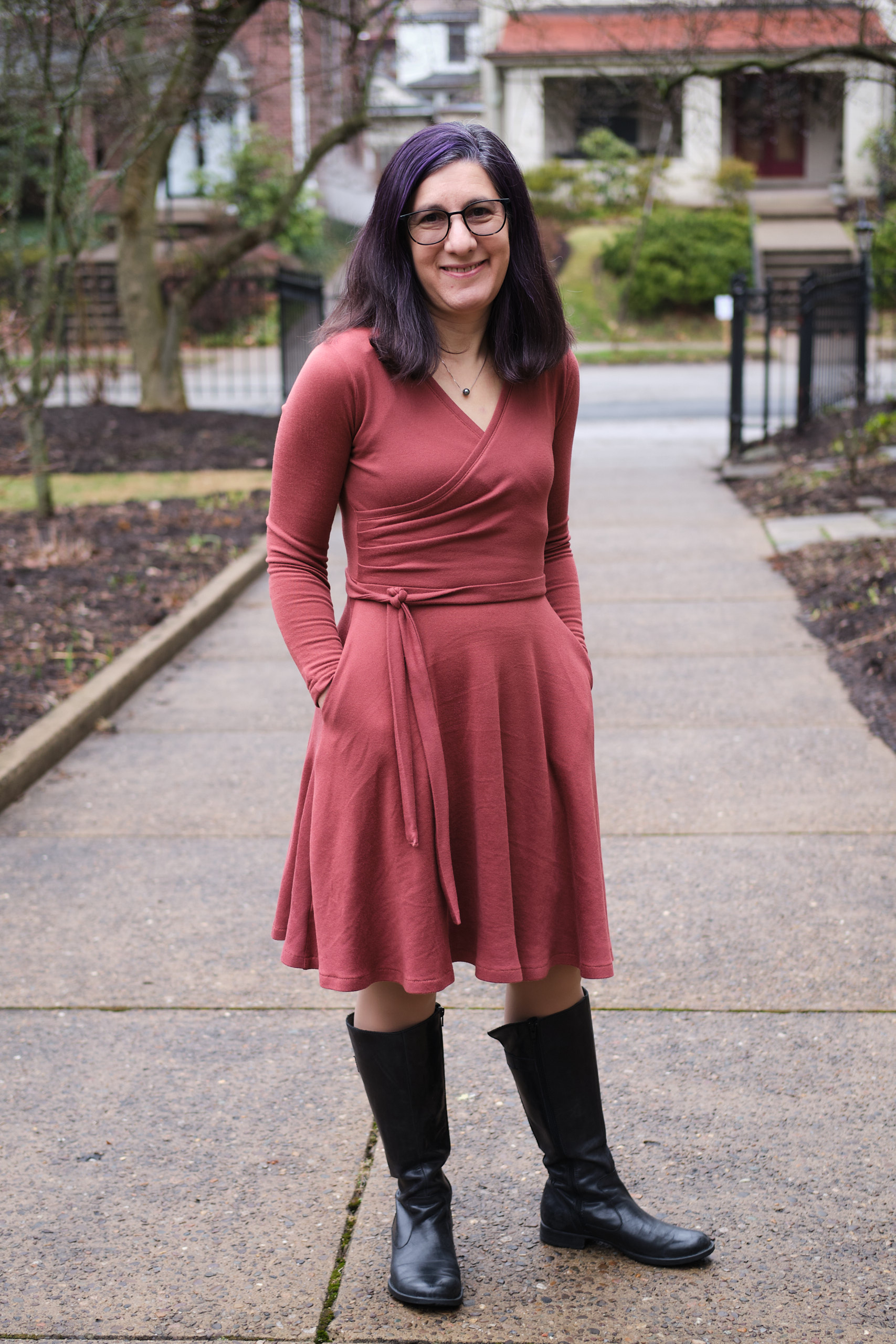
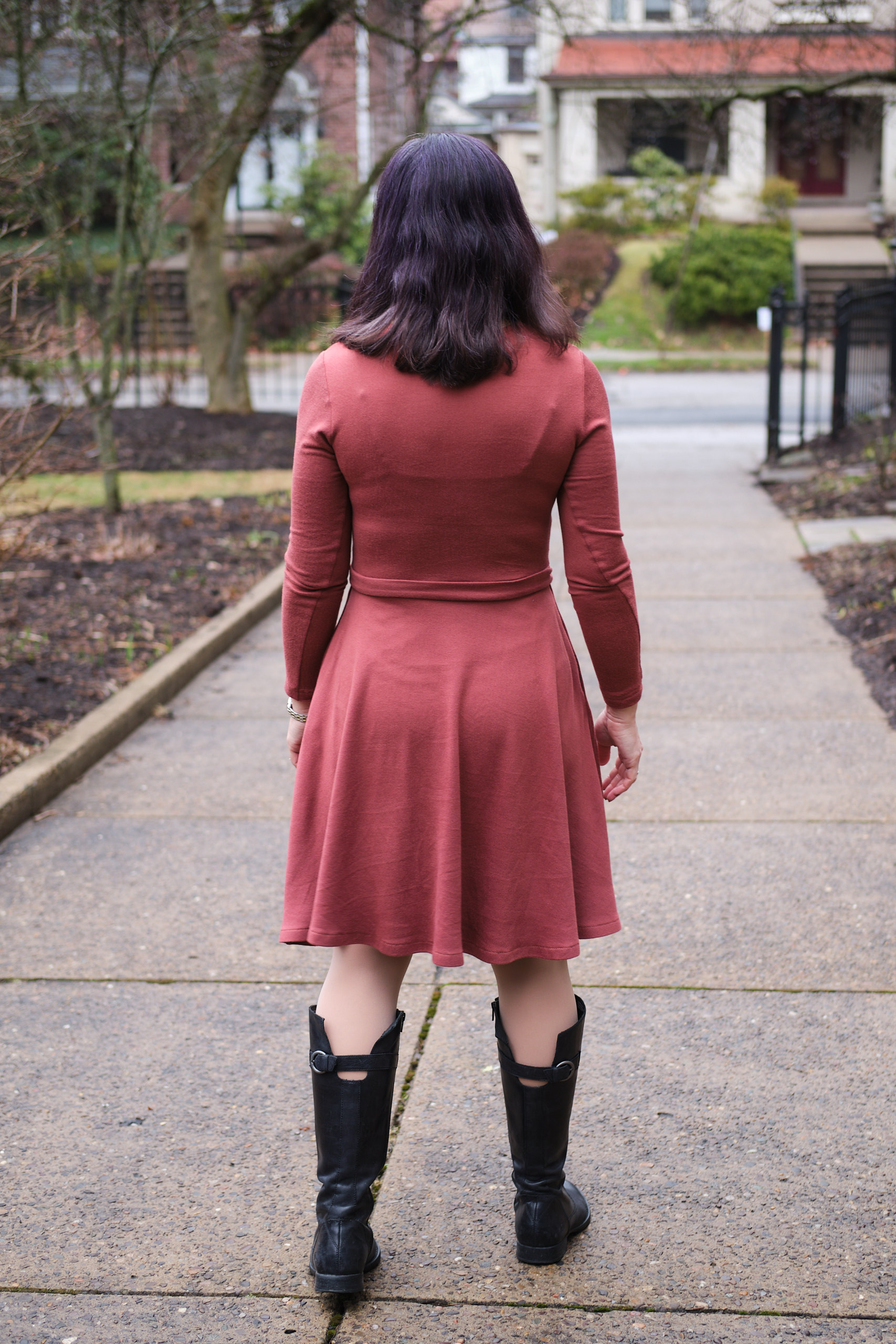
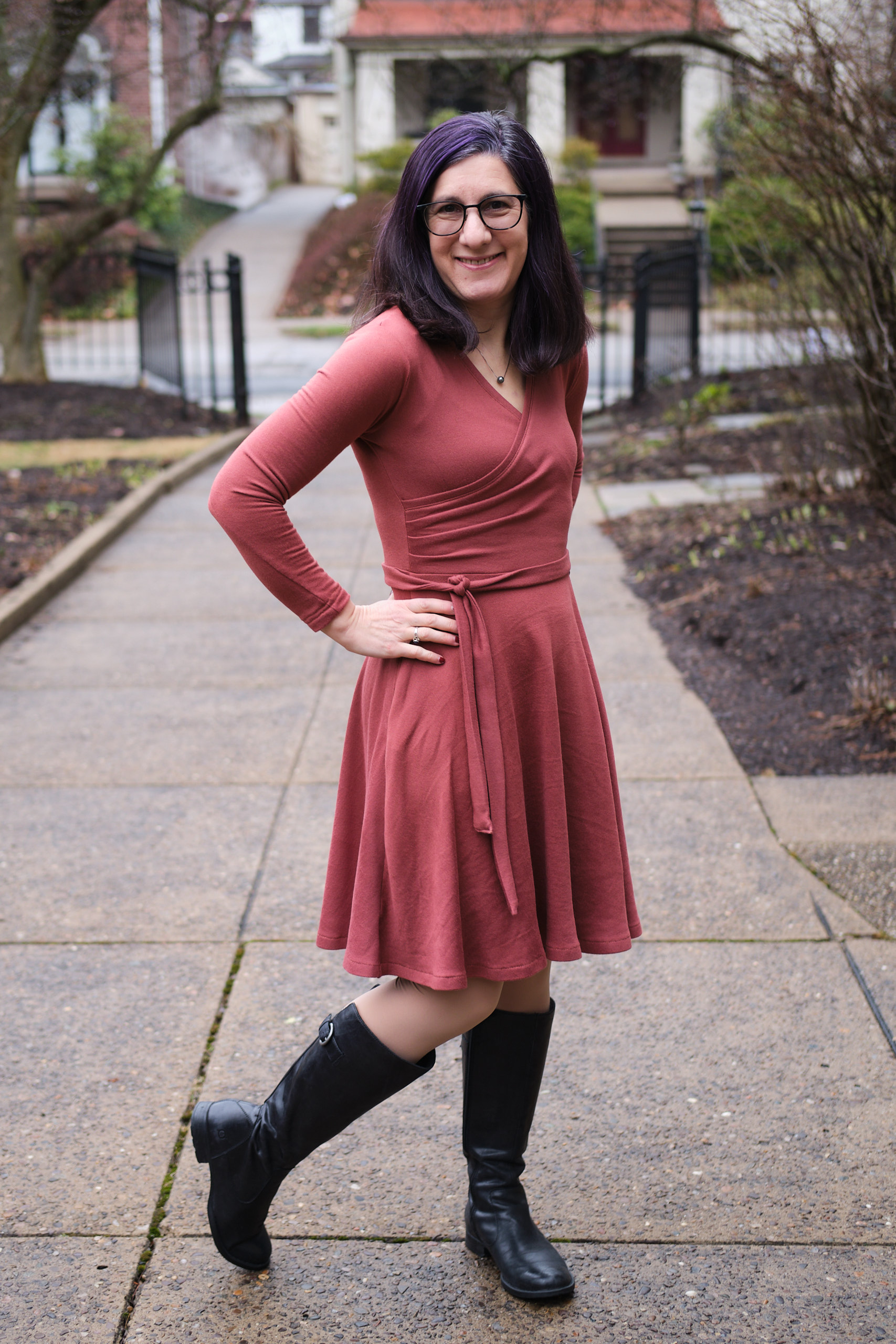
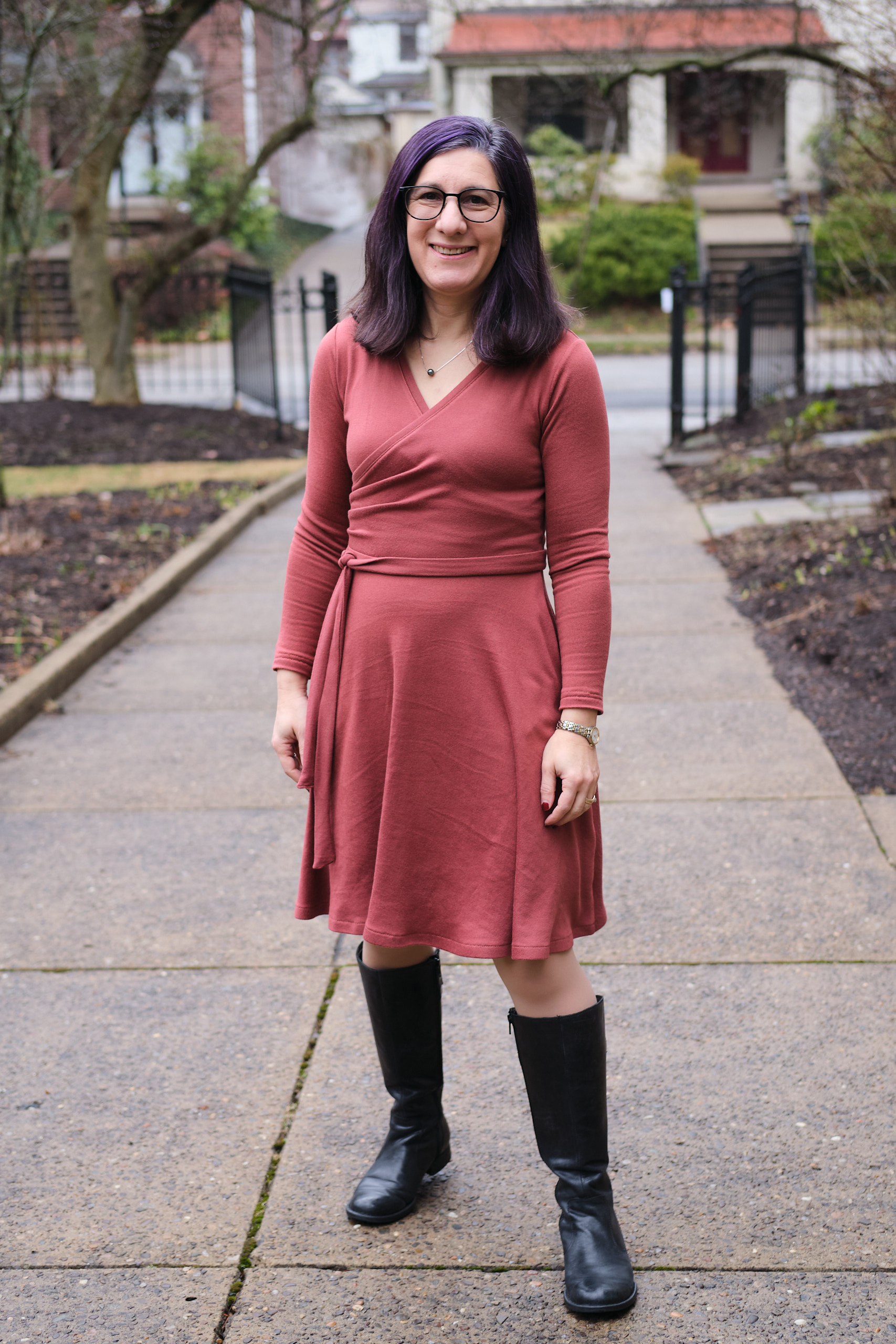
Joanne faux wrap knit dress with long sleeves, size P4, knee length, pockets modified so as not to attach to waist, made from 2 yards Sienna Versailles brushed hacci.
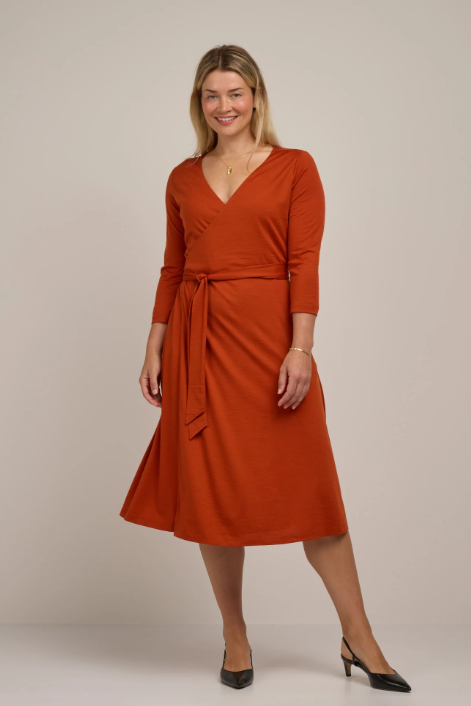
I saw an ad for a Merino wool wrap sweater dress in “terracotta” and was inspired to make my own, except in a faux wrap style (easier to deal with) and in a faux wool (easier to wash). And while I was at it, knee length (rather than midi length) and full length sleeves (rather than 3/4). I used two yards of Sienna Versailles brushed hacci, which I’ve used before for a Sweet Cheeks sweater. It is 5%Poly/5%Spandex, 200gsm, with 50% horizontal and vertical stretch. It is super cozy because it is brushed on the inside, which gives it a polished finish while being very comfortable to wear.
I selected the Sinclair Joanne faux wrap knit dress, size p4 knee length, which I’ve made before in ITY with flounce sleeves and as a “double faux” with a faux wrap skirt. There are other faux wrap knit dresses from other pattern companies, and maybe someday I will try one of those, but it is a very well-constructed and easy-to-follow pattern that fits me perfectly with no alterations, so why change?
I made this one exactly according to the pattern, except I modified the pockets so they attach only to the side seams and not the waist and made them a little deeper and sewed the openings up a bit so nothing falls out. I made the long sleeve version for the first time — the sleeve length is perfect. It is a fairly tight-fitting sleeve, so for a lower stretch fabric, I might cut it a little wider. I hemmed the sleeves with two rows of shallow zigzag. I skipped the hem tape and then regretted it. So I used my favorite knit hem tape before I zigzagged the bottom hem.
I made a simple narrow belt by cutting a 3″ strip across the width of my fabric, folding it horizontally, surging, turning it right side out, and sewing down the open end.
I wasn’t sure how this pattern would work in a sweater knit, and was especially worried that I would have to add a waistband to support the pockets. But it worked fine as is — I didn’t even have to add elastic to the waist. I used 1” fusible knit stay tape to reinforce the side seams around the pockets. Anyway, Joanne makes a great sweater dress!
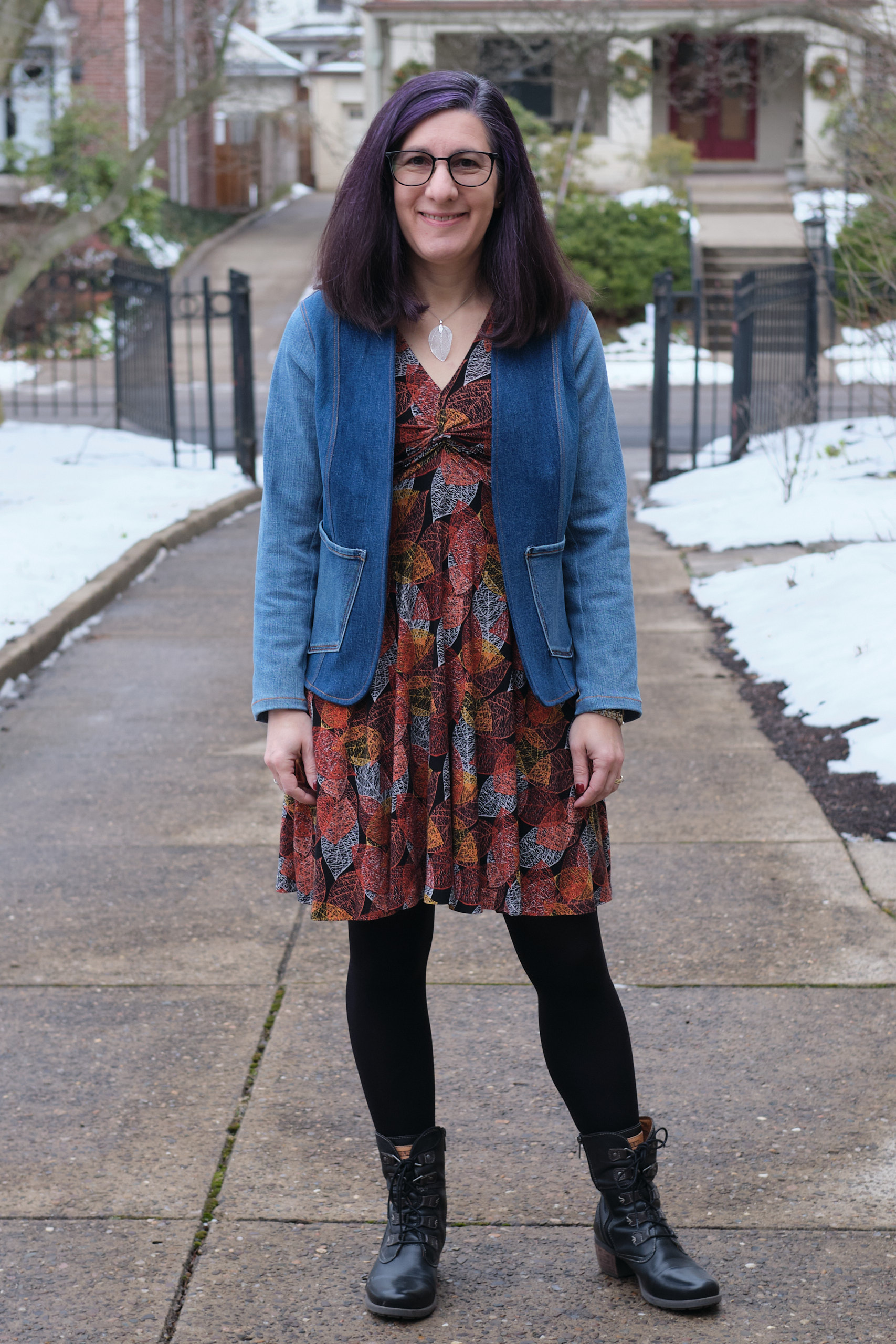
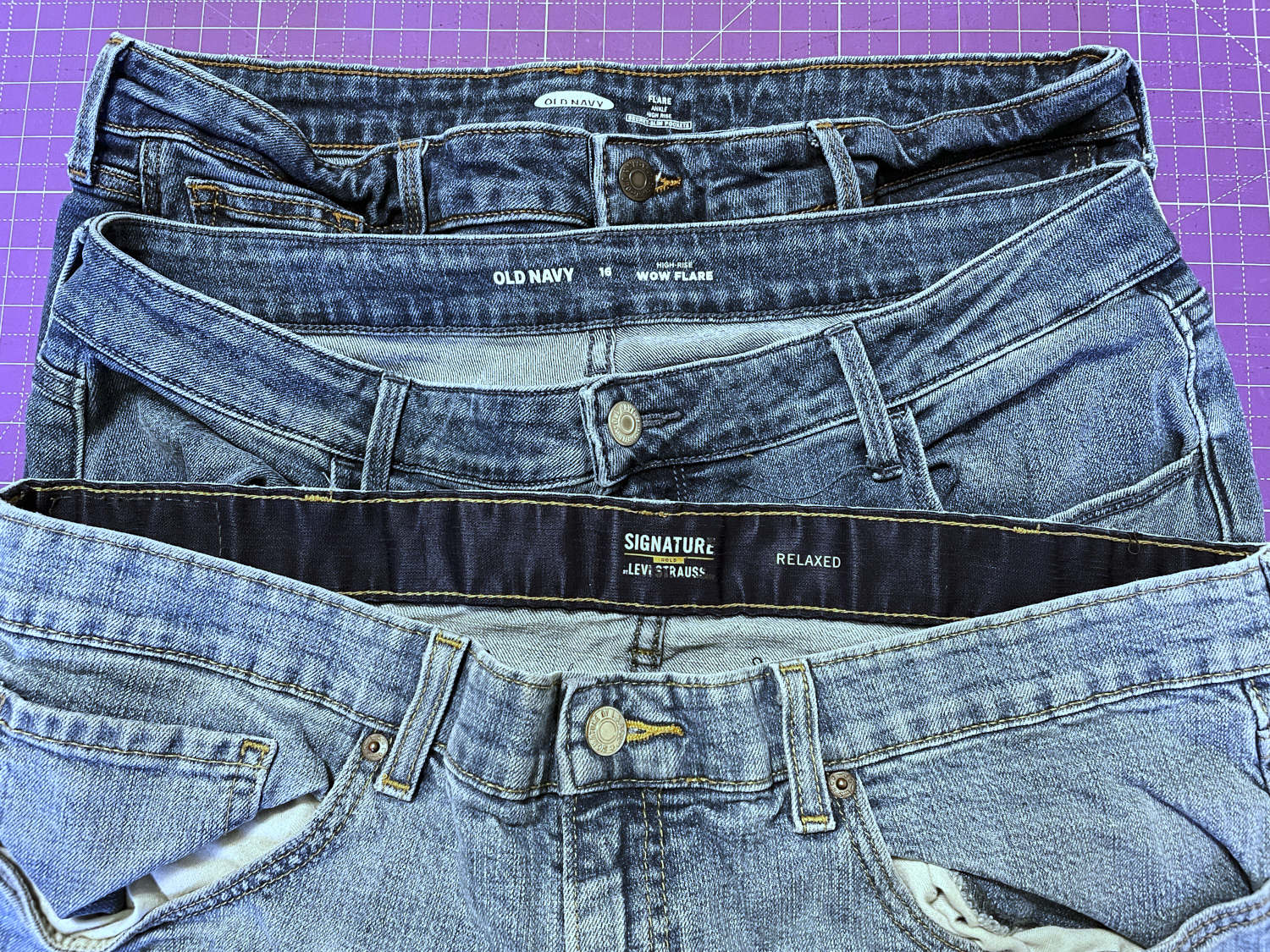
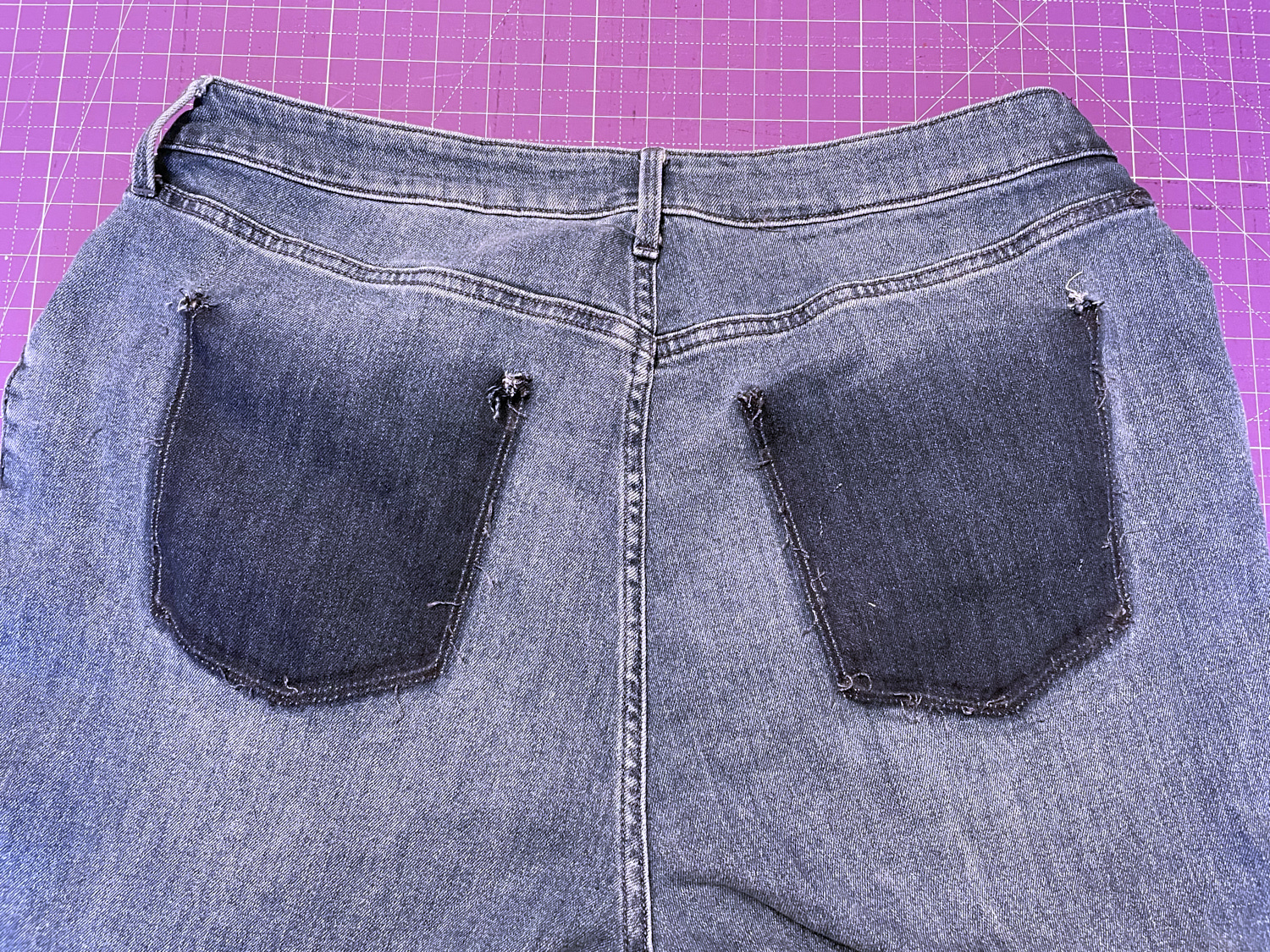
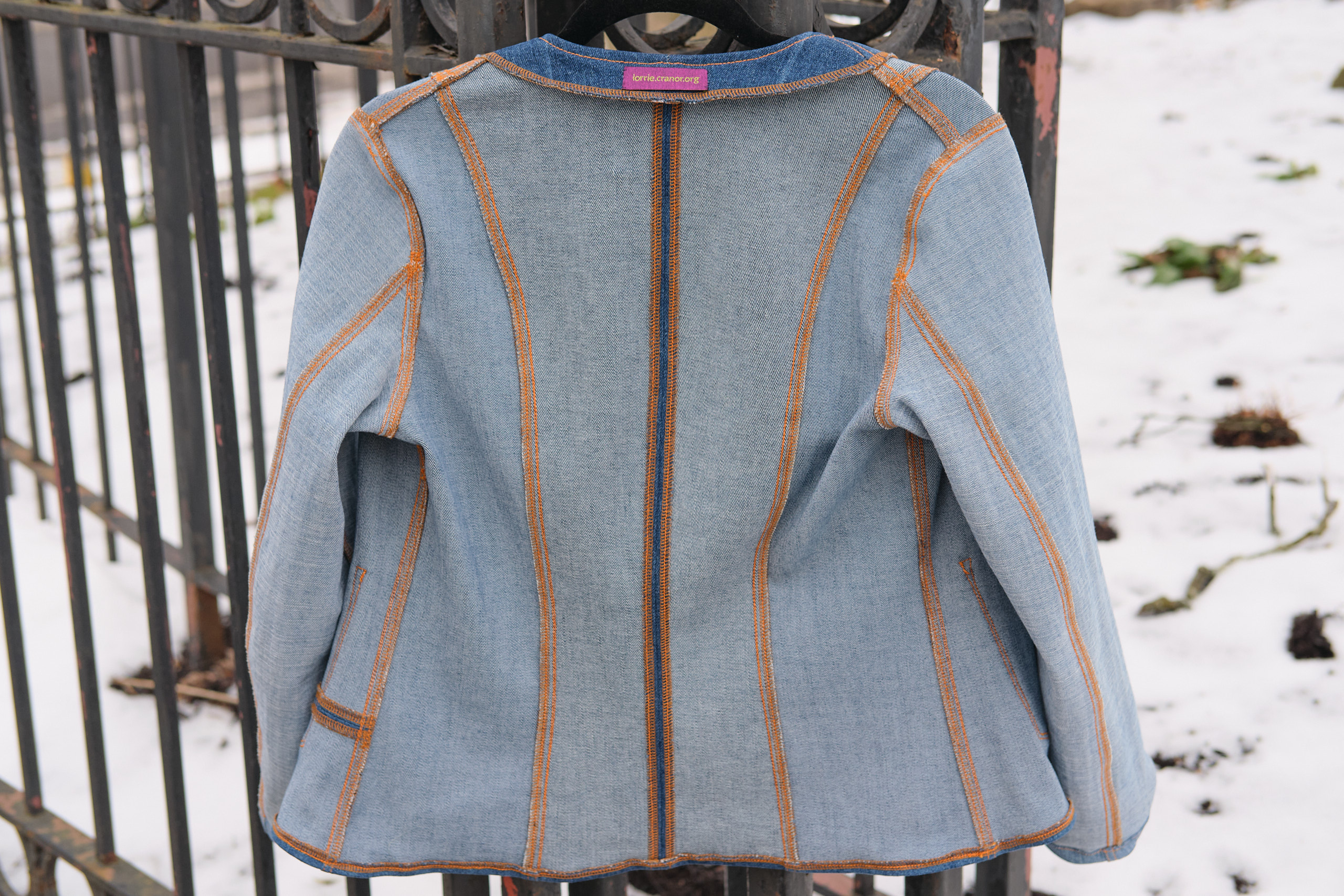
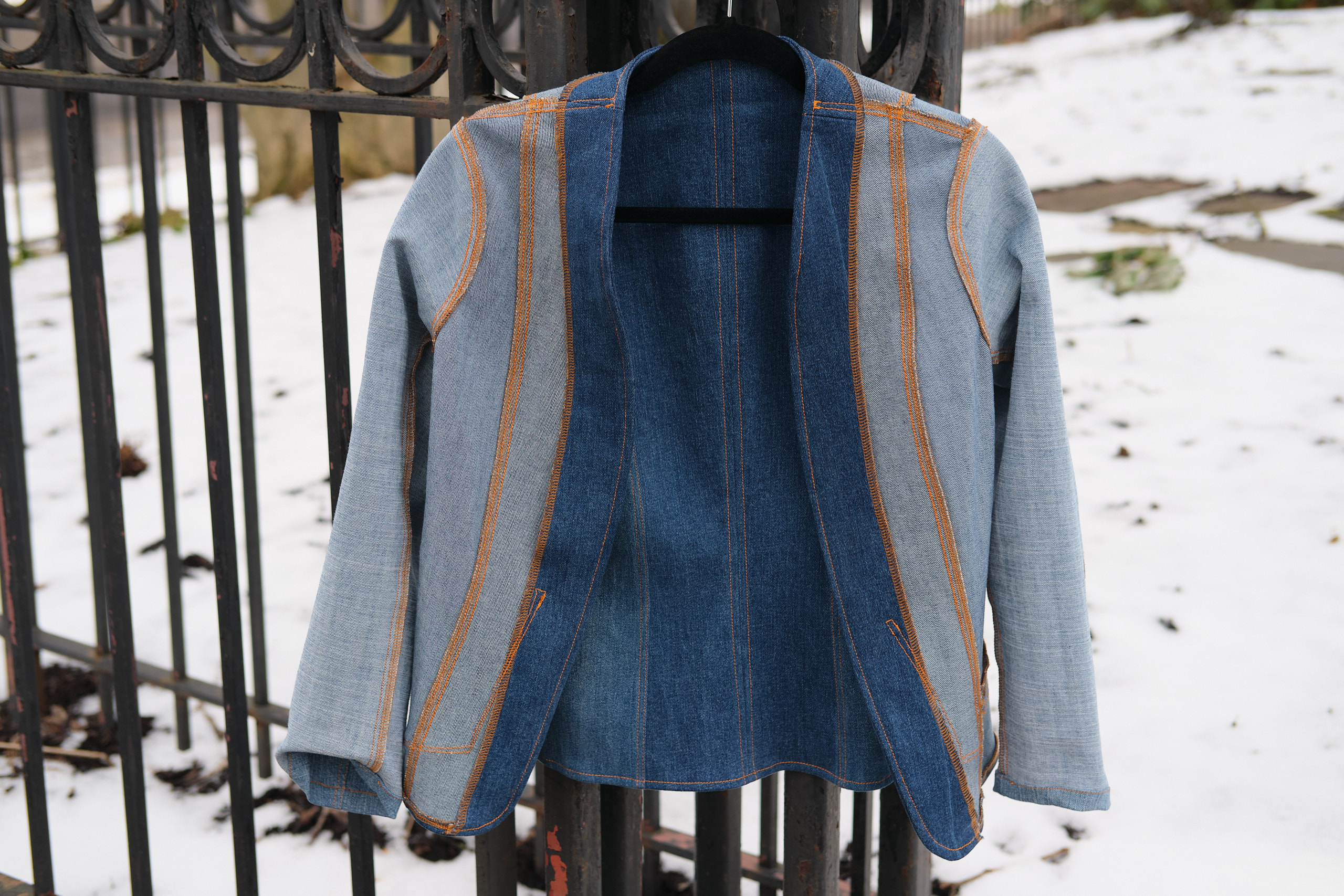
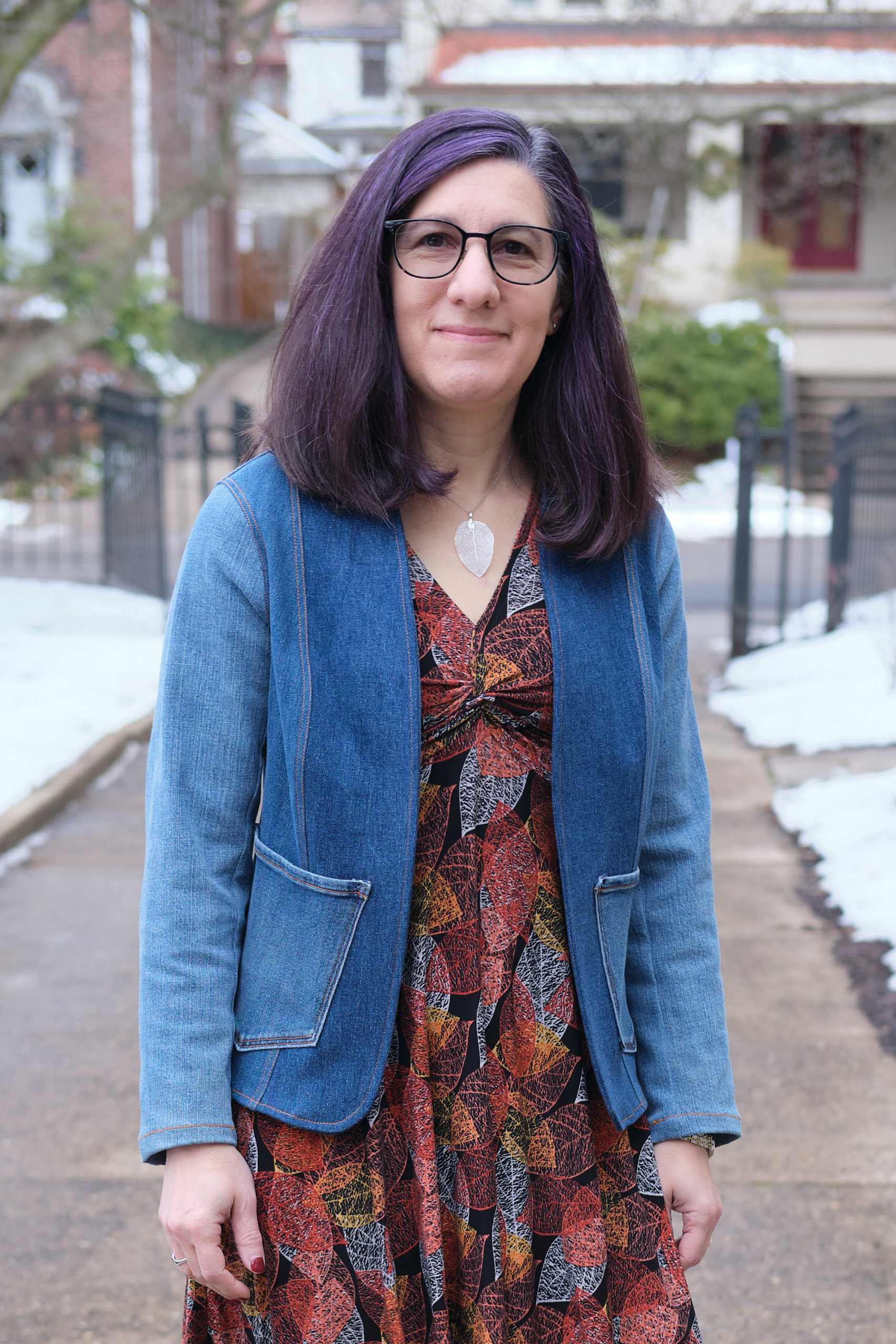
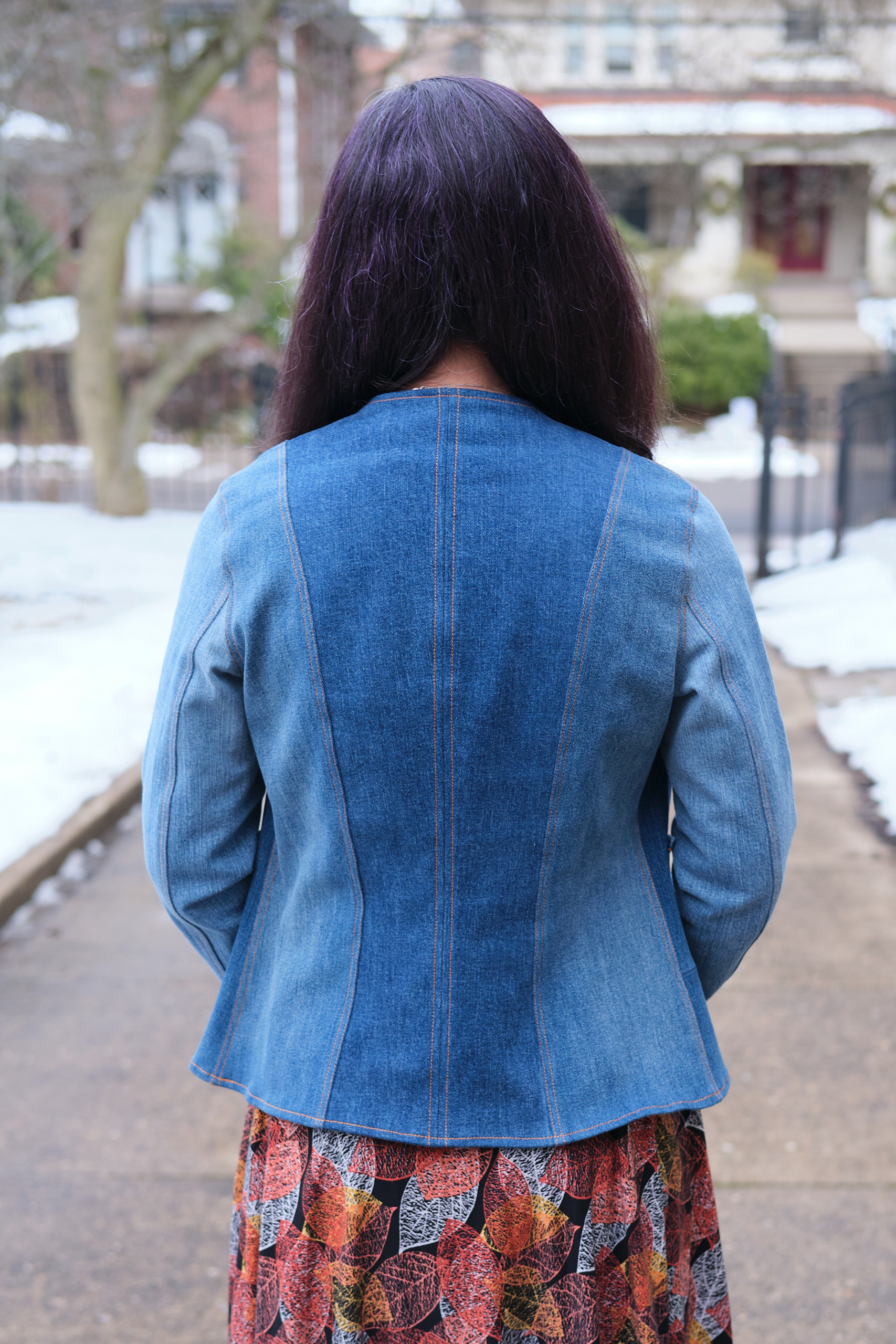
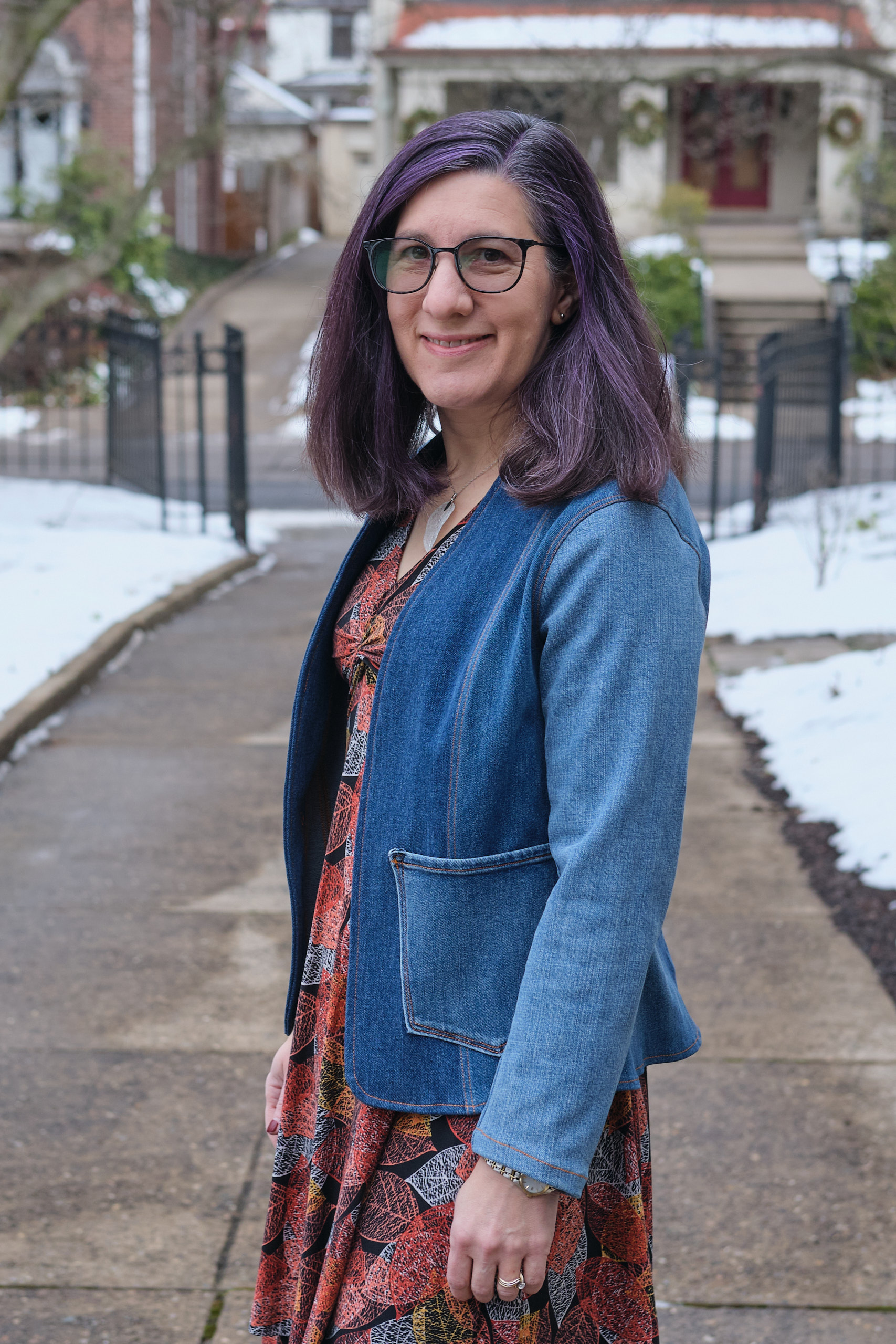
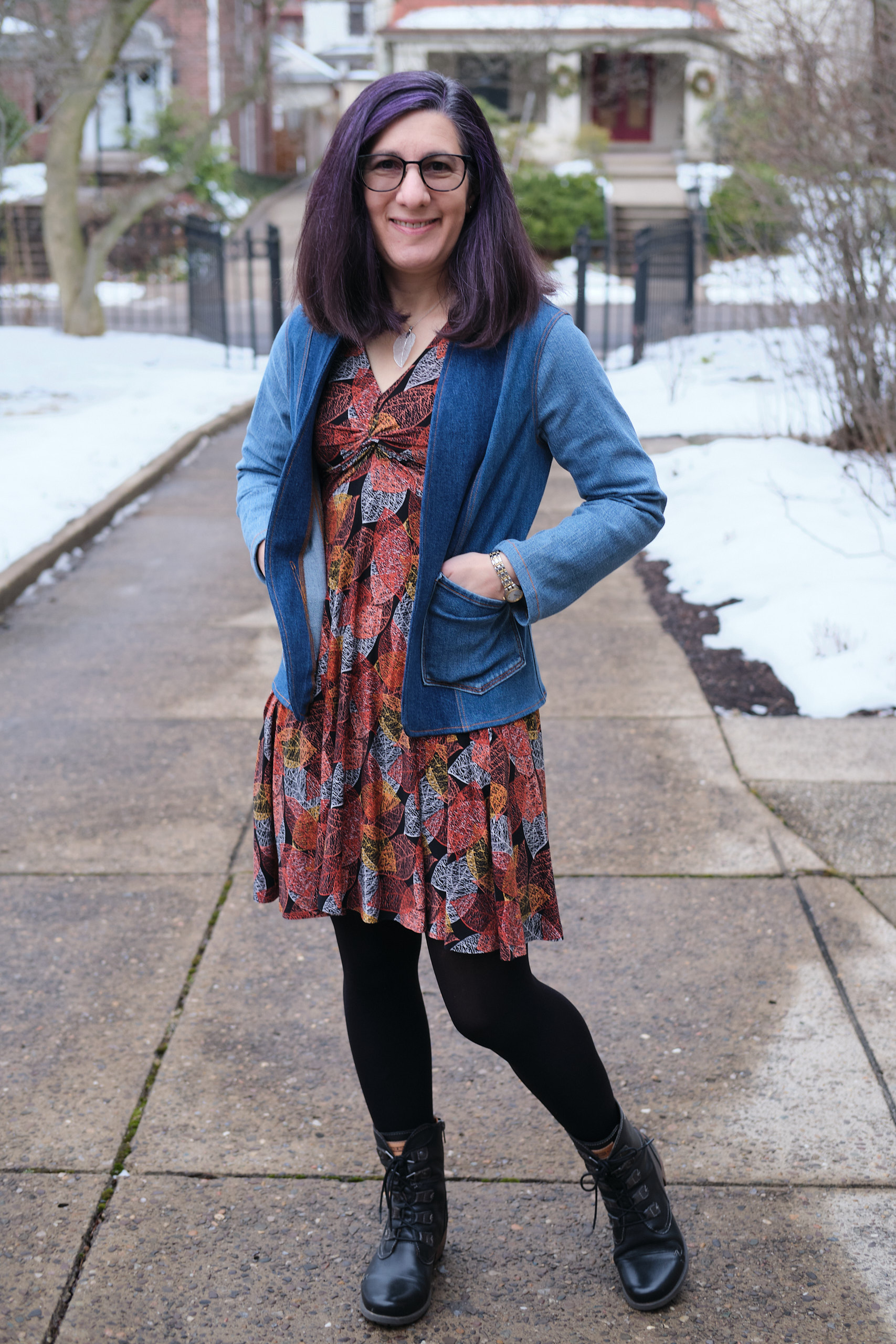
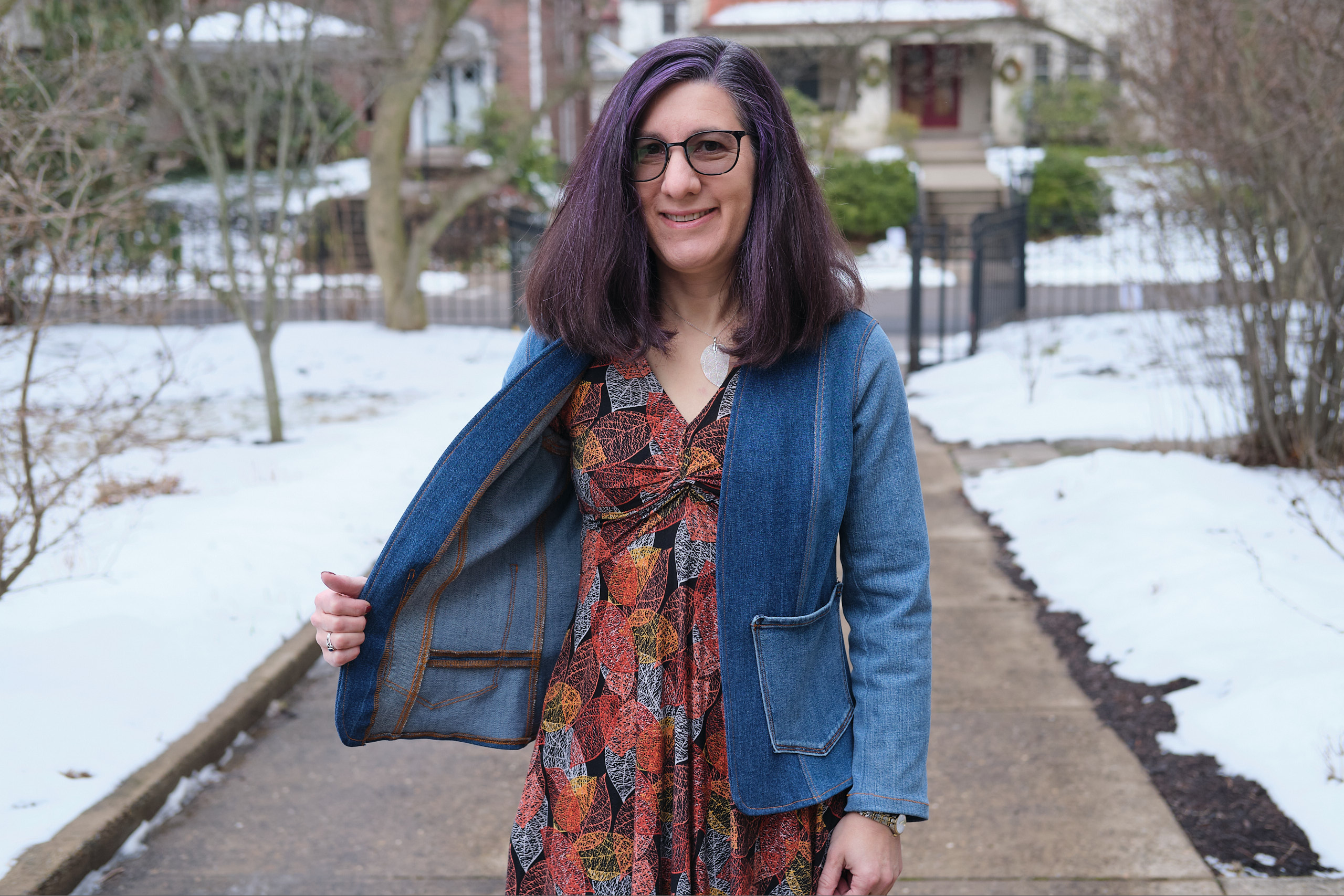
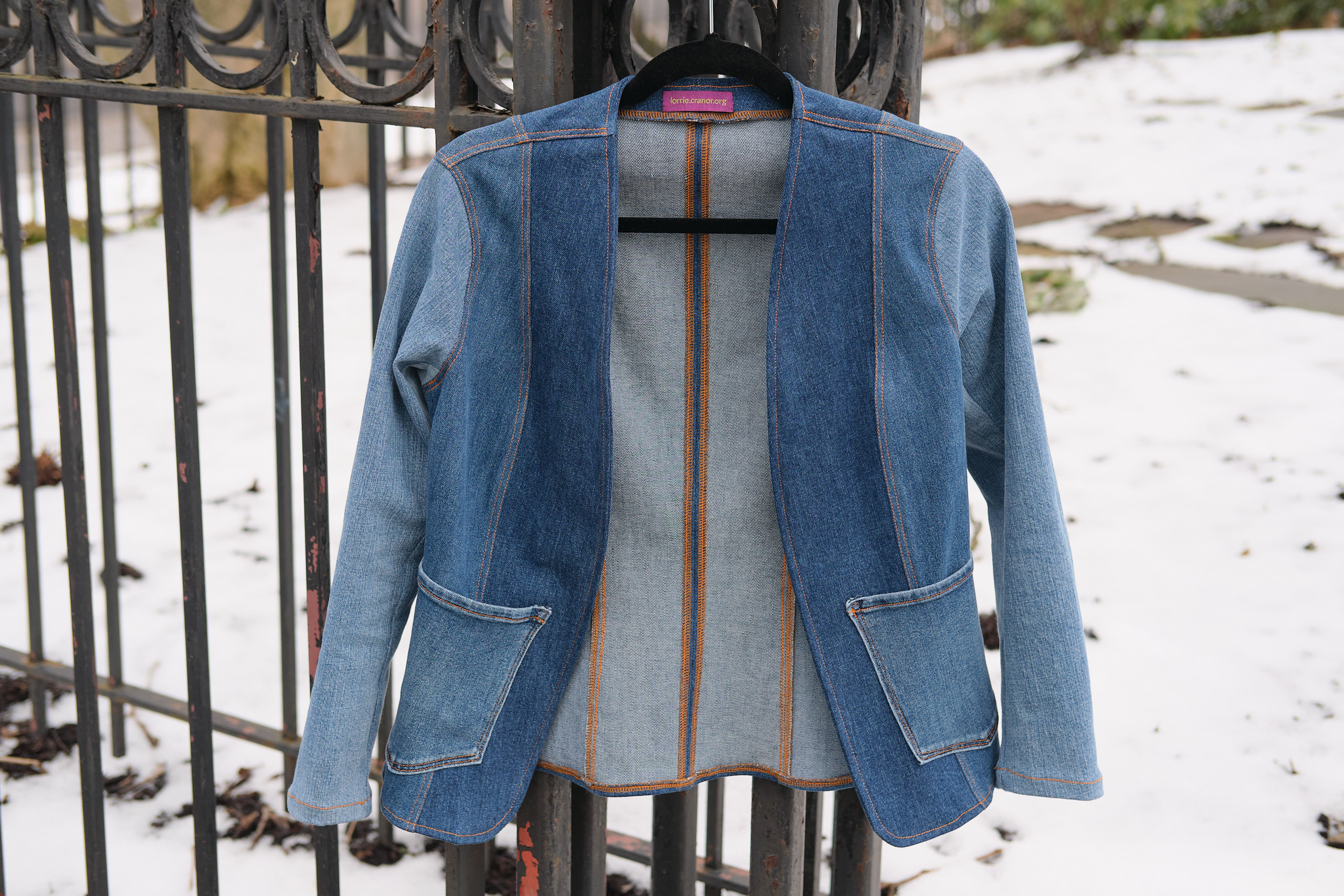
Boo & Lu Onyxblazer, size 4 with small bust adjustment, shortened waist and sleeves, lower back neck facing, repurposed jeans pockets. Made from three pairs of thrifted jeans.
I used to love wearing denim jackets, which seem to go with just about everything, but I’ve found their collars increasingly uncomfortable. So the thought of a collarless denim jacket in a bit dressier blazer style was appealing. Unfortunately, I seem to have already given away most of the discarded jeans in my household and those that I could find were either full of holes and paint spots or ridiculously skinny and thus had very little fabric to work with.
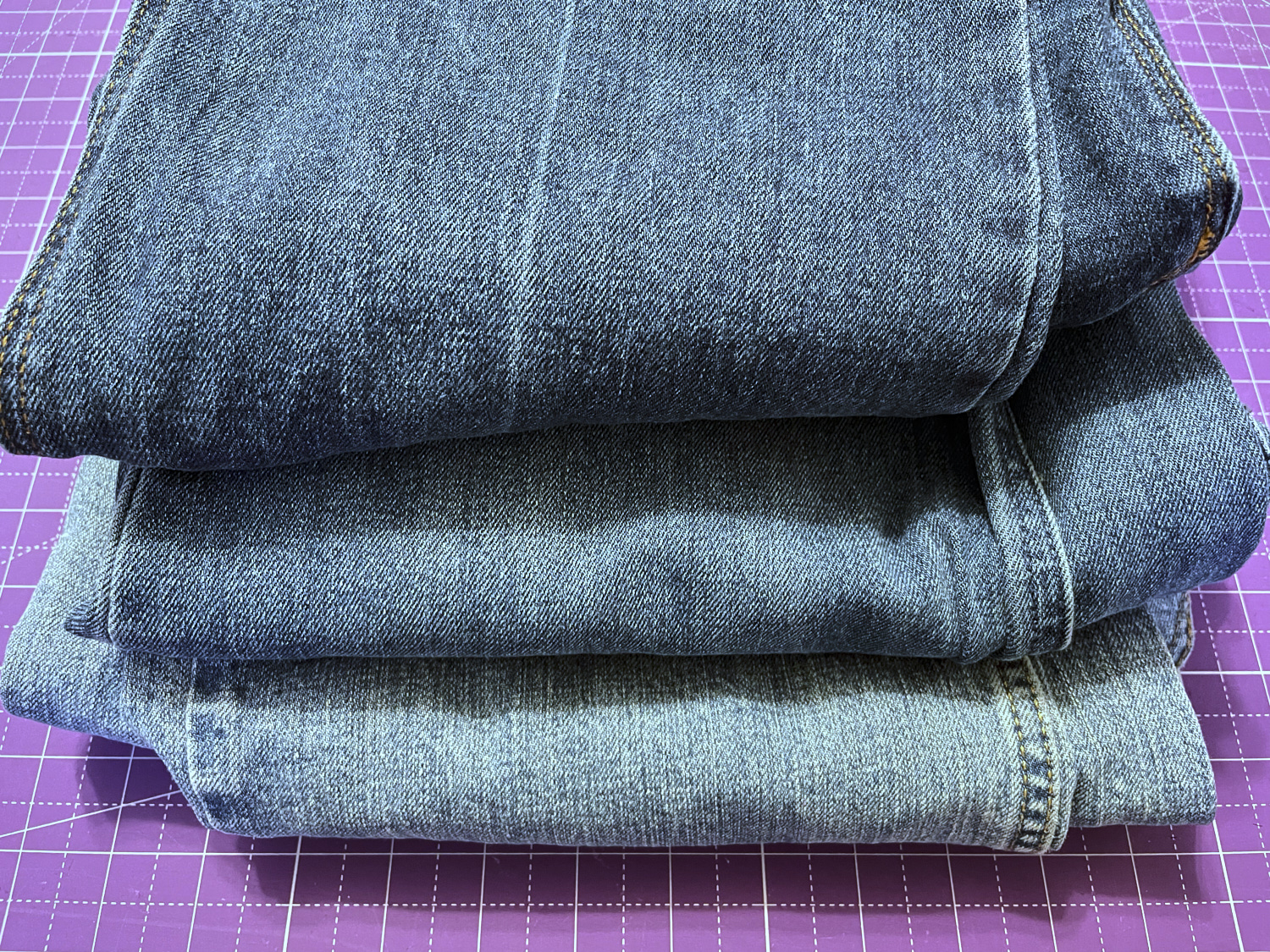
Last fall, when I was visiting my daughters in Boston, we went to a thrift shop and I asked them to help me find three pairs of inexpensive jeans I could cut up. I looked for jeans that were less than $10 a pair, medium-weight, slightly stretchy denim, in large sizes. I collected a pile of jeans that met these criteria and sorted them from lightest to darkest. Then I selected three pairs with distinctly different shades of blue that went well together. They were $6 each and with the $6 coupon I picked up on my way into the store, I paid a total of $12 for all three pairs.
I didn’t get around to working on the jacket project until New Year’s Day. First, I spent a lot of time debating the color placement and where to place each pattern piece. I decided to go with a symmetrical color arrangement and place the pieces from the darkest in the center to the lightest on the sleeves.
I previously spent a lot of time working out adjustments to the size 4 hip length version of the jacket pattern to fit me better. These worked great on my grey and magenta ponte jackets so I used the same pattern file I had already prepared with all of these adjustments: small-bust adjustment (performed by redrawing the inner curve on the side-front pieces to have less of a contour and then shortening the center front pieces to match the length of the new curve), sloped-shoulder adjustment (3/4 inch), round-back adjustments (two 5/8-inch adjustments near top and bottom of arscye), back neckline lowered by about 3/4 inch, bottom hem and sleeves shortened by 2 inches. The only thing I did differently was using the jeans pockets rather than the pattern pocket pieces and using the normal pattern facings rather than the wider facings I used previously. There’s always a risk that a pattern fitted with one type of fabric won’t fit right when cut from a very different type of fabric. Thankfully, my denim version seems to fit pretty much the same way as the ponte.
I carefully cut out all the pieces, making sure to pair pieces from the left and right legs of each pair, cut at approximately the same height on the leg. I accidentally cut one of the front side pieces too short and wasn’t going to be able to cut a piece of a similar color at the full size so I just cut the missing part and spliced them together. I knew most of this seam would be under a pocket and hardly noticeable.
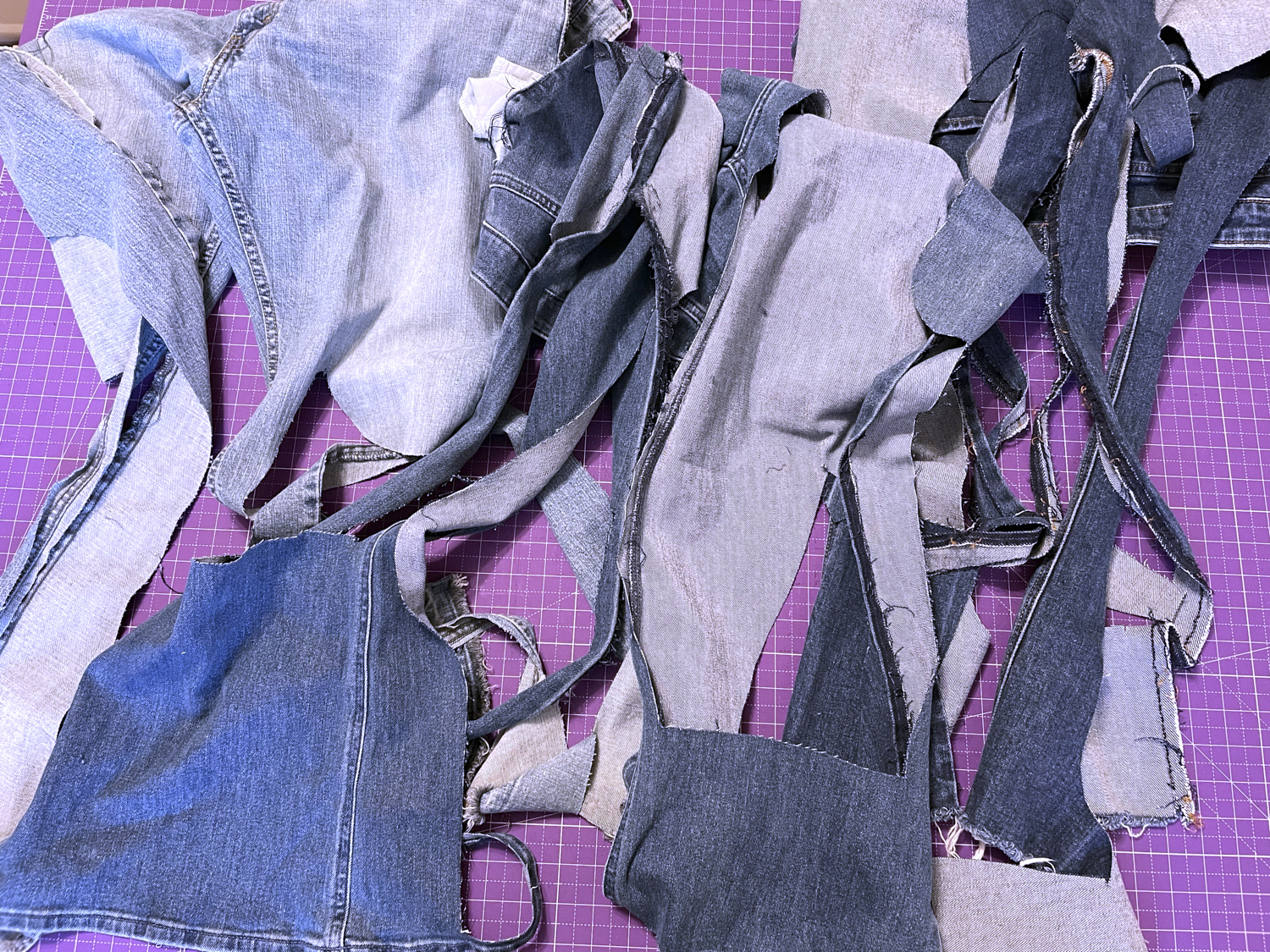
Rather than using the pocket design included in the pattern, I decided to use the rear pockets from one pair of jeans. I carefully unpicked them and removed all the top stitching. Unpicking pockets from jeans is mostly easy as they are attached with a chain stitch that easily unravels – except for the corners, which are thoroughly attached with a bartack and require some effort and a bit of elbow grease to remove. I ended up using most of the legs of all three pairs of jeans. There is still a little bit of leg fabric and seat fabric that might be used for other projects that can use smaller pieces.
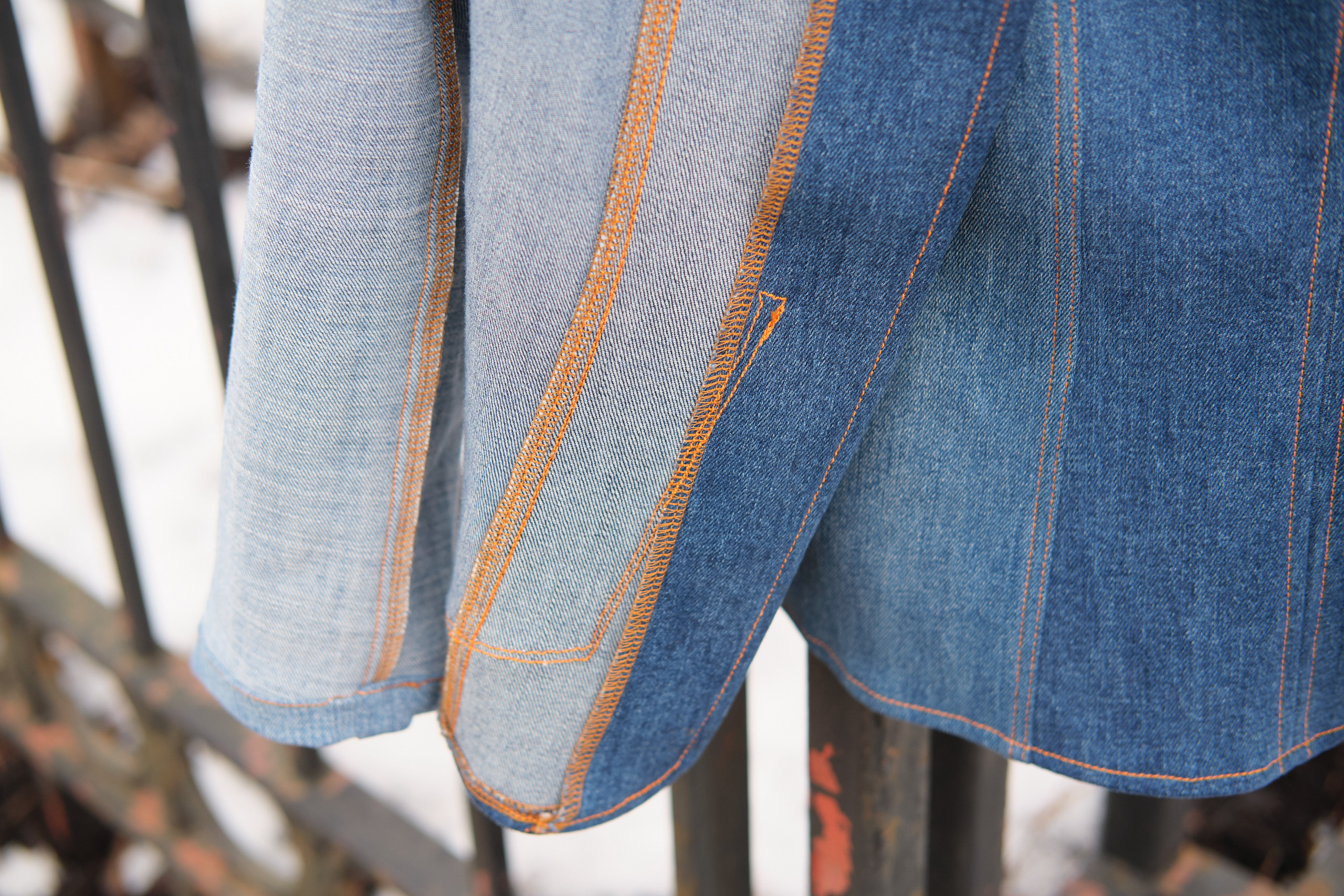
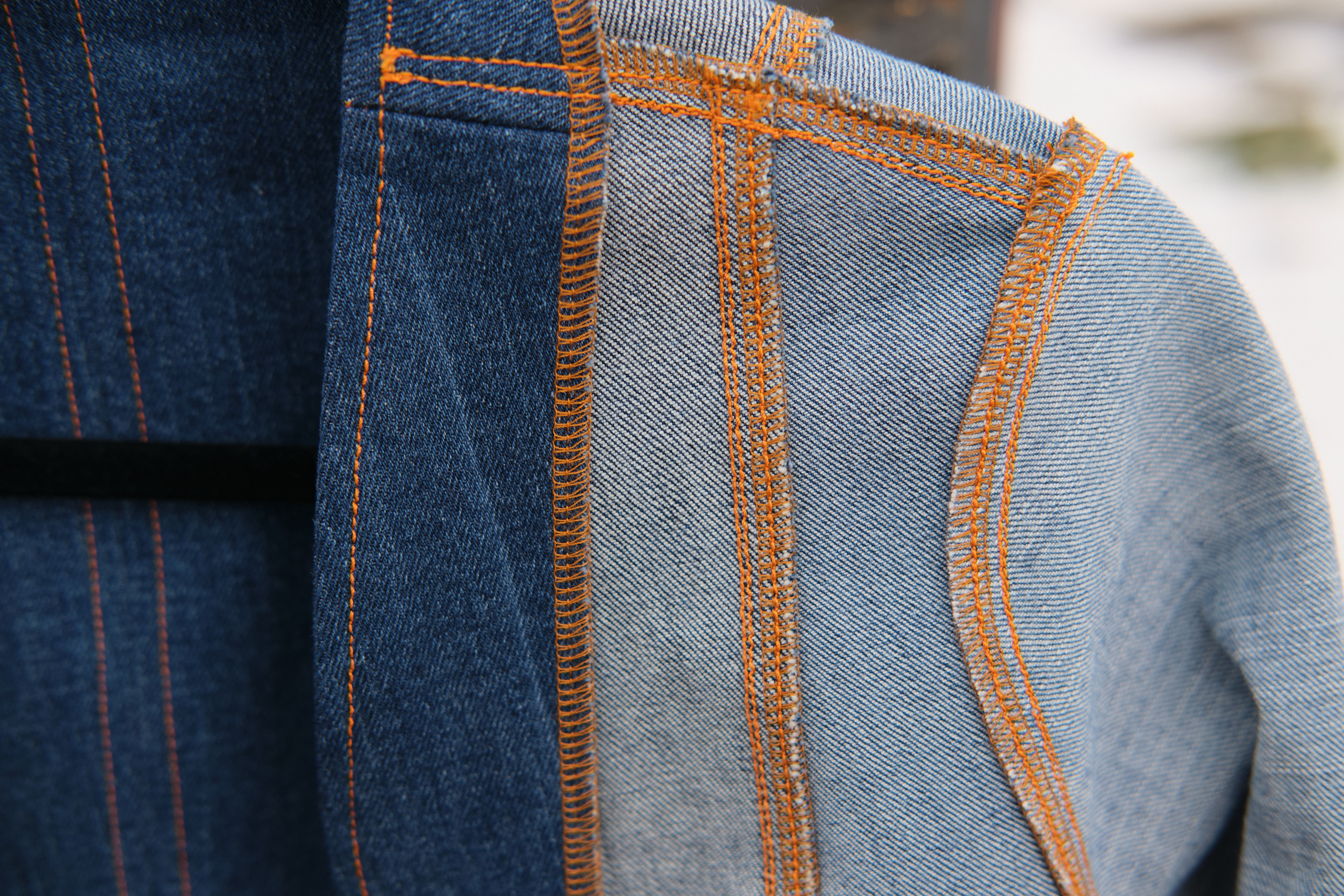
I also spent some time studying the stitching on different brands of jeans and denim jackets to see what color top stitching thread is used and where the top stitching is placed. I also read some blog posts on jeans anatomy. Some jeans match the top stitching to the denim color, others use a light yellow gold, and still others a more orangy gold. I’m sure there are other variations too. I observed that most jeans top stitching is done in two parallel lines, and generally as a chain stitch. Of course, it can’t be done everywhere because once you close both sides of a pant leg or sleeve, it is no longer possible to topstitch. Thus, one side is topstitched while the leg or sleeve is still open and the other side doesn’t get topstitched. I noticed that jackets don’t usually have topstitching on the side seams, but there is no practical reason not to do it so I decided to do it anyway.
I threaded my sewing machine with 30 weight polyester topstitching thread in a golden orange color that I thought would nicely “pop” against the blue denim. After some tests on denim scraps, I decided I would use the topstitching thread for piecing as well so as to avoid lots of thread changes. I set a slightly longer-than-normal stitch length of 3. I did not opt for chain stitching as that would have required lots of resets on my serger. I found I could achieve the parallel topstitching lines by stitching very close to the seam with my edge foot with the needle shifted 3 clicks, and then a quarter inch over using my quarter-inch quilting guide foot. I threaded the serger with four spools of regular polyester overlocking thread in a similar color as the topstitching thread.
The pieces of the jacket were easy to sew together and the topstitching looked awesome. It took a while as I stitched most seams four times: first I joined the fabric with a 3/8-inch seam allowance on my sewing machine, then I cleaned up and overlocked the edges (without trimming fabric, just stray threads) on my serger, then pressed the seam with steam, then I sewed the two parallel lines of topstitching. It was a lot of work, but also somewhat meditative to sew.
The facing pieces were more problematic. I debated whether the fusible interfacing was needed and also whether I should make the facing out of denim or a lighter fabric. I eventually opted for denim with the fusible interfacing, as recommended in the pattern instructions. I cut the facings as the pattern specified and did not make them wider as I had with the last two jackets. I had previously had trouble using non-stretch interfacing with stretchy ponte knit fabric. This time I didn’t think that would be a problem since I was using woven fabric. However, the denim I used has a bit of stretch. I don’t fully understand how it happened, but after fusing the interfacing onto the facings and sewing the three facing pieces together, the facings ended up slightly longer than the jacket front pieces they were supposed to attach to. I decided to sew them on anyway and figured I could trim the bottoms. But I noticed as I was sewing with the interfacing side on the bottom, the jacket was stretching to match the size of the facings. But I could see if I was not careful it would stretch too much. With some careful flipping and a bit of unpicking I was eventually able to get the jack front and facings to match each other. This was a complete trial and error approach and not the ideal way to do it. There are some very thick layers where the interfaced pieces join. I’m still not sure what approach would have been better, but probably not what I did. Nonetheless, it all came together, I was able to iron it all flat, and it looks fine. I top stitched across the shoulder seam, which helped hold the facing in place. The pockets also ended up holding the facing down and so far I haven’t had the problem I had with the ponte jackets where the facing doesn’t lie flat and requires gluing.
I followed the pattern steps a bit out of order and sewed the whole jacket together before I started working on the sleeves. The order really doesn’t matter and I just wanted to be able to try it on without the sleeves and see how it was coming together. The sleeves went together easily. I topstitched the outer sleeve edge. I was also able to easily set the sleeve heads into the armscye without any need for ease stitches. I sewed a 3/8-inch seam on my sewing machine and then overlocked the edges of the armscye. I then topstitched all the way around the armscye. I hemmed the sleeves by folding under 1/4 inch and then again at 3/4 inch and top stitched.
The final step was adding the pockets. First I topstitched the top edge of the pocket where they had been previously topstitched (but I had removed all the thread). I tried on the jacket and pinned the pockets where I wanted them. Then I took off the jacket and measured carefully and repositioned slightly so they would be symmetrical. I followed the dark line from where the previous top stitching had been and top stitched a pair of parallel lines around the pocket edges. Then I pressed everything again and I was done!
The topstitching thread is heavy, and a bobbin doesn’t hold a lot of it. I had to reload my bobbin twice. I also used a lot of steam when pressing my seams. I lost track of how many times I had to refill my iron. I managed to get through the whole project without breaking a needle, which was good because I was using my last topstitching needle.
I’m really happy with how this came out and I know I will wear this jacket a lot! I’m modeling it here with my Boo & Lu Blizzard dress, but it also looks great with pants, and even jeans.
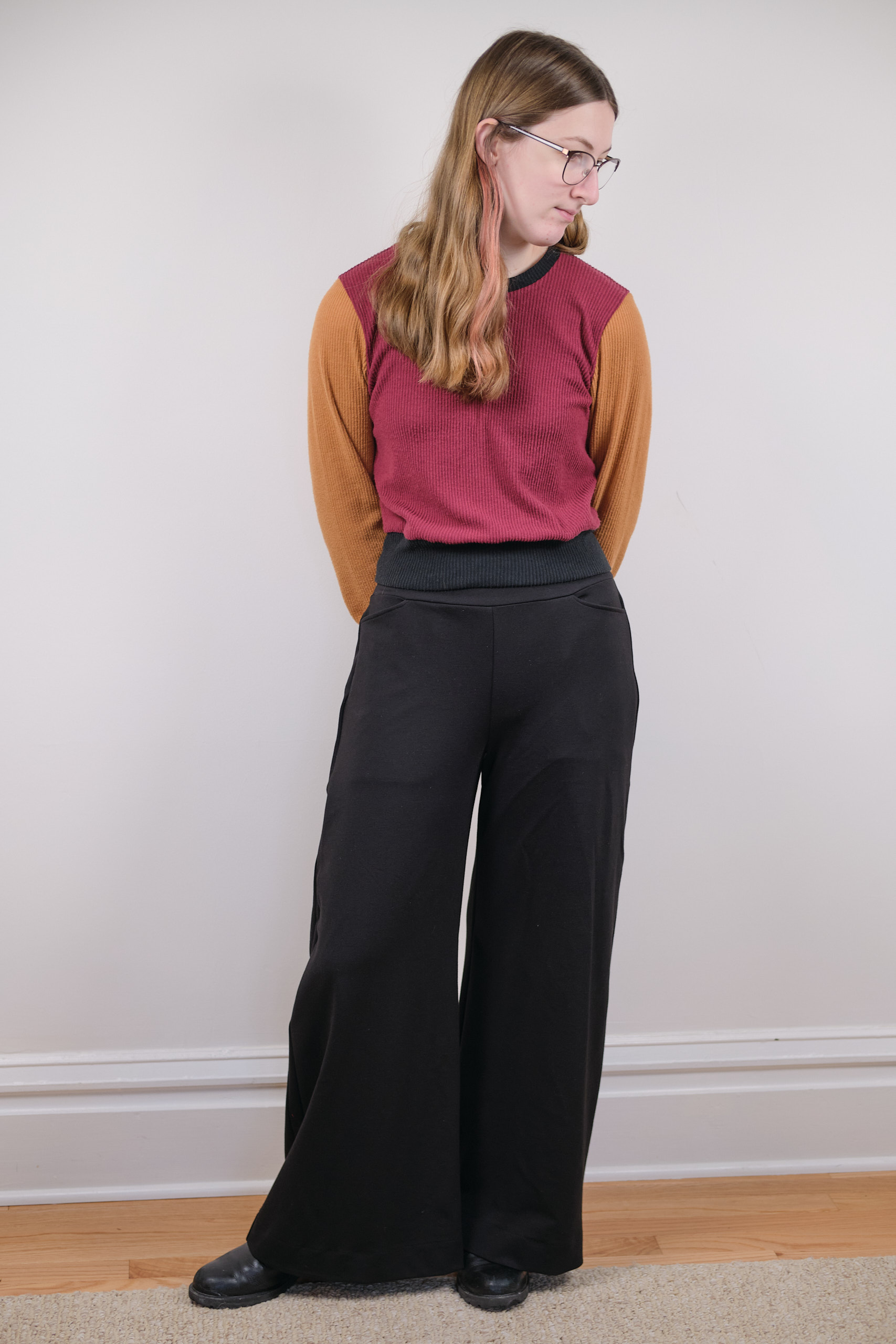
Pattern Emporium Walk Boldly pants with high rise and modified yoga waistband from PE Urban pants and jeans pockets with a straight diagonal opening from 2 yards black ponte designer deadstock, AU10.
My daughter loves her Pattern Emporium black Urban/Walk Boldly mashup pants! She asked for another pair and I delivered. These are pretty much the same as the ones I made for her in the past, except this time I used a super smooth designer deadstock ponte fabric (all ponte fabric is not created equally). I also accidentally cut the regular wide leg line rather than the extra wide walk boldly line on my pattern. I didn’t have enough of the deadstock ponte to recut it, and I didn’t want to make one leg out of the bit of regular black ponte I had leftover from the last ponte pants I made her. So I spliced on the extra boldness. It’s kind of like a tuxedo stripe. It looks fine and she doesn’t care. But she does wish I wouldn’t insist on taking her picture every time I sew her a new pair of pants.
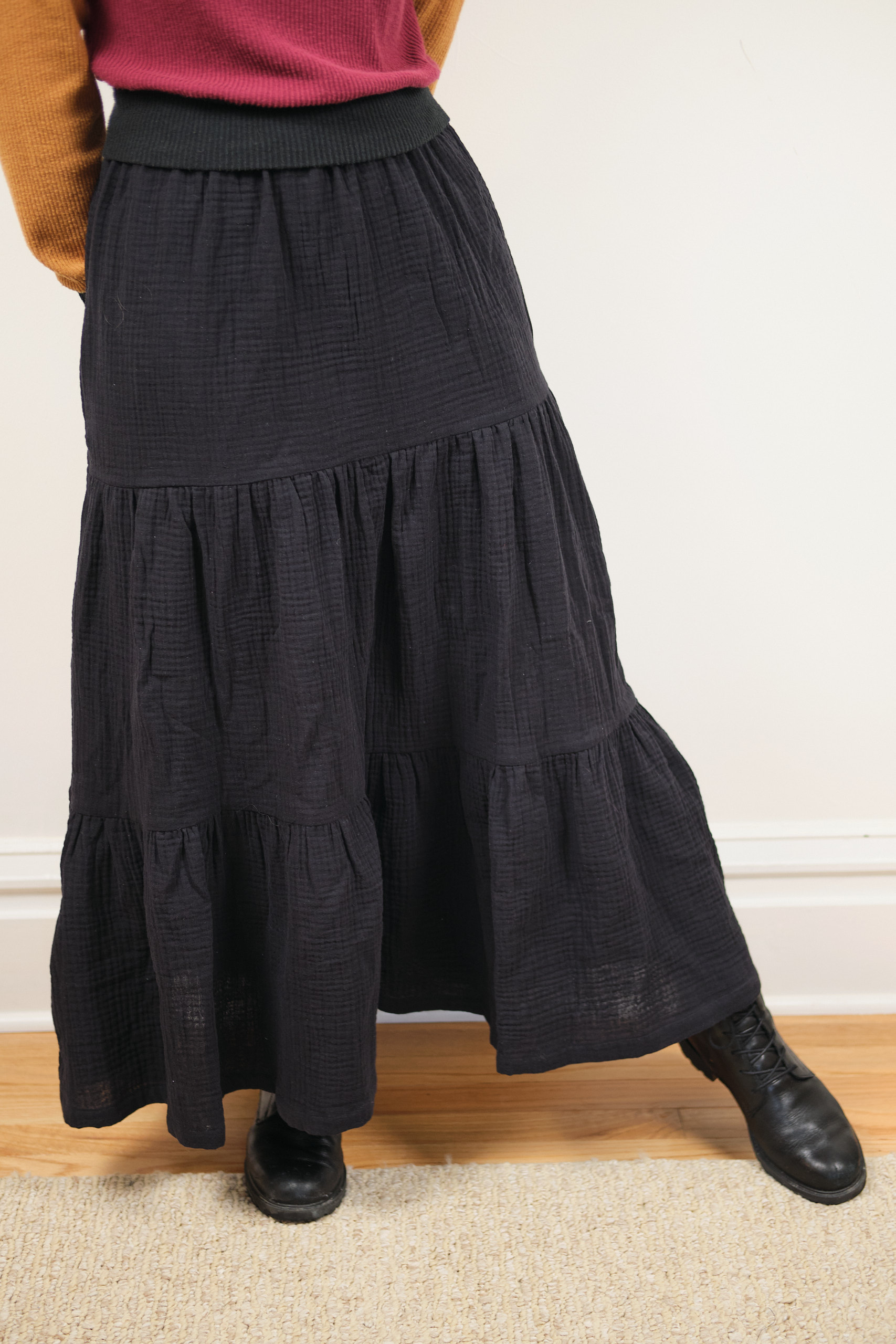
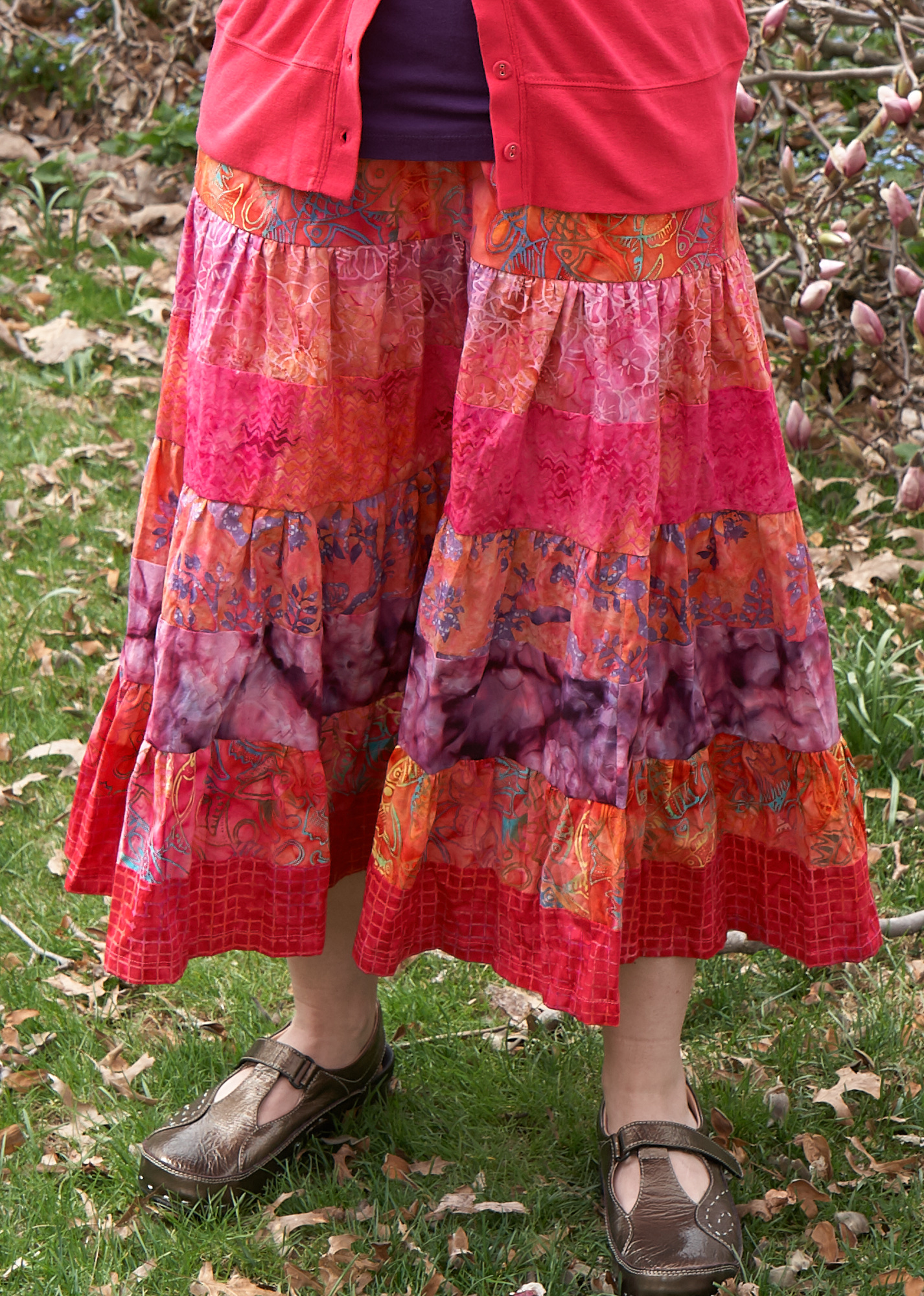
My daughter who now won’t wear any pants I didn’t sew for her, bought herself a cheap woven-polyester, black, tiered maxi skirt on Amazon. It didn’t take long before she inquired whether I could make something like it for her, but not so cheap looking. I asked her to measure the length and circumference of the cheap skirt and take a look at the black fabrics in my stash. She thought the black cotton double gauze would work, which is great because I still have a lot of double gauze I purchased when it was on clearance two years ago.
I have previously made tiered skirts from quilting cotton by sewing together gathered rectangles of fabric. I thought I might actually use a pattern this time. I looked at tiered skirt patterns from my favorite pattern companies and purchased one that I decided not to use because it was based on curved rather than straight skirt pieces. I went back to my rectangle approach and used the pockets and gathering instructions from the Pattern Emporium Meet You There dress. I used this dress last year to make a dress from orange cotton double gauze, and really liked the instructions for gathering the tiers using clear elastic.
Gathering a large length of fabric using the traditional method of sewing long basting stitches, pulling the threads, and trying to distribute the gathers evenly is time consuming. With the elastic method, you cut your elastic just a bit bigger than the tier you want to attach your gathers to, and mark quarters and eighths. Then you mark the quarters and eighths on your big piece of fabric. As you sew you stretch the elastic and match the marks on the elastic with the marks on the fabric. When you let go of the elastic, it contracts and the fabric is perfectly gathered. Buy the pattern for a better explanation of this. I like to have marks every few inches, within what fits on the extended bed of my sewing machine. So for the largest tier I ended up splitting the quarters into thirds, and thus I marked twelfths rather than eighths.
I decide don the size of each rectangle based on the desired length and circumference. I made the bottom tier an inch longer to support a 1-inch hem and I made the top tier an inch longer so I could fold it under 1 inch and insert elastic. Here were the dimensions I used for two rectangles for each tier (6 rectangles total):
top tier: 14×22 middle tier: 13×35 bottom tier: 14×56
Each tier is roughly 1.6 times larger than the one above it. You don’t want a ratio much bigger than that or you will end up with an enormous bottom tier. I could have started with a wider top tier and reduced the ratio, resulting in more gathers at the waist, wider hips, and less gathering below — and still achieved the same bottom circumference.
I gathered and sewed the front and back separately, added the pockets, and then sewed the front to the back. Then I folded under the waistband and threaded in elastic. And finally, I hemmed the bottom.
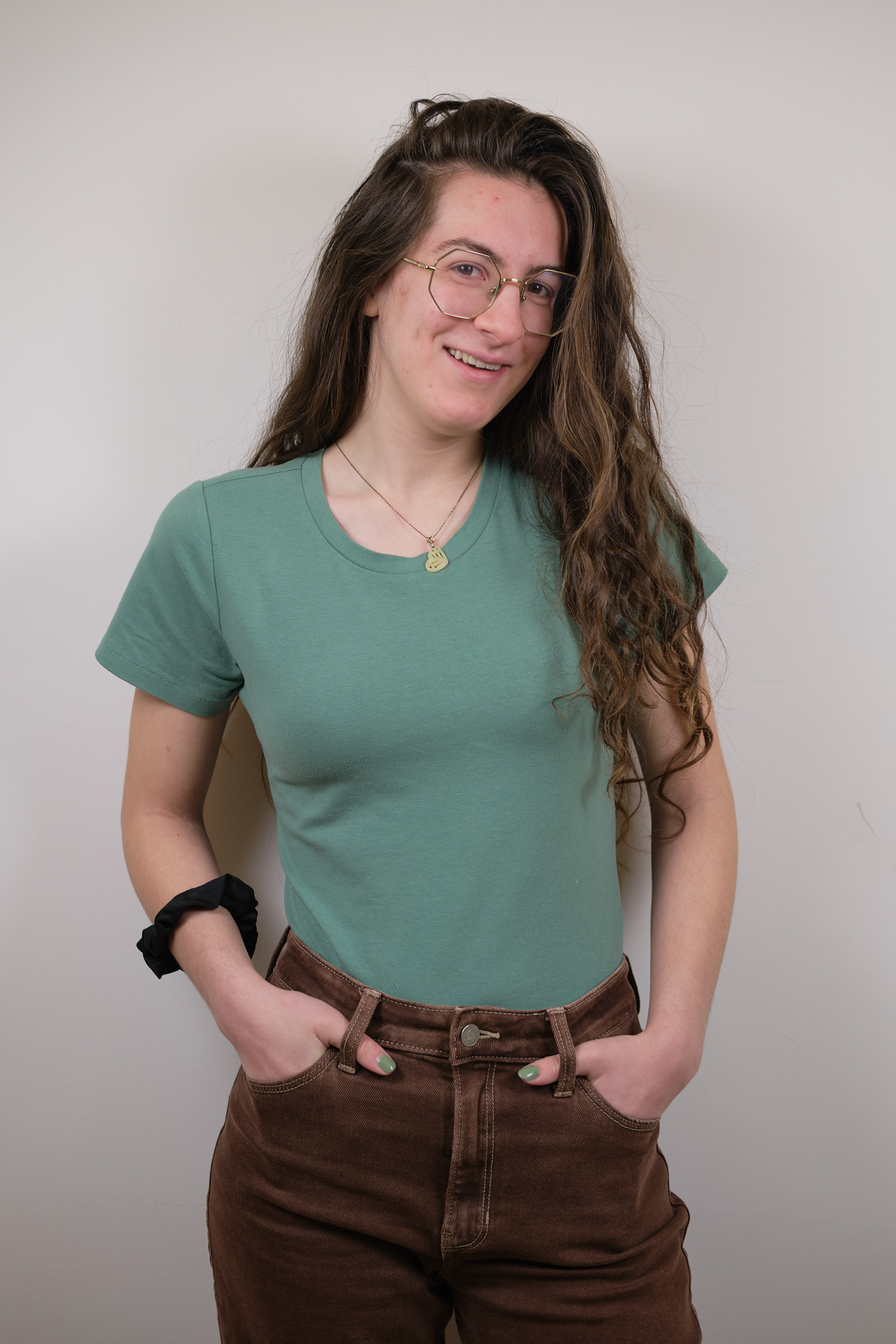
In December, while travelling, I ventured into a mall for the first time in a long time, probably since last December. I don’t live near a mall that is all that convenient, and I think I’m just about over malls. I spent a lot of time wandering around malls in high school, and mall walking when I lived in New Jersey. Now I shop online or in neighborhood stores and make a large fraction of my clothes anyway. But the reason I mention all this is I found myself in a clothing store in a mall with one of my young-adult daughters as she was debating what size to buy in a plain white t-shirt when neither size she was considering fit her quite the way she wanted. I looked at the cotton Lycra t-shirt and sighed. “I could make you one of these that would fit you exactly the way you want,” I told her. So she left the store without the t-shirts.
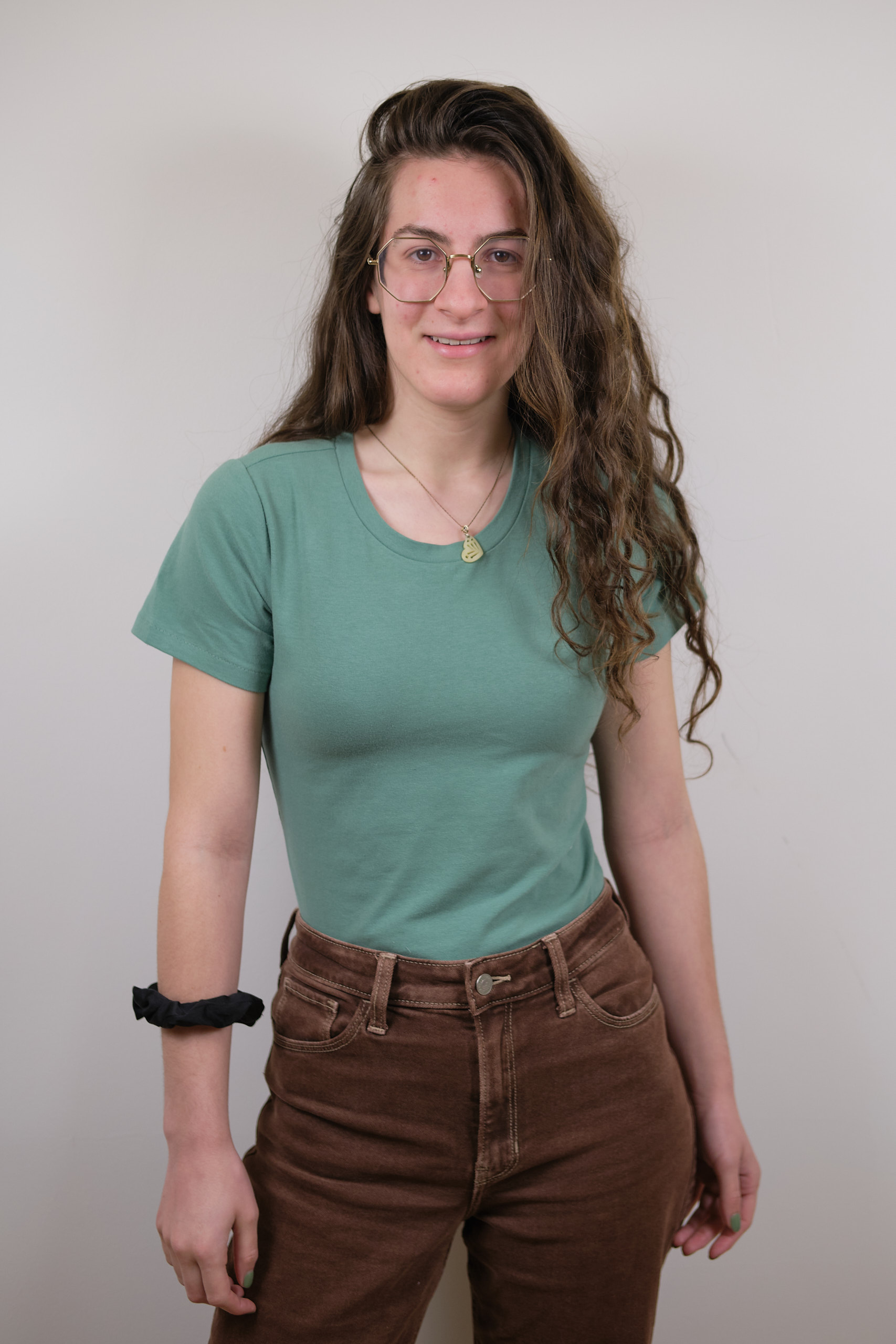
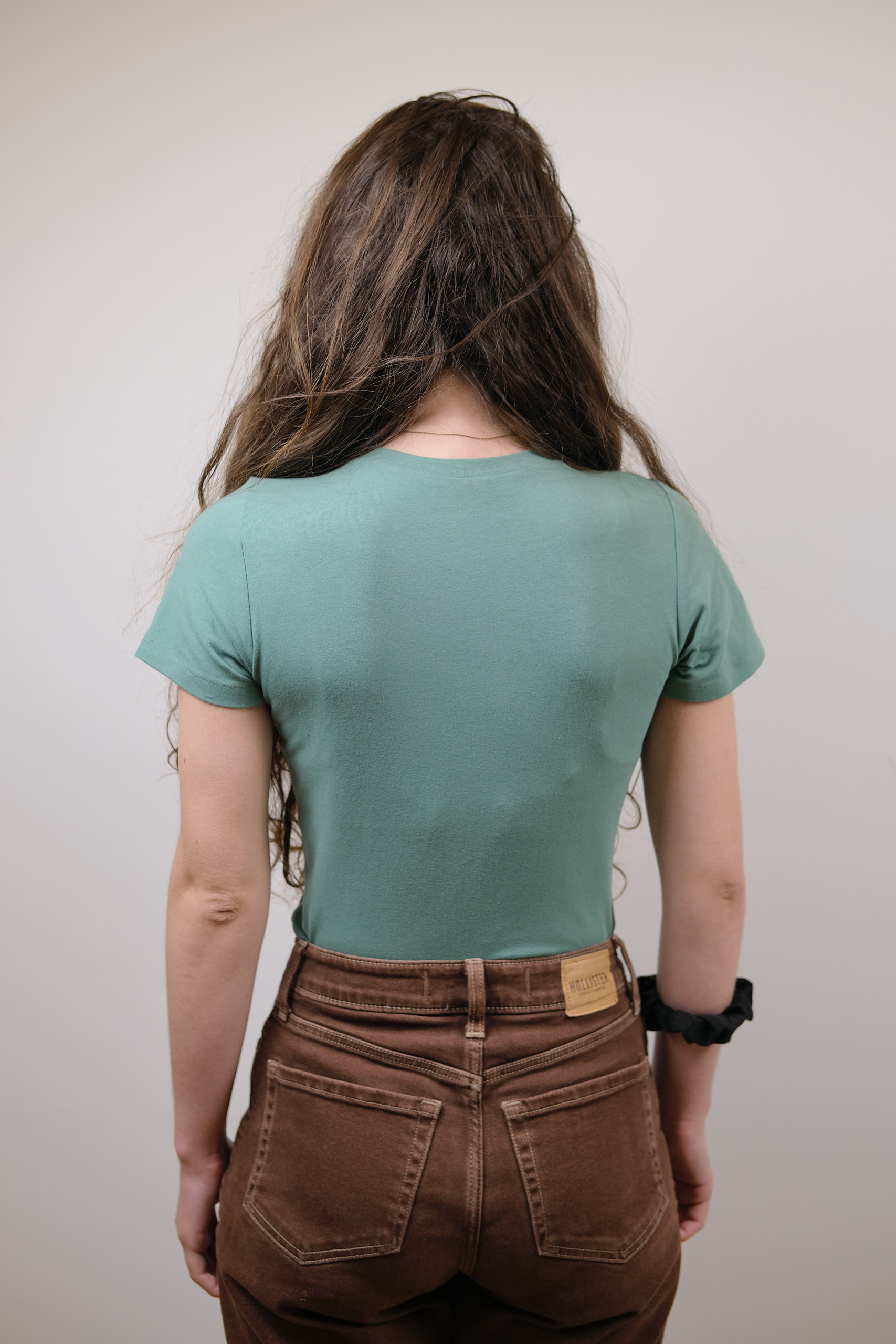
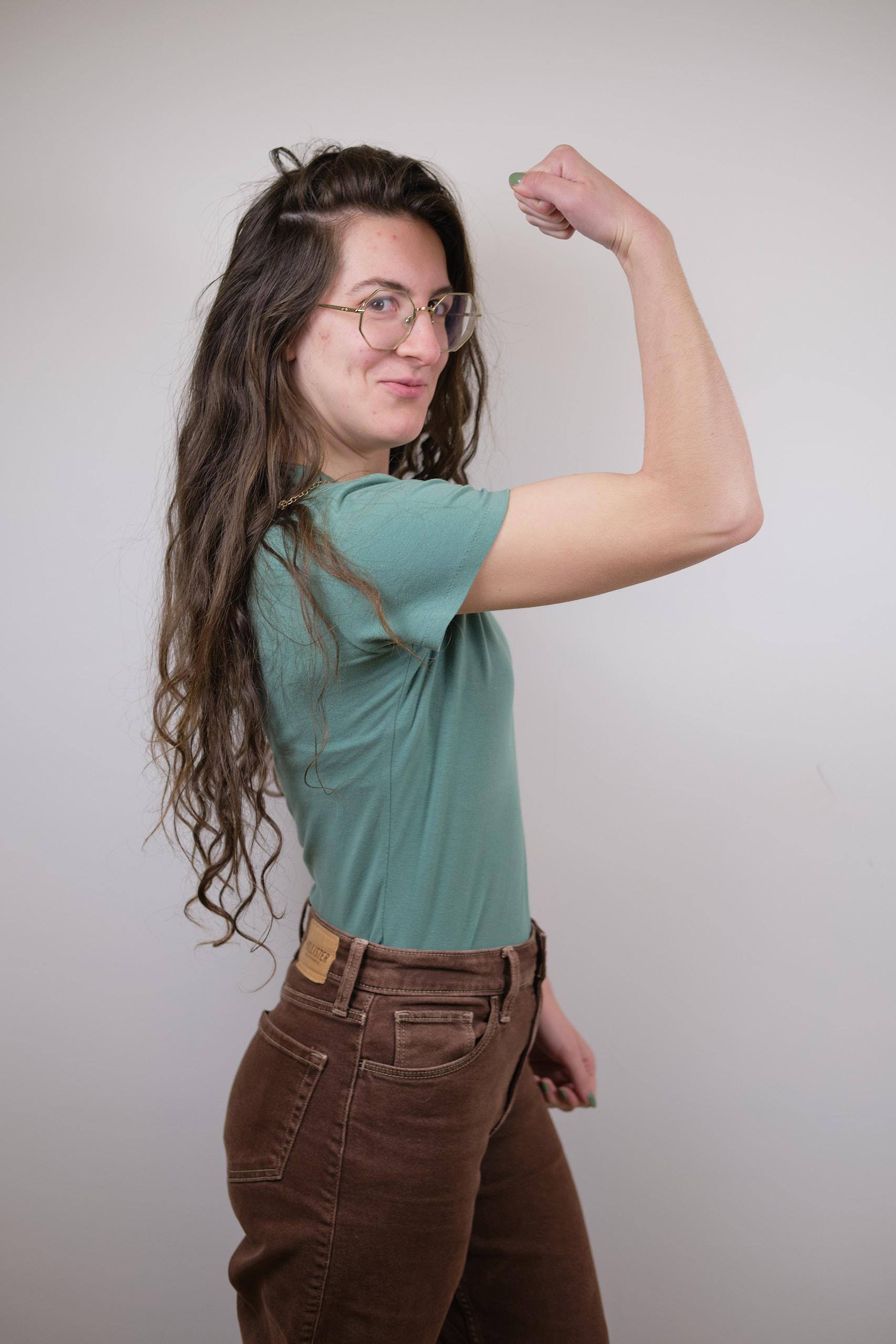
A week later, I showed her what cotton-lycra fabric I had in my stash. Sadly, I had no white, and not enough black for a shirt. But I had just enough sage green (left over from a cropped t-shirt for my other daughter) that I thought I could eke out a shirt for her. I discussed her shirt preferences and adjusted my Sinclair Bondi classic fitted t-shirt pattern for her. I cut a size 4 regular crew neck one-inch-above-hip length and graded it in from the bottom of the armscye to the hem for an even more fitted fit. After trying it on she asked for further grading. The end result fits her really well. Next time (after I order some black and white CL fabric) I will do a broad shoulder adjustment and then the shoulders will fit even better. She also asked for the crew neck opening to be raised half an inch, which is just her personal preference.
My daughter suggested I try a different fabric for her lightweight flowy pants and selected a 190gsm black athletic brushed poly jersey from Surge. The fabric is pretty stretchy, with 75% stretch in both directions. I was about to cut the Walk Boldly-Urban mashup again when she asked if I could make them with even wider legs. So I downloaded the Pattern Emporium Palazzo Pants pattern for stretch knits and decided to give it a try in the subtle flare version with the high waist and yoga waistband. She wears a size AU10, which the pattern says takes about 2.5 yards of fabric. Unfortunately, I had only two yards on hand, but since the stretch is the same in both orientations, I was able to rotate the pattern 90 degrees and lay out all the pieces on 2 yards of 58″-width fabric.
The Palazzo Pants pattern has many of the elements I’ve come to expect in other PE pants patterns. I love the fact that this pattern has so many options: both the yoga and elastic waistbands, high and low waist, multiple types of pockets, and two levels of flare. I typically mix and match elements from the Urban Pants collection and the Walk Boldly pants. It’s nice having everything here in one pattern. This pattern is similar to the Urban Pants/Walk Boldly combo, but with a lot more flare in the legs and no back darts.
I sewed the pattern as written with only one change: I stitched a row of 1/2-inch elastic inside the yoga waistband before I folded it in half. I find that if you put stuff in your pockets, the yoga waistband tends not to stay up on its own and needs the elastic for reinforcement. I could just use the elastic waistband, but I like how the elastic is stitched down and doesn’t twist and the band itself is less bulky. But both styles are nice. I cut the regular length of the pants and gave them a generous 2-inch hem to keep the stretchy fabric from dragging on the ground and getting stepped on (a 1-inch hem would have looked fine based on her height and the shoes she usually wears). I overlocked the bottom edge, folded it under, and sewed the hem with a shallow zigzag.
My daughter and I are both pretty happy with how the pants turned out. I’m sure I will be making these again. The subtle flare is quite flared enough. I usually raise the pocket openings of PE pants and I forgot to do that on these — I would probably do that in the future and might also add interfacing to the top edge of the pocket opening to keep it from drooping. (Pants modelled here with the color-blocked Sinclair Crew sweater I made her in a cropped version.)
Bonus picture below on New Year’s Eve. My palazzo-pants-wearing daughter is also wearing an Ellie and Mac Lakeisha top I made her two years ago.
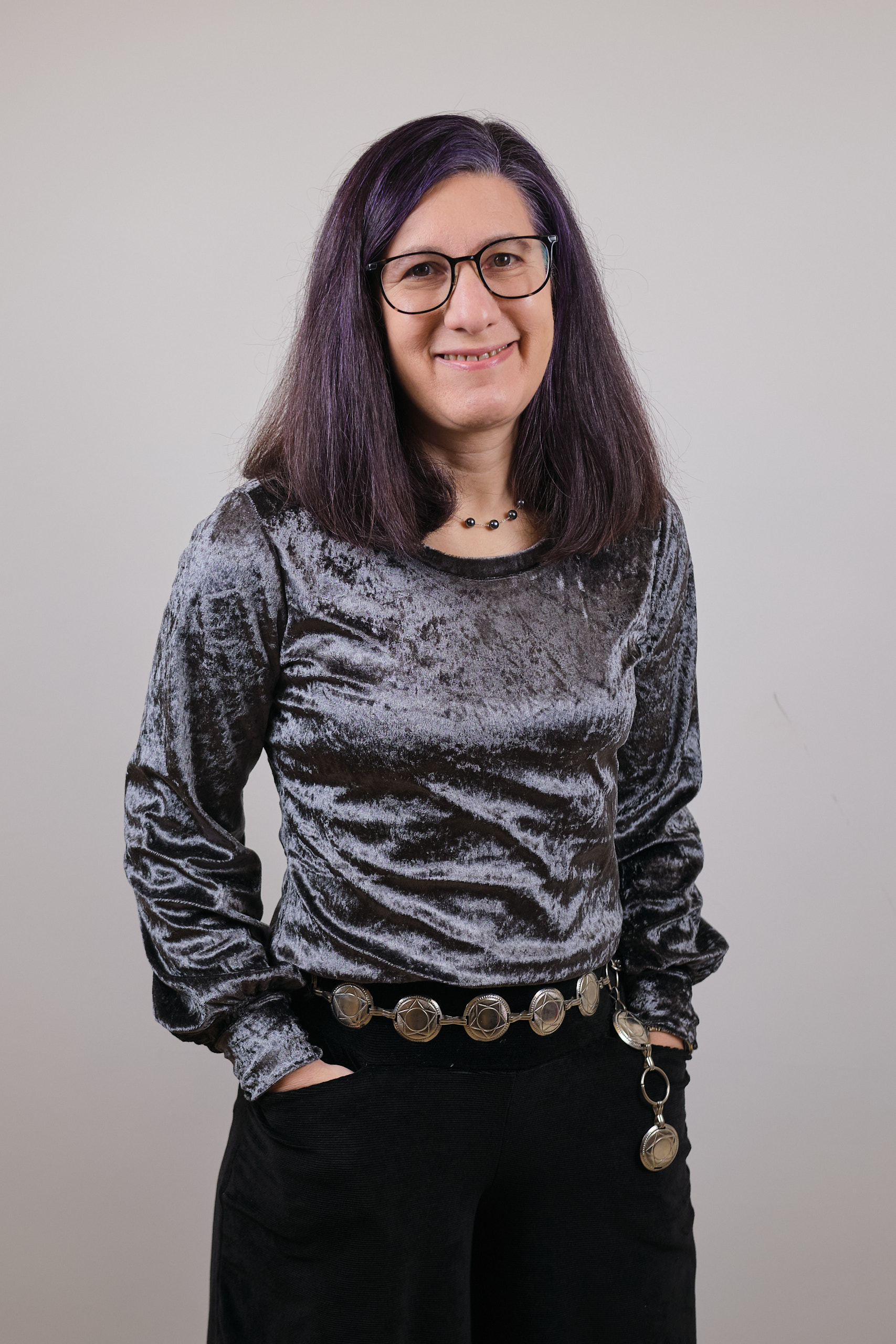
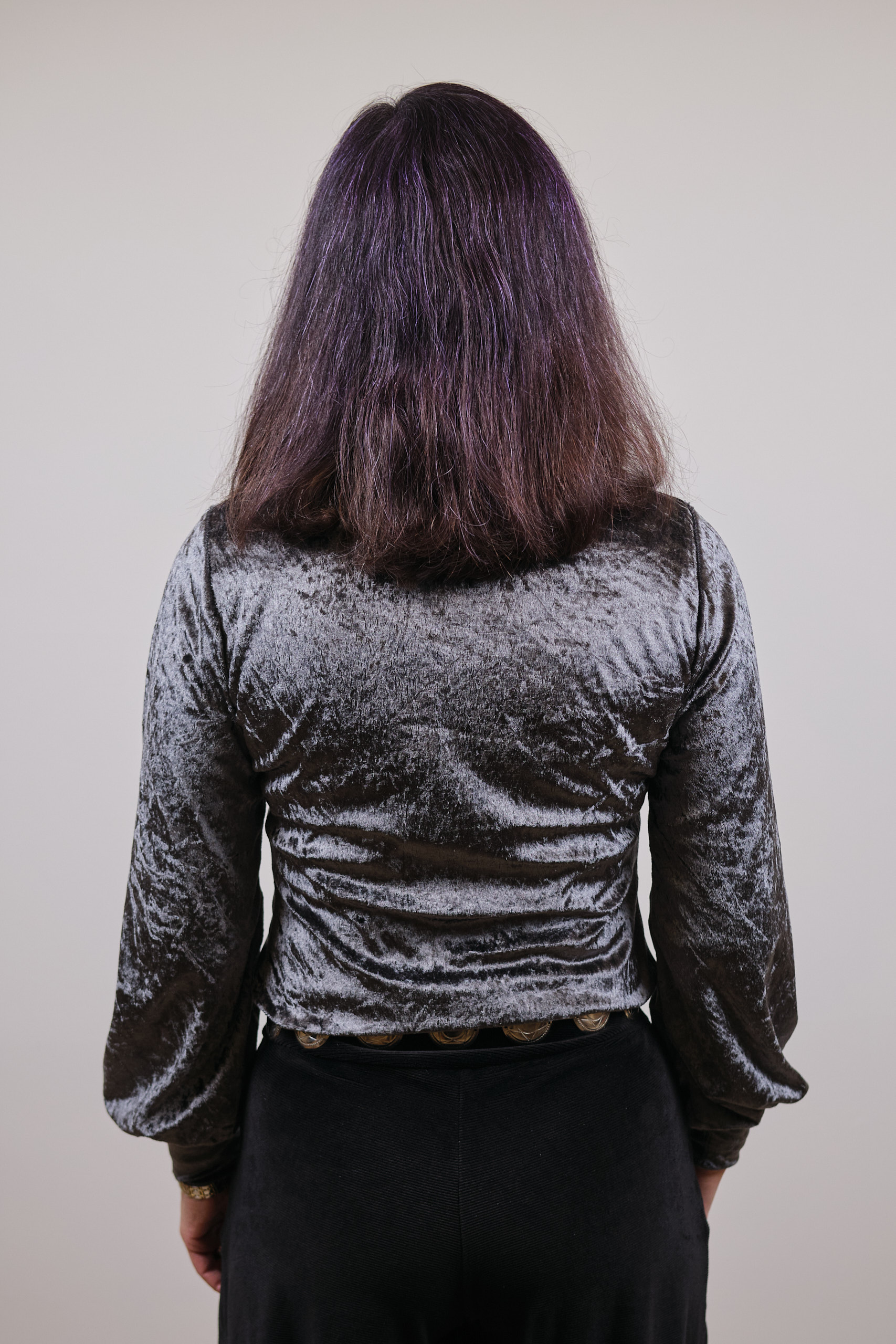
Sinclair Bondi classic fitted t-shirt 6p, screwp neck, broad and sloped shoulder adjustments, bishop sleeves with long cuff, 1.5 yards 160 gsm 2-way stretch dark grey polyester crushed velour.
I bought a yard and a half of dark grey polyester crushed velour last winter and thought it might make a nice dressy top. It’s a medium-weight 160 gsm all polyester with no spandex. I didn’t notice until I got it out to sew it that it was only 2-way stretch, not 4-way stretch.
Most knit patterns I own (and most that my favorite pattern makers sell) are designed for 4-way stretch knits. These are knits that stretch BOTH horizontally and vertically. They are in many ways easier to work with than 2-way knits that stretch only horizontally (or occasionally only vertically) and tend to be easier to fit and more forgiving. When sewing a fitted knit shirt, it is obvious that we want some significant stretch in the horizontal direction to go around the body. But it is also helpful to have at least a little bit of vertical stretch so that the top doesn’t get stuck and ride up around the bust. A lot of vertical stretch can be problematic on a dress as the waistband may get pulled down and the dress may not be able to support pockets. A loose-fitting garment (a typical cotton t-shirt, for example) doesn’t need stretch to fit, since it doesn’t really even try to conform to the body. Some garments get around lack of stretch by adding seams and darts to help the garment contour to the body. Generally, patterns designed for woven fabric do this.
So, I wanted to make a somewhat fitted top out of my 2-way stretch velour, and none of the fitted top patterns I own claim to be suited for 2-way stretch fabric. (Actually, one of my patterns claimed it was for 2-way stretch, but that turned out to be an error in the pattern description that I caught because all the photos of garments people made with the pattern seemed to be using 4-way stretch fabric. A lot of people assume 2-way stretch is stretch in 2 directions, but that’s actually not how the term is used.) I considered using a woven pattern but after too much overthinking I finally decided to throw caution to the wind and use my favorite Sinclair Bondi classic fitted t-shirt pattern and just size up one size. Actually, this was not a completely reckless thing to do as I have made a lot of Bondis and I have a good sense for how it fits and how to customize it for me. I recently had problems using a low-stretch fabric with a different knit shirt pattern, but sizing up one size seemed to make it work.
The crushed velour was a bit slippery to work with, it shed silver dust all over the place as I cut and sewed it, and the edges curled a bit. The fabric listing said to iron it only on the wrong side, but I recklessly ironed it any which way I could to get it to behave, and it doesn’t seem to be any worse for the wear. I positioned the pattern carefully so that the fabric nap would all go the same way, and when wearing the garment, it would feel smooth when running my hands from top to bottom. My youngest daughter recently ranted about how much she hates it when the nap runs the “wrong way,” and she doesn’t like the feel of the rough fabric against her skin. I wasn’t about to make that mistake!
Sizing up one size seemed to have done the trick and made the 2-way fabric work quite nicely with my 4-way stretch pattern. The shirt is comfortable to wear and mostly stays in place, especially when tucked in. The sleeve cuffs want to bunch up, probably because the nap is going the wrong way on the inside of the cuff — I suppose I could have turned them the other way and violated my daughters’ rule on the outside, or maybe added a seam so the nap would go the right way on both sides.
Anyway, it was good enough for my New Year’s Eve outfit, and I could even wear another shirt underneath since the weather was frigid. I also wore my Sinclair Cleo palazzo pants (also in stretch velour, but this one is a 4-way stretch). My daughters suggested I wear it with the chain belt I’ve had since high school, which apparently is fashionable again.