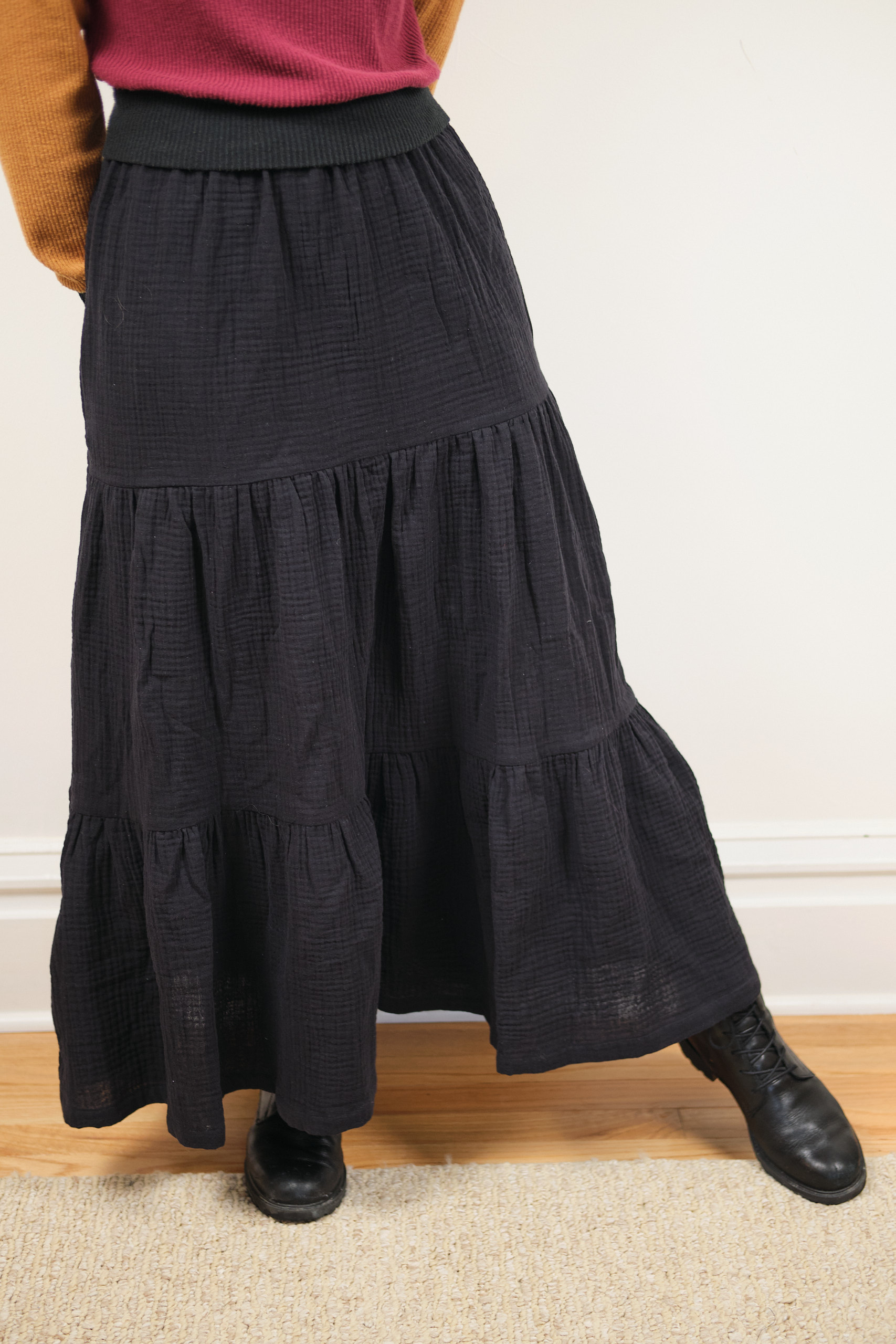
Pattern Emporium Meet You There dress skirt instructions and pockets with adjusted rectangle sizes, in 2 yards black cotton double gauze.
My daughter who now won’t wear any pants I didn’t sew for her, bought herself a cheap woven-polyester, black, tiered maxi skirt on Amazon. It didn’t take long before she inquired whether I could make something like it for her, but not so cheap looking. I asked her to measure the length and circumference of the cheap skirt and take a look at the black fabrics in my stash. She thought the black cotton double gauze would work, which is great because I still have a lot of double gauze I purchased when it was on clearance two years ago.
I have previously made tiered skirts from quilting cotton by sewing together gathered rectangles of fabric. I thought I might actually use a pattern this time. I looked at tiered skirt patterns from my favorite pattern companies and purchased one that I decided not to use because it was based on curved rather than straight skirt pieces. I went back to my rectangle approach and used the pockets and gathering instructions from the Pattern Emporium Meet You There dress. I used this dress last year to make a dress from orange cotton double gauze, and really liked the instructions for gathering the tiers using clear elastic.
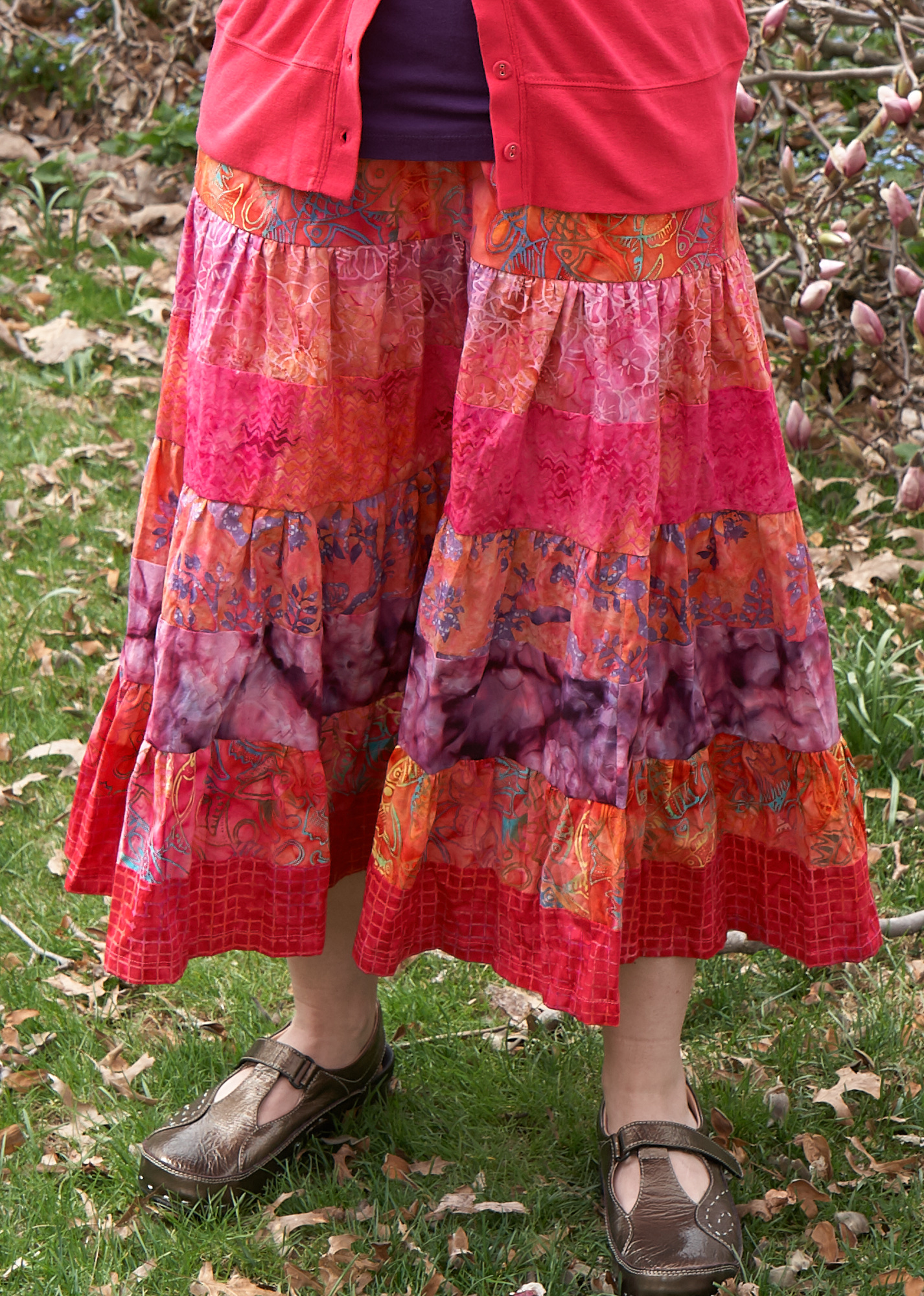
Gathering a large length of fabric using the traditional method of sewing long basting stitches, pulling the threads, and trying to distribute the gathers evenly is time consuming. With the elastic method, you cut your elastic just a bit bigger than the tier you want to attach your gathers to, and mark quarters and eighths. Then you mark the quarters and eighths on your big piece of fabric. As you sew you stretch the elastic and match the marks on the elastic with the marks on the fabric. When you let go of the elastic, it contracts and the fabric is perfectly gathered. Buy the pattern for a better explanation of this. I like to have marks every few inches, within what fits on the extended bed of my sewing machine. So for the largest tier I ended up splitting the quarters into thirds, and thus I marked twelfths rather than eighths.
I decide don the size of each rectangle based on the desired length and circumference. I made the bottom tier an inch longer to support a 1-inch hem and I made the top tier an inch longer so I could fold it under 1 inch and insert elastic. Here were the dimensions I used for two rectangles for each tier (6 rectangles total):
top tier: 14×22
middle tier: 13×35
bottom tier: 14×56
Each tier is roughly 1.6 times larger than the one above it. You don’t want a ratio much bigger than that or you will end up with an enormous bottom tier. I could have started with a wider top tier and reduced the ratio, resulting in more gathers at the waist, wider hips, and less gathering below — and still achieved the same bottom circumference.
I gathered and sewed the front and back separately, added the pockets, and then sewed the front to the back. Then I folded under the waistband and threaded in elastic. And finally, I hemmed the bottom.
Here is my daughter modeling the skirt with her cropped Sinclair Crew sweater.